Thank you for visiting SNEWPapers!
Sign up free
Literary
November 14, 1844
The Ohio Democrat
New Philadelphia, Tuscarawas County, Ohio
What is this article about?
Humorous sketch by Joseph C. Neal satirizing Peleg W. Ponder, an indecisive man who cannot commit to political sides during elections, extending his indecision to personal life like marriage and daily choices.
Clipping
OCR Quality
95%
Excellent
Full Text
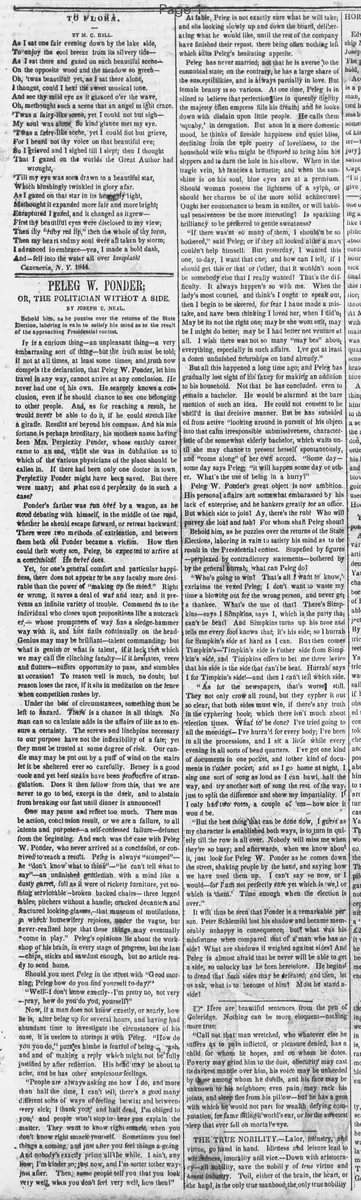
PELEG W. PONDER:
OR, THE POLITICIAN WITHOUT A SIDE.
BY JOSEPH C. NEAL.
Behold him, as he puzzles over the returns of the State Election, laboring in vain to satisfy his mind as to the result of the approaching Presidential contest.
It is a curious thing—an unpleasant thing—a very embarrassing sort of thing—but the truth must be told; if not at all times, at least some times; and truth now compels the declaration, that Peleg W. Ponder, let him travel in any way, cannot arrive at any conclusion. He never had one of his own. He scarcely knows a conclusion, even if he should chance to see one belonging to other people. And, as for reaching a result, he would never be able to do it, if he could stretch like a giraffe. Results are beyond his compass. And his misfortune is perhaps hereditary, his mother's name having been Mrs. Perplexity Ponder, whose earthly career came to an end, while she was in dubitation as to which of the various physicians of the place should be called in. If there had been only one doctor in town, Perplexity Ponder might have been saved. But there were many; and what could perplexity do in such a case?
Ponder's father was run over by a wagon, as he stood debating with himself, in the middle of the road, whether he should escape forward, or retreat backward. There were two methods of extrication, and between them both old Ponder became a victim. How then could their worthy son, Peleg, be expected to arrive at a conclusion? He never does.
Yet, for one's general comfort and particular happiness, there does not appear to be any faculty more desirable than the power of "making up the mind." Right or wrong, it saves a deal of wear and tear; and it prevents an infinite variety of trouble. Commend us to the individual who closes upon propositions like a nutcracker—whose promptness of way has a sledge-hammer way with it, and hits nails continually on the head. Genius may be brilliant—talent commanding; but what is genius or what is talent, if it lack that which we may call the clinching faculty—if it hesitates, veers and flutters—suffers opportunity to pass, and stumbles at occasion? To reason well is much, no doubt; but reason loses the race, if it sits in meditation on the fence when competition rushes by.
Under the best of circumstances, something must be left to Hazard. There is a chance in all things. No man can so calculate odds in the affairs of life as to ensure a certainty. The screws and linchpins necessary to our purpose have not the inflexibility of a fate; yet they must be trusted at some degree of risk. Our candle may be put out by a puff of wind on the stairs let it be sheltered ever so carefully. Betsey is a good cook and yet beef steaks have been productive of strangulation. Does it then follow from this, that we are never to go to bed, except in the dark, and to abstain from breaking our fast until dinner is announced?
One may pause and reflect too much. There must be action, conclusion, result, or we are a failure, to all intents and purposes—a self-confessed failure—defunct from the beginning. And such was the case with Peleg W. Ponder, who never arrived at a conclusion, or contrived to reach a result. Peleg is always "stumped"—he "don't know what to think"—he can't tell what to say"—an unfinished gentleman, with a mind like a dusty garret, full as it were of rickety furniture, yet nothing serviceable—broken backed chairs—three legged tables; pitchers without a handle; cracked decanters and fractured looking-glasses,—that museum of mutilations, in which housewifery rejoices, under the vague, but never-realized hope that these things may eventually come in play." Peleg's opinions lie about the workshop of his brain, in every stage of progress, but the last—chips, sticks and sawdust enough, but no article ready to send home.
Should you meet Peleg in the street with "Good morning; Peleg how do you find yourself to-day?" "Well:—I don't know exactly—I'm pretty no, not very—pray, how do you do you; yourself?"
Now, if a man does not know exactly, or nearly, how he is, after being up for several hours, and having had abundant time to investigate the circumstances of his case, it is useless to attempt it with Peleg. "How do you do," puzzles him; he is fearful of being rash, and of making a reply which might not be fully justified by after reflection. His head may be about to ache, and he has other suspicious feelings.
"People are always asking me how I do, and more than half the time, I can't tell; there's a good many different sorts of ways of feeling betwixt and between, very sick; I thank you; and half dead, I'm obliged to you; and people won't stop to hear you explain the matter. They want to know right smack when you don't know right smack yourself. Sometimes you feel things a coming, and just after you feel things a-going. And nobody's exactly prime all the while. I ain't, anyhow; I'm kinder so; just now, and I'm sorter tother way just after. Then, some people tell you that you look very well, when you don't feel very well, how then?"
At table, Peleg is not exactly sure what he will take: and sits looking slowly up and down the board, deliberating what he would like, until the rest of the company have finished their repast, there being often nothing left which suits Peleg's hesitating appetite.
Peleg has never married; not that he is averse to the connubial state; on the contrary, he has a large share of the susceptibilities, and is always partially in love. But female beauty is so various. At one time, Peleg is inclined to believe that perfection lies in queenly dignity the majesty often empress fills his dream and he looks down with disdain upon little people. He calls them 'squabby,' in derogation. But anon in a more domestic mood, he thinks of fireside happiness and quiet bliss, declining from the epic poetry of loveliness, to the household wife who might be disposed to bring him his slippers and to darn the hole in his elbow. When in the tragic vein, he fancies a brunette; and when the sunshine is on his soul, blue eyes are at a premium.
Should woman possess the lightness of a sylph, or should her charms be of the more solid architecture? Ought her countenance to beam in smiles, or will habitual pensiveness be the more interesting? Is sparkling brilliancy to be preferred to gentle sweetness?
"If there wasn't so many of them, I shouldn't be so bothered," said Peleg; or if they all looked alike a man couldn't help himself: But yesterday, I wanted this one, to-day, I want that one; and how can I tell; if I should get this or that or t'other, that it wouldn't soon be somebody else that I really wanted? That's the difficulty. It always happens so with me. When the lady's most courted, and thinks I ought to speak out, then I begin to be skeered, for fear I have made a mistake, and have been thinking I loved her, when I didn't. May be its not the right one; may be she wont suit, may be I might do better; may be I had better not venture at all. I wish there was not so many "may bes" about everything, especially in such affairs. I've got at least a dozen unfinished courtships on hand already."
But all this happened a long time ago; and Peleg has gradually lost sight of his fancy for making an addition to his household. Not that he has concluded: even to remain a bachelor. He would be alarmed at the bare mention of such an idea. He could not consent to be shelved in that decisive manner. But he has subsided from active "looking around in pursuit of his object into that calm irresponsible submissiveness, characteristic of the somewhat elderly bachelor, which waits until she may chance to present herself spontaneously and "come along" of her own accord. "Some day—some day says Peleg;" it will happen some day or other. What's the use of being in a hurry?"
Peleg W. Ponder's great object is now ambition. His personal affairs are somewhat embarrassed by his lack of enterprise; and he hankers greatly for an office. But which side to join? Ay, there's the rub! Who will purvey the loaf and fish? For whom shall Peleg shout?
Behold him, as he puzzles over the returns of the State Elections, laboring in vain to satisfy his mind as to the result in the Presidential contest. Stupefied by figures—perplexed by contradictory statements—bothered by the general hurrah; what can Peleg do?
"Who's going to win? That's all I want to know," exclaims the vexed Peleg; I don't want to waste my time a blowing out for the wrong person, and never get a thankee. What's the use of that? There's Simpkins—says I Simpkins, says I. which is the party that can't be beat? And Simpkins turns up his nose and tells me every fool knows that; it's his side; so I hurrah for Simpkins's side as hard as I can. But then comes Timpkins—Timpkins's side is t'other side from Simpkins's side, and Timpkins offers to bet me three levies that his side is the side that can't be beat. Hurrah! says I for Timpkins's side!—and then I can't tell which side.
"As for the newspapers, that's worse still. They not only crow all round, but they cypher it out so clear, that both sides must win, if there's any truth in the cyphering book; which there isn't much about election times. What to be done? I've tried going to all the meetings—I've hurra'd for every body; I've been in all the processions, and I sit a little while every evening in all sorts of head quarters. I've got one kind of documents in one pocket, and t'other kind of documents in t'other pocket; and as I go home at night, I sing one sort of song as loud as I can bawl, half the way, and try another sort of song the rest of the way, just to split the difference and show my impartiality. If I only had two votes, a couple of 'em—how nice it would be.
"But the best thing that can be done now, I guess as my character is established both ways, is to turn in quietly till the row is all over. Nobody will miss me when they're so busy; and afterwards, when we know about it, just look for Peleg W. Ponder as he comes down the street, shaking people by the hand, and saying how we have used them up. I can't say so now, or I would—for I am not perfectly sure yet which is 'we,' or which is 'them.' Time enough when the election is over."
It will thus be seen that Ponder is a remarkable person. Peter Schlemiel lost his shadow and became memorably unhappy in consequence; but what was his misfortune when compared that of a man who has no side? What are shadows if weighed against sides? And Peleg is almost afraid that he never will be able to get a side, so unlucky has he been heretofore. He begins to dread that both sides may be defeated; and then, let us ask, what is to become of him! Must he stand a-side?
OR, THE POLITICIAN WITHOUT A SIDE.
BY JOSEPH C. NEAL.
Behold him, as he puzzles over the returns of the State Election, laboring in vain to satisfy his mind as to the result of the approaching Presidential contest.
It is a curious thing—an unpleasant thing—a very embarrassing sort of thing—but the truth must be told; if not at all times, at least some times; and truth now compels the declaration, that Peleg W. Ponder, let him travel in any way, cannot arrive at any conclusion. He never had one of his own. He scarcely knows a conclusion, even if he should chance to see one belonging to other people. And, as for reaching a result, he would never be able to do it, if he could stretch like a giraffe. Results are beyond his compass. And his misfortune is perhaps hereditary, his mother's name having been Mrs. Perplexity Ponder, whose earthly career came to an end, while she was in dubitation as to which of the various physicians of the place should be called in. If there had been only one doctor in town, Perplexity Ponder might have been saved. But there were many; and what could perplexity do in such a case?
Ponder's father was run over by a wagon, as he stood debating with himself, in the middle of the road, whether he should escape forward, or retreat backward. There were two methods of extrication, and between them both old Ponder became a victim. How then could their worthy son, Peleg, be expected to arrive at a conclusion? He never does.
Yet, for one's general comfort and particular happiness, there does not appear to be any faculty more desirable than the power of "making up the mind." Right or wrong, it saves a deal of wear and tear; and it prevents an infinite variety of trouble. Commend us to the individual who closes upon propositions like a nutcracker—whose promptness of way has a sledge-hammer way with it, and hits nails continually on the head. Genius may be brilliant—talent commanding; but what is genius or what is talent, if it lack that which we may call the clinching faculty—if it hesitates, veers and flutters—suffers opportunity to pass, and stumbles at occasion? To reason well is much, no doubt; but reason loses the race, if it sits in meditation on the fence when competition rushes by.
Under the best of circumstances, something must be left to Hazard. There is a chance in all things. No man can so calculate odds in the affairs of life as to ensure a certainty. The screws and linchpins necessary to our purpose have not the inflexibility of a fate; yet they must be trusted at some degree of risk. Our candle may be put out by a puff of wind on the stairs let it be sheltered ever so carefully. Betsey is a good cook and yet beef steaks have been productive of strangulation. Does it then follow from this, that we are never to go to bed, except in the dark, and to abstain from breaking our fast until dinner is announced?
One may pause and reflect too much. There must be action, conclusion, result, or we are a failure, to all intents and purposes—a self-confessed failure—defunct from the beginning. And such was the case with Peleg W. Ponder, who never arrived at a conclusion, or contrived to reach a result. Peleg is always "stumped"—he "don't know what to think"—he can't tell what to say"—an unfinished gentleman, with a mind like a dusty garret, full as it were of rickety furniture, yet nothing serviceable—broken backed chairs—three legged tables; pitchers without a handle; cracked decanters and fractured looking-glasses,—that museum of mutilations, in which housewifery rejoices, under the vague, but never-realized hope that these things may eventually come in play." Peleg's opinions lie about the workshop of his brain, in every stage of progress, but the last—chips, sticks and sawdust enough, but no article ready to send home.
Should you meet Peleg in the street with "Good morning; Peleg how do you find yourself to-day?" "Well:—I don't know exactly—I'm pretty no, not very—pray, how do you do you; yourself?"
Now, if a man does not know exactly, or nearly, how he is, after being up for several hours, and having had abundant time to investigate the circumstances of his case, it is useless to attempt it with Peleg. "How do you do," puzzles him; he is fearful of being rash, and of making a reply which might not be fully justified by after reflection. His head may be about to ache, and he has other suspicious feelings.
"People are always asking me how I do, and more than half the time, I can't tell; there's a good many different sorts of ways of feeling betwixt and between, very sick; I thank you; and half dead, I'm obliged to you; and people won't stop to hear you explain the matter. They want to know right smack when you don't know right smack yourself. Sometimes you feel things a coming, and just after you feel things a-going. And nobody's exactly prime all the while. I ain't, anyhow; I'm kinder so; just now, and I'm sorter tother way just after. Then, some people tell you that you look very well, when you don't feel very well, how then?"
At table, Peleg is not exactly sure what he will take: and sits looking slowly up and down the board, deliberating what he would like, until the rest of the company have finished their repast, there being often nothing left which suits Peleg's hesitating appetite.
Peleg has never married; not that he is averse to the connubial state; on the contrary, he has a large share of the susceptibilities, and is always partially in love. But female beauty is so various. At one time, Peleg is inclined to believe that perfection lies in queenly dignity the majesty often empress fills his dream and he looks down with disdain upon little people. He calls them 'squabby,' in derogation. But anon in a more domestic mood, he thinks of fireside happiness and quiet bliss, declining from the epic poetry of loveliness, to the household wife who might be disposed to bring him his slippers and to darn the hole in his elbow. When in the tragic vein, he fancies a brunette; and when the sunshine is on his soul, blue eyes are at a premium.
Should woman possess the lightness of a sylph, or should her charms be of the more solid architecture? Ought her countenance to beam in smiles, or will habitual pensiveness be the more interesting? Is sparkling brilliancy to be preferred to gentle sweetness?
"If there wasn't so many of them, I shouldn't be so bothered," said Peleg; or if they all looked alike a man couldn't help himself: But yesterday, I wanted this one, to-day, I want that one; and how can I tell; if I should get this or that or t'other, that it wouldn't soon be somebody else that I really wanted? That's the difficulty. It always happens so with me. When the lady's most courted, and thinks I ought to speak out, then I begin to be skeered, for fear I have made a mistake, and have been thinking I loved her, when I didn't. May be its not the right one; may be she wont suit, may be I might do better; may be I had better not venture at all. I wish there was not so many "may bes" about everything, especially in such affairs. I've got at least a dozen unfinished courtships on hand already."
But all this happened a long time ago; and Peleg has gradually lost sight of his fancy for making an addition to his household. Not that he has concluded: even to remain a bachelor. He would be alarmed at the bare mention of such an idea. He could not consent to be shelved in that decisive manner. But he has subsided from active "looking around in pursuit of his object into that calm irresponsible submissiveness, characteristic of the somewhat elderly bachelor, which waits until she may chance to present herself spontaneously and "come along" of her own accord. "Some day—some day says Peleg;" it will happen some day or other. What's the use of being in a hurry?"
Peleg W. Ponder's great object is now ambition. His personal affairs are somewhat embarrassed by his lack of enterprise; and he hankers greatly for an office. But which side to join? Ay, there's the rub! Who will purvey the loaf and fish? For whom shall Peleg shout?
Behold him, as he puzzles over the returns of the State Elections, laboring in vain to satisfy his mind as to the result in the Presidential contest. Stupefied by figures—perplexed by contradictory statements—bothered by the general hurrah; what can Peleg do?
"Who's going to win? That's all I want to know," exclaims the vexed Peleg; I don't want to waste my time a blowing out for the wrong person, and never get a thankee. What's the use of that? There's Simpkins—says I Simpkins, says I. which is the party that can't be beat? And Simpkins turns up his nose and tells me every fool knows that; it's his side; so I hurrah for Simpkins's side as hard as I can. But then comes Timpkins—Timpkins's side is t'other side from Simpkins's side, and Timpkins offers to bet me three levies that his side is the side that can't be beat. Hurrah! says I for Timpkins's side!—and then I can't tell which side.
"As for the newspapers, that's worse still. They not only crow all round, but they cypher it out so clear, that both sides must win, if there's any truth in the cyphering book; which there isn't much about election times. What to be done? I've tried going to all the meetings—I've hurra'd for every body; I've been in all the processions, and I sit a little while every evening in all sorts of head quarters. I've got one kind of documents in one pocket, and t'other kind of documents in t'other pocket; and as I go home at night, I sing one sort of song as loud as I can bawl, half the way, and try another sort of song the rest of the way, just to split the difference and show my impartiality. If I only had two votes, a couple of 'em—how nice it would be.
"But the best thing that can be done now, I guess as my character is established both ways, is to turn in quietly till the row is all over. Nobody will miss me when they're so busy; and afterwards, when we know about it, just look for Peleg W. Ponder as he comes down the street, shaking people by the hand, and saying how we have used them up. I can't say so now, or I would—for I am not perfectly sure yet which is 'we,' or which is 'them.' Time enough when the election is over."
It will thus be seen that Ponder is a remarkable person. Peter Schlemiel lost his shadow and became memorably unhappy in consequence; but what was his misfortune when compared that of a man who has no side? What are shadows if weighed against sides? And Peleg is almost afraid that he never will be able to get a side, so unlucky has he been heretofore. He begins to dread that both sides may be defeated; and then, let us ask, what is to become of him! Must he stand a-side?
What sub-type of article is it?
Satire
Prose Fiction
What themes does it cover?
Political
Social Manners
What keywords are associated?
Political Satire
Indecision
Elections
Bachelorhood
Character Sketch
What entities or persons were involved?
By Joseph C. Neal.
Literary Details
Title
Peleg W. Ponder: Or, The Politician Without A Side.
Author
By Joseph C. Neal.
Subject
Satire On Political Indecision And Personal Hesitancy
Key Lines
He Never Had One Of His Own. He Scarcely Knows A Conclusion, Even If He Should Chance To See One Belonging To Other People.
Yet, For One's General Comfort And Particular Happiness, There Does Not Appear To Be Any Faculty More Desirable Than The Power Of "Making Up The Mind."
Peleg Is Always "Stumped"—He "Don't Know What To Think"—He Can't Tell What To Say"—An Unfinished Gentleman, With A Mind Like A Dusty Garret, Full As It Were Of Rickety Furniture, Yet Nothing Serviceable—
I've Got At Least A Dozen Unfinished Courtships On Hand Already.
But Which Side To Join? Ay, There's The Rub! Who Will Purvey The Loaf And Fish? For Whom Shall Peleg Shout?