Thank you for visiting SNEWPapers!
Sign up free
Story
April 29, 1854
Lynchburg Daily Virginian
Lynchburg, Virginia
What is this article about?
The Richmond Whig reports on Senator Thomas Hart Benton's vehement speech opposing the Nebraska bill, criticizing its contradictions, squatter sovereignty, and administration interference, using wit, historical allusions, and a fable to rebuke opponents.
Clipping
OCR Quality
95%
Excellent
Full Text
From the Richmond Whig.
Col. Benton on Nebraska.
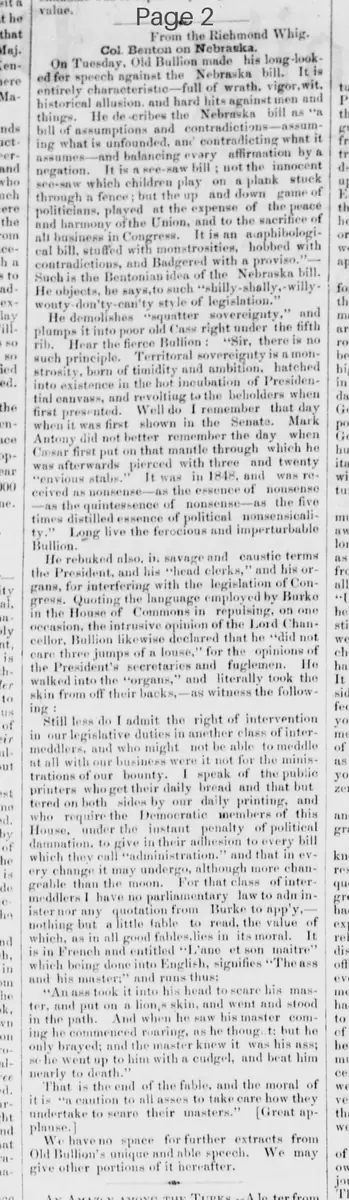
On Tuesday, Old Bullion made his long-looked for speech against the Nebraska bill. It is entirely characteristic—full of wrath, vigor, wit, historical allusion, and hard hits against men and things. He describes the Nebraska bill as "a bill of assumptions and contradictions—assuming what is unfounded, and contradicting what it assumes—and balancing every affirmation by a negation. It is a see-saw bill: not the innocent see-saw which children play on a plank stuck through a fence; but the up and down game of politicians, played at the expense of the peace and harmony of the Union, and to the sacrifice of all business in Congress. It is an amphibological bill, stuffed with monstrosities, hobbled with contradictions, and badgered with a proviso."
Such is the Bentonian idea of the Nebraska bill.
He objects, he says, to such "shilly-shally, willy-nilly, don't-ye style of legislation."
He demolishes "squatter sovereignty," and plumps it into poor old Cass right under the fifth rib. Hear the fierce Bullion: "Sir, there is no such principle. Territorial sovereignty is a monstrosity, born of timidity and ambition, hatched into existence in the hot incubation of Presidential canvass, and revolting to the beholders when first presented. Well do I remember that day when it was first shown in the Senate. Mark Antony did not better remember the day when Caesar first put on that mantle through which he was afterwards pierced with three and twenty envious stabs." It was in 1848, and was received as nonsense—as the essence of nonsense—as the quintessence of nonsense—as the five times distilled essence of political nonsensicality." Long live the ferocious and imperturbable Bullion.
He rebuked also, in savage and caustic terms the President, and his "head clerks," and his organs, for interfering with the legislation of Congress. Quoting the language employed by Burke in the House of Commons in repulsing, on one occasion, the intrusive opinion of the Lord Chancellor, Bullion likewise declared that he "did not care three jumps of a louse," for the opinions of the President's secretaries and fuglemen. He walked into the "organs," and literally took the skin from off their backs,—as witness the following:
Still less do I admit the right of intervention in our legislative duties in another class of intermeddlers, and who might not be able to meddle at all with our business were it not for the ministrations of our bounty. I speak of the public printers who get their daily bread and that buttered on both sides by our daily printing, and who require the Democratic members of this House, under the instant penalty of political damnation, to give in their adhesion to every bill which they call "administration," and that in every change it may undergo, although more changeable than the moon. For that class of intermeddlers I have no parliamentary law to administer nor any quotation from Burke to apply,—nothing but a little fable to read, the value of which, as in all good fables, lies in its moral. It is in French and entitled "L'ane et son maitre" which being done into English, signifies "The ass and his master;" and runs thus:
"An ass took it into his head to scare his master, and put on a lion's skin, and went and stood in the path. And when he saw his master coming he commenced roaring, as he thought; but he only brayed; and the master knew it was his ass; so he went up to him with a cudgel, and beat him nearly to death."
That is the end of the fable, and the moral of it is "a caution to all asses to take care how they undertake to scare their masters." [Great applause.]
We have no space for further extracts from Old Bullion's unique and able speech. We may give other portions of it hereafter.
Col. Benton on Nebraska.
On Tuesday, Old Bullion made his long-looked for speech against the Nebraska bill. It is entirely characteristic—full of wrath, vigor, wit, historical allusion, and hard hits against men and things. He describes the Nebraska bill as "a bill of assumptions and contradictions—assuming what is unfounded, and contradicting what it assumes—and balancing every affirmation by a negation. It is a see-saw bill: not the innocent see-saw which children play on a plank stuck through a fence; but the up and down game of politicians, played at the expense of the peace and harmony of the Union, and to the sacrifice of all business in Congress. It is an amphibological bill, stuffed with monstrosities, hobbled with contradictions, and badgered with a proviso."
Such is the Bentonian idea of the Nebraska bill.
He objects, he says, to such "shilly-shally, willy-nilly, don't-ye style of legislation."
He demolishes "squatter sovereignty," and plumps it into poor old Cass right under the fifth rib. Hear the fierce Bullion: "Sir, there is no such principle. Territorial sovereignty is a monstrosity, born of timidity and ambition, hatched into existence in the hot incubation of Presidential canvass, and revolting to the beholders when first presented. Well do I remember that day when it was first shown in the Senate. Mark Antony did not better remember the day when Caesar first put on that mantle through which he was afterwards pierced with three and twenty envious stabs." It was in 1848, and was received as nonsense—as the essence of nonsense—as the quintessence of nonsense—as the five times distilled essence of political nonsensicality." Long live the ferocious and imperturbable Bullion.
He rebuked also, in savage and caustic terms the President, and his "head clerks," and his organs, for interfering with the legislation of Congress. Quoting the language employed by Burke in the House of Commons in repulsing, on one occasion, the intrusive opinion of the Lord Chancellor, Bullion likewise declared that he "did not care three jumps of a louse," for the opinions of the President's secretaries and fuglemen. He walked into the "organs," and literally took the skin from off their backs,—as witness the following:
Still less do I admit the right of intervention in our legislative duties in another class of intermeddlers, and who might not be able to meddle at all with our business were it not for the ministrations of our bounty. I speak of the public printers who get their daily bread and that buttered on both sides by our daily printing, and who require the Democratic members of this House, under the instant penalty of political damnation, to give in their adhesion to every bill which they call "administration," and that in every change it may undergo, although more changeable than the moon. For that class of intermeddlers I have no parliamentary law to administer nor any quotation from Burke to apply,—nothing but a little fable to read, the value of which, as in all good fables, lies in its moral. It is in French and entitled "L'ane et son maitre" which being done into English, signifies "The ass and his master;" and runs thus:
"An ass took it into his head to scare his master, and put on a lion's skin, and went and stood in the path. And when he saw his master coming he commenced roaring, as he thought; but he only brayed; and the master knew it was his ass; so he went up to him with a cudgel, and beat him nearly to death."
That is the end of the fable, and the moral of it is "a caution to all asses to take care how they undertake to scare their masters." [Great applause.]
We have no space for further extracts from Old Bullion's unique and able speech. We may give other portions of it hereafter.
What sub-type of article is it?
Historical Event
Biography
What themes does it cover?
Deception
Justice
Moral Virtue
What keywords are associated?
Nebraska Bill
Benton Speech
Squatter Sovereignty
Political Criticism
Administration Interference
Fable Moral
What entities or persons were involved?
Col. Benton
Old Bullion
Cass
President
Burke
Where did it happen?
Senate
Story Details
Key Persons
Col. Benton
Old Bullion
Cass
President
Burke
Location
Senate
Event Date
On Tuesday
Story Details
Senator Benton delivers a fiery speech against the Nebraska bill, calling it contradictory and a 'see-saw' of politics; he attacks squatter sovereignty as nonsense from 1848, rebukes the President and his supporters, and ends with a fable warning intermeddlers.