Thank you for visiting SNEWPapers!
Sign up free
Gazette Of The United States, & Philadelphia Daily Advertiser
Philadelphia, Philadelphia County, Pennsylvania
What is this article about?
In April 1798, the U.S. House debates establishing a separate Department of the Navy, weighing economy against defense needs amid tensions with France. Opponents argue it's unnecessary expense; proponents cite efficiency and naval growth. Bill passes 42-27 after yeas/nays vote. Related proceedings on militia, appropriations, and resolutions.
Merged-components note: This is a continuous report of the congressional debate on establishing the Navy Department, split across multiple components due to OCR parsing. The tables contain the yeas and nays vote lists referenced in the text, so they are merged into the overall story component.
Clippings
1 of 2
OCR Quality
Full Text
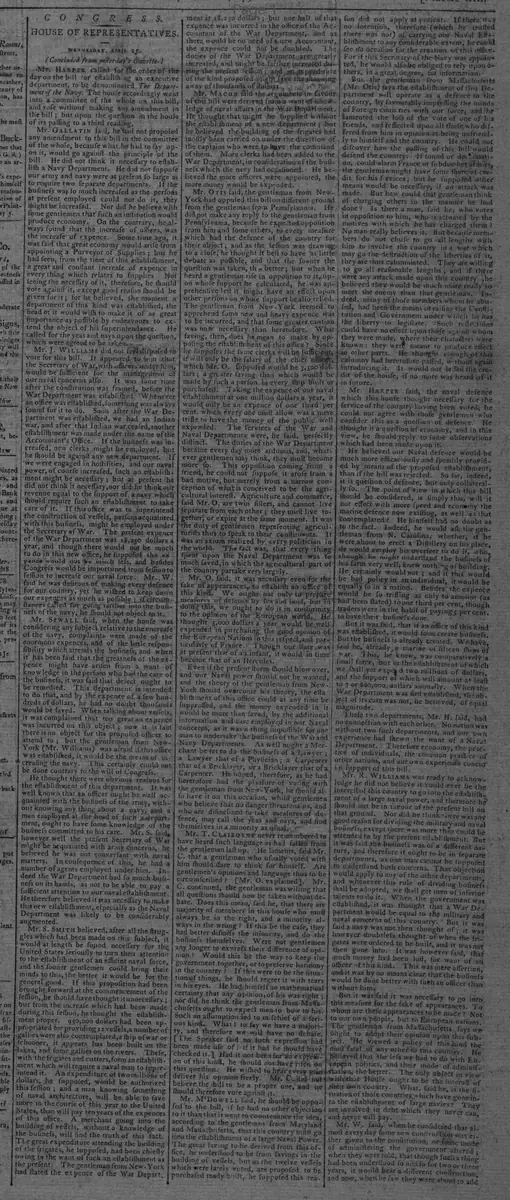
Mr. Gallatin said, he had not proposed any amendment to this bill in the committee of the whole, because what, he had to say upon it, would go against the principle of the bill. He did not think it necessary to establish a Navy Department. He did not suppose our army and navy were at present so large as to require two separate departments. If the business was so much increased as the persons at present employed could not do it, they might be increased. Nor did he believe with some gentlemen that such an institution would produce economy. On the contrary, he always found that the increase of offices, was the increase of expense. Some time ago, it was said that great economy would arise from appointing a Purveyor of Supplies; but he had seen, from the time of this establishment, a great and constant increase of expense in every thing which relates to supplies Not seeing the necessity of it, therefore, he should vote against it, except good reason should be given for it: for he believed, the moment a department of this kind was established, the head of it would wish to make it of as great importance as possible by endeavours to extend the object of his superintendence. He called for the yeas and nays upon the question, which were agreed to be taken.-
Mr. I. Williams did not feel disposed to vote for this bill. It appeared to him that the Secretary of War, with officers under him, would be sufficient for the management of our naval concerns also. It was some time after the constitution was framed, before the War Department was established, Whenever an office was established, something was always found for it to do. Soon after the War Department was established, we had an Indian war, and after that Indian war ceased, another establishment was made under the name of the Accountant's Office. If the business was increased, new clerks might be employed, but he should be against any new department. If we were engaged in hostilities, and our naval power, of course increased, such an establishment might be necessary; but at present he did not think it necessary, nor did he think our revenue equal to the support of a navy which should require such an establishment to take care of it. If this office was to superintend the construction of vessels, persons acquainted with this business, might be employed under the Secretary of War. The present expense of the War Department was 18,250 dollars a year, and though there would not be much to do in this new office, he supposed the expense would not be much less, and besides Congress would be importuned from session to session to increase our naval force. Mr. W. said he was desirous of making every defence for our country, yet he wished to keep down our expenses as much as possible; if circumstances called for going farther into the business of the navy, he should not object to it.
Mr. Sewall said, when the house was considering any subject relative to the increase of the navy, complaints were made of the enormous expenses, and of the little responsibility which attends the business, and when it has been said that the greatness of the expense might have arisen from a want of knowledge in the persons who had the care of the business, it was said that defect ought to be remedied. This department is intended to do that, and by the expense of a few hundreds of dollars, he had no doubt thousands would be saved. When talking about vessels, it was complained that too great an expense was incurred on this object; now it is said there is no object for the proposed officer to attend to; but the gentleman from New-York (Mr. Williams) was afraid if this office was established, it would be the means of increasing the navy. This certainly could not be done contrary to the will of Congress.
He thought there were obvious reasons for the establishment of this department. It was well known that an officer might be well acquainted with the business of the army, without knowing any thing about a navy, and a man employed at the head of such a department, ought to have some knowledge of the business committed to his care. Mr. S. said, however well the present Secretary of War might be acquainted with army concerns, he believed he was not conversant with naval matters. In consequence of this, he had a number of agents employed under him,--Indeed the War Department had so much business on its hands, as not to be able to pay a sufficient attention to our naval establishment.
He therefore believed it was necessary to make this new establishment, especially as the Naval Department was likely to be considerably augmented.
Mr. S. Smith believed, after all the struggles which had been made on this subject, it would at length be found necessary for the United States seriously to turn their attention to the establishment of an efficient naval force, and the sooner gentlemen could bring their minds to this, the better it would be for the general good. If this proposition had been brought forward at the commencement of the session, he should have thought it unnecessary; but from the increase which had been made during this session, he thought the establishment proper. 950,000 dollars had been appropriated for providing 12 vessels, a number of gallies were also contemplated, a ship of war or schooner, it appears has been built on the lakes, and some gallies on the rivers. These, with the frigates and cutters, form an establishment which will require a naval man to superintend it. An expenditure of two millions of dollars, he supposed, would be authorized this session; and a man knowing something of naval architecture. will be able to save more in the course of this year to the United States, than will pay ten years of the expenses of this office. A merchant going into the building of vessels, without a knowledge of the business, will find the truth of this fact. The great expenditure attending the building of the frigates, he supposed, had been chiefly owing to the want of such an establishment as the present. The gentleman from New-York had stated the expense of the War Depart. ment at 18,250 dollars; but one half of that expense was incurred in the office of the Accountant of the War Department, and as there would be no need of a new Accountant, the expense could not be doubled. The duties of the War Department are greatly increased, and might be farther increased during the present session; and an expenditure of the kind proposed might avoid the throwing away of thousands of dollars.
Mr. Macon said the arguments in favour of this bill were derived from a want of knowledge of naval affairs in the War Department. He thought that might be supplied without the establishment of a new department; but he believed the building of the frigates had mostly been carried on under the direction of the captains who were to have the command of them. More clerks had been added to the War Department, in consideration of the business which the navy had occasioned. He believed the more officers were appointed, the more money would be expended.
Mr. Otis said, the gentleman from New-York had opposed this bill on different ground from the gentleman from Pennsylvania. He did not make any reply to the gentleman from Pennsylvania, because he expected opposition from him and some others, to every measure which had the defence of the country for their object: and as the session was drawing to a close, he thought it best to have as little debate as possible, and that the sooner the question was taken, the better; but when he heard a gentleman rise in opposition to it, upon whose support he calculated, he was apprehensive lest it might have an effect upon other persons on whose support he also relied.
The gentleman from New-York seemed to apprehend some new and heavy expense was to be incurred, and that some greater caution was now necessary than heretofore. What saving, then, does he mean to make by opposing the establishment of this office? Since he supposes the same clerks will be sufficient, it will only be the salary of the chief officer, which Mr. O. supposed would be 3,500 dollars; a greater saving than which would be made by such a person in every ship built or purchased. Taking the expense of our naval establishment at one million dollars a year, it would only be an expense of one third per cent. which every one must allow was a mere trifle to have the money of the public well expended. The services of the War and Naval Departments were, he said, perfectly distinct. The duties of the War Department became every day more arduous, and, whatever gentlemen may think, they must become more so. This opposition coming from a friend, he could not suppose it arose from a bad motive, but merely from a narrow conception of what is conceived to be the agricultural interest." Agriculture and commerce, said Mr. O. are twin sisters. and cannot. live separate from each other; they must live together, or expire at the same moment. It was the duty of gentlemen representing agriculturists thus to speak to their constituents. It was an axiom realized by every politician in the world. The fact was, that every thing spent upon the Naval Department was so much saved, in which the agricultural part of the country partake very largely.
Mr. O. said, it was necessary even for the sake of appearances, to establish an office of this kind. We ought not only to prepare measures of defence by sea and land, but in doing this, we ought to do it in conformity to the opinion of the European world, He thought 5,000 dollars a year would be well expended in purchasing the good opinion of the European Nations in this respect,and particularly of France.) Though our state was at present that of an infant, it would in time become that of an Hercules.
Even if the present storm should blow over, and our Naval power should not be wanted, and the theory of the gentleman from New-York should overcome his theory, the establishment of this office could at any time be suppressed, and the money expended in it would be more than saved, by the additional information and care employed in our Naval concerns, as it was a thing impossible for one man to undertake the business of the War and Navy Departments. As well might a Merchant be set to do the business of a Lawyer; a Lawyer that of a Physician; a Carpenter that of a Bricklayer, or a Bricklayer that of a Carpenter. He hoped, therefore, as he had heretofore had the pleasure of voting with the gentleman from New-York, he should also have it on this occasion, whilst gentlemen who believe that no danger threatens us, and who are disinclined to take measures of defence, may call the yeas and nays, and find themselves in a minority as usual.
Mr. T. Claiborne never remembered to have heard such language as had fallen from the gentleman last up. He laments, said Mr. C. that a gentleman who usually voted with him should dare to think for himself. Are gentlemen's opinions and language thus to be circumscribed? [Mr. O. explained]. Mr. C. continued, the gentleman was willing that all questions should now be taken without debate. Does this mean, said he, that there are majority of members in this house who must always be in the right, and a minority always in the wrong? If this be the case, they had better dismiss the minority, and do the business themselves. Were not gentlemen any longer to express their difference of opinion? Would this be the way to keep the government together, or to preserve harmony in the country? If this were to be the situation of things, he should regret it with tears in his eyes. He had himself no mathematical certainty that any opinion,of his was right; nor did he think the gentleman from Massachusetts ought to expect men to bow to his. Such an assumption led to mischief of a serious kind. What ! to say we have a majority, and therefore we will have no debate.
The Speaker said no such expression had been made use of : if it had he should have checked it.] Had it not been for an expression of this kind, he should not have risen on this question. He wished to hear every man deliver his opinion freely. Mr. C. did not believe the bill to be a proper one, and he should therefore vote against it.
Mr. M'Dowell said, he should be opposed to the bill, if he had no other objection to it than that it went to countenance the idea, according to the gentleman from Maryland and Massachusetts, that this country must go into the establishment of a large Naval Power. The great saving to be derived from this office, he understood to be from savings in the building of vessels, but as the twelve vessels which were lately voted, are proposed to be purchased ready built, he supposed this reason did not apply at present. If there was no intention, therefore (which he trusted there was not) of carrying our Naval Establishment to any considerable extent. he could see no occasion for the creation of this office. For if this Secretary of the Navy was appointed, he would also be obliged to rely upon others, in a great degree, for information.
But the gentleman from Massachusetts (Mr. Otis) says the establishment of this Department will operate as a defence to the country, by favourably impressing the minds of Foreign countries with our force, and he lamented the loss of the vote of one of his friends, and reflected upon all those who differed from him in opinion as being unfriendly to himself and the country. He could not discover how the passing of this bill would defend the country: If sound or declamation, could alarm France or subdue her armies, the gentleman might have some share of credit for his services; but he supposed other means would be necessary, if an attack was made. But how could that gentleman think of charging others in the manner he had done? Is there a man, said he, who votes in opposition to him, who is actuated by the motives with which he has charged them? No man really believes it. But because members do not chuse to go all lengths with him to involve the country in a war which may go the destruction of the liberties of it, they are thus calumniated. They are willing to go all reasonable lengths; and if there were any attack made upon this country ,he believed they would be much more ready to meet the enemy than that gentleman. Indeed, many of those members whom he abused, had been the means of raising the Constitution and Government under which he has the liberty to legislate. Such reflections could have no effect upon those against whom they were made, where their characters were known : they were meant to produce effect in other parts. He thought enough of this calumny had heretofore passed, without again introducing it. It would not lessen the credit of the house, if no more was heard of it in future.
Mr. Harper said, the naval defence which this house thought necessary for the service of the country having been voted, he could not agree with those gentlemen who consider this as a question of defence. He thought it a question of economy, and in this view, he should reply to some observations which had been made upon it.
He believed our Naval defence would be much more efficaciously and speedily provided by means of the proposed establishment, than if the bill was rejected. So far, indeed, it is question of defence, but only collaterally so. The point of view in which this bill should be considered, is simply this, will it not effect with more speed and economy the marine defence now existing, as well as that contemplated? He himself had no doubt as to the fact. Indeed, he would ask the gentleman from N. Carolina, whether, if he were about to erect a Distillery on his place, he would employ his overseer to do it, who, though he might understand the business of his farm very well, knew nothing of building. He certainly would not; and if this would be bad policy in an individual, it would be equally so in a nation. Besides the expense would be so trifling as only to amount (as had been stated) to one third per cent, though traders were in the habit of paying 5 per cent. to have their business done.
But it was said, that if an office of this kind was established, it would soon create business. But the business is already created. We have, said he, already a marine of fifteen ships of war. This, he knew, was comparatively a small force, but in the establishment of which we shall yet expend two millions of dollars, and the support of which will amount at least to 700 or 800,000 dollars annually. When the War Department was first established, the object of its care was not, he believed, of equal magnitude.
These two departments, Mr. H. said, had no connection with each other. No nation was without two such departments, and our own experience had shown the want of a Naval Department. Therefore economy, the practice of individuals, the common practice of other nations, and our own experience concur in support of this bill.
Mr. R. Williams was ready to acknowledge he did not believe it could ever be the interest of this country to go into the establishment of a large naval power, and therefore he should not be in favour of the present bill on that ground. Nor did he think there was any good reason for dividing the military and naval business, except there was more than could be attended to by the present establishment. But it was said the business was of a different nature, and therefore it ought to be in separate departments, as one man cannot be supposed to understand both concerns. That objection would apply to any of the other departments, and whenever this rule of dividing business shall be adopted, we shall get men of inferior talents to do it., When the government was established, it was thought that a War Department would be equal to the military and naval concerns of this country.' But it was said a navy was not then thought of; it was however doubtless thought of when the frigates were ordered to be built, and it was not then gone into. It was however said, that much money had been lost, for want of an officer of this kind. This was mere assertion, and it was by no means clear that the business would be done better with such an officer than without him
But it was said it was necessary to go into this measure for the sake of appearances. To whom are these appearances to be made? Not to our own people, but to European nations. The gentleman from Massachusetts says we ought to adopt their opinion upon this subject. He viewed a policy of this kind the most fatal of any other to this country. He believed that the less we had to do with European politics, and their mode of administration, the better. The only object in view with that House ought to be the interest of their own country. What, said he, is the situation of those countries which have gone into the establishment of large navies? They are involved in debt which they never can, and never will pay.
Mr. W. said, when he considered that almost every day some new construction was either given to the constitution, or some mode of administering the government altered; when they were told, that though such a thing had been understood so and so for two or three years, it would bear a different construction, and now, when he saw they were about to add
| Champlin, | Morris, | |
| Chapman, | Otis, | |
| Cochran, | J. Parker, | |
| Coit, | Pinckney, | |
| Craik, | Reed, | |
| Dana, | Rutledge, | |
| Dennis, | Schureman, | |
| Dent, | Sewall, | |
| Evans, | Shepard, | |
| A. Foster, | Sinnickson, | |
| D. Foster, | Skinner, | |
| J. Freeman, | N. Smith, | |
| Glen, | S. Smith, | |
| Goodrich, | Sprague, | |
| Griswold, | Thatcher, | |
| Grove, | Thompson, | |
| Harper, | Thomas, | |
| Hindman, | Tillinghast, | |
| Hosmer, | Van Alen, | |
| Imlay, | Wadsworth, | |
| Lyman, | 47 |
| Messrs. Baldwin, | Messrs. Jones, |
| Bard, | Livingston, |
| Benton, | Locke, |
| Blount, | Lyon, |
| Brent, | Macon, |
| Bryan, | M'Clenachan |
| Bullock, | M'Dowell, |
| T. Claiborne, | Milledge, |
| W. Claiborne | New, |
| Clay, | W. Smith, |
| Davis, | Sprigg, |
| Dawson, | Sumter, |
| Elmondorf, | Stanford, |
| Findley, | A. Trigg, |
| Fowler, | J. Trigg, |
| Gallatin, | Van Cortlandt |
| Gillespie, | Varnum, |
| Harrison, | Venable, |
| Hosmer, | J. Williams, |
| Heister, | R. Williams, |
| Holmes, | 41. |
a grand department to our government, not contemplated by the constitution, he owned he was alarmed. Whenever he saw the business of the navy so extensive, as to require a separate department, he should vote for it; but he thought it would not be wise to go on to the establishment of new departments, before there was business for them to do; because, whenever such a department was constituted, he had no doubt business would be found for it to do, as the officer at the head of it would be continually drawing out, and laying before Congress plans for its increase. As to what had been said about the line of conduct adopted by gentlemen in this House, he should say nothing of it. He thought too much had already been said on that subject, and he believed it would be best to suffer such reflections to refute themselves.
Mr. J. Williams said, the only point in dispute was, whether a separate office should be established for the business of the navy, or whether it should be put under the care of a Superintendant in the War Department. He wished the gentleman from Massachusetts (Mr. Otis) had spared his observations, until he had heard those of the gentleman from Maryland (Mr. S. Smith). It had appeared to him that a Superintendant in the War Department would have been sufficient, and he yet thought so. He did not think the business of the navy was so great as to require a separate establishment. There was more business in the War Department in 1794 than at present, and nothing was then heard of a new department. He should not have opposed this measure if he had not been convinced that every measure taken to increase the navy beyond its present establishment, would have a bad effect on this country. It had been proposed last Winter to purchase all the live-oak timber in the Southern States; afterwards a proposition was brought forward for the establishment of Naval Yards. Those measures had been defeated, and they were now called upon to establish a new department for this favourite object. He was not willing to do it. The gentleman from Massachusetts said there would only be a difference betwixt making a new office and continuing to do the business in the War Department, of the salary of the chief officer; but if he looked at the second clause of the bill, he would find himself mistaken, as there was in that provision for a principal clerk, and such other clerks as he shall judge necessary. So that he may have a clerk for every port in the Union, if he pleases. If he represented, as the gentleman from Massachusetts does, a commercial interest, he might be as favorable to a navy as him; but as that was not the case, he was opposed to it. He gave his approbation to such appropriations as he thought necessary; and if, in this instance, he differed in opinion from the gentleman from Massachusetts, he should stand excused. He believed with that gentleman, that the commercial and agricultural interests were closely connected; they differed only as to the extent to which it was proper to carry our naval defence. He did not wish, however, at present, to reject the bill. He believed it might be amended, and he had no objection to the question being postponed for that purpose.
Mr. Livingston said, he was almost tempted to smile at the arrogant pretensions of some gentlemen in this House, in their treatment of others, at least their equals on this floor, whatever they might be out of doors, being equally with them Representatives of the People. They were told by the gentleman from Massachusetts (Mr. Otis) that opposition was expected, was looked for from certain gentlemen; that no argument was necessary on the occasion, because those members who were opposed to all measures of defence, would oppose this measure also; but that those who had originated the measure would carry it into effect. This simple declaration of a strength of party was also attended with a very handsome rebuke of one of his colleagues (Mr. J. Williams) for having dared to doubt the propriety of the measure before the committee. He was happy to find this rebuke had produced its effect, and that though his colleague was at first very decidedly against the bill, he was now disposed to doubt; and the effect of another rebuke, he supposed, would obtain his vote in favour of the new establishment. For his own part, neither the rebuke, nor the preliminary observations with which it was accompanied, had produced any effect upon him. He did very much doubt the propriety of the measure; for although there was a great deal of business in the war office, and the same person could not be supposed to be acquainted with military and naval affairs, if a ship builder was to have the appointment, he could not think such a person fit to be one of the great council of the nation; and it must be recollected that the person who holds this office will become one of the counsellors of the President on all great concerns. But if the idea was adopted, that no person in the government was to have business under his direction which he does not perfectly understand, this division must not stop here. Could it be said that the Secretary of War had a perfect knowledge of every thing under his direction, except what related to the navy? Certainly not. To be so, he must not only be a perfect engineer, but be acquainted with the construction of arms. To carry this idea to its full extent, it would not only be necessary to have separate departments, but also a great variety of subdivisions; they must have, he supposed, commissioners of gun barrels and of ramrods. But it was said, that the establishment of this new office would be the means of saving money, and the excess of expenditure on the frigates was pointed at as a proof of the want of an officer of this kind; but he believed if other business was looked at which had been immediately under the direction of the Secretary of War—the frigate for the Dey of Algiers for instance—it would be found to have been well and speedily done, which was a proof that the Secretary of War could attend to that business. It was said that this establishment was necessary, in order to give an appearance of defence to Europe, as if the establishment of a Department of the Navy was to have the effect to do away all our past and to prevent future injuries. But our appearance to Europe was not all; the example of European countries was mentioned. All were said to have a Marine Department. The practice of Europe, Mr. L. said, had proved itself to be a bad one, as the Navies of those countries, had proved the ruin of them. Mr. L. would make no reply to the insinuations, thrown out against gentlemen, which represented them as being opposed to every measure of defence, as not a question came before the house in which the same unfounded charge had not been repeated; and he supposed by and by, that a new Post Office could not be proposed, or the most trifling business done, without a repetition of those charges. The Yeas and Nays were taken upon this bill going to its third reading, as follows:
On motion of Mr. Harper, the house then took up the amendments of the Senate to the bill respecting the compensation of Clerks. Mr. Harper stated the effect of these amendments to be, to give to the Secretary of the Senate and the Clerk of that house, an addition of 250 dollars each to their present salaries. He recommended an agreement to these amendments as reasonable, as the salaries of these officers were fixed at the same time at which the salaries of the Clerks and inferior officers were fixed, which had been advanced. Mr. Gallatin enquired what the present salaries of these officers were. It was answered 200 dollars a year, and two dollars a day during the session of Congress. Mr. G. thought this sufficient, and that since their salaries had not been increased at a time when living was much dearer than it is at present, or likely to be, he could not consent to the proposed advance. The question was taken by Yeas and Nays, and negatived 36 to 28. The following, being part of the proceedings of Monday, April 23, were accidentally omitted in their proper course. On motion of Mr. J. Williams, the house went into a committee of the whole on the bill for organizing, arming, and disciplining the militia of the United States. Very soon after the committee was formed, Mr. Otis wished the committee to rise, in order to move in the house, a postponement of the consideration of this bill till the next session of Congress. He was convinced that the principle in the bill which went to divide the militia into select and reserved corps, was a good one; but he did not think this was a proper moment to make the new arrangement. The bill contained, he said, a great variety of detail, which would consume considerable time to discuss, and after all, he did not believe it would be got through this session. It was probable, he said, that a provisional army, or some other arrangement, would be necessary for the present, in order to prepare for any attack that may be made upon us; and he thought it would be very wrong to disorganize the present system of militia at this time, since he saw no good effect that could be immediately produced by the change.
This motion was supported by Messrs. Skinner, Varnum, and T. Claiborne; and opposed by Messrs. Shepard, S. Smith, R. Williams, Nicholas, M'Dowell, and Macon. It was negatived 38 to 37. The consideration of the bill was then resumed and some progress made on it, when the committee rose, and the house adjourned.
Thursday, April 26. Mr. D. Foster, from the committee of claims, made an unfavourable report on the petition of Alexander Power, attorney in fact for Edward Bryan, and others, soldiers in the Pennsylvania line, which was concurred in. The bill for establishing an executive department, to be denominated the department of the navy, was read the third time, and passed, 42 to 27. On motion, the house again resolved itself into a committee of the whole on the bill appropriating for the military establishment for the year 1798; when the question for filling the blank in the quarter master department with 200,000 dollars again recurring, Mr. Harper said, it would be recollected that when the house last rose, it was for the purpose of affording time to make some discrimination in the appropriations. The gentleman from Pennsylvania (Mr. Gallatin) had done this, and it appeared to him correctly. Mr. H. enumerated the different items, and the sums calculated for each. The vessels on the Lakes he had no doubt would be an useful object, and ought to be provided for, but not under the quarter master department. He would introduce it as a distinct item; but he did not know under what authority the vessels on the Ohio and Mississippi were constructed, or for what purpose they were wanted. Perhaps it might have been for the lower part of the Mississippi, from the idea of a rupture in that quarter; but though this might have been the case, he was far from admitting the principle that the war department had a right to determine the propriety of such a measure. He believed, if such an expense was necessary an appropriation ought to have been made by Congress. He was therefore willing to drop this item altogether. It was stated that the construction of these vessels was commenced; he was notwithstanding willing that it should be suspended, until some enquiry was made into the business, and Congress shall pass a law to authorize the expenditure. He could not say these vessels were not necessary; but he was willing to say they should not be provided for at present. Mr. H. again objected to the expense of 34,000 dollars for the transportation of ordnance and stores from this city to Pittsburgh. As Congress had no assurances of these being wanted, he should be willing to omit this item also. He wished likewise to enquire whether ordnance could not be procured in that country, without being at so great an expense in transporting them from this city. Mr. H. still wished the blank to be filled with 200,000 dollars. The former estimate was 185,000 dollars, but he believed it would be well to appropriate the even sum he had named, as the average of the expense of the five last years in this department (as he had already stated) had been 200,000 dollars.
Mr. Sewall wished to know whether the gentleman from S. Carolina had had any conversation with the Secretary of War respecting the vessels constructing on the Lakes and the Ohio? He supposed it was not expected that an act should be passed to enable the President to replace vessels used as transports, when worn out. Perhaps it might be necessary to arm these transports occasionally, as they were subject to the attacks of the Indians.
Mr. Harper said, he did not object to the vessels on the Lakes; he meant to propose a separate appropriation for them. It was to the vessels on the Ohio and Mississippi that he objected, which were not wanted for transportation.
Mr. Craik did not think the committee were prepared to say these vessels were not wanted. He had so full a confidence in the Secretary of War, that he was ready to vote for all the items which he had recommended. He wished, therefore, that the decision upon this question might be postponed, until further information was received on the subject. The rising of the committee was advocated by Messrs. Craik, Dayton and Rutledge, and opposed by Messrs. Harper, S. Smith and Gallatin. The question for rising was negatived. Mr. Macon said, he was at a loss how to vote on this subject. Whatever sum was appropriated for this department, there was always a deficiency; it was not, therefore, worth while to be very particular.
Mr. Gallatin moved to fill the blank with 150,000 dollars, which was the sum he had proposed on a former day, since which, he said, the house had received a number of statements from the Secretary of War, in order to induce a larger appropriation. As there seemed to be a general concurrence of opinion to restrict the expenses of the war department, he wished some gentleman better able to do it than himself, would compare the number of troops in service with the sums there required. Mr. G. noticed a number of items which appeared to him unaccountably extravagant, and contrasted the very great expense incurred on the north western frontier with that of the troops employed on the seaboard. Mr. G. also took a view of the expenses under this head from the year 1789 to the present time, in order to shew that 150,000 dollars would be a sufficient appropriation. After commenting pretty freely and at large on the estimates from the War Office, Mr. G. said, he believed there was some radical defect with respect to the connection subsisting betwixt the Accountant's Department, the Treasury and War Departments, which prevented a proper investigation of accounts. So far as relates to the Treasury Department, the accounts were always very clear, and there was no ground of complaint: but from the connection which subsists betwixt the War Department and the Accountant's Department, there seemed to be a want of responsibility.
In the details which had been laid before the house, Mr. G. said, he found items under the head of contingencies, which he should never have expected to have found there; one was for the pay of an Inspector of the troops and garrisons of the United States at a salary of 60 dollars a month. He could not say such an officer was not necessary; but if he was, he would say he ought to have been provided for by law. The other item was for a much larger sum, viz. for the pay of an Engineer of the fortifications of the United States at a salary of 3,000 dollars a year, which was a salary greater than that of the Secretary of War. It appears this Engineer was engaged for three years; but after he had been some time in the service, 2,000 dollars were given him over and above his pay to relinquish his contract. After a few observations from Mr. Dana in favour of the Secretary of War, Mr. Shepard rose and went over the different items contained in the statement read yesterday, particularly the boatmen, 13,000 dollars, the packhorsemen 5,000, the waggoners 7,000, the labourers 3,000, the armourers 6,000, the artificers 14,000, hire of expresses 6,000, and fuel 8,000 dollars. He could not tell how so many boatmen, packhorsemen and waggoners could be employed (for it was not for boats, packhorses and waggons, but for the men alone); and what so many labourers could be employed in he could not imagine. He did not see why the soldiers could not do all the labour the army had to do themselves. When he was in the army, he was at no expense like this. And how the repairing of the arms for 3,000 men could cost 6,000 dollars, he could not tell. Nor could he see how 14,000 dollars could be expended on artificers. If we were to be involved in war, it would not do, to expend money in this manner. It was very easy to write down 30, 50 or 100,000 dollars for this or that, but when the taxes came to be laid, the money would not be so easily raised. Mr. S. passed over a number of articles, till he came to the fuel. He thought 8,000 dollars a year for fuel, in a country where the trees were ready to fall upon them, was a very exorbitant charge. Whilst he was in the army, it never cost him expense for fuel. The United States had better purchase the land upon which the timber grows at once; they would be able to get it for a much less sum. If these expenses were to be incurred for 5,000 men, what, he asked, would be the expense of an army of 30,000 men? This estimate, he was sure, must be much too large; and it became Congress to be careful how they gave encouragement to such charges as these; for the country would scarcely be able to support the expense of any considerable establishment, if more economy was not used. The question on filling the blank with 200,000 dollars was put and negatived, without a division. Mr. Craik moved to fill the blank with 224,000 dollars, in order to take in an item recommended by the Secretary of War. Mr. C. thought the character of this officer had been very illiberally and very unfairly attacked by the gentleman from Pennsylvania. If this gentleman had acted improperly he might be called to account, when he would have an opportunity of speaking for himself. [The Chairman said these remarks were not in order: no such charges had been made.] Mr. C. thought the observations of the gentleman to whom he alluded, must have been so misunderstood. The motion of Mr. Craik not being seconded, it fell to the ground. Mr. Gallatin moved to fill the blank with 150,000 dollars. He said, that with respect to the integrity the Secretary of War, he did not doubt it in the least; as to his talents he had had no opportunity of forming a correct judgment of them; he was however, some judge of accounts, and he saw enough of them, to authorize the declaration which he had made, as to the improper connection of the different departments. He had spoken of facts only. The question for filling the blank with 150,000 dollars, was put and carried, without a division. After agreeing to several other items, amongst which was one for the vessels on the Lakes, the committee rose, the house agreed to the amendment, and the bill was ordered to be engrossed for a third reading. Mr. Craik presented a set of resolutions which had been agreed to at a public meeting at Georgetown, approbating the measures expressing the firmest reliance on the councils of the Executive with respect to France, and of the nation. Mr. Thomas presented an address from upwards of 4,000 citizens of Philadelphia and the liberties, approbatory of the measures of the Executive (mentioned in a former paper). These resolutions and address had the usual reference. The Speaker then laid before the house Mr. Pinckney's letter on the subject of the presents offered to him by the courts of Spain and Great Britain (which has already been mentioned) asking the decision of Congress whether he should be allowed to receive them or not, which, after some few observations, was referred to a select committee of three members. Adjourned.
What sub-type of article is it?
What themes does it cover?
What keywords are associated?
What entities or persons were involved?
Where did it happen?
Story Details
Key Persons
Location
U.S. House Of Representatives
Event Date
April 1798
Story Details
Debate on bill to establish Department of the Navy; opponents cite unnecessary expense and potential for increased spending, proponents argue for efficiency, expertise, and national defense amid French tensions; bill advances to third reading after yeas 47-nays 41, later passes 42-27; includes related discussions on militia organization, military appropriations, and public resolutions supporting executive.