Thank you for visiting SNEWPapers!
Sign up free
The Representative
Saint Paul, Minneapolis, Ramsey County, Hennepin County, Minnesota
What is this article about?
Hon. John Arnold Keyes delivers a speech to the State Farmers Alliance in Minneapolis on January 10, 1893, critiquing plutocracy, celebrating progress in personal liberty, equality before the law, and political rights, and calling for addressing individual property rights to achieve universal prosperity.
Clipping
OCR Quality
Full Text
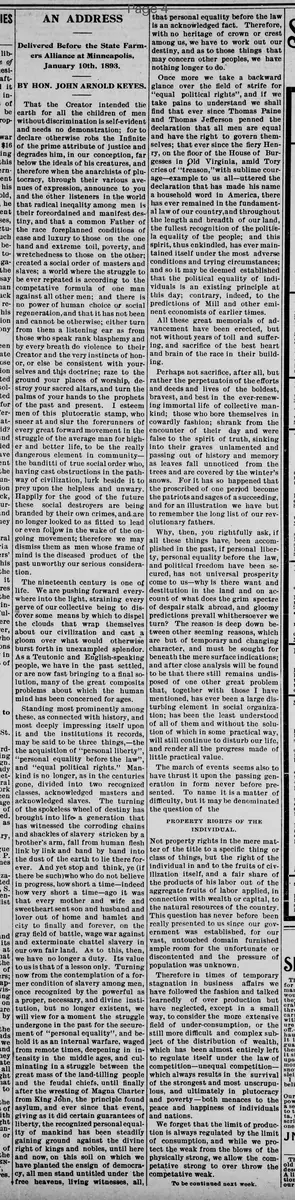
Delivered Before the State Farmers Alliance at Minneapolis,
January 10th, 1893.
BY HON. JOHN ARNOLD KEYES
That the Creator intended the earth for all the children of men without discrimination is self-evident and needs no demonstration; for to declare otherwise robs the Infinite of the prime attribute of justice and degrades him, in our conception, far below the ideals of his creatures, and therefore when the anarchists of plutocracy, through their various avenues of expression, announce to you and the other listeners in the world that radical inequality among men is their foreordained and manifest destiny, and that a common Father of the race foreplanned conditions of ease and luxury to those on the one hand and extreme toil, poverty, and wretchedness to those on the other: created a social order of masters and slaves: a world where the struggle to be ever repeated is according to the competitive formula of one man against all other men; and there is no power of human choice or social regeneration, and that it has not been and cannot be otherwise; either turn from them a listening ear as from those who speak rank blasphemy and by every breath do violence to their Creator and the very instincts of honor, or else be consistent with yourselves and this doctrine; raze to the ground your places of worship, destroy your sacred altars, and turn the palms of your hands to the prophets of the past and present. I esteem men of this plutocratic stamp, who sneer at and slur the forerunners of every great forward movement in the struggle of the average man for higher and better life, to be the really dangerous element in community- the banditti of true social order who, having cast obstructions in the pathway of civilization, lurk beside it to prey upon the helpless and unwary. Happily for the good of the future these social destroyers are being branded by their own crimes, and are no longer looked to as fitted to lead or even follow in the wake of the ongoing movement; therefore we may dismiss them as men whose frame of mind is the diseased product of the past unworthy our serious consideration.
The nineteenth century is one of life. We are pushing forward everywhere into the light, straining every nerve of our collective being to discover some means by which to dispel the clouds that wrap themselves about our civilization and cast a gloom over what would otherwise burst forth in unexampled splendor. As a Teutonic and English-speaking people, we have in the past settled, or are now fast bringing to a final solution, many of the great composite problems about which the human mind has been concerned for ages. Standing most prominently among these, as connected with history, and most deeply impressing itself upon it and the institutions it records, may be said to be three things,- the acquisition of "personal liberty", "personal equality before the law" and "equal political rights." Mankind is no longer, as in the centuries gone, divided into two recognized classes, acknowledged masters and acknowledged slaves. The turning of the spokeless wheel of destiny has brought into life a generation that has witnessed the corroding chains and shackles of slavery stricken by a brother's arm, fall from human flesh link by link and band by band into the dust of the earth to lie there forever. And yet stop and think, ye who do not believe in progress, how short a time-indeed how very short a time-ago it was that every mother and wife and sweetheart sent son and husband and lover out of home and hamlet and city to finally and forever, on the gray field of battle, wage war against and exterminate chattel slavery in our own fair land. As to this, then, we have no longer a duty. Its value to us is that of a lesson only. Turning now from the contemplation of a former condition of slavery among men, once recognized by the powerful as a proper, necessary, and divine institution, but no longer existent, we will view for a moment the struggle undergone in the past for the securement of "personal equality", and behold it as an internal warfare, waged from remote times, deepening in intensity in the middle ages, and culminating in a struggle between the great mass of the land-tilling people and the feudal chiefs, until finally after the wresting of Magna Carta from King John, the principle found asylum, and ever since that event, giving as it did certain guarantees of liberty, the recognized personal equality of mankind has been steadily gaining ground against the divine right of kings and nobles, until here and now, on this soil on which we have planted the ensign of democracy, all men stand untitled under the free heavens, living witnesses, all, that personal equality before the law is an acknowledged fact. Therefore, with no heritage of crown or crest among us, we have to work out our destiny, and as to those things that may concern other peoples, we have nothing longer to do.
Once more we take a backward glance over the field of strife for "equal political rights", and if we take pains to understand we shall find that ever since Thomas Paine and Thomas Jefferson penned the declaration that all men are equal and have the right to govern themselves; that ever since the fiery Henry, on the floor of the House of Burgesses in Old Virginia, amid Tory cries of 'treason," with sublime courage-example to us all-uttered the declaration that has made his name a household word in America, there has ever remained in the fundamental law of our country, and throughout the length and breadth of our land, the fullest recognition of the political equality of the people: and this spirit, thus enkindled, has ever maintained itself under the most adverse conditions and trying circumstances; and so it may be deemed established that the political equality of individuals is an existing principle at this day; contrary, indeed, to the predictions of Mill and other eminent economists of earlier times.
All these great memorials of advancement have been erected, but not without years of toil and suffering, and sacrifice of the best heart and brain of the race in their building.
Perhaps not sacrifice, after all, but rather the perpetuation of the efforts and deeds and lives of the boldest, bravest, and best in the ever-renewing immortal life of collective mankind; those who bore themselves in cowardly fashion; shrank from the encounter of their day and were false to the spirit of truth, sinking into their graves unlamented and passing out of history and memory as leaves fall unnoticed from the trees and are covered by the winter's snows. For it has so happened that the proscribed of one period become the patriots and sages of a succeeding, and for an illustration we have but to remember the long list of our revolutionary fathers.
Why, then, you rightfully ask, if all these things have been accomplished in the past, if personal liberty, personal equality before the law, and political freedom have been secured, has not universal prosperity come to us-why is there want and destitution in the land and on account of what does the grim spectre of despair stalk abroad, and gloomy predictions prevail whithersoever we turn? The reason is deep down between other seeming reasons, which are but of temporary and changing character, and must be sought for beneath the mere surface indications; and after close analysis will be found to be that there still remains undisposed of one other great problem that, together with those I have mentioned, has ever been a large disturbing element in social organization: has been the least understood of all of them and without the solution of which in some practical way, will still continue to disturb our life, and render all the progress made of little practical value.
The march of events seems also to have thrust it upon the passing generation in form never before presented. To name it is a matter of difficulty, but it may be denominated the question of the
PROPERTY RIGHTS OF THE
INDIVIDUAL.
Not property rights in the mere matter of the title to a specific thing or class of things, but the right of the individual in and to the fruits of civilization itself, and a fair share of the products of his labor out of the aggregate fruits of labor applied, in connection with wealth or capital, to the natural resources of the country. This question has never before been really presented to us since our government was established, for our vast, untouched domain furnished ample room for the unfortunate or discontented and the pressure of population was unknown. Therefore in times of temporary stagnation in business affairs we have followed the fashion and talked learnedly of over production but have neglected, except in a small way, to consider the more extensive field of under-consumption, or the still more difficult and complex subject of the distribution of wealth, which has been almost entirely left to regulate itself under the law of competition-unequal competition- which always results in the survival of the strongest and most unscrupulous, and ultimately in plutocracy and poverty-both menaces to the peace and happiness of individuals and nations. We forget that the limit of production is always regulated by the limit of consumption, and while we protect the weak from the blows of the physically strong, we allow the competitive strong to overthrow the competitive weak.
To be continued next week
What sub-type of article is it?
What themes does it cover?
What keywords are associated?
What entities or persons were involved?
Where did it happen?
Story Details
Key Persons
Location
Minneapolis
Event Date
January 10th, 1893
Story Details
Keyes critiques plutocracy as blasphemous inequality, celebrates historical achievements in personal liberty, equality before the law, and political rights, and argues that unresolved individual property rights issues cause ongoing poverty and social disturbance, urging fair distribution of wealth's fruits.