Thank you for visiting SNEWPapers!
Sign up free
Editorial
March 29, 1800
Gazette Of The United States, & Philadelphia Daily Advertiser
Philadelphia, Philadelphia County, Pennsylvania
What is this article about?
An editorial critiques the French Revolution for imitating ancient Rome instead of the British constitution, praises Montesquieu and Burke, condemns Tom Paine's influence, and argues for restoring limited monarchy in France to ensure peace and stability, benefiting Britain and the US.
Clipping
OCR Quality
95%
Excellent
Full Text
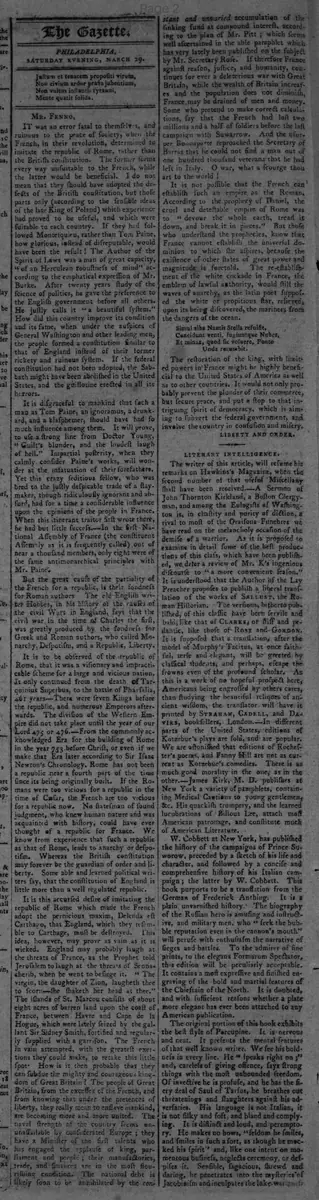
MR. FENNO.
IT was an error fatal to themselves, and
ruinous to the peace of society, when the
French, in their revolution, determined to
imitate the republic of Rome, rather than
the British constitution. The former seems
every way unsuitable to the French, while
the latter would be beneficial. I do not
mean that they should have adopted the de-
fects of the British constitution, but those
parts only (according to the sensible ideas
of the late King of Poland) which experience
had proved to be useful, and which were
suitable to each country. If they had fol-
lowed Montesquieu, rather than Tom Paine,
how glorious, instead of disreputable, would
have been the result! The Author of the
Spirit of Laws was a man of great capacity,
"of an Herculean robustness of mind" ac-
according to the emphatical expression of Mr.
Burke. After twenty years study of the
science of politics, he gave the preference to
the English government before all others.
He justly calls it "a beautiful system."
How did this country improve its condition
and its fame, when under the auspices of
General Washington and other leading men,
the people formed a constitution similar to
that of England instead of their former
rickety and ruinous system. If the federal
constitution had not been adopted, the Sab-
bath might have been abolished in the United
States, and the guillotine erected in all its
horrors.
It is disgraceful to mankind that such a
man as Tom Paine, an ignoramus, a drunk-
ard, and a blasphemer, should have had so
much influence among them. It will prove,
to use a strong line from Doctor Young,
"Guilt's blunder, and the loudest laugh
of hell." Impartial posterity, when they
calmly consider Paine's works, will won-
der at the infatuation of their forefathers.
Yet this crazy seditious fellow, who was
bred to the justly despicable trade of a stay-
maker, though ridiculously ignorant and ab-
surd, had for a time a considerable influence
upon the opinions of the people in France.
When this itinerant traitor first wrote there,
he had but little success.—In the first Na-
tional Assembly of France (the constituent
Assembly as it is frequently called). out of
near a thousand members, only eight were of
the same antimonarchical principles with
Mr. Paine.
But the great cause of the partiality of
the French for a republic, is their fondness
for Roman authors The old-English wri-
ter Hobbes, in his history of the causes of
the civil Wars in England, says that the
civil war in the time of Charles the first,
was greatly produced by the fondness for
Greek and Roman authors, who called Mo-
narchy, Despotism, and a Republic, Liberty.
It is to be observed of the republic of
Rome, that it was a visionary and impracti-
cable scheme for a large and vicious nation.
It only continued from the death of Tar-
quinius Superbus, to the battle of Pharsalia,
461 years—There were even Kings before
the republic, and numerous Emperors after-
wards. The division of the Western Em-
pire did not take place until the year of our
Lord 475 or 476. From the commonly ac-
knowledged Era for the building of Rome
in the year 753. before Christ, or even if we
make that Era later according to Sir Isaac
Newton's Chronology, Rome has not been
a republic near a fourth part of the time
since its being originally built. If the Ro-
mans were too vicious for a republic in the
time of Caesar, the French are too vicious
for a republic now. No statesman of sound
judgment, who knew human nature and was
acquainted with history, could have ever
thought of a republic for France. We
know from experience that such a republic
as that of Rome, leads to anarchy or despo-
tism. Whereas the British constitution
may forever be the guardian of order and li-
berty. Some able and learned political wri-
ters say, that the constitution of England is
little more than a well regulated republic.
It is this accursed desire of imitating the
republic of Rome which made the French
adopt the pernicious maxim, Delenda est
Carthago, that England, which they resem-
ble to Carthage, must be destroyed. This
idea, however, may prove as vain as it is
wicked. England may probably laugh at
the threats of France, as the Prophet told
Jerusalem to laugh at the threats of Senna-
cherib, when he went to besiege it. "The
virgin, the daughter of Zion, laugheth thee
to scorn; she shaketh her head at thee."
The islands of St. Marcou consist of about
eight acres of barren land upon the coast of
France, between Havre and Cape de la
Hogue, which were lately seized by the gal-
lant Sir Sidney Smith, fortified and regular-
ly supplied with a garrison. The French
in vain attempted, with the greatest exer-
tions they could make, to retake this little
post· How is it then probable that they
can subdue the mighty and courageous king-
dom of Great Britain? The people of Great
Britain, from the excess of the French, and
from knowing that under the pretences of
liberty, they really mean to enslave mankind,
are becoming more and more united. The
naval strength of the country seems un-
assailable by confederated Europe ; they
have a Minister of the first talents who
has engaged the applause of king, par-
liament and people; their manufactories,
trade, and finances are in the most flour-
ishing condition. The national debt is
likely soon to be annihilated by the con-
stant and unvaried accumulation of the
sinking fund at compound interest, accord-
ing to the plan of Mr. Pitt ; which seems
well ascertained in the able pamphlet which
has very lately been published on the subject
by Mr. Secretary Rose. If therefore France
against reason, justice, and humanity, con-
tinues for ever a deleterious war with Great
Britain, while the wealth of Britain increa-
ses and the population does not diminish,
France may be drained of men and money.
Some who pretend to make correct calcula-
tions, say that the French had lost two
millions and a half of soldiers before the last
campaign with Suwarrow. And the Em-
peror Buonaparte reproached the Secretary of
War that he could not find a man out of
one hundred thousand veterans that he had
left in Italy. O war, what a scourge thou
art to the world !
It is not possible that the French can
establish such an empire as the Roman.
According to the prophecy of Daniel, the
cruel and detestable empire of Rome was
to "devour the whole earth, tread it
down, and break it in pieces." But those
who understand the prophecies, know that
France cannot establish the universal do-
minion to which she aspires, because the
existence of other states of great power and
magnitude is foretold. The re-establish-
ment of the white cockade in France, the
emblem of lawful authority, would still the
waves of anarchy, as the Latin poet suppo-
sed the white star propitious relieved
upon its being discovered, the mariners from
the dangers of the ocean.
Simul alba Nautis
Stella refulsit,
Cedunt venti, fugiuntque Nubes,
Et minas, quod sic voluere, Ponto
Unda recumbit.
The restoration of the king, with limit-
ed powers in France might be highly benefi-
cial to the United States of America as well
as to other countries. It would not only pro-
bably prevent the plunder of their commerce,
but secure peace, and put a stop to that in-
trigging spirit of democracy, which is aim-
ing to subvert the federal government, and
involve the country in confusion and misery.
LIBERTY AND ORDER.
IT was an error fatal to themselves, and
ruinous to the peace of society, when the
French, in their revolution, determined to
imitate the republic of Rome, rather than
the British constitution. The former seems
every way unsuitable to the French, while
the latter would be beneficial. I do not
mean that they should have adopted the de-
fects of the British constitution, but those
parts only (according to the sensible ideas
of the late King of Poland) which experience
had proved to be useful, and which were
suitable to each country. If they had fol-
lowed Montesquieu, rather than Tom Paine,
how glorious, instead of disreputable, would
have been the result! The Author of the
Spirit of Laws was a man of great capacity,
"of an Herculean robustness of mind" ac-
according to the emphatical expression of Mr.
Burke. After twenty years study of the
science of politics, he gave the preference to
the English government before all others.
He justly calls it "a beautiful system."
How did this country improve its condition
and its fame, when under the auspices of
General Washington and other leading men,
the people formed a constitution similar to
that of England instead of their former
rickety and ruinous system. If the federal
constitution had not been adopted, the Sab-
bath might have been abolished in the United
States, and the guillotine erected in all its
horrors.
It is disgraceful to mankind that such a
man as Tom Paine, an ignoramus, a drunk-
ard, and a blasphemer, should have had so
much influence among them. It will prove,
to use a strong line from Doctor Young,
"Guilt's blunder, and the loudest laugh
of hell." Impartial posterity, when they
calmly consider Paine's works, will won-
der at the infatuation of their forefathers.
Yet this crazy seditious fellow, who was
bred to the justly despicable trade of a stay-
maker, though ridiculously ignorant and ab-
surd, had for a time a considerable influence
upon the opinions of the people in France.
When this itinerant traitor first wrote there,
he had but little success.—In the first Na-
tional Assembly of France (the constituent
Assembly as it is frequently called). out of
near a thousand members, only eight were of
the same antimonarchical principles with
Mr. Paine.
But the great cause of the partiality of
the French for a republic, is their fondness
for Roman authors The old-English wri-
ter Hobbes, in his history of the causes of
the civil Wars in England, says that the
civil war in the time of Charles the first,
was greatly produced by the fondness for
Greek and Roman authors, who called Mo-
narchy, Despotism, and a Republic, Liberty.
It is to be observed of the republic of
Rome, that it was a visionary and impracti-
cable scheme for a large and vicious nation.
It only continued from the death of Tar-
quinius Superbus, to the battle of Pharsalia,
461 years—There were even Kings before
the republic, and numerous Emperors after-
wards. The division of the Western Em-
pire did not take place until the year of our
Lord 475 or 476. From the commonly ac-
knowledged Era for the building of Rome
in the year 753. before Christ, or even if we
make that Era later according to Sir Isaac
Newton's Chronology, Rome has not been
a republic near a fourth part of the time
since its being originally built. If the Ro-
mans were too vicious for a republic in the
time of Caesar, the French are too vicious
for a republic now. No statesman of sound
judgment, who knew human nature and was
acquainted with history, could have ever
thought of a republic for France. We
know from experience that such a republic
as that of Rome, leads to anarchy or despo-
tism. Whereas the British constitution
may forever be the guardian of order and li-
berty. Some able and learned political wri-
ters say, that the constitution of England is
little more than a well regulated republic.
It is this accursed desire of imitating the
republic of Rome which made the French
adopt the pernicious maxim, Delenda est
Carthago, that England, which they resem-
ble to Carthage, must be destroyed. This
idea, however, may prove as vain as it is
wicked. England may probably laugh at
the threats of France, as the Prophet told
Jerusalem to laugh at the threats of Senna-
cherib, when he went to besiege it. "The
virgin, the daughter of Zion, laugheth thee
to scorn; she shaketh her head at thee."
The islands of St. Marcou consist of about
eight acres of barren land upon the coast of
France, between Havre and Cape de la
Hogue, which were lately seized by the gal-
lant Sir Sidney Smith, fortified and regular-
ly supplied with a garrison. The French
in vain attempted, with the greatest exer-
tions they could make, to retake this little
post· How is it then probable that they
can subdue the mighty and courageous king-
dom of Great Britain? The people of Great
Britain, from the excess of the French, and
from knowing that under the pretences of
liberty, they really mean to enslave mankind,
are becoming more and more united. The
naval strength of the country seems un-
assailable by confederated Europe ; they
have a Minister of the first talents who
has engaged the applause of king, par-
liament and people; their manufactories,
trade, and finances are in the most flour-
ishing condition. The national debt is
likely soon to be annihilated by the con-
stant and unvaried accumulation of the
sinking fund at compound interest, accord-
ing to the plan of Mr. Pitt ; which seems
well ascertained in the able pamphlet which
has very lately been published on the subject
by Mr. Secretary Rose. If therefore France
against reason, justice, and humanity, con-
tinues for ever a deleterious war with Great
Britain, while the wealth of Britain increa-
ses and the population does not diminish,
France may be drained of men and money.
Some who pretend to make correct calcula-
tions, say that the French had lost two
millions and a half of soldiers before the last
campaign with Suwarrow. And the Em-
peror Buonaparte reproached the Secretary of
War that he could not find a man out of
one hundred thousand veterans that he had
left in Italy. O war, what a scourge thou
art to the world !
It is not possible that the French can
establish such an empire as the Roman.
According to the prophecy of Daniel, the
cruel and detestable empire of Rome was
to "devour the whole earth, tread it
down, and break it in pieces." But those
who understand the prophecies, know that
France cannot establish the universal do-
minion to which she aspires, because the
existence of other states of great power and
magnitude is foretold. The re-establish-
ment of the white cockade in France, the
emblem of lawful authority, would still the
waves of anarchy, as the Latin poet suppo-
sed the white star propitious relieved
upon its being discovered, the mariners from
the dangers of the ocean.
Simul alba Nautis
Stella refulsit,
Cedunt venti, fugiuntque Nubes,
Et minas, quod sic voluere, Ponto
Unda recumbit.
The restoration of the king, with limit-
ed powers in France might be highly benefi-
cial to the United States of America as well
as to other countries. It would not only pro-
bably prevent the plunder of their commerce,
but secure peace, and put a stop to that in-
trigging spirit of democracy, which is aim-
ing to subvert the federal government, and
involve the country in confusion and misery.
LIBERTY AND ORDER.
What sub-type of article is it?
Foreign Affairs
War Or Peace
Moral Or Religious
What keywords are associated?
French Revolution
British Constitution
Tom Paine
Montesquieu
Roman Republic
Monarchy Restoration
War With Britain
Us Federal Government
What entities or persons were involved?
French
Tom Paine
Montesquieu
Mr. Burke
General Washington
Hobbes
Caesar
Mr. Pitt
Mr. Secretary Rose
Suwarrow
Emperor Buonaparte
Daniel
Editorial Details
Primary Topic
Critique Of French Revolution Imitating Rome Over British Constitution
Stance / Tone
Strongly Pro British Monarchy And Constitution, Anti Republican French Revolution, Supportive Of French Monarchy Restoration
Key Figures
French
Tom Paine
Montesquieu
Mr. Burke
General Washington
Hobbes
Caesar
Mr. Pitt
Mr. Secretary Rose
Suwarrow
Emperor Buonaparte
Daniel
Key Arguments
French Revolution Erred By Imitating Roman Republic Instead Of British Constitution
Montesquieu's Preference For English Government Over Others
Us Federal Constitution Similar To England's Prevented Chaos
Tom Paine's Influence Disgraceful Due To His Ignorance And Blasphemy
Roman Republic Unsuitable For Large Vicious Nations Like France
British Constitution Guards Order And Liberty
French Threats Against England Vain; Britain Strong In Navy, Finances
Restoration Of French King Beneficial For Peace And Us Stability