Thank you for visiting SNEWPapers!
Sign up free
Editorial
November 9, 1945
The Ypsilanti Daily Press
Ypsilanti, Washtenaw County, Michigan
What is this article about?
Roger W. Babson argues that while post-war plant reconversion is simple, distributing consumer goods will be challenging. He urges training salesmen, investing in advertising, and supporting local newspapers for economic recovery and community welfare.
Clipping
OCR Quality
95%
Excellent
Full Text
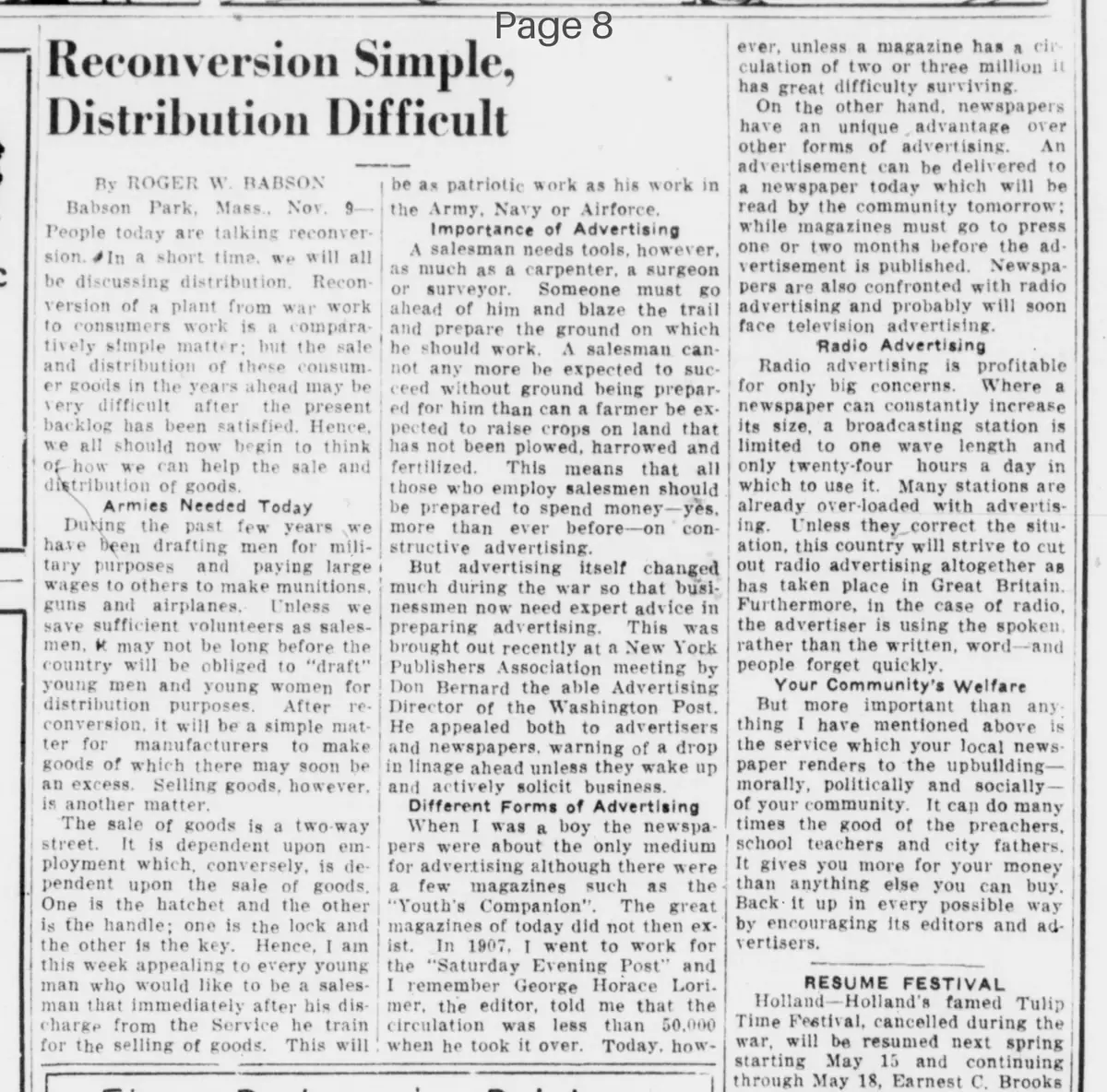
Reconversion
Simple.
Distribution
Difficult
By ROGER W. BABSON
Babson Park,
Mass. Nov. 9
People today are talking reconversion. In a short time we will all
be discussing distribution. Reconversion of a plant from war work
to consumers work is a compara-
tively simple matter: but the sale
and distribution of these consumer
goods in the years ahead may be
very difficult after the present
backlog has been satisfied. Hence,
we all should now begin to think
of how we can help the sale and
distribution of goods.
Armies Needed Today
During the past few years we
have been drafting men for mili-
tary purposes and paying large
wages to others to make munitions,
guns and airplanes.
Unless we
save sufficient volunteers as sales-
men, it may not be long before the
country will be obliged to "draft"
young men and young women for
distribution purposes. After re-
conversion, it will be a simple mat-
ter for manufacturers to make
goods of which there may soon be
an excess. Selling goods, however,
is another matter.
The sale of goods is a two way
street. It is dependent upon em-
ployment which, conversely, is de-
pendent upon the sale of goods.
One is the hatchet and the other
is the handle: one is the lock and
the other is the key. Hence, I am
this week appealing to every young
man who would like to be a sales
man that immediately after his dis-
charge from the Service he train
for the selling of goods. This will
be as patriotic work as his work in
the Army, Navy or Airforce.
Importance of Advertising
A salesman needs tools, however,
as much as a carpenter, a surgeon
or surveyor. Someone must go
ahead of him and blaze the trail
and prepare the ground on which
he should work. A salesman can-
not any more be expected to suc-
ceed without ground being prepar-
ed for him than can a farmer be ex-
pected to raise crops on land that
has not been plowed, harrowed and
fertilized. This means that all
those who employ salesmen should
be prepared to spend money-yes,
more than ever before-on con-
structive advertising.
But advertising itself changed
much during the war so that busi-
nessmen now need expert advice in
preparing advertising. This was
brought out recently at a New York
Publishers Association meeting by
Don Bernard the able Advertising
Director of the Washington Post.
He appealed both to advertisers
and newspapers, warning of a drop
in linage ahead unless they wake up
and actively solicit business.
Different Forms of Advertising
When I was a boy the newspa-
papers were about the only medium
for advertising although there were
a few magazines such as the
"Youth's Companion". The great
magazines of today did not then ex-
ist. In 1907, I went to work for
the "Saturday Evening Post" and
I remember George Horace Lorimer,
the editor, told me that the
circulation was less than 50,000
when he took it over. Today, how-
ever, unless a magazine has a cir-
circulation of two or three million it
has great difficulty surviving.
On the other hand, newspapers
have an unique advantage over
other forms of advertising.
An
advertisement can be delivered to
a newspaper today which will be
read by the community tomorrow:
while magazines must go to press
one or two months before the ad.
vertisement is published. Newspa-
papers are also confronted with radio
advertising and probably will soon
face television advertising.
Radio Advertising
Radio advertising is
profitable
for only big concerns.
Where a
newspaper can constantly increase
its size, a broadcasting station is
limited to one wave length and
only twenty-four hours a day in
which to use it. Many stations are
already over-loaded with advertis-
ing. Unless they correct the situ-
ation, this country will strive to cut
out radio advertising altogether as
has taken place in Great Britain.
Furthermore, in the case of radio,
the advertiser is using the spoken
rather than the written word-and
people forget quickly.
Your Community's Welfare
But more important than any-
thing I have mentioned above is
the service which your local news
paper renders to the upbuilding-
morally, politically and socially-
of your community. It can do many
times the good of the preachers,
school teachers and city fathers.
It gives you more for your money
than anything else you can buy.
Back it up in every possible way
by encouraging its editors and ad-
vertisers.
Simple.
Distribution
Difficult
By ROGER W. BABSON
Babson Park,
Mass. Nov. 9
People today are talking reconversion. In a short time we will all
be discussing distribution. Reconversion of a plant from war work
to consumers work is a compara-
tively simple matter: but the sale
and distribution of these consumer
goods in the years ahead may be
very difficult after the present
backlog has been satisfied. Hence,
we all should now begin to think
of how we can help the sale and
distribution of goods.
Armies Needed Today
During the past few years we
have been drafting men for mili-
tary purposes and paying large
wages to others to make munitions,
guns and airplanes.
Unless we
save sufficient volunteers as sales-
men, it may not be long before the
country will be obliged to "draft"
young men and young women for
distribution purposes. After re-
conversion, it will be a simple mat-
ter for manufacturers to make
goods of which there may soon be
an excess. Selling goods, however,
is another matter.
The sale of goods is a two way
street. It is dependent upon em-
ployment which, conversely, is de-
pendent upon the sale of goods.
One is the hatchet and the other
is the handle: one is the lock and
the other is the key. Hence, I am
this week appealing to every young
man who would like to be a sales
man that immediately after his dis-
charge from the Service he train
for the selling of goods. This will
be as patriotic work as his work in
the Army, Navy or Airforce.
Importance of Advertising
A salesman needs tools, however,
as much as a carpenter, a surgeon
or surveyor. Someone must go
ahead of him and blaze the trail
and prepare the ground on which
he should work. A salesman can-
not any more be expected to suc-
ceed without ground being prepar-
ed for him than can a farmer be ex-
pected to raise crops on land that
has not been plowed, harrowed and
fertilized. This means that all
those who employ salesmen should
be prepared to spend money-yes,
more than ever before-on con-
structive advertising.
But advertising itself changed
much during the war so that busi-
nessmen now need expert advice in
preparing advertising. This was
brought out recently at a New York
Publishers Association meeting by
Don Bernard the able Advertising
Director of the Washington Post.
He appealed both to advertisers
and newspapers, warning of a drop
in linage ahead unless they wake up
and actively solicit business.
Different Forms of Advertising
When I was a boy the newspa-
papers were about the only medium
for advertising although there were
a few magazines such as the
"Youth's Companion". The great
magazines of today did not then ex-
ist. In 1907, I went to work for
the "Saturday Evening Post" and
I remember George Horace Lorimer,
the editor, told me that the
circulation was less than 50,000
when he took it over. Today, how-
ever, unless a magazine has a cir-
circulation of two or three million it
has great difficulty surviving.
On the other hand, newspapers
have an unique advantage over
other forms of advertising.
An
advertisement can be delivered to
a newspaper today which will be
read by the community tomorrow:
while magazines must go to press
one or two months before the ad.
vertisement is published. Newspa-
papers are also confronted with radio
advertising and probably will soon
face television advertising.
Radio Advertising
Radio advertising is
profitable
for only big concerns.
Where a
newspaper can constantly increase
its size, a broadcasting station is
limited to one wave length and
only twenty-four hours a day in
which to use it. Many stations are
already over-loaded with advertis-
ing. Unless they correct the situ-
ation, this country will strive to cut
out radio advertising altogether as
has taken place in Great Britain.
Furthermore, in the case of radio,
the advertiser is using the spoken
rather than the written word-and
people forget quickly.
Your Community's Welfare
But more important than any-
thing I have mentioned above is
the service which your local news
paper renders to the upbuilding-
morally, politically and socially-
of your community. It can do many
times the good of the preachers,
school teachers and city fathers.
It gives you more for your money
than anything else you can buy.
Back it up in every possible way
by encouraging its editors and ad-
vertisers.
What sub-type of article is it?
Economic Policy
Trade Or Commerce
What keywords are associated?
Reconversion
Distribution
Salesmen
Advertising
Newspapers
Radio Advertising
Post War Economy
What entities or persons were involved?
Roger W. Babson
Don Bernard
Washington Post
George Horace Lorimer
Saturday Evening Post
New York Publishers Association
Editorial Details
Primary Topic
Post War Reconversion And Distribution Challenges
Stance / Tone
Advocacy For Sales Training And Advertising Investment
Key Figures
Roger W. Babson
Don Bernard
Washington Post
George Horace Lorimer
Saturday Evening Post
New York Publishers Association
Key Arguments
Reconversion From War To Consumer Production Is Simple But Distribution Will Be Difficult
Need To Draft Or Train Salesmen Post War To Avoid Excess Goods
Selling Depends On Employment In A Circular Manner
Salesmen Require Preparatory Advertising Like Tools
War Changed Advertising; Need Expert Advice And More Spending
Newspapers Offer Timely Advantages Over Magazines And Radio
Radio Advertising Limited And Potentially Regulable
Local Newspapers Essential For Community Welfare