Thank you for visiting SNEWPapers!
Sign up free
Gazette Of The United States, & Philadelphia Daily Advertiser
Philadelphia, Philadelphia County, Pennsylvania
What is this article about?
Proceedings in the U.S. House of Representatives on January 3-4, debating a committee report on balances due from states to the federal government, including motions for postponement (defeated) and the resolution passing; also, seating of new member and handling of various petitions.
Clipping
OCR Quality
Full Text
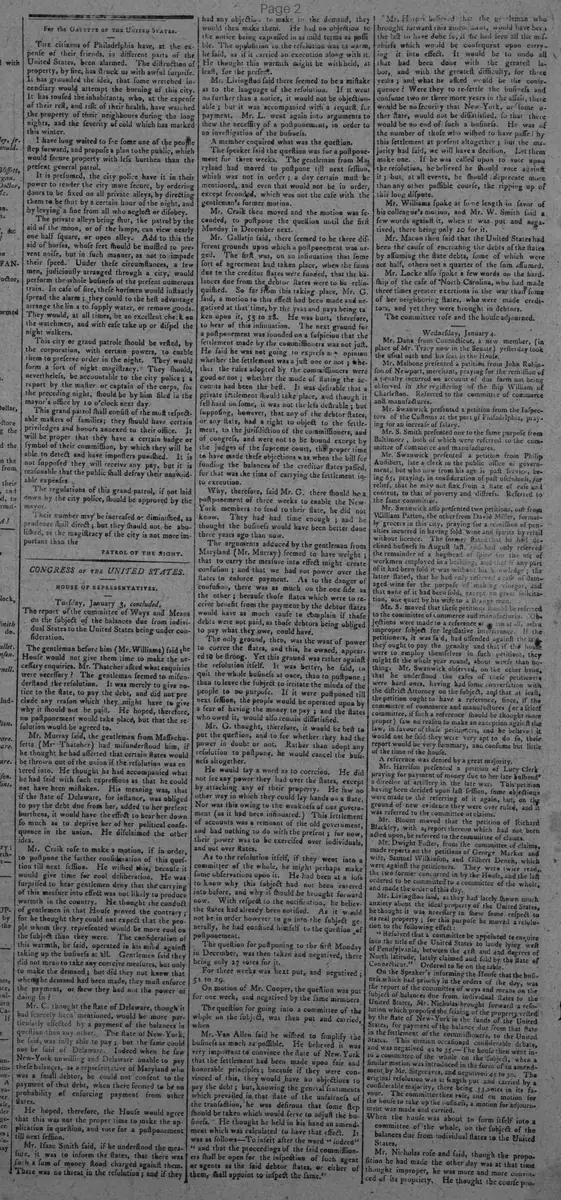
HOUSE OF REPRESENTATIVES.
Tuesday, January 3, concluded.
The report of the committee of Ways and Means on the subject of the balances due from individual States to the United States being under consideration.
The gentleman before him (Mr. Williams) said he House would not give them time to make the necessary enquiries. Mr. Thatcher asked what enquiries were necessary? The gentleman seemed to misunderstand the resolution. It was merely to give notice to the state, to pay the debt, and did not preclude any reason which they might have to give why it should not be paid. He hoped, therefore, no postponement would take place, but that the resolution would be agreed to.
Mr. Murray said, the gentleman from Massachusetts (Mr. Thatcher) had misunderstood him, if he thought he had asserted that certain states would be thrown out of the union if the resolution was entered into. He thought he had accompanied what he had said with such expressions as that he could not have been mistaken. His meaning was, that if the state of Delaware, for instance, was obliged to pay the debt due from her, added to her present burthens, it would have the effect to bear her down so much as to deprive her of her political consequence in the union. He disclaimed the other idea.
Mr. Craik rose to make a motion, if in order, to postpone the farther consideration of this question till next session. He wished this, because it would give time for cool deliberation. He was surprised to hear gentlemen deny that the carrying of this measure into effect was not likely to produce warmth in the country. He thought the conduct of gentlemen in that House proved the contrary; for he thought they could not expect that the people whom they represented would be more cool on the subject than they were. The consideration of this warmth, he said, operated in his mind against taking up the business at all. Gentlemen said they did not mean to take any coercive measures, but only to make the demand; but did they not know that when the demand had been made, they must enforce the payment, or show they had not the power of doing so?
Mr. C. thought the state of Delaware, though it had scarcely been mentioned, would be more particularly affected by a payment of the balances in question than any other. The state of New-York, he said, was fully able to pay; but the same could not be said of Delaware. Indeed when he saw New-York unwilling and Delaware unable to pay these balances, as a representative of Maryland who was a small debtor, he could not consent to the payment of that debt, when there seemed to be no probability of enforcing payment from other states.
He hoped, therefore, the House would agree that this was not the proper time to make the application in question, and vote for a postponement till next session.
Mr. Isaac Smith said, if he understood the measure, it was to inform the states, that there was such a sum of money stood charged against them. There was no threat in the resolution; and if they had any objection to make to the demand, they would then make them. He had no objection to the notice being expressed in as mild terms as possible. The opposition to the resolution was as warm, he said, as if it carried an execution along with it. He thought this warmth might be withheld, at least, for the present.
Mr. Livingston said there seemed to be a mistake as to the language of the resolution. If it went no further than a notice, it would not be objectionable; but it was accompanied with a request, for payment. Mr. L. went again into arguments to shew the necessity of a postponement, in order to an investigation of the business.
A member enquired what was the question.
The Speaker said the question was for a postponement for three weeks. The gentleman from Maryland had moved to postpone till next session, which was not in order; a day certain must be mentioned, and even that would not be in order, except seconded, which was not the case with the gentleman's former motion.
Mr. Craik then moved and the motion was seconded; to postpone the question until the first Monday in December next.
Mr. Gallatin said, there seemed to be three different grounds upon which a postponement was urged. The first was, on an insinuation that some sort of agreement had taken place, when the sums due to the creditor states were funded, that the balances due from the debtor states were to be relinquished. So far from this taking place, Mr. G. said, a motion to this effect had been made and negatived at that time, by the yeas and nays being taken upon it, 59 to 28. He was hurt, therefore, to hear of this insinuation. The next ground for a postponement was founded on a suspicion that the settlement made by the commissioners was not just. He said he was not going to express an opinion whether the settlement was a just one or not; whether the rules adopted by the commissioners were good or not; whether the mode of stating the accounts had been the best. It was desirable that a private settlement should take place, and though it fell hard on some, it was not the less desirable; but supposing, however, that any of the debtor states, or any state, had a right to object to the settlement, to the jurisdiction of the commissioners, and of congress, and were not to be bound except by the judges of the supreme court, the proper time to have made these objections was when the bill for funding the balances of the creditor states passed, for that was the time of carrying the settlement into execution.
Why, therefore, said Mr. G. there should be a postponement of three weeks to enable the New-York members to send to their state, he did not know. They had had time enough; and he thought the business would have been better done three years ago than now.
The arguments adduced by the gentleman from Maryland (Mr. Murray) seemed to have weight; that to carry the measure into effect might create confusion; and that we had not power over the states to enforce payment. As to the danger of confusion, there was as much on the one side as the other: because those states which were to receive benefit from the payment by the debtor states would have as much cause to complain if those debts were not paid, as those debtors being obliged to pay what they owe, could have.
The only ground, then, was the want of power to coerce the states, and this, he owned, appeared to be strong. Yet this ground was rather against the resolution itself. It was better, he said, to quit the whole business at once, than to postpone; than to leave the subject to irritate the minds of the people to no purpose. If it were postponed till next session, the peoples would be operated upon by a fear of having the money to pay; and the states who owed it, would also remain dissatisfied.
Mr. G. thought, therefore, it would be best to put the question, and to see whether they had the power in doubt or not. Rather than adopt any resolution to postpone, he would cancel the business altogether.
He would say a word as to coercion. He did not see any power they had over the states, except by attaching any of their property. He saw no other way in which they could lay hands on a state. Nor was this owing to the weakness of our government (as it had been insinuated.)—This settlement of accounts was a remnant of the old government, and had nothing to do with the present; for now, their power was to be exercised over individuals, and not over states.
As to the resolution itself, if they went into a committee of the whole, he might perhaps make some observations upon it. He had been at a loss to know why this subject had not been entered into before, and why it should be brought forward now. With respect to the notification, he believed the states had already been notified. As it would not be in order however to go into the subject generally, he had confined himself to the question of postponement.
The question for postponing to the first Monday in December, was then taken and negatived, there being only 27 votes for it.
For three weeks was next put, and negatived; 51 to 29.
On motion of Mr. Cooper, the question was put for one week, and negatived by the same members
The question for going into a committee of the whole on the subject, was then put and carried, when
Mr. Van Allen said he wished to simplify the business as much as possible. He believed it was very important to convince the state of New-York that the settlement had been made upon fair and honorable principles; because if they were convinced of this, they would have no objections to pay the debt; but, knowing the general sentiments which prevailed in that state of the unfairness of the transaction, he was desirous that some step should be taken which would serve to adjust the business. He thought he held in his hand an amendment which was calculated to have that effect. It was as follows—To insert after the word "indeed" " and that the proceedings of the said commissioners shall be open for the inspection of such agent or agents as the said debtor states, or either of them, shall appoint to inspect the same."
Mr. Harper believed that the gentleman who brought forward this amendment, would have been the last to have done so, if he had seen all the mischiefs which would be consequent upon carrying it into effect. It would be to undo all that had been done with the greatest labor, and with the greatest difficulty, for three years; and what he asked would be the consequence? Were they to re-settle the business and consume two or three more years in the affair, there would be no security that New-York, or some other state, would not be dissatisfied. So that there would be no end of such a business. He was of the number of those who wished to have passed by this settlement at present altogether; but the majority had said, we will have a decision. Let them make one. If he was called upon to vote upon the resolution, he believed he should vote against it; but, at all events, he should deprecate more than any other possible course, the ripping up of this long dispute.
Mr. Williams spoke at some length in favor of his colleague's motion, and Mr. W. Smith said a few words against it, when it was put and negatived, there being only 20 for it.
Mr. Macon then said that the United States had been the cause of increasing the debts of the states by assuming the state debts, some of which were not half, others not a quarter of the sum assumed.
Mr. Locke also spoke a few words on the hardship of the case of North Carolina, who had made greater exertions in the war than some of her neighboring states, who were made creditors, and yet they were brought in debtors.
The committee rose and the house adjourned.
Wednesday, January 4.
Mr. Dana from Connecticut, a new member, (in place of Mr. Tracy now in the Senate) yesterday took the usual oath and his seat in the House.
Mr. Malbone presented a petition from John Robinson of Newport, merchant, praying for the remission of a penalty incurred on account of due form not being observed in the registering of the ship William of Charleston. Referred to the committee of commerce and manufactures.
Mr. Swanwick presented a petition from the Inspectors of the Customs at the port of Philadelphia, praying for an increase of salary.
Mr. S. Smith presented one to the same purpose from Baltimore, both of which were referred to the committee of commerce and manufactures.
Mr. Swanwick presented a petition from Philip Audibert, late a clerk in the public office of government, but who now from his age is past service, being 65, praying, in consideration of past usefulness, for relief, that he may not sink from a state of ease and content, to that of poverty and distress. Referred to the same committee.
Mr. Swanwick also presented two petitions, one from William Patten, the other from David Miller, formerly grocers in this city, praying for a remission of penalties incurred in having old wine and spirits by retail without licence. The former stated that he had declined business in August last, and had only reserved the remainder of a hogshead of rum or wine for use of workmen employed in a building, and that if any part of it had been sold it was without his knowledge; the latter stated, that he had only reserved a cask of damaged wine for the purpose of making vinegar, and that none of it had been sold, except on great solicitation, one quart by his wife to a strange man.
Mr. S. moved that these petitions should be referred to the committee of commerce and manufactures. Objections were made to a reference to them at all, as an improper subject for legislative interference. If the petitioners, it was said, had offended against the law they ought to pay the penalty and that if the house were to employ themselves in such petitions, they might sit the whole year round, about worse than nothing. Mr. Swanwick observed, on the other hand, that he understood the cases of these petitioners were hard ones, having had some conversation with the district Attorney on the subject, and that at least, the petition ought to have a reference, since, if the committee of commerce and manufactures (or a select committee, if such a reference should be thought more proper) saw no reason to make an exception against the law, in favour of these petitioners, and he believed it would not be said they were very apt to do so, their report would be very summary, and consume but little time of the house.
A reference was denied by a great majority.
Mr. Harrison presented a petition of Lucy Clerke praying for payment of money due to her late husband a director of artillery in the late war. This petition having been decided upon last session, some objections were made to the referring of it again, but, on the ground of new evidence they were over ruled, and it was referred to the committee of claims.
Mr. Blount moved that the petition of Richard Blackledge, with a report thereon which had not been acted upon, be referred to the committee of claims.
Mr. Dwight Foster, from the committee of claims, made reports on the petitions of George Marker and wife, Samuel Wilkinson, and Gilbert Dench, which were against the petitioners. They were twice read, the two former concurred in by the House, and the last ordered to be committed to a committee of the whole, and made the order of this day.
Mr. Livingston said, as they had lately shown much anxiety about the ideal property of the United States, he thought it was necessary to shew some respect to its real property; for this purpose he moved a resolution to the following effect:
" Resolved that a committee be appointed to enquire into the title of the United States to lands lying west of Pennsylvania, between the 41st and 42d degrees of North latitude, lately claimed and sold by the state of Connecticut." Ordered to lie on the table.
On the Speaker's informing the House that the business which had priority in the orders of the day, was the report of the committee of ways and means on the subject of balances due from individual states to the United States. Mr. Nicholas brought forward a resolution which proposed the seizing of the property vested by the state of New-York in the funds of the United States, for payment of the balance due from that state in the settlement of the commissioners, to the United States. This motion occasioned considerable debate, and was negatived 42 to 35.—The house then went into a committee of the whole on the subject, when a similar motion was introduced in the form of an amendment by Mr. Sitgreaves, and negatived 48 to 30. The original resolution was at length put and carried by a considerable majority, there being 53 votes in its favour. The committee then rose, and on motion for the house to take up the business, a motion for adjournment was made and carried.
When the house was about to form itself into a committee of the whole, on the subject of the balances due from individual states to the United States.
Mr. Nicholas rose and said, though the proposition he had made the other day was at that time thought improper, he was more and more convinced of its propriety. He thought the course pro-
What sub-type of article is it?
What keywords are associated?
What entities or persons were involved?
Domestic News Details
Event Date
Tuesday, January 3, And Wednesday, January 4
Key Persons
Outcome
motions to postpone debate negatived (27, 51-29, one week); amendment for inspection negatived (20); resolution on state balances carried (53); motion to seize new york property negatived (42-35, 48-30); various petitions referred or denied; reports on claims concurred or committed.
Event Details
The House considered the committee report on balances due from states, debating necessity of notification, fairness of settlements, coercion powers, and effects on states like Delaware, New York, Maryland, North Carolina. Speakers argued for and against postponement. House went into committee, rejected amendment for agent inspection, heard comments on debt assumptions. On January 4, Mr. Dana seated; petitions from John Robinson, customs inspectors in Philadelphia and Baltimore, Philip Audibert, William Patten, David Miller, Lucy Clerke, Richard Blackledge presented and handled; reports from claims committee; resolution on western lands tabled; Nicholas's seizure resolution negatived; original resolution passed before adjournment.