Thank you for visiting SNEWPapers!
Sign up free
White Pine News
East Ely, White Pine County, Nevada
What is this article about?
Nevada agricultural experiment station reports spring rabbit brush fatally poisons sheep, causing losses when forage is scarce; larkspur is deadly to cattle but not sheep; greasewood causes bloating in hungry sheep.
Merged-components note: Image overlaps with the article on poisonous plants, likely an illustration for the domestic agricultural news.
Clipping
OCR Quality
Full Text
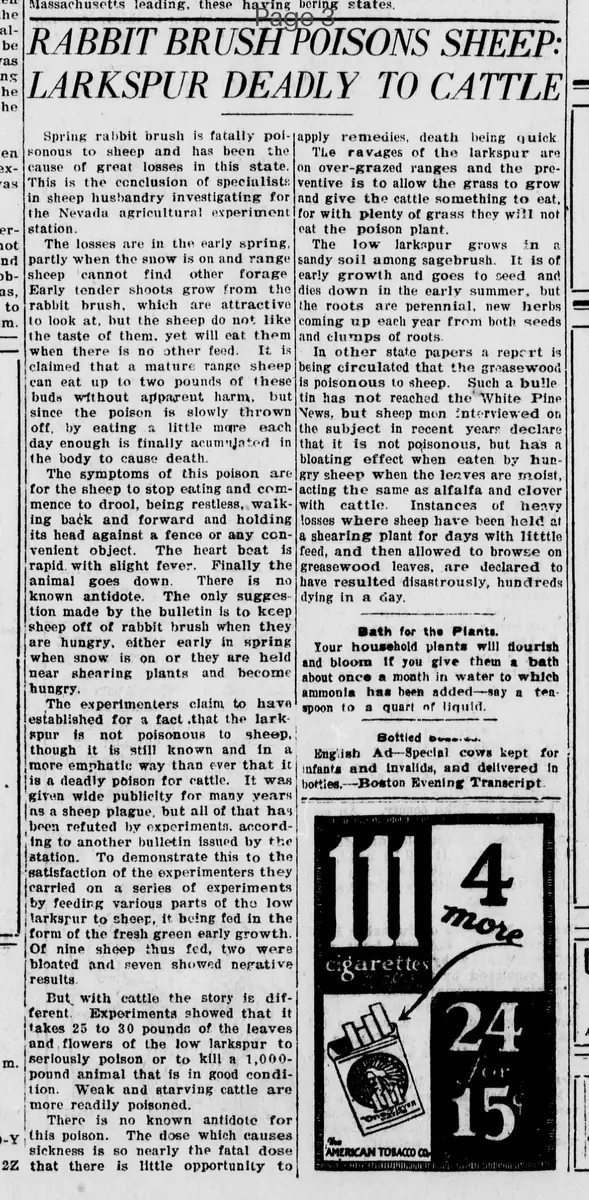
LARKSPUR DEADLY TO CATTLE
Spring rabbit brush is fatally poisonous to sheep and has been the cause of great losses in this state.
This is the conclusion of specialists in sheep husbandry investigating for the Nevada agricultural experiment station.
The losses are in the early spring, partly when the snow is on and range sheep cannot find other forage. Early tender shoots grow from the rabbit brush, which are attractive to look at, but the sheep do not like the taste of them, yet will eat them when there is no other feed. It is claimed that a mature range sheep can eat up to two pounds of these buds without apparent harm, but since the poison is slowly thrown off, by eating a little more each day enough is finally accumulated in the body to cause death.
The symptoms of this poison are for the sheep to stop eating and commence to drool, being restless, walking back and forward and holding its head against a fence or any convenient object. The heart beat is rapid, with slight fever. Finally the animal goes down.
There is no known antidote. The only suggestion made by the bulletin is to keep sheep off of rabbit brush when they are hungry, either early in spring when snow is on or they are held near shearing plants and become hungry.
The experimenters claim to have established for a fact that the larkspur is not poisonous to sheep, though it is still known and in a more emphatic way than ever that it is a deadly poison for cattle. It was given wide publicity for many years as a sheep plague, but all of that has been refuted by experiments, according to another bulletin issued by the station. To demonstrate this to the satisfaction of the experimenters they carried on a series of experiments by feeding various parts of the low larkspur to sheep, it being fed in the form of the fresh green early growth. Of nine sheep thus fed, two were bloated and seven showed negative results.
But with cattle the story is different. Experiments showed that it takes 25 to 30 pounds of the leaves and flowers of the low larkspur to seriously poison or to kill a 1,000-pound animal that is in good condition. Weak and starving cattle are more readily poisoned.
There is no known antidote for this poison. The dose which causes sickness is so nearly the fatal dose that there is little opportunity to apply remedies, death being quick.
The ravages of the larkspur are on over-grazed ranges and the preventive is to allow the grass to grow and give the cattle something to eat, for with plenty of grass they will not eat the poison plant.
The low larkspur grows in a sandy soil among sagebrush. It is of early growth and goes to seed and dies down in the early summer, but the roots are perennial, new herbs coming up each year from both seeds and clumps of roots.
In other state papers a report is being circulated that the greasewood is poisonous to sheep. Such a bulletin has not reached the White Pine News, but sheep men interviewed on the subject in recent years declare that it is not poisonous, but has a bloating effect when eaten by hungry sheep when the leaves are moist, acting the same as alfalfa and clover with cattle.
Instances of heavy losses where sheep have been held at a shearing plant for days with little feed, and then allowed to browse on greasewood leaves, are declared to have resulted disastrously, hundreds dying in a day.
What sub-type of article is it?
What keywords are associated?
Where did it happen?
Domestic News Details
Primary Location
Nevada
Outcome
great losses of sheep from rabbit brush poisoning; larkspur kills cattle (25-30 pounds fatal to 1,000-pound animal); bloating and deaths from greasewood in hungry sheep.
Event Details
Nevada agricultural experiment station concludes spring rabbit brush fatally poisons sheep when hungry, accumulating toxin over days; no antidote, prevent by providing other forage. Larkspur not poisonous to sheep (experiments on 9 sheep: 2 bloated, 7 unaffected) but deadly to cattle on overgrazed ranges; no antidote. Greasewood not poisonous but causes bloating and deaths in hungry sheep.