Thank you for visiting SNEWPapers!
Sign up free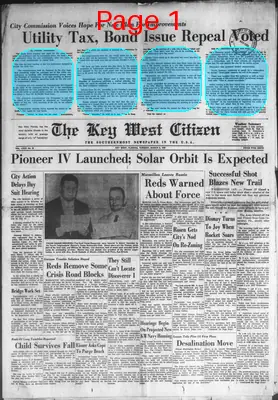
The Key West Citizen
Key West, Monroe County, Florida
What is this article about?
In Key West, the city commission unanimously repeals controversial utility tax and bond ordinances after debate, admitting hasty action. They seek alternatives like Chamber-backed loans to fund improvements, amid warnings of financial penalties and calls for referendum. (214 chars)
Clipping
OCR Quality
Full Text
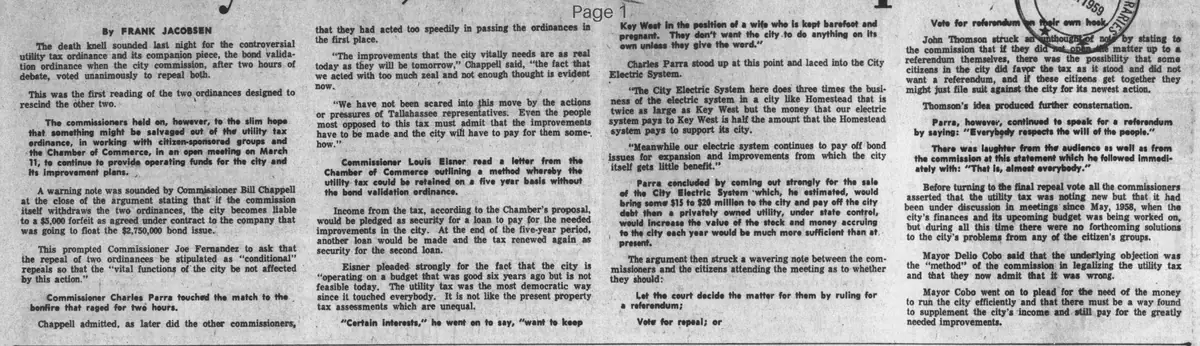
The death knell sounded last night for the controversial utility tax ordinance and its companion piece, the bond validation ordinance when the city commission, after two hours of debate, voted unanimously to repeal both.
This was the first reading of the two ordinances designed to rescind the other two.
The commissioners held on, however, to the slim hope that something might be salvaged out of the utility tax ordinance, in working with citizen-sponsored groups and the Chamber of Commerce, in an open meeting on March 11, to continue to provide operating funds for the city and its improvement plans.
A warning note was sounded by Commissioner Bill Chappell at the close of the argument stating that if the commission itself withdraws the two ordinances, the city becomes liable to a $5,000 forfeit as agreed under contract to the company that was going to float the $2,750,000 bond issue.
This prompted Commissioner Joe Fernandez to ask that the repeal of two ordinances be stipulated as "conditional" repeals so that the "vital functions of the city be not affected by this action."
Commissioner Charles Parra touched the match to the bonfire that raged for two hours.
Chappell admitted, as later did the other commissioners, that they had acted too speedily in passing the ordinances in the first place.
"The improvements that the city vitally needs are as real today as they will be tomorrow," Chappell said, "the fact that we acted with too much zeal and not enough thought is evident now.
"We have not been scared into this move by the actions or pressures of Tallahassee representatives. Even the people most opposed to this tax must admit that the improvements have to be made and the city will have to pay for them somehow."
Commissioner Louis Eisner read a letter from the Chamber of Commerce outlining a method whereby the utility tax could be retained on a five year basis without the bond validation ordinance.
Income from the tax, according to the Chamber's proposal would be pledged as security for a loan to pay for the needed improvements in the city. At the end of the five-year period, another loan would be made and the tax renewed again as security for the second loan.
Eisner pleaded strongly for the fact that the city is "operating on a budget that was good six years ago but is not feasible today. The utility tax was the most democratic way since it touched everybody. It is not like the present property tax assessments which are unequal.
"Certain interests," he went on to say, "want to keep Key West in the position of a wife who is kept barefoot and pregnant. They don't want the city to do anything on its own unless they give the word."
Charles Parra stood up at this point and laced into the City Electric System.
"The City Electric System here does three times the business of the electric system in a city like Homestead that is twice as large as Key West but the money that our electric system pays to Key West is half the amount that the Homestead system pays to support its city.
"Meanwhile our electric system continues to pay off bond issues for expansion and improvements from which the city itself gets little benefit."
Parra concluded by coming out strongly for the sale of the City Electric System which, he estimated, would bring some $15 to $20 million to the city and pay off the city debt then a privately owned utility, under state control, would increase the value of the stock and money accruing to the city each year would be much more sufficient than at present.
The argument then struck a wavering note between the commissioners and the citizens attending the meeting as to whether they should:
Let the court decide the matter for them by ruling for a referendum;
Vote for referendum.
John Thomson struck a thought of not by stating to the commission that if they did not open the matter up to a referendum themselves, there was the possibility that some citizens in the city did favor the tax as it stood and did not want a referendum, and if these citizens get together they might just file suit against the city for its newest action.
Thomson's idea produced further consternation.
Parra, however, continued to speak for a referendum by saying: "Everybody respects the will of the people."
There was laughter from the audience as well as from the commission at this statement which he followed immediately with: "That is, almost everybody."
Before turning to the final repeal vote all the commissioners asserted that the utility tax was nothing new but that it had been under discussion in meetings since May, 1958, when the city's finances and its upcoming budget was being worked on, but during all this time there were no forthcoming solutions to the city's problems from any of the citizen's groups.
Mayor Delio Cobo said that the underlying objection was the "method" of the commission in legalizing the utility tax and that they now admit that it was wrong.
Mayor Cobo went on to plead for the need of the money to run the city efficiently and that there must be a way found to supplement the city's income and still pay for the greatly needed improvements.
What sub-type of article is it?
What themes does it cover?
What keywords are associated?
What entities or persons were involved?
Where did it happen?
Story Details
Key Persons
Location
Key West
Event Date
Last Night, March 11
Story Details
The Key West city commission debates for two hours and unanimously votes to repeal the controversial utility tax and bond validation ordinances on first reading, admitting hasty initial passage. They explore salvaging the tax via citizen groups and Chamber of Commerce proposals for loans secured by tax income over five years. Concerns raised about $5,000 forfeit, conditional repeal, city finances, electric system performance, and potential referendum or lawsuit. Commissioners emphasize need for improvements and democratic funding methods.