Thank you for visiting SNEWPapers!
Sign up free
Editorial
December 20, 1866
Maryland Free Press
Hagerstown, Williamsport, Washington County, Maryland
What is this article about?
Editorial praises Clement Vallandigham's oratory, compares it to Fox, and excerpts his speech refusing to condemn Lincoln's aides (Seward, Stanton, etc.) for abuses without also condemning Lincoln, who supported them, from a Democratic perspective opposing his policies.
Clipping
OCR Quality
98%
Excellent
Full Text
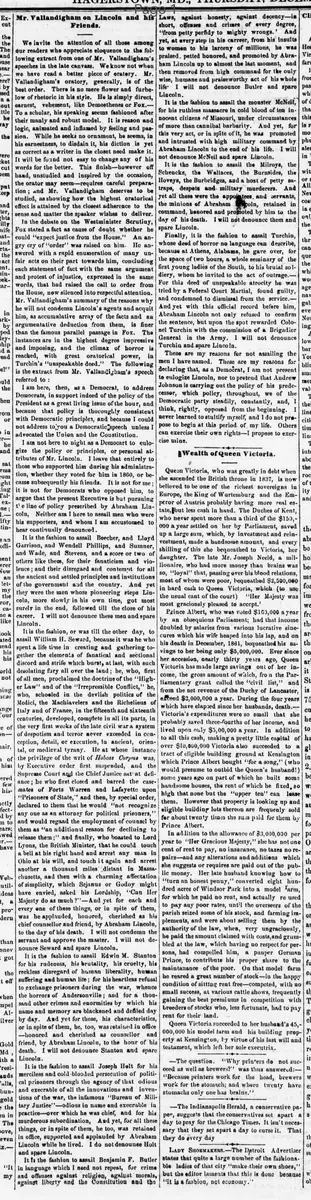
Mr. Vallandigham on Lincoln and his Friends.
We invite the attention of all those among our readers who appreciate eloquence to the following extract from one of Mr. Vallandigham's speeches in the late canvass. We know not when we have read a better piece of oratory. Mr. Vallandigham's oratory, generally, is of the best order. There is no mere flower and furbelow of rhetoric in his style. He is simply direct, earnest, vehement, like Demosthenes or Fox. To a scholar, his speaking seems fashioned after their manly and robust model. It is reason and logic, animated and inflamed by feeling and passion. While he seeks no ornament, he seems, in his earnestness, to disdain it, his diction is yet as correct as a writer in the closet need make it. It will be found not easy to change any of his words for the better. This finish—however off hand, unstudied and inspired by the occasion, the orator may seem—requires careful preparation; and Mr. Vallandigham deserves to be studied, as showing how the highest oratorical effect is attained by the closest adherence to the sense and matter the speaker wishes to deliver.
In the debate on the Westminster Scrutiny, Fox stated a fact as cause of doubt whether he could "expect justice from the House." An angry cry of "order" was raised on him. He answered with a rapid enumeration of many unfair acts on their part towards him, concluding each statement of fact with the same argument and protest of injustice, expressed in the same words, that had raised the call to order from the House, now silenced into respectful attention.
Mr. Vallandigham's summary of the reasons why he will not condemn Lincoln's agents and acquit him, as accumulative array of the facts and an argumentative deduction from them, is finer than the famous parallel passage in Fox. The instances are in the highest degree impressive and imposing, and the climax of horror is reached, with great oratorical power, in Turchin's "unspeakable deed." The following is the extract from Mr. Vallandigham's speech referred to:
I am here, then, as a Democrat, to address Democrats, in support indeed of the policy of the President as a great living issue of the hour, and because that policy is thoroughly consistent with Democratic principles, and because I could not address to you a Democratic speech unless I advocated the Union and the Constitution.
I am not here to night as a Democrat to eulogize the policy or principles, or personal attributes of Mr. Lincoln. I leave that entirely to those who supported him during his administration, whether they voted for him in 1860, or became subsequently his friends. It is not for me; it is not for Democrats who opposed him, to argue that the present Executive is but pursuing the line of policy prescribed by Abraham Lincoln. Neither am I here to assail men who were his supporters, and whom I am accustomed to hear continually denounced.
It is the fashion to assail Beecher, and Lloyd Garrison, and Wendell Phillips, and Sumner, and Wade, and Stevens, and a score or two of others like them, for their fanaticism and violence: and their disregard and contempt for all the ancient and settled principles and institutions of the government and the country. And yet they were the men whose pioneering steps Lincoln, more slowly in his own time, got most surely in the end, followed till the close of his career. I will not denounce these men and spare Lincoln.
It is the fashion, or was till the other day, to assail William H. Seward, because it was he who spent a life time in creating and gathering together the elements of fanatical and sectional discord and strife which burst, at last, with such desolating fury all over the land: he, who first of all men, proclaimed the doctrine of the "Higher Law" and of the "Irrepressible Conflict," he, who, schooled in the devilish politics of the Medici, the Machiavels and the Richelieus of Italy and of France, in the fifteenth and sixteenth centuries, developed, complete in all its parts, in the very first weeks of the late civil war a system of despotism and terror never exceeded in conception, detail, or execution, in ancient, oriental, or medieval tyranny. He at whose instance the privilege of the writ of Habeas Corpus was, by Executive order first suspended, and the Supreme Court and the Chief Justice Taney defied; he who first closed and barred the casemates of Forts Warren and Lafayette upon "Prisoners of State," and then, by special order, declared to them that he would "not recognize any one as an attorney for political prisoners," and would regard the employment of counsel by them as "an additional reason for declining to release them;" and finally, who boasted to Lord Lyons, the British Minister, that he could touch a bell at his right hand and arrest any man in Ohio at his will, and touch it again and arrest another a thousand miles distant in Massachusetts, and then with a charming affectation of simplicity, which Sejanus or Godoy might have envied, asked his Lordship, "Can Her Majesty do as much?"—And yet for each and every one of these things, or in spite of them, was he applauded, honored, cherished as his chief counsellor and friend, by Abraham Lincoln, to the day of his death. I will not condemn the servant and approve the master. I will not denounce Seward and spare Lincoln.
It is the fashion to assail Edwin M. Stanton for his rudeness, his brutality, his cruelty, his reckless disregard of human liberty, human suffering and human life; for his heartless refusal to exchange prisoners during the war, whence the horrors of Andersonville; and for a thousand other crimes and enormities by which his name and memory are blackened and defiled day by day. And yet for these, his characteristics, or in spite of them, he, too, was retained in office—honored and cherished as counsellor and friend, by Abraham Lincoln, to the hour of his death. I will not denounce Stanton and spare Lincoln.
It is the fashion to assail Joseph Holt for his merciless and cold-blooded persecution of political prisoners through the agency of that odious and execrable of all the innovations and inventions of the war, the infamous "Bureau of Military Justice"—odious in name and execrable in practice—over which he was chief, and for his murderous subordination. And yet, for all these things, or in spite of them, he too, was retained in office, supported and applauded by Abraham Lincoln while he lived. I do not denounce Holt and spare Lincoln.
It is the fashion to assail Benjamin F. Butler in language which I need not repeat, for crimes and offenses against religion, against morals, against liberty and the Constitution and the Laws, against honesty, against decency—in short, offenses and crimes of every degree, "from petty perfidy to mighty wrongs." And yet, at every step in his career, from his insults to women to his larceny of millions, he was praised, petted honored, and promoted by Abraham Lincoln up to almost the last moment, and then removed from high command for the only wise, humane and praiseworthy act of his whole life. I will not denounce Butler and spare Lincoln.
It is the fashion to assail the monster McNeil, for his ruthless massacre in cold blood of ten innocent citizens of Missouri, under circumstances of more than cannibal barbarity. And yet, for this very act, or in spite of it, he was promoted and intrusted with high military command by Abraham Lincoln to the end of his life. I will not denounce McNeil and spare Lincoln.
It is the fashion to assail the Milroys, the Schencks, the Wallaces, the Burnsides, the Hoveys, the Burbridges, and a host of petty satraps, despots and military murderers. And yet all these were the appointees, and servants, the minions of Abraham Lincoln, retained in command, honored and promoted by him to the day of his death. I will not denounce them and spare Lincoln.
Finally, it is the fashion to assail Turchin whose deed of horror no language can describe, because at Athens, Alabama, he gave over, for the space of two hours, a whole seminary of the first young ladies of the South, to his brutal soldiery, whom he invited to the act of outrage.— For this deed of unspeakable atrocity he was tried by a Federal Court Martial, found guilty, and condemned to dismissal from the service.— And yet with this official record before him, Abraham Lincoln not only refused to confirm the sentence, but upon the spot rewarded Colonel Turchin with the commission of a Brigadier General in the Army. I will not denounce Turchin and spare Lincoln.
These are my reasons for not assailing the men I have named. These are my reasons for declaring that, as a Democrat, I am not present to eulogize Lincoln, nor to pretend that Andrew Johnson is carrying out the policy of his predecessor, which policy, throughout, we of the Democratic party steadily, constantly, and, I think, rightly, opposed from the beginning. I never learned to stultify myself, and I do not propose to begin at this period of my life. Others can exercise their own rights—I propose to exercise mine.
We invite the attention of all those among our readers who appreciate eloquence to the following extract from one of Mr. Vallandigham's speeches in the late canvass. We know not when we have read a better piece of oratory. Mr. Vallandigham's oratory, generally, is of the best order. There is no mere flower and furbelow of rhetoric in his style. He is simply direct, earnest, vehement, like Demosthenes or Fox. To a scholar, his speaking seems fashioned after their manly and robust model. It is reason and logic, animated and inflamed by feeling and passion. While he seeks no ornament, he seems, in his earnestness, to disdain it, his diction is yet as correct as a writer in the closet need make it. It will be found not easy to change any of his words for the better. This finish—however off hand, unstudied and inspired by the occasion, the orator may seem—requires careful preparation; and Mr. Vallandigham deserves to be studied, as showing how the highest oratorical effect is attained by the closest adherence to the sense and matter the speaker wishes to deliver.
In the debate on the Westminster Scrutiny, Fox stated a fact as cause of doubt whether he could "expect justice from the House." An angry cry of "order" was raised on him. He answered with a rapid enumeration of many unfair acts on their part towards him, concluding each statement of fact with the same argument and protest of injustice, expressed in the same words, that had raised the call to order from the House, now silenced into respectful attention.
Mr. Vallandigham's summary of the reasons why he will not condemn Lincoln's agents and acquit him, as accumulative array of the facts and an argumentative deduction from them, is finer than the famous parallel passage in Fox. The instances are in the highest degree impressive and imposing, and the climax of horror is reached, with great oratorical power, in Turchin's "unspeakable deed." The following is the extract from Mr. Vallandigham's speech referred to:
I am here, then, as a Democrat, to address Democrats, in support indeed of the policy of the President as a great living issue of the hour, and because that policy is thoroughly consistent with Democratic principles, and because I could not address to you a Democratic speech unless I advocated the Union and the Constitution.
I am not here to night as a Democrat to eulogize the policy or principles, or personal attributes of Mr. Lincoln. I leave that entirely to those who supported him during his administration, whether they voted for him in 1860, or became subsequently his friends. It is not for me; it is not for Democrats who opposed him, to argue that the present Executive is but pursuing the line of policy prescribed by Abraham Lincoln. Neither am I here to assail men who were his supporters, and whom I am accustomed to hear continually denounced.
It is the fashion to assail Beecher, and Lloyd Garrison, and Wendell Phillips, and Sumner, and Wade, and Stevens, and a score or two of others like them, for their fanaticism and violence: and their disregard and contempt for all the ancient and settled principles and institutions of the government and the country. And yet they were the men whose pioneering steps Lincoln, more slowly in his own time, got most surely in the end, followed till the close of his career. I will not denounce these men and spare Lincoln.
It is the fashion, or was till the other day, to assail William H. Seward, because it was he who spent a life time in creating and gathering together the elements of fanatical and sectional discord and strife which burst, at last, with such desolating fury all over the land: he, who first of all men, proclaimed the doctrine of the "Higher Law" and of the "Irrepressible Conflict," he, who, schooled in the devilish politics of the Medici, the Machiavels and the Richelieus of Italy and of France, in the fifteenth and sixteenth centuries, developed, complete in all its parts, in the very first weeks of the late civil war a system of despotism and terror never exceeded in conception, detail, or execution, in ancient, oriental, or medieval tyranny. He at whose instance the privilege of the writ of Habeas Corpus was, by Executive order first suspended, and the Supreme Court and the Chief Justice Taney defied; he who first closed and barred the casemates of Forts Warren and Lafayette upon "Prisoners of State," and then, by special order, declared to them that he would "not recognize any one as an attorney for political prisoners," and would regard the employment of counsel by them as "an additional reason for declining to release them;" and finally, who boasted to Lord Lyons, the British Minister, that he could touch a bell at his right hand and arrest any man in Ohio at his will, and touch it again and arrest another a thousand miles distant in Massachusetts, and then with a charming affectation of simplicity, which Sejanus or Godoy might have envied, asked his Lordship, "Can Her Majesty do as much?"—And yet for each and every one of these things, or in spite of them, was he applauded, honored, cherished as his chief counsellor and friend, by Abraham Lincoln, to the day of his death. I will not condemn the servant and approve the master. I will not denounce Seward and spare Lincoln.
It is the fashion to assail Edwin M. Stanton for his rudeness, his brutality, his cruelty, his reckless disregard of human liberty, human suffering and human life; for his heartless refusal to exchange prisoners during the war, whence the horrors of Andersonville; and for a thousand other crimes and enormities by which his name and memory are blackened and defiled day by day. And yet for these, his characteristics, or in spite of them, he, too, was retained in office—honored and cherished as counsellor and friend, by Abraham Lincoln, to the hour of his death. I will not denounce Stanton and spare Lincoln.
It is the fashion to assail Joseph Holt for his merciless and cold-blooded persecution of political prisoners through the agency of that odious and execrable of all the innovations and inventions of the war, the infamous "Bureau of Military Justice"—odious in name and execrable in practice—over which he was chief, and for his murderous subordination. And yet, for all these things, or in spite of them, he too, was retained in office, supported and applauded by Abraham Lincoln while he lived. I do not denounce Holt and spare Lincoln.
It is the fashion to assail Benjamin F. Butler in language which I need not repeat, for crimes and offenses against religion, against morals, against liberty and the Constitution and the Laws, against honesty, against decency—in short, offenses and crimes of every degree, "from petty perfidy to mighty wrongs." And yet, at every step in his career, from his insults to women to his larceny of millions, he was praised, petted honored, and promoted by Abraham Lincoln up to almost the last moment, and then removed from high command for the only wise, humane and praiseworthy act of his whole life. I will not denounce Butler and spare Lincoln.
It is the fashion to assail the monster McNeil, for his ruthless massacre in cold blood of ten innocent citizens of Missouri, under circumstances of more than cannibal barbarity. And yet, for this very act, or in spite of it, he was promoted and intrusted with high military command by Abraham Lincoln to the end of his life. I will not denounce McNeil and spare Lincoln.
It is the fashion to assail the Milroys, the Schencks, the Wallaces, the Burnsides, the Hoveys, the Burbridges, and a host of petty satraps, despots and military murderers. And yet all these were the appointees, and servants, the minions of Abraham Lincoln, retained in command, honored and promoted by him to the day of his death. I will not denounce them and spare Lincoln.
Finally, it is the fashion to assail Turchin whose deed of horror no language can describe, because at Athens, Alabama, he gave over, for the space of two hours, a whole seminary of the first young ladies of the South, to his brutal soldiery, whom he invited to the act of outrage.— For this deed of unspeakable atrocity he was tried by a Federal Court Martial, found guilty, and condemned to dismissal from the service.— And yet with this official record before him, Abraham Lincoln not only refused to confirm the sentence, but upon the spot rewarded Colonel Turchin with the commission of a Brigadier General in the Army. I will not denounce Turchin and spare Lincoln.
These are my reasons for not assailing the men I have named. These are my reasons for declaring that, as a Democrat, I am not present to eulogize Lincoln, nor to pretend that Andrew Johnson is carrying out the policy of his predecessor, which policy, throughout, we of the Democratic party steadily, constantly, and, I think, rightly, opposed from the beginning. I never learned to stultify myself, and I do not propose to begin at this period of my life. Others can exercise their own rights—I propose to exercise mine.
What sub-type of article is it?
Partisan Politics
Military Affairs
What keywords are associated?
Vallandigham Speech
Lincoln Criticism
Democratic Opposition
Civil War Despotism
Military Abuses
Political Prisoners
Habeas Corpus
Turchin Atrocity
What entities or persons were involved?
Clement Vallandigham
Abraham Lincoln
William H. Seward
Edwin M. Stanton
Joseph Holt
Benjamin F. Butler
John Mcneil
John Turchin
Henry Ward Beecher
William Lloyd Garrison
Wendell Phillips
Charles Sumner
Benjamin Wade
Thaddeus Stevens
Andrew Johnson
Editorial Details
Primary Topic
Vallandigham's Critique Of Lincoln Through His Associates' Abuses
Stance / Tone
Critical Of Lincoln's Complicity In Despotism And Military Atrocities
Key Figures
Clement Vallandigham
Abraham Lincoln
William H. Seward
Edwin M. Stanton
Joseph Holt
Benjamin F. Butler
John Mcneil
John Turchin
Henry Ward Beecher
William Lloyd Garrison
Wendell Phillips
Charles Sumner
Benjamin Wade
Thaddeus Stevens
Andrew Johnson
Key Arguments
Democrats Support Union And Constitution But Oppose Lincoln's Policies
Lincoln Followed Fanatics Like Beecher And Garrison
Seward's Suspension Of Habeas Corpus And Arrests Were Approved By Lincoln
Stanton's Cruelty And Refusal To Exchange Prisoners Honored By Lincoln
Holt's Persecution Via Military Justice Bureau Supported By Lincoln
Butler's Crimes Promoted By Lincoln
Mcneil's Massacre Rewarded By Lincoln
Turchin's Atrocity Pardoned And Promoted By Lincoln
Cannot Denounce Lincoln's Aides Without Condemning Lincoln Himself