Thank you for visiting SNEWPapers!
Sign up free
New Orleans Republican
New Orleans, Orleans County, Louisiana
What is this article about?
Historical analysis of Ireland's religious divisions, penal laws, corrupt governance, disproportionate church support, and land practices causing Catholic poverty, degradation, and potential rebellion against English ascendancy.
Clipping
OCR Quality
Full Text
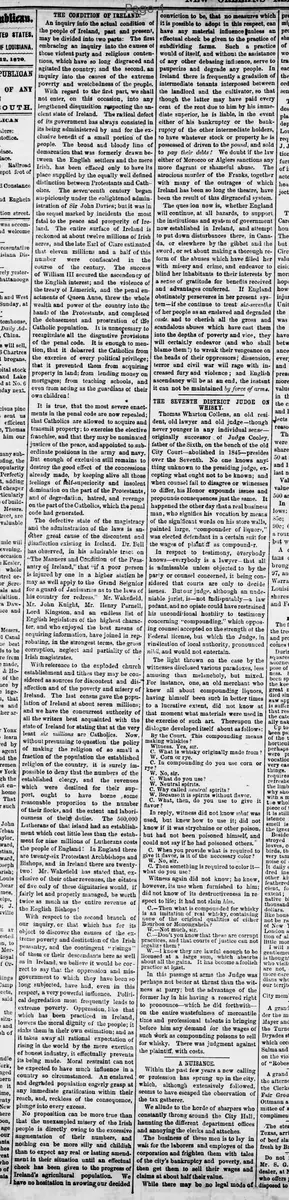
With regard to the first part, we shall not enter, on this occasion, into any lengthened disquisition respecting the ancient state of Ireland. The radical defect of its government has always consisted in its being administered by and for the exclusive benefit of a small portion of the people. The broad and bloody line of demarcation that was formerly drawn between the English settlers and the mere Irish, has been effaced only to have its place supplied by the equally well defined distinction between Protestants and Catholics.
The seventeenth century began auspiciously under the enlightened administration of Sir John Davies; but it was in the sequel marked by incidents the most fatal to the peace and prosperity of Ireland. The entire surface of Ireland is reckoned at about twelve millions of Irish acres, and the late Earl of Clare estimated that eleven millions and a half of this number were confiscated in the course of the century.
The success of William III secured the ascendency of the English interest; and the violence of the treaty of Limerick, and the penal enactments of Queen Anne, threw the whole wealth and power of the country into the hands of the Protestants, and completed the debasement and prostration of the Catholic population. It is unnecessary to recapitulate all the disgusting provisions of the penal code. It is enough to mention, that it debarred the Catholics from the exercise of every political privilege; that it prevented them from acquiring property in land; from lending money on mortgages; from teaching schools, and even from acting as the guardians of their own children!
It is true, that the most severe enactments in the penal code are now repealed; that Catholics are allowed to acquire and transmit property; to exercise the elective franchise, and that they may be nominated justices of the peace, and appointed to subordinate positions in the army and navy. But enough of exclusion still remains to destroy the good effect of the concessions already made, by keeping alive all those feelings of self-superiority and insolent domination on the part of the Protestants, and of degradation, hatred, and revenge on the part of the Catholics, which the penal code had generated.
The defective state of the magistracy and the administration of the laws is another great cause of the discontent and disaffection existing in Ireland. Dr. Bell has observed, in his admirable tract on "The Manners and Condition of the Peasantry of Ireland," that "if a poor person is injured by one in a higher station he may as well apply to the Grand Seignior for a guard of Janissaries as to the laws of his country for redress." Mr. Wakefield, Mr. John Knight, Mr. Henry Parnell, Lord Kingston, and an endless list of English legislators of the highest character, and who enjoyed the best means of acquiring information, have joined in reprobating, in the strongest terms, the gross corruption, neglect and partiality of the Irish magistrates.
With reference to the exploded church establishment and tithes they may be considered as sources for discontent and disaffection and of the poverty and misery of Ireland. The last census gave the population of Ireland at about seven millions; and we have the concurrent authority of all the writers best acquainted with the state of Ireland for stating that at the very least six millions are Catholics.
Now, without presuming to question the policy of making the religion of so small a fraction of the population the established religion of the country, it is surely impossible to deny that the numbers of the established clergy, and the revenues which were destined for their support, ought to have borne some reasonable proportion to the number of their flocks, and the extent and laboriousness of their duties. The 500,000 Lutherans of that island had an establishment which cost little less than the establishment for nine millions of Lutherans costs the people of England! In England there are twenty-six Protestant Archbishops and Bishops, and in Ireland there are twenty-two! Mr. Wakefield has stated that, exclusive of their other revenues, the estates of five only of these dignitaries would, if fairly let and properly managed, be worth twice as much as the entire revenue of the English Bishops!
With respect to the second branch of our inquiry, or that which has for its object to discover the causes of the extreme poverty and destitution of the Irish peasantry, and the contingent "risings of them or their descendants here as well as in Ireland, we believe it would be correct to say that the oppression and misgovernment to which they have been so long subjected, have had, even in this respect, a very powerful influence. Political degradation most frequently leads to extreme poverty. Oppression, like that which has been practiced in Ireland, lowers the moral dignity of the people; it sinks them in their own estimation; and as it takes away all rational expectation of rising in the world by the mere exertion of honest industry, it effectually prevents its being made. Moral restraint can not be expected to have much influence in a country so circumstanced. An enslaved and degraded population eagerly grasp at any immediate gratification within their reach, and, reckless of the consequence, plunge into every excess.
No proposition can be more true than that the unexampled misery of the Irish people is directly owing to the excessive augmentation of their numbers, and nothing can be more silly and childish than to expect any real or lasting amendment in their situation until an effectual check has been given to the progress of Ireland's agricultural population. We have no hesitation in avowing our decided conviction to be, that no measures which it is possible to adopt in this respect, can have any material influence unless an effectual check be given to the practice of subdividing farms. Such a practice would of itself, and without the assistance of any other debasing influence, serve to pauperize and degrade any people. In Ireland there is frequently a gradation of intermediate tenants interposed between the landlord and the cultivator, so that though the latter may have paid every cent of the rent due to him by his immediate superior, he is liable, in the event either of his bankruptcy or the bankruptcy of the other intermediate holders, to have whatever stock or property he is possessed of driven to the pound, and sold to pay their debts! We doubt if the law either of Morocco or Algiers sanctions any more flagrant or shameful abuse. The atrocious murder of the Franks, together with many of the outrages of which Ireland has been so long the theatre, have been the result of this disgraceful system.
The question now is, whether England will continue, at all hazards, to support the institutions and system of government now established in Ireland, and attempt to put down disturbances there, in Canada, or elsewhere by the gibbet and the sword, or set about making a thorough reform of the abuses which have filled her with misery and crime, and endeavor to bind her inhabitants to their interests by a sense of gratitude for benefits received and advantages conferred. If England obstinately perseveres in her present system—if she continue to treat six-sevenths of her people as an enslaved and degraded caste, and to cherish all the gross and scandalous abuses which have cast them into the depths of poverty and vice, they will certainly endeavor (and who shall blame them?) to wreak their vengeance on the heads of their oppressors; dissension, terror and civil war will rage with increased fury and violence; and English ascendancy will be at an end, the instant it can not be maintained by force of arms.
What sub-type of article is it?
What keywords are associated?
What entities or persons were involved?
Where did it happen?
Foreign News Details
Primary Location
Ireland
Key Persons
Outcome
eleven millions and a half irish acres confiscated in the seventeenth century; extreme poverty and wretchedness of the catholic population; potential for dissension, terror, and civil war if reforms not made.
Event Details
Inquiry into causes of violent party and religious contentions in Ireland, including historical administration for benefit of small portion, confiscations, treaty of Limerick, penal enactments debasing Catholics; defective magistracy and laws; exploded church establishment and tithes disproportionate to Protestant population; oppression leading to poverty through excessive population growth and farm subdivision, resulting in moral degradation and outrages.