Thank you for visiting SNEWPapers!
Sign up free
Editorial
January 11, 1788
The New York Journal, And Daily Patriotic Register
New York, New York County, New York
What is this article about?
Federalist No. 34 defends the Constitution's grant of internal taxation power to the national legislature, arguing it can be effectively exercised with knowledge from state representatives, without interfering with state revenues, and is preferable to requisitions for efficacy and uniformity.
Merged-components note: These components are continuations of The Federalist No. XXXIV, serialized across columns and pages, forming a single logical editorial essay.
Clippings
1 of 2
OCR Quality
95%
Excellent
Full Text
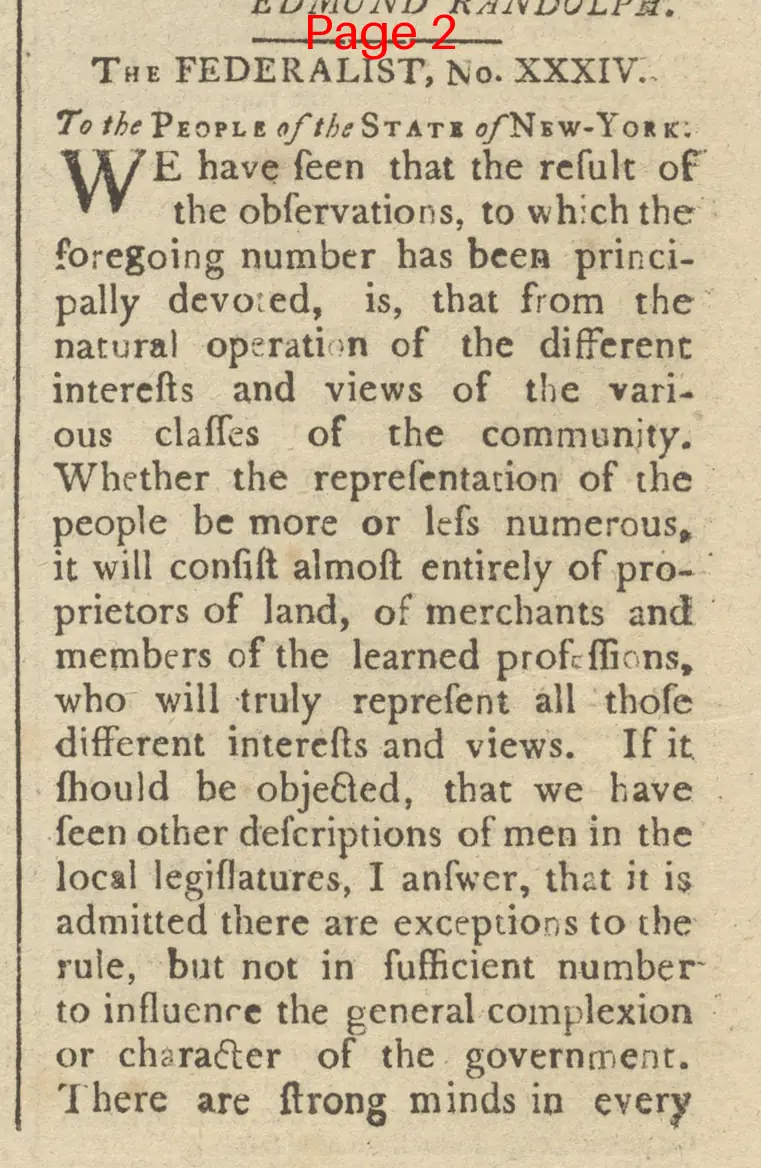
THE FEDERALIST, NO. XXXIV.
To the People of the State of New-York:
WE have seen that the result of the foregoing number has been principally devoted, is, that from the natural operation of the different interests and views of the various classes of the community.
Whether the representation of the people be more or less numerous, it will consist almost entirely of proprietors of land, of merchants and members of the learned professions, who will truly represent all those different interests and views. If it should be objected, that we have seen other descriptions of men in the local legislatures, I answer, that it is admitted there are exceptions to the rule, but not in sufficient number to influence the general complexion or character of the government.
There are strong minds in every walk of life, that will rise superior to the disadvantages of situation, and will command the tribute due to their merit. not only from the classes to which they particularly belong. but from the society in general. The door ought to be equally open to all : and I trust, for the credit of human nature, that we shall see examples of such vigor as plants flourishing in the soil of federal, as well as of state legislation : but occasional instances of this sort, will not render the rea- soning, founded upon the general course of things, less conclusive.
The subject might be placed in several other lights, that would lead all to the same result ; and in par- ticular. it might be asked, what great- er affinity or relation of interest can be conceived between the carpenter and black smith, and the linen manu- facturer or stocking weaver, than between the merchant and either of them ? It is notorious, that there are often as great rivalships between different branches of the mechanic or manufacturing arts, as there are between any of the departments of labor and industry; so that unless the representative body were to be far more numerous than would be consistent with any idea of regular ty or wisdom in its deliberations, it is impossible that what seems to be the spirit of the objection we have been considering, should ever be realized in practice. But I forbear to dwell any longer on a matter, which has hitherto worn too loose a garb to ad- mit even of an accurate inspection of its real shape or tendency.
There is another objection of a somewhat more precise nature, that claims our attention. It has been asserted that a power of internal tax- ation in the national leg islature could never be exercised with advantage, as well from the want of a sufficient knowledge of local circumstances, as from an interference between the revenue laws of the union, and of the particular states. The suppo- sition of a want of proper knowledge, seems to be entirely destitute of foun- dation. If any question is depend- ing in a state leg islature, respecting one of the counties which demands a knowledge of local details, how is it acquired ? No doubt from the information of the members of the county. Cannot the like knowledge be obtained in the national leg isla- ture from the representatives of each state ? And is it not to be pre- sumed that the men who will gene- rally be sent there, will be possessed of the necessary degree of intelligence to be able to communicate that in- formation ? Is the knowledge of lo- cal circumstances, as applied to tax- ation, a minute topographical ac- quaintance with all the mountains, rivers, streams, high-ways and bye- paths in each state, or is it a general acquaintance with its situation and resources-with. the state of its agri- culture, commerce, manufactures- with the nature of its products and consumptions-with the different degrees and kinds of its wealth, pro- perty and industry ?
Nations in general, even under governments of the more popular kind, usually commit the admin f. tration of their finances to single men, or to boards composed of a few individuals, who digest and pre- pare, in the first instance, the plans of taxation, which are afterwards passed into laws by the authority of the sovereign or legislature.
Inquisitive and enlightened state. men are deemed every where best qualified to make a judicious elec- tion of the objects proper for reve- nue ; which is a clear indication, as far as the sense of mankind can have weight in the question, of the species of knowledge of local circumstances requisite to the purposes of taxation.
The taxes intended to be compri- sed under the general denomination of internal taxes, may be subdivided into those of the direct and those of the indirect kind. Though the ob- jection be made to both, yet the reasoning upon it seems to be con- fined to the former branch. And indeed, as to the latter, by which must be understood duties and ex- cises on articles of consumption, one is at a loss to conceive what can be the nature of the difficulties ap- prehended. The knowledge re- lating to them, must evidently be of a kind that will either be sug- gested by the nature of the article itself, or can easily be procured from any well informed man, es- pecially of the mercantile class.- The circumstances that may distin- guish its situation in one state from its situation in another must be few. simple, and easy to be comprehend- ed, The principal thing to be at- tended to would be to avoid those articles which had been previously appropriated to the use of a parti- cular state; and there could be no difficulty in ascertaining the reve- nue system of each. This could al- ways be known from the respective codes of laws, as well as from the information of the members of the several states.
The objection when applied to real property, or to houses and lands, appears to have, at first sight, more foundation; but even in this view,it will not bear a close exa- mination. Land taxes are common- ly laid in'one of two modes, either by actual valuations permanent of periodical, or by occasional ass- essments, at the discretion or accord- ing to the best judgment of certain officers, whose duty it is to make them.--In either case the execution of the business, which alone requires the knowledge of local details, must be devolved upon discreet persons in the character of commission or assessors, elected by the people, or appointed by the government for the purpose. All that the law can do must be to name the persons or to prescribe the manner of their election or appointment, to fix their numbers and qualifications; and to draw the general outlines of their powers and duties. And what is there in all this, that cannot as well be performed by the national legislature as by a state legislature? The attention of either can only reach to generalprinciples; local details, as already observed, must be referred to those who are to exe- cute the plan.
But there is a simple point of view in which this matter may be placed, that must be altogether satisfactory. The national legislature can make use of the system of each state with- in that state. The method of lay- ing and collecting this species of taxes in each state, can, in all its parts, be adopted and employed by the federal government.
Let it be recollected. that the proportion of these taxes is not to be left to the discretion of the na- tional legislature; but is to be de- termined by the numbers of each state, as described in the second sec- tion of the first article. An actual census or enumeration of the peo- ple must furnish the rule; a cir- cumstance which effectually shuts the door to partiality or oppression.
The abuse of this power of taxation seems to have been provided against with guarded circumspection. In addition to the precaution just men- tioned, there is a provision that " all duties, imposts, and excises, shall be uniform throughout the United States."
It has been very properly obser- ved by different speakers and writers on the side of the constitution, that if the exercise of the power of inter- nal taxation by the Union, Should be discovered on experiment, to be really inconvenient, the federal go- vernment may then forbear the use of it, and have recourse to requisi- tions in its stead. By way of answer to this, it has been triumphantly asked, why not in the first instance omit that ambiguous power, and rely upon the latter resources? Two solid answers may be given; the first is, that the exercise of that pow- er, if convenient, will be preferable, because it will be more effectual ; and it is impossible to prove in theory or otherwise than by the experiment that it cannotbe advantageously exercised. The contrary indeed ap- pears most probable. The second answer is, that the existence of such a power in the constitution will have a strong influence in giving efficacy to requisitions. When the states know that the Union can supply itself without their agency, it will be a powerful motive for exertion on their part.
To be continued.
To the People of the State of New-York:
WE have seen that the result of the foregoing number has been principally devoted, is, that from the natural operation of the different interests and views of the various classes of the community.
Whether the representation of the people be more or less numerous, it will consist almost entirely of proprietors of land, of merchants and members of the learned professions, who will truly represent all those different interests and views. If it should be objected, that we have seen other descriptions of men in the local legislatures, I answer, that it is admitted there are exceptions to the rule, but not in sufficient number to influence the general complexion or character of the government.
There are strong minds in every walk of life, that will rise superior to the disadvantages of situation, and will command the tribute due to their merit. not only from the classes to which they particularly belong. but from the society in general. The door ought to be equally open to all : and I trust, for the credit of human nature, that we shall see examples of such vigor as plants flourishing in the soil of federal, as well as of state legislation : but occasional instances of this sort, will not render the rea- soning, founded upon the general course of things, less conclusive.
The subject might be placed in several other lights, that would lead all to the same result ; and in par- ticular. it might be asked, what great- er affinity or relation of interest can be conceived between the carpenter and black smith, and the linen manu- facturer or stocking weaver, than between the merchant and either of them ? It is notorious, that there are often as great rivalships between different branches of the mechanic or manufacturing arts, as there are between any of the departments of labor and industry; so that unless the representative body were to be far more numerous than would be consistent with any idea of regular ty or wisdom in its deliberations, it is impossible that what seems to be the spirit of the objection we have been considering, should ever be realized in practice. But I forbear to dwell any longer on a matter, which has hitherto worn too loose a garb to ad- mit even of an accurate inspection of its real shape or tendency.
There is another objection of a somewhat more precise nature, that claims our attention. It has been asserted that a power of internal tax- ation in the national leg islature could never be exercised with advantage, as well from the want of a sufficient knowledge of local circumstances, as from an interference between the revenue laws of the union, and of the particular states. The suppo- sition of a want of proper knowledge, seems to be entirely destitute of foun- dation. If any question is depend- ing in a state leg islature, respecting one of the counties which demands a knowledge of local details, how is it acquired ? No doubt from the information of the members of the county. Cannot the like knowledge be obtained in the national leg isla- ture from the representatives of each state ? And is it not to be pre- sumed that the men who will gene- rally be sent there, will be possessed of the necessary degree of intelligence to be able to communicate that in- formation ? Is the knowledge of lo- cal circumstances, as applied to tax- ation, a minute topographical ac- quaintance with all the mountains, rivers, streams, high-ways and bye- paths in each state, or is it a general acquaintance with its situation and resources-with. the state of its agri- culture, commerce, manufactures- with the nature of its products and consumptions-with the different degrees and kinds of its wealth, pro- perty and industry ?
Nations in general, even under governments of the more popular kind, usually commit the admin f. tration of their finances to single men, or to boards composed of a few individuals, who digest and pre- pare, in the first instance, the plans of taxation, which are afterwards passed into laws by the authority of the sovereign or legislature.
Inquisitive and enlightened state. men are deemed every where best qualified to make a judicious elec- tion of the objects proper for reve- nue ; which is a clear indication, as far as the sense of mankind can have weight in the question, of the species of knowledge of local circumstances requisite to the purposes of taxation.
The taxes intended to be compri- sed under the general denomination of internal taxes, may be subdivided into those of the direct and those of the indirect kind. Though the ob- jection be made to both, yet the reasoning upon it seems to be con- fined to the former branch. And indeed, as to the latter, by which must be understood duties and ex- cises on articles of consumption, one is at a loss to conceive what can be the nature of the difficulties ap- prehended. The knowledge re- lating to them, must evidently be of a kind that will either be sug- gested by the nature of the article itself, or can easily be procured from any well informed man, es- pecially of the mercantile class.- The circumstances that may distin- guish its situation in one state from its situation in another must be few. simple, and easy to be comprehend- ed, The principal thing to be at- tended to would be to avoid those articles which had been previously appropriated to the use of a parti- cular state; and there could be no difficulty in ascertaining the reve- nue system of each. This could al- ways be known from the respective codes of laws, as well as from the information of the members of the several states.
The objection when applied to real property, or to houses and lands, appears to have, at first sight, more foundation; but even in this view,it will not bear a close exa- mination. Land taxes are common- ly laid in'one of two modes, either by actual valuations permanent of periodical, or by occasional ass- essments, at the discretion or accord- ing to the best judgment of certain officers, whose duty it is to make them.--In either case the execution of the business, which alone requires the knowledge of local details, must be devolved upon discreet persons in the character of commission or assessors, elected by the people, or appointed by the government for the purpose. All that the law can do must be to name the persons or to prescribe the manner of their election or appointment, to fix their numbers and qualifications; and to draw the general outlines of their powers and duties. And what is there in all this, that cannot as well be performed by the national legislature as by a state legislature? The attention of either can only reach to generalprinciples; local details, as already observed, must be referred to those who are to exe- cute the plan.
But there is a simple point of view in which this matter may be placed, that must be altogether satisfactory. The national legislature can make use of the system of each state with- in that state. The method of lay- ing and collecting this species of taxes in each state, can, in all its parts, be adopted and employed by the federal government.
Let it be recollected. that the proportion of these taxes is not to be left to the discretion of the na- tional legislature; but is to be de- termined by the numbers of each state, as described in the second sec- tion of the first article. An actual census or enumeration of the peo- ple must furnish the rule; a cir- cumstance which effectually shuts the door to partiality or oppression.
The abuse of this power of taxation seems to have been provided against with guarded circumspection. In addition to the precaution just men- tioned, there is a provision that " all duties, imposts, and excises, shall be uniform throughout the United States."
It has been very properly obser- ved by different speakers and writers on the side of the constitution, that if the exercise of the power of inter- nal taxation by the Union, Should be discovered on experiment, to be really inconvenient, the federal go- vernment may then forbear the use of it, and have recourse to requisi- tions in its stead. By way of answer to this, it has been triumphantly asked, why not in the first instance omit that ambiguous power, and rely upon the latter resources? Two solid answers may be given; the first is, that the exercise of that pow- er, if convenient, will be preferable, because it will be more effectual ; and it is impossible to prove in theory or otherwise than by the experiment that it cannotbe advantageously exercised. The contrary indeed ap- pears most probable. The second answer is, that the existence of such a power in the constitution will have a strong influence in giving efficacy to requisitions. When the states know that the Union can supply itself without their agency, it will be a powerful motive for exertion on their part.
To be continued.
What sub-type of article is it?
Constitutional
Taxation
Economic Policy
What keywords are associated?
Federal Taxation
Internal Taxes
Constitutional Power
Local Knowledge
State Representation
Revenue Laws
Uniformity
Requisitions
What entities or persons were involved?
National Legislature
State Legislatures
Union
States
Editorial Details
Primary Topic
Defense Of Federal Internal Taxation Power
Stance / Tone
Supportive Of Constitutional Taxation Provisions
Key Figures
National Legislature
State Legislatures
Union
States
Key Arguments
Representation In National Legislature Will Adequately Reflect Diverse Interests Despite Class Composition.
Knowledge Of Local Circumstances For Taxation Can Be Obtained From State Representatives.
Indirect Taxes On Consumption Are Straightforward And Easily Informed.
Direct Taxes On Property Can Use State Systems Or Local Assessors Without Needing Detailed National Knowledge.
Tax Proportions Are Determined By Population Census To Prevent Partiality.
Uniformity Clause Ensures Fairness In Duties And Excises.
Federal Taxation Power Enhances Efficacy Of Requisitions If Needed.