Thank you for visiting SNEWPapers!
Sign up free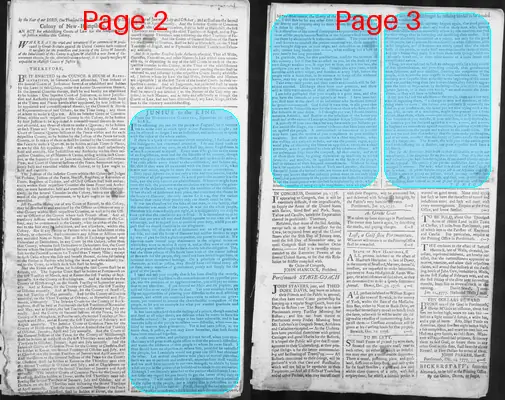
Editorial
February 4, 1777
The Freeman's Journal, Or, New Hampshire Gazette
Portsmouth, Rockingham County, New Hampshire
What is this article about?
In a letter to King George III, Junius criticizes the monarch's ministers for provoking the American war and infringing constitutional liberties, urging dismissal of the corrupt advisors to avert national ruin and restore mutual trust between king and people.
Merged-components note: Continuation of the Junius letter to the King across pages 2 and 3, same topic and flow.
Clippings
1 of 2
OCR Quality
95%
Excellent
Full Text
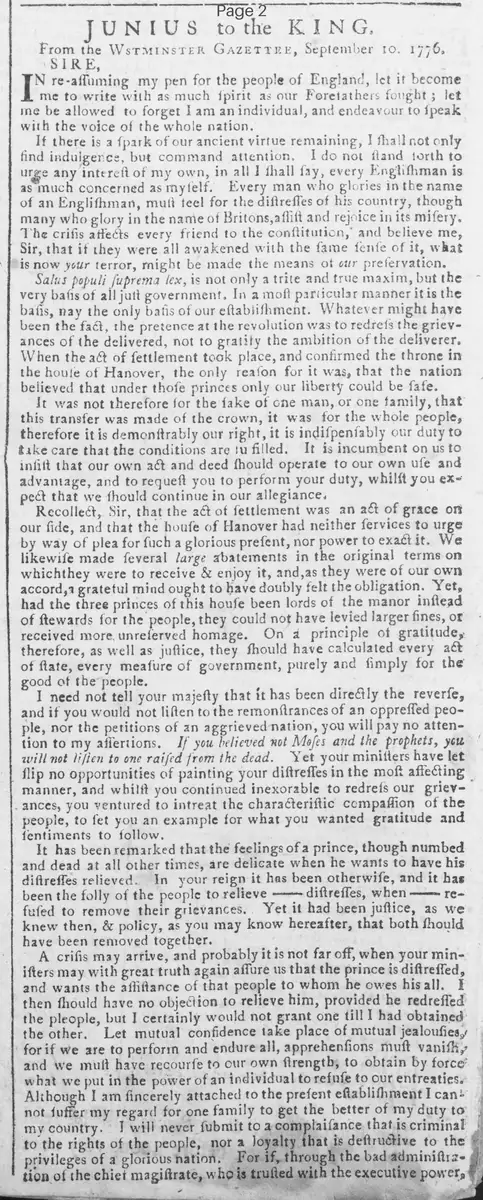
JUNIUS to the KING.
From the WESTMINSTER GAZETTE, September 10. 1776,
SIRE,
IN re-assuming my pen for the people of England, let it become me to write with as much spirit as our Forefathers fought; let me be allowed to forget I am an individual, and endeavour to speak with the voice of the whole nation.
If there is a spark of our ancient virtue remaining, I shall not only find indulgence, but command attention. I do not stand forth to urge any interest of my own, in all I shall say, every Englishman is as much concerned as myself. Every man who glories in the name of an Englishman, must feel for the distresses of his country, though many who glory in the name of Britons, assist and rejoice in its misery.
The crisis affects every friend to the constitution, and believe me, Sir, that if they were all awakened with the same sense of it, what is now your terror, might be made the means of our preservation.
Salus populi suprema lex, is not only a trite and true maxim, but the very basis of all just government. In a most particular manner it is the basis, nay the only basis of our establishment. Whatever might have been the fact, the pretence at the revolution was to redress the grievances of the delivered, not to gratify the ambition of the deliverer.
When the act of settlement took place, and confirmed the throne in the house of Hanover, the only reason for it was, that the nation believed that under those princes only our liberty could be safe.
It was not therefore for the sake of one man, or one family, that this transfer was made of the crown, it was for the whole people, therefore it is demonstrably our right, it is indispensably our duty to take care that the conditions are fulfilled. It is incumbent on us to insist that our own act and deed should operate to our own use and advantage, and to request you to perform your duty, whilst you expect that we should continue in our allegiance.
Recollect, Sir, that the act of settlement was an act of grace on our side, and that the house of Hanover had neither services to urge by way of plea for such a glorious present, nor power to exact it. We likewise made several large abatements in the original terms on which they were to receive & enjoy it, and, as they were of our own accord, a grateful mind ought to have doubly felt the obligation. Yet, had the three princes of this house been lords of the manor instead of stewards for the people, they could not have levied larger fines, or received more, unreserved homage. On a principle of gratitude, therefore, as well as justice, they should have calculated every act of state, every measure of government, purely and simply for the good of the people.
I need not tell your majesty that it has been directly the reverse, and if you would not listen to the remonstrances of an oppressed people, nor the petitions of an aggrieved nation, you will pay no attention to my assertions. If you believed not Moses and the prophets, you will not listen to one raised from the dead. Yet your ministers have let slip no opportunities of painting your distresses in the most affecting manner, and whilst you continued inexorable to redress our grievances, you ventured to intreat the characteristic compassion of the people, to set you an example for what you wanted gratitude and sentiments to follow.
It has been remarked that the feelings of a prince, though numbed and dead at all other times, are delicate when he wants to have his distresses relieved. In your reign it has been otherwise, and it has been the folly of the people to relieve your distresses, when you refused to remove their grievances. Yet it had been justice, as we knew then, & policy, as you may know hereafter, that both should have been removed together.
A crisis may arrive, and probably it is not far off, when your ministers may with great truth again assure us that the prince is distressed, and wants the assistance of that people to whom he owes his all. I then should have no objection to relieve him, provided he redressed the people, but I certainly would not grant one till I had obtained the other. Let mutual confidence take place of mutual jealousies for if we are to perform and endure all, apprehensions must vanish and we must have recourse to our own strength, to obtain by force what we put in the power of an individual to refuse to our entreaties.
Although I am sincerely attached to the present establishment I cannot suffer my regard for one family to get the better of my duty to my country. I will never submit to a compliance that is criminal to the rights of the people, nor a loyalty that is destructive to the privileges of a glorious nation. For if, through the bad administration of the chief magistrate, who is trusted with the executive power, by any other means, the liberty of the people shall become precarious, I will then be for any other form of government under which their liberty and property may be more secure, though till then I do not desire to change.
It is therefore of the utmost consequence to your majesty to reflect, before all the people become sensible of the injuries which have been done them by abominable & traitorous ministers. That junto which is well known to conduct the present unnatural war, those men who have brought disgrace on your reign, and destruction on your subjects, cannot long hinder your -
, what nothing but a love of your family has long prevented.
In gratitude, then, for this predilection, consider the situation of this country; but if that has no effect on you, let the sense of your own danger awaken you, & urge you to shun, ere it is too late, the precipice you are on the brink of. Dismiss this aspen junto, which trembles with every whisper, and shudders at every blast, before the people raise a storm that, in its violence to shake off the withered leaves, may tear up the tree that made them bud.
Take away their power, and their credit and counsels will be faded and exposed. Discharge them from your presence, and there will as little trace remain of their abilities as their virtue.
I am fully persuaded that your majesty is a good man, and that you have the interests of your subjects at heart. I have been told you shed tears at the death of an individual who sacrificed himself to
grant--request. God forbid it were true, or else grant that you are not so susceptible now for the lives of those who have crossed the Atlantic at your desire. If I thought you was, I should dread to mention America, and shudder at the reflection of the horror you must feel at the names of Lexington, Bunker hill, or Sullivan's-island.
A jealousy of your own character may have made you hitherto passive amidst the illegal, the criminal violences that have been carried on against the people. A consciousness of innocence in yourself may have been the motive of your compliance to your minister's measures. But these are no excuses for a chief magistrate,
when the welfare of a nation is at stake, nor can the puerile, vague, equivocal plea of throwing the blame on opposition, exculpate a chief governor, who is permitted to choose all his subaltern officers. All our unfortunate kings since the conquest, lost their crowns, and most of them their lives, by giving themselves up implicitly to wicked favourites and ministers, in opposition to the sense of the people, and in defiance of their frequent remonstrances. Without looking back for centuries to the houses of York and Lancaster, the circumstances of James the second's case, are recent and striking examples.
Every one knows that that unhappy prince went on not only obstinately, but precipitately in the prosecution of his destructive schemes. What the consequence was, can best be explained by those, who, by solemn promises of being upright magistrates, were adopted in the
place of him we had discharged for suffering himself to be deluded by his ministers.
It has often happened, and may happen again, that good princes as well as bad, have put their only trust in those men, who, having first rendered themselves universally odious by vile measures, can find no other refuge than in betraying and sacrificing their master. It is therefore absolutely incumbent on a prince, not only for the good of his people, but to prevent his own dismission when dissensions arise in his kingdom, and ill humours are visibly spread thro' the whole body of the people, to make strict enquiries into the causes of them, and see whether they really flow from those little springs which occasionally break out, or from other sources of a more latent and complicated nature.
Things are now reduced to such an unhappy crisis, by a long course of mal-administration, and provoking conduct, that government seem desperate; and your ministers, dreading the vengeance of the people, wish to involve your majesty in their inevitable ruin. Their timidity now surpasses their absurdity in the beginning of this unnatural war, and knowing their fate is unavoidable, they strive to aggregate the mass of desperadoes by declaring Una salus miseris nullam sperare salutem, or in their own words, " we must murder the Americans, or they will have us beheaded."
After you had lost the affections of the people, there were but two ways of regaining them, " a change of men and measures, or subduing them by force ;" the former you positively & repeatedly refused to your constituents, the latter you are now trying with a nation, who, in case of a revolution, might have granted you a surer asylum, than those, whose you occupy, found at St. Germains.
The situation of your majesty, & your ministers, is truly deplorable. In America you are declared against as a tyrant, and a
a , and a
In England we remonstrate against measures, & petition against ministers as enemies to the people and traitors to the constitution. We are not yet sunk into that lethargy that the junto make you imagine, and if we were, recollect that the frenzy of James awoke the nation out of a deeper one. The honest, the wise part of this nation grow tired with suffering for a shadow, our great appetites must have a substance.
How far the Americans spoke truth in their declaration, or we in our remonstrances, is too dangerous for my pen to decide. True it is that our most valuable rights have been infringed on, & our dearest liberties attacked and destroyed. The enemies of our glorious constitution have been encouraged by
But hold ! what is to defend and protect me if I say by whom.
As yet the habeas corpus act is not suspended and till it is I will venture to put up one petition, which is-may confusion cover those, who, by his obstinacy and folly, and those, who, by their violence and treachery, have reduced us to our present disgraceful and ruinous situation.
JUNIUS.
From the WESTMINSTER GAZETTE, September 10. 1776,
SIRE,
IN re-assuming my pen for the people of England, let it become me to write with as much spirit as our Forefathers fought; let me be allowed to forget I am an individual, and endeavour to speak with the voice of the whole nation.
If there is a spark of our ancient virtue remaining, I shall not only find indulgence, but command attention. I do not stand forth to urge any interest of my own, in all I shall say, every Englishman is as much concerned as myself. Every man who glories in the name of an Englishman, must feel for the distresses of his country, though many who glory in the name of Britons, assist and rejoice in its misery.
The crisis affects every friend to the constitution, and believe me, Sir, that if they were all awakened with the same sense of it, what is now your terror, might be made the means of our preservation.
Salus populi suprema lex, is not only a trite and true maxim, but the very basis of all just government. In a most particular manner it is the basis, nay the only basis of our establishment. Whatever might have been the fact, the pretence at the revolution was to redress the grievances of the delivered, not to gratify the ambition of the deliverer.
When the act of settlement took place, and confirmed the throne in the house of Hanover, the only reason for it was, that the nation believed that under those princes only our liberty could be safe.
It was not therefore for the sake of one man, or one family, that this transfer was made of the crown, it was for the whole people, therefore it is demonstrably our right, it is indispensably our duty to take care that the conditions are fulfilled. It is incumbent on us to insist that our own act and deed should operate to our own use and advantage, and to request you to perform your duty, whilst you expect that we should continue in our allegiance.
Recollect, Sir, that the act of settlement was an act of grace on our side, and that the house of Hanover had neither services to urge by way of plea for such a glorious present, nor power to exact it. We likewise made several large abatements in the original terms on which they were to receive & enjoy it, and, as they were of our own accord, a grateful mind ought to have doubly felt the obligation. Yet, had the three princes of this house been lords of the manor instead of stewards for the people, they could not have levied larger fines, or received more, unreserved homage. On a principle of gratitude, therefore, as well as justice, they should have calculated every act of state, every measure of government, purely and simply for the good of the people.
I need not tell your majesty that it has been directly the reverse, and if you would not listen to the remonstrances of an oppressed people, nor the petitions of an aggrieved nation, you will pay no attention to my assertions. If you believed not Moses and the prophets, you will not listen to one raised from the dead. Yet your ministers have let slip no opportunities of painting your distresses in the most affecting manner, and whilst you continued inexorable to redress our grievances, you ventured to intreat the characteristic compassion of the people, to set you an example for what you wanted gratitude and sentiments to follow.
It has been remarked that the feelings of a prince, though numbed and dead at all other times, are delicate when he wants to have his distresses relieved. In your reign it has been otherwise, and it has been the folly of the people to relieve your distresses, when you refused to remove their grievances. Yet it had been justice, as we knew then, & policy, as you may know hereafter, that both should have been removed together.
A crisis may arrive, and probably it is not far off, when your ministers may with great truth again assure us that the prince is distressed, and wants the assistance of that people to whom he owes his all. I then should have no objection to relieve him, provided he redressed the people, but I certainly would not grant one till I had obtained the other. Let mutual confidence take place of mutual jealousies for if we are to perform and endure all, apprehensions must vanish and we must have recourse to our own strength, to obtain by force what we put in the power of an individual to refuse to our entreaties.
Although I am sincerely attached to the present establishment I cannot suffer my regard for one family to get the better of my duty to my country. I will never submit to a compliance that is criminal to the rights of the people, nor a loyalty that is destructive to the privileges of a glorious nation. For if, through the bad administration of the chief magistrate, who is trusted with the executive power, by any other means, the liberty of the people shall become precarious, I will then be for any other form of government under which their liberty and property may be more secure, though till then I do not desire to change.
It is therefore of the utmost consequence to your majesty to reflect, before all the people become sensible of the injuries which have been done them by abominable & traitorous ministers. That junto which is well known to conduct the present unnatural war, those men who have brought disgrace on your reign, and destruction on your subjects, cannot long hinder your -
, what nothing but a love of your family has long prevented.
In gratitude, then, for this predilection, consider the situation of this country; but if that has no effect on you, let the sense of your own danger awaken you, & urge you to shun, ere it is too late, the precipice you are on the brink of. Dismiss this aspen junto, which trembles with every whisper, and shudders at every blast, before the people raise a storm that, in its violence to shake off the withered leaves, may tear up the tree that made them bud.
Take away their power, and their credit and counsels will be faded and exposed. Discharge them from your presence, and there will as little trace remain of their abilities as their virtue.
I am fully persuaded that your majesty is a good man, and that you have the interests of your subjects at heart. I have been told you shed tears at the death of an individual who sacrificed himself to
grant--request. God forbid it were true, or else grant that you are not so susceptible now for the lives of those who have crossed the Atlantic at your desire. If I thought you was, I should dread to mention America, and shudder at the reflection of the horror you must feel at the names of Lexington, Bunker hill, or Sullivan's-island.
A jealousy of your own character may have made you hitherto passive amidst the illegal, the criminal violences that have been carried on against the people. A consciousness of innocence in yourself may have been the motive of your compliance to your minister's measures. But these are no excuses for a chief magistrate,
when the welfare of a nation is at stake, nor can the puerile, vague, equivocal plea of throwing the blame on opposition, exculpate a chief governor, who is permitted to choose all his subaltern officers. All our unfortunate kings since the conquest, lost their crowns, and most of them their lives, by giving themselves up implicitly to wicked favourites and ministers, in opposition to the sense of the people, and in defiance of their frequent remonstrances. Without looking back for centuries to the houses of York and Lancaster, the circumstances of James the second's case, are recent and striking examples.
Every one knows that that unhappy prince went on not only obstinately, but precipitately in the prosecution of his destructive schemes. What the consequence was, can best be explained by those, who, by solemn promises of being upright magistrates, were adopted in the
place of him we had discharged for suffering himself to be deluded by his ministers.
It has often happened, and may happen again, that good princes as well as bad, have put their only trust in those men, who, having first rendered themselves universally odious by vile measures, can find no other refuge than in betraying and sacrificing their master. It is therefore absolutely incumbent on a prince, not only for the good of his people, but to prevent his own dismission when dissensions arise in his kingdom, and ill humours are visibly spread thro' the whole body of the people, to make strict enquiries into the causes of them, and see whether they really flow from those little springs which occasionally break out, or from other sources of a more latent and complicated nature.
Things are now reduced to such an unhappy crisis, by a long course of mal-administration, and provoking conduct, that government seem desperate; and your ministers, dreading the vengeance of the people, wish to involve your majesty in their inevitable ruin. Their timidity now surpasses their absurdity in the beginning of this unnatural war, and knowing their fate is unavoidable, they strive to aggregate the mass of desperadoes by declaring Una salus miseris nullam sperare salutem, or in their own words, " we must murder the Americans, or they will have us beheaded."
After you had lost the affections of the people, there were but two ways of regaining them, " a change of men and measures, or subduing them by force ;" the former you positively & repeatedly refused to your constituents, the latter you are now trying with a nation, who, in case of a revolution, might have granted you a surer asylum, than those, whose you occupy, found at St. Germains.
The situation of your majesty, & your ministers, is truly deplorable. In America you are declared against as a tyrant, and a
a , and a
In England we remonstrate against measures, & petition against ministers as enemies to the people and traitors to the constitution. We are not yet sunk into that lethargy that the junto make you imagine, and if we were, recollect that the frenzy of James awoke the nation out of a deeper one. The honest, the wise part of this nation grow tired with suffering for a shadow, our great appetites must have a substance.
How far the Americans spoke truth in their declaration, or we in our remonstrances, is too dangerous for my pen to decide. True it is that our most valuable rights have been infringed on, & our dearest liberties attacked and destroyed. The enemies of our glorious constitution have been encouraged by
But hold ! what is to defend and protect me if I say by whom.
As yet the habeas corpus act is not suspended and till it is I will venture to put up one petition, which is-may confusion cover those, who, by his obstinacy and folly, and those, who, by their violence and treachery, have reduced us to our present disgraceful and ruinous situation.
JUNIUS.
What sub-type of article is it?
Constitutional
War Or Peace
Foreign Affairs
What keywords are associated?
Junius Letter
King George Iii
American War
Constitutional Liberties
Corrupt Ministers
Act Of Settlement
Unnatural War
Habeas Corpus
What entities or persons were involved?
King George Iii
House Of Hanover
Ministers
Junto
Americans
James Ii
Editorial Details
Primary Topic
Critique Of The King's Ministers And Policy In The American War
Stance / Tone
Strongly Critical And Admonitory, Urging Reform And Dismissal Of Corrupt Advisors
Key Figures
King George Iii
House Of Hanover
Ministers
Junto
Americans
James Ii
Key Arguments
The Act Of Settlement Obligates The Monarch To Protect The People's Liberty As Stewards, Not Lords.
Current Administration Reverses This By Acting Against The People's Good Out Of Ingratitude.
The King Must Dismiss Traitorous Ministers Conducting The Unnatural American War To Avoid Ruin.
Historical Examples Like James Ii Show Kings Lose Power By Trusting Wicked Advisors Against The People.
Mutual Confidence Requires Redressing Grievances Before Granting Aid; Force May Be Needed Otherwise.
The King's Passive Compliance With Illegal Measures Excuses Nothing When National Welfare Is At Stake.
Americans And English Both Suffer From Tyrannical Policies Infringing Rights And Liberties.
Government Is Desperate; Ministers Seek To Drag The King Into Their Ruin By Escalating The War.
Refusal To Change Men And Measures Has Lost The People's Affections, Risking Revolution.
Habeas Corpus Remains; Petition For Confusion On The Obstinate King And Treacherous Ministers.