Thank you for visiting SNEWPapers!
Sign up free
Rocky Mountain Husbandman
Great Falls, Diamond City, White Sulphur Springs, Cascade County, Broadwater County, Meagher County, Montana
What is this article about?
Scientific article explaining how the human body consumes energy through labor and requires food to replenish it, including calculations on daily food use (about 8 pounds) and energy output (equivalent to raising 340 tons one foot high), reprinted from Scientific American. Ends with a humorous anecdote about a lady eating eight hot rolls.
Clipping
OCR Quality
Full Text
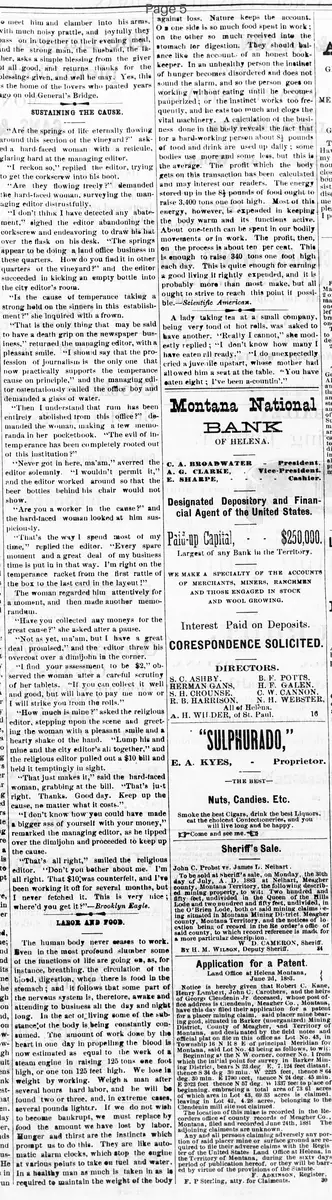
The human body never ceases to work. Even in the most profound slumber some of the functions of life are going on, as, for instance, breathing, the circulation of the blood, digestion when there is food in the stomach; and it follows that some part of the nervous system is, therefore, awake and attending to business all the day and night long. In the act of living some of the substance of the body is being constantly consumed. The amount of work done by the heart in one day in propelling the blood is now estimated as equal to the work of a steam engine in raising 125 tons one foot high, or one ton 125 feet high. We lose in weight by working. Weigh a man after several hours hard labor, and he will be found two or three, and, in extreme cases, several pounds lighter. If we do not wish to become bankrupt, we must replace by food the amount we have lost by labor. Hunger and thirst are the instincts which prompt us to do this. They are like automatic alarm clocks, which stop the engine at various points to take on fuel and water. In a healthy man as much is taken in as is required to maintain the weight of the body against loss. Nature keeps the account. On one side is so much food spent in work; on the other so much received into the stomach for digestion. They should balance like the accounts of an honest bookkeeper. In an unhealthy person the instinct of hunger becomes disordered and does not sound the alarm, and so the person goes on working without eating until he becomes pauperized; or the instinct works too frequently, and he eats too much and clogs the vital machinery. A calculation of the business done in the body reveals the fact that for a hard-working person about 8 pounds of food and drink are used up daily; some bodies use more and some less, but this is the average.
The profit which the body gets on this transaction has been calculated and may interest our readers. The energy stored up in the 8 pounds of food ought to raise 3,400 tons one foot high. Most of this energy, however, is expended in keeping the body warm and its functions active. About one-tenth can be spent in our bodily movements or in work. The profit, then, on the process is about ten per cent. This is enough to raise 340 tons one foot high each day. This is quite enough for earning a good living if rightly expended, and it is probably more than most make, but all ought to strive to reach this point if possible.—Scientific American.
A lady taking tea at a small company, being very fond of hot rolls, was asked to have another. "Really I cannot," she modestly replied; "I don't know how many I have eaten already." "I do," unexpectedly cried a juvenile upstart, whose mother had allowed him a seat at the table. "You have eaten eight; I've been a-counting."
What sub-type of article is it?
What keywords are associated?
Domestic News Details
Event Details
Explanation of the body's continuous work, energy consumption through labor, weight loss, role of hunger in replenishing via food, daily average of 8 pounds food/drink used, energy calculations showing 10% profit for work equivalent to raising 340 tons one foot high, sourced from Scientific American, plus anecdote of lady eating eight rolls.