Thank you for visiting SNEWPapers!
Sign up free
The Somerset Herald
Somerset, Somerset County, Pennsylvania
What is this article about?
Iowa's Centennial exhibit displays deep soil samples in glass cylinders from each county, showcasing rich black prairie soil. While attractive to western settlers, the article cautions that depth alone won't sustain crops long-term without manuring, referencing Ohio's depleted lands and preferring shallow plowing for prairies.
Clipping
OCR Quality
Full Text
Deep Soil.
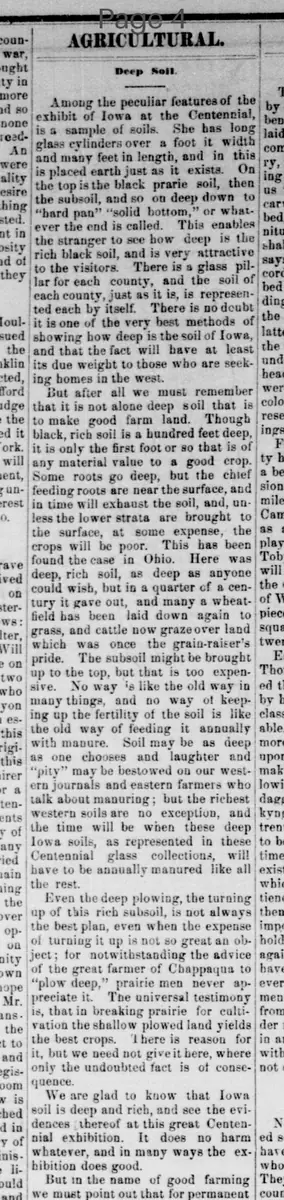
Among the peculiar features of the exhibit of Iowa at the Centennial, is a sample of soils. She has long glass cylinders over a foot in width and many feet in length, and in this is placed earth just as it exists. On the top is the black prairie soil, then the subsoil, and so on deep down to "hard pan" "solid bottom," or whatever the end is called. This enables the stranger to see how deep is the rich black soil, and is very attractive to the visitors. There is a glass pillar for each county, and the soil of each county, just as it is, is represented each by itself. There is no doubt it is one of the very best methods of showing how deep is the soil of Iowa, and that the fact will have at least its due weight to those who are seeking homes in the west. But after all we must remember that it is not alone deep soil that is to make good farm land. Though black, rich soil is a hundred feet deep, it is only the first foot or so that is of any material value to a good crop. Some roots go deep, but the chief feeding roots are near the surface, and in time will exhaust the soil, and, unless the lower strata are brought to the surface, at some expense, the crops will be poor. This has been found the case in Ohio. Here was deep, rich soil, as deep as anyone could wish, but in a quarter of a century it gave out, and many a wheat-field has been laid down again to grass, and cattle now graze over land which was once the grain-raiser's pride. The subsoil might be brought up to the top, but that is too expensive. No way is like the old way in many things, and no way of keeping up the fertility of the soil is like the old way of feeding it annually with manure. Soil may be as deep as one chooses and laughter and "pity" may be bestowed on our western journals and eastern farmers who talk about manuring; but the richest western soils are no exception, and the time will be when these deep Iowa soils, as represented in these Centennial glass collections, will have to be annually manured like all the rest. Even the deep plowing, the turning up of this rich subsoil, is not always the best plan, even when the expense of turning it up is not so great an object; for notwithstanding the advice of the great farmer of Chappaqua to "plow deep," prairie men never appreciate it. The universal testimony is, that in breaking prairie for cultivation the shallow plowed land yields the best crops. There is reason for it, but we need not give it here, where only the undoubted fact is of consequence.
We are glad to know that Iowa soil is deep and rich, and see the evidences thereof at this great Centennial exhibition. It does no harm whatever, and in many ways the exhibition does good. But in the name of good farming we must point out that for permanent and genuine agricultural it is of little account. The English have no virgin soil, no black deep bottoms to their land, but by judicious and cheap management, it yields to-day crops of which the black lands of Iowa might be proud.
What sub-type of article is it?
What themes does it cover?
What keywords are associated?
Where did it happen?
Story Details
Location
Centennial Exhibition, Iowa
Event Date
Centennial
Story Details
Iowa's exhibit at the Centennial features glass cylinders showing deep soil layers from each county, highlighting rich black prairie soil down to hard pan. The article praises the display for attracting settlers but warns that deep soil alone does not ensure long-term fertility, citing Ohio's exhaustion of rich lands and advocating annual manuring over deep plowing for sustainable farming.