Thank you for visiting SNEWPapers!
Sign up free
Editorial
July 24, 1807
The National Intelligencer And Washington Advertiser
Washington, District Of Columbia
What is this article about?
The Aurora editorial concludes its critique of Erick Bollman's letter defending Aaron Burr, portraying Bollman as duplicitous and treacherous for betraying Burr after turning state's evidence. It defends General Wilkinson and President Jefferson against Bollman's accusations, highlighting Wilkinson's role in thwarting the conspiracy and Jefferson's merciful pardon of Bollman.
Clipping
OCR Quality
95%
Excellent
Full Text
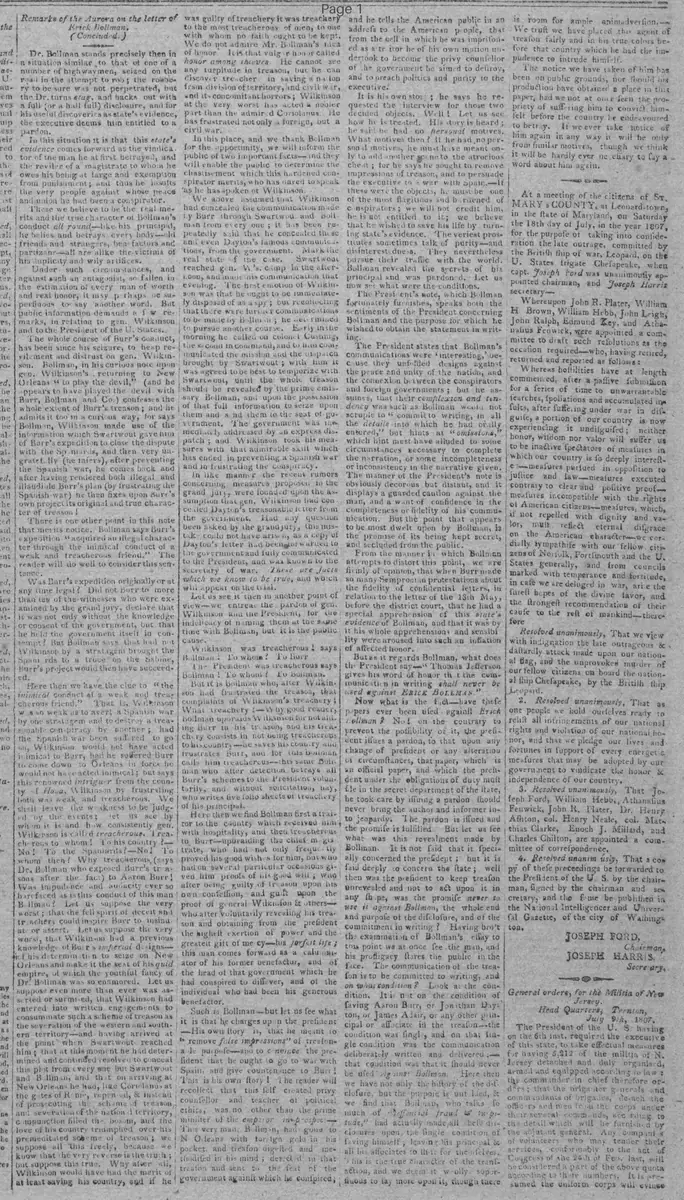
Remarks of the Aurora on the letter of Erick Bollman.
(Concluded.)
Dr. Bollman stands precisely then in a situation similar to that of one of a number of highwaymen, seized on the road in the attempt to rob; the robbery to be sure was not perpetrated, but the Dr. turns state's evidence, and backs out with a full (or a half full) disclosure, and for his useful discoveries as state's evidence, the executive deems him entitled to a pardon.
In this situation it is that this state's evidence comes forward as the vindicator of the man he at first betrayed, and the reviler of a magistrate to whom he owes his being at large and exemption from punishment; and thus he insults the very people against whose peace and union he had been a conspirator.
These we believe to be the real merits and the true character of Bollman's conduct all round--like his principal, he belies and betrays every body--old friends and strangers, benefactors and partizans--all are alike the victims of his duplicity and wily artifices.
Under such circumstances, and against such an antagonist, so fallen in the estimation of every man of worth and real honor, it may perhaps be superfluous to say another word. But public information demands a few remarks, in relation to gen. Wilkinson and to the President of the U. States.
The whole course of Burr's conduct, has been since his seizure, to heap revilement and distrust on gen. Wilkinson. Bollman, in his curious note upon gen. Wilkinson's returning to New Orleans "to play the devil," (and he appears to have played the devil with Burr, Bollman and Co.) confesses the whole extent of Burr's treason; and he admits it too in a curious way, for says Bollman, Wilkinson made use of the information which Swartwout gave him of Burr's expedition to close the dispute with the Spaniards, and then very ungratefully (he infers), after preventing the Spanish war, he comes back and after having rendered both illegal and illaudable Burr's plan (by frustrating the Spanish war) he then fixes upon Burr's own project its original and true character of treason!
There is one other point in this note that merits notice. Bollman says Burr's expedition "acquired an illegal character through the inimical conduct of a weak and treacherous friend." The reader will do well to consider this sentence.
Was Burr's expedition originally or at any time legal? Did not Burr to more than ten of the witnesses who were examined by the grand jury, declare that it was not only without the knowledge or consent of the government, but that he held the government itself in contempt? But Bollman says that had not Wilkinson by a stratagem brought the Spaniards to a truce on the Sabine, Burr's project would then have succeeded.
Here then we have the clue to "the inimical conduct of a weak and treacherous friend." That is, Wilkinson was so weak as to avert a Spanish war by one stratagem and to destroy a treasonable conspiracy by another; had the Spanish war been suffered to go on, Wilkinson would not have acted inimical to Burr, had he suffered Burr to come down to Orleans in force he would not have acted inimical; but says this renowned intriguer from the county of Hoy a, Wilkinson by frustrating both was weak and treacherous. We shall leave the weakness to be judged by the events; let us see by whom it is and how consistently gen. Wilkinson is called treacherous. Treacherous to whom! To his country?--No! To the Spaniards?--No! To whom then? Why treacherous. (says Dr. Bollman who exposed Burr's treason after the fact) to Aaron Burr!
Was impudence and audacity ever so bare faced as is this conduct of this man Bollman? Let us suppose the very worst; that the fell spirit of deceit and treachery could inspire Burr to insinuate or assert, Let us suppose the very worst, that Wilkinson had a previous knowledge of Burr's infernal designs--In his determination to seize on New Orleans and make it the seat of his gilded empire, of which the youthful fancy of Dr. Bollman was so enamored. Let us suppose even more than ever was asserted or surmised, that Wilkinson had entered into written engagements to consummate such a scheme of treason as the severance of the western and southern territory and having arrived at the point when Swartwout reached him; that at this moment he had determined and continued resolved to conceal this plot from every one but Swartwout and Bollman, and that on arriving at New Orleans he had, like Coriolanus at the gates of Rome, repented, & instead of prosecuting the scheme of treason and severance of the national territory, compunction filled the bosom, and the love of his country triumphed over his premeditated scheme of treason; we suppose all this freely, because we know that the very reverse is the truth; but suppose this true. Why after all, Wilkinson would have had the merit of at least saving his country, and if he was guilty of treachery it was treachery to the most treacherous of men, to one with whom no faith ought to be kept.
We do not admire Mr. Bollman's idea of honor It is that vulgar honor called honor among thieves. He cannot see any turpitude in treason, but he can discover treachery in saving a nation from division of territory, and civil war, and its concomitant horrors: Wilkinson at the very worst has acted a nobler part than the admired Coriolanus. He has frustrated not only a foreign, but a civil war.
In this place, and we thank Bollman for the opportunity, we will inform the public of two important facts- and they will enable the public to determine the chastisement which this hardened conspirator merits, who has dared to speak as he has spoken of Wilkinson.
We above assumed that Wilkinson had concealed the communication made by Burr through Swartwout and Bollman from every one; it has been repeatedly said that he concealed the seal and even Dayton's famous communication, from the government. Mark the real state of the Case. Swartwout reached gen. W's. Camp in the afternoon, and made his Communication that evening. The first emotion of Wilkinson was that he ought to be immediately disposed of as a spy; but recollecting that there were further communications to be made by Bollman; he determined to pursue another course. Early in the morning he called on colonel Cushing the second in command, and to him communicated the mission and the despatches brought by Swartwout; with him it was agreed to be best to temporize with Swartwout, until the whole treason should be revealed by the prime emissary Bollman, and upon the possession of that full information to seize upon them and send them to the seat of government. The government was immediately addressed by an express dispatch; and Wilkinson took his measures with that admirable skill which has ended in preventing a Spanish war and in frustrating the conspiracy.
In like manner the recent rumors concerning measures proposed in the grand jury, were founded upon the assumption that gen, Wilkinson had concealed Dayton's treasonable letter from the government. Had any question been asked by the grand jury, this mistake could not have arisen, as a copy of Dayton's letter had been forwarded to the government and fully communicated to the President, and was known to the secretary of war. These are facts which we know to be true, and which will appear on the trial.
Let us see it then in another point of view-we entreat the pardon of gen. Wilkinson and the President, for the indelicacy of naming them at the same time with Bollman, but it is the public Cause.
Wilkinson was treacherous! says Bollman! To whom? To Burr. The President was treacherous says Bollman! To whom? To Bollman. But it is Bollman who, after Wilkinson had frustrated the treason, that complains of Wilkinson's treachery! What treachery?--Why good reader, Bollman upbraids Wilkinson for not aiding Burr in his treason, and his treachery consists in not being treacherous to his country--he saves his country and frustrates Burr, and for this Bollman calls him treacherous--this same Bollman who after detection betrays all Burr's schemes to the President voluntarily, and without solicitation, nay, who writes five folio sheets of treachery of his principal,
Here then we find Bollman first a traitor to the Country which received him with hospitality, and then treacherous to Burr--upbraiding the chief magistrate, who had not only frequently proved his good wishes for him, but who had on several particular occasions given him proofs of his good will; who after being guilty of treason upon his own confession, and guilt upon the proof of general Wilkinson & others who after voluntarily revealing his treason and obtaining from the president the highest exertion of power and the greatest gift of mercy-his forfeited life; this man comes forward as a calumniator of his former benefactor, and of the head of that government which he had conspired to divide, and of the individual who had been his generous benefactor.
Such is Bollman -but let us see what it is that he charges upon the president --His own story is, that he meant to remove false impressions" of treason- a lie purpose-manu to convince the president that he ought to go to war with Spainl, and give countenance to Burr! This is his own story! The reader will recollect that this self created privy councillor and teacher of political ethics, was no other than the prime minister of the emperor in specie-- This very man, Bollman, had gone to New Orleans with treason gold in his pocket, and treason digested and methodized in his mind; detected in that treason and sent to the seat of the government against which he conspired;
and he tells the American public in an address to the American people, that from the cell in which he was imprisoned as a traitor he of his own motion undertook to become the privy councillor of the government he aimed to destroy, and to preach politics and purity to the executive!
It is his own story; he says he requested the interview for those two decided objects. Well! Let us see how he is treated. His story is heard; he says he had no personal motives. What motives then? If he had no personal motives, he must have meant only to add another scene to the atrocious cheat; for he says he sought to remove impressions of treason, and to persuade the executive to + war with Spain,--If these were the objects, he must be one of the most flagitious and hardened of conspirators; we will not credit him, he is not entitled to it: we believe that he wished to save his life by turning state's evidence. The veriest prostitutes sometimes talk of purity--and disinterestedness. They nevertheless pursue their traffic with the world.
Bollman revealed the secrets of his principal and was pardoned. Let us now see what were the conditions. The President's note, which Bollman fortunately furnishes, speaks both the sentiments of the President concerning Bollman and the purpose for which he wished to obtain the statement in writing.
The President states that Bollman's communications were interesting,'because they unfolded designs against the peace and unity of the nation, and the connexion between the conspirators and foreign governments; but he assumes, that their complexion and tendency was such as Bollman would not scruple to commit to writing, in all the details into which he had orally entered," but hints at "omissions," which hint must have alluded to some circumstances necessary to complete the narration, or some incompleteness or inconsistency in the narrative given.
The manner of the President's note is obviously decorous but distant, and it displays a guarded caution against the man, and a want of confidence in the completeness or fidelity of his communication. But the point that appears to be most dwelt upon by Bollman, is the promise of its being kept secret, and secluded from the public.
From the manner in which Bollman attempts to distort this point, we are firmly of opinion, that when Burr made so many Sempronian protestations about the fidelity of confidential letters, in relation to the letter of the 18th May, before the district court, that he had a special apprehension of this state's evidence of Bollman, and that it was by it his whole apprehensions and sensibility were aroused into such an inflation of affected honor.
But as it regards Bollman, what does the President say-" Thomas Jefferson gives his word of honor that the communication in writing shall never be used against ERICK BOLL MAN"
Now what is the fact-have these papers ever been used against Erick Bollman? No! on the contrary to prevent the possibility of it, the president issues a pardon, so that upon any change of president or any alteration of circumstances, that paper, which is an official paper, and which the president under the obligations of duty may file in the secret department of the state, he took care by issuing a pardon should never bring the author and informer into jeopardy. The pardon is issued and the promise is fulfilled. But let us see what was this revelation made by Bollman. It is not said that it peculiarly concerned the president; but it is said deeply to concern the state; well then was the president to keep treason unrevealed and not to act upon it in any shape, was the promise never to use it against Bollman, the whole end and purpose of the disclosure, and of the commitment in writing? Having brought the examination of Bollman's case to the point we at once see the man, and his profligacy stares the public in the face. The communication of the treason is to be committed to writing, and on what condition? Look at the condition, It is not on the condition of saving Aaron Burr, or Jonathan Dayton, or James Adair, or any other principal or associate in the treason--the condition was single, and on that single condition was the communication deliberately written and delivered:- that condition was that it should never be used against Bollman. Here then we have not only the history of the disclosure. but the purpose is fulfilled, & we find that Bollman, who talks so much of venal fraud & turpitude," had actually made all his disclosures upon the single condition of saving himself; leaving his principal & all his associates to shift for themselves. This is the true character of the transaction, and we deem it wholly superfluous to say more upon it, though there is room for ample animadversion.
We trust we have placed this agent of treason fairly and in his true colors before that country which he had the impudence to intrude himself. The notice we have taken of him has been on public grounds, nor should his production have obtained a place in this paper, had we not at once seen the propriety of suffering him to convict himself before the country be endeavoured to betray. If we ever take notice of him again in any way it will be only from similar motives, though we think it will be hardly ever necessary to say a word about him again.
(Concluded.)
Dr. Bollman stands precisely then in a situation similar to that of one of a number of highwaymen, seized on the road in the attempt to rob; the robbery to be sure was not perpetrated, but the Dr. turns state's evidence, and backs out with a full (or a half full) disclosure, and for his useful discoveries as state's evidence, the executive deems him entitled to a pardon.
In this situation it is that this state's evidence comes forward as the vindicator of the man he at first betrayed, and the reviler of a magistrate to whom he owes his being at large and exemption from punishment; and thus he insults the very people against whose peace and union he had been a conspirator.
These we believe to be the real merits and the true character of Bollman's conduct all round--like his principal, he belies and betrays every body--old friends and strangers, benefactors and partizans--all are alike the victims of his duplicity and wily artifices.
Under such circumstances, and against such an antagonist, so fallen in the estimation of every man of worth and real honor, it may perhaps be superfluous to say another word. But public information demands a few remarks, in relation to gen. Wilkinson and to the President of the U. States.
The whole course of Burr's conduct, has been since his seizure, to heap revilement and distrust on gen. Wilkinson. Bollman, in his curious note upon gen. Wilkinson's returning to New Orleans "to play the devil," (and he appears to have played the devil with Burr, Bollman and Co.) confesses the whole extent of Burr's treason; and he admits it too in a curious way, for says Bollman, Wilkinson made use of the information which Swartwout gave him of Burr's expedition to close the dispute with the Spaniards, and then very ungratefully (he infers), after preventing the Spanish war, he comes back and after having rendered both illegal and illaudable Burr's plan (by frustrating the Spanish war) he then fixes upon Burr's own project its original and true character of treason!
There is one other point in this note that merits notice. Bollman says Burr's expedition "acquired an illegal character through the inimical conduct of a weak and treacherous friend." The reader will do well to consider this sentence.
Was Burr's expedition originally or at any time legal? Did not Burr to more than ten of the witnesses who were examined by the grand jury, declare that it was not only without the knowledge or consent of the government, but that he held the government itself in contempt? But Bollman says that had not Wilkinson by a stratagem brought the Spaniards to a truce on the Sabine, Burr's project would then have succeeded.
Here then we have the clue to "the inimical conduct of a weak and treacherous friend." That is, Wilkinson was so weak as to avert a Spanish war by one stratagem and to destroy a treasonable conspiracy by another; had the Spanish war been suffered to go on, Wilkinson would not have acted inimical to Burr, had he suffered Burr to come down to Orleans in force he would not have acted inimical; but says this renowned intriguer from the county of Hoy a, Wilkinson by frustrating both was weak and treacherous. We shall leave the weakness to be judged by the events; let us see by whom it is and how consistently gen. Wilkinson is called treacherous. Treacherous to whom! To his country?--No! To the Spaniards?--No! To whom then? Why treacherous. (says Dr. Bollman who exposed Burr's treason after the fact) to Aaron Burr!
Was impudence and audacity ever so bare faced as is this conduct of this man Bollman? Let us suppose the very worst; that the fell spirit of deceit and treachery could inspire Burr to insinuate or assert, Let us suppose the very worst, that Wilkinson had a previous knowledge of Burr's infernal designs--In his determination to seize on New Orleans and make it the seat of his gilded empire, of which the youthful fancy of Dr. Bollman was so enamored. Let us suppose even more than ever was asserted or surmised, that Wilkinson had entered into written engagements to consummate such a scheme of treason as the severance of the western and southern territory and having arrived at the point when Swartwout reached him; that at this moment he had determined and continued resolved to conceal this plot from every one but Swartwout and Bollman, and that on arriving at New Orleans he had, like Coriolanus at the gates of Rome, repented, & instead of prosecuting the scheme of treason and severance of the national territory, compunction filled the bosom, and the love of his country triumphed over his premeditated scheme of treason; we suppose all this freely, because we know that the very reverse is the truth; but suppose this true. Why after all, Wilkinson would have had the merit of at least saving his country, and if he was guilty of treachery it was treachery to the most treacherous of men, to one with whom no faith ought to be kept.
We do not admire Mr. Bollman's idea of honor It is that vulgar honor called honor among thieves. He cannot see any turpitude in treason, but he can discover treachery in saving a nation from division of territory, and civil war, and its concomitant horrors: Wilkinson at the very worst has acted a nobler part than the admired Coriolanus. He has frustrated not only a foreign, but a civil war.
In this place, and we thank Bollman for the opportunity, we will inform the public of two important facts- and they will enable the public to determine the chastisement which this hardened conspirator merits, who has dared to speak as he has spoken of Wilkinson.
We above assumed that Wilkinson had concealed the communication made by Burr through Swartwout and Bollman from every one; it has been repeatedly said that he concealed the seal and even Dayton's famous communication, from the government. Mark the real state of the Case. Swartwout reached gen. W's. Camp in the afternoon, and made his Communication that evening. The first emotion of Wilkinson was that he ought to be immediately disposed of as a spy; but recollecting that there were further communications to be made by Bollman; he determined to pursue another course. Early in the morning he called on colonel Cushing the second in command, and to him communicated the mission and the despatches brought by Swartwout; with him it was agreed to be best to temporize with Swartwout, until the whole treason should be revealed by the prime emissary Bollman, and upon the possession of that full information to seize upon them and send them to the seat of government. The government was immediately addressed by an express dispatch; and Wilkinson took his measures with that admirable skill which has ended in preventing a Spanish war and in frustrating the conspiracy.
In like manner the recent rumors concerning measures proposed in the grand jury, were founded upon the assumption that gen, Wilkinson had concealed Dayton's treasonable letter from the government. Had any question been asked by the grand jury, this mistake could not have arisen, as a copy of Dayton's letter had been forwarded to the government and fully communicated to the President, and was known to the secretary of war. These are facts which we know to be true, and which will appear on the trial.
Let us see it then in another point of view-we entreat the pardon of gen. Wilkinson and the President, for the indelicacy of naming them at the same time with Bollman, but it is the public Cause.
Wilkinson was treacherous! says Bollman! To whom? To Burr. The President was treacherous says Bollman! To whom? To Bollman. But it is Bollman who, after Wilkinson had frustrated the treason, that complains of Wilkinson's treachery! What treachery?--Why good reader, Bollman upbraids Wilkinson for not aiding Burr in his treason, and his treachery consists in not being treacherous to his country--he saves his country and frustrates Burr, and for this Bollman calls him treacherous--this same Bollman who after detection betrays all Burr's schemes to the President voluntarily, and without solicitation, nay, who writes five folio sheets of treachery of his principal,
Here then we find Bollman first a traitor to the Country which received him with hospitality, and then treacherous to Burr--upbraiding the chief magistrate, who had not only frequently proved his good wishes for him, but who had on several particular occasions given him proofs of his good will; who after being guilty of treason upon his own confession, and guilt upon the proof of general Wilkinson & others who after voluntarily revealing his treason and obtaining from the president the highest exertion of power and the greatest gift of mercy-his forfeited life; this man comes forward as a calumniator of his former benefactor, and of the head of that government which he had conspired to divide, and of the individual who had been his generous benefactor.
Such is Bollman -but let us see what it is that he charges upon the president --His own story is, that he meant to remove false impressions" of treason- a lie purpose-manu to convince the president that he ought to go to war with Spainl, and give countenance to Burr! This is his own story! The reader will recollect that this self created privy councillor and teacher of political ethics, was no other than the prime minister of the emperor in specie-- This very man, Bollman, had gone to New Orleans with treason gold in his pocket, and treason digested and methodized in his mind; detected in that treason and sent to the seat of the government against which he conspired;
and he tells the American public in an address to the American people, that from the cell in which he was imprisoned as a traitor he of his own motion undertook to become the privy councillor of the government he aimed to destroy, and to preach politics and purity to the executive!
It is his own story; he says he requested the interview for those two decided objects. Well! Let us see how he is treated. His story is heard; he says he had no personal motives. What motives then? If he had no personal motives, he must have meant only to add another scene to the atrocious cheat; for he says he sought to remove impressions of treason, and to persuade the executive to + war with Spain,--If these were the objects, he must be one of the most flagitious and hardened of conspirators; we will not credit him, he is not entitled to it: we believe that he wished to save his life by turning state's evidence. The veriest prostitutes sometimes talk of purity--and disinterestedness. They nevertheless pursue their traffic with the world.
Bollman revealed the secrets of his principal and was pardoned. Let us now see what were the conditions. The President's note, which Bollman fortunately furnishes, speaks both the sentiments of the President concerning Bollman and the purpose for which he wished to obtain the statement in writing.
The President states that Bollman's communications were interesting,'because they unfolded designs against the peace and unity of the nation, and the connexion between the conspirators and foreign governments; but he assumes, that their complexion and tendency was such as Bollman would not scruple to commit to writing, in all the details into which he had orally entered," but hints at "omissions," which hint must have alluded to some circumstances necessary to complete the narration, or some incompleteness or inconsistency in the narrative given.
The manner of the President's note is obviously decorous but distant, and it displays a guarded caution against the man, and a want of confidence in the completeness or fidelity of his communication. But the point that appears to be most dwelt upon by Bollman, is the promise of its being kept secret, and secluded from the public.
From the manner in which Bollman attempts to distort this point, we are firmly of opinion, that when Burr made so many Sempronian protestations about the fidelity of confidential letters, in relation to the letter of the 18th May, before the district court, that he had a special apprehension of this state's evidence of Bollman, and that it was by it his whole apprehensions and sensibility were aroused into such an inflation of affected honor.
But as it regards Bollman, what does the President say-" Thomas Jefferson gives his word of honor that the communication in writing shall never be used against ERICK BOLL MAN"
Now what is the fact-have these papers ever been used against Erick Bollman? No! on the contrary to prevent the possibility of it, the president issues a pardon, so that upon any change of president or any alteration of circumstances, that paper, which is an official paper, and which the president under the obligations of duty may file in the secret department of the state, he took care by issuing a pardon should never bring the author and informer into jeopardy. The pardon is issued and the promise is fulfilled. But let us see what was this revelation made by Bollman. It is not said that it peculiarly concerned the president; but it is said deeply to concern the state; well then was the president to keep treason unrevealed and not to act upon it in any shape, was the promise never to use it against Bollman, the whole end and purpose of the disclosure, and of the commitment in writing? Having brought the examination of Bollman's case to the point we at once see the man, and his profligacy stares the public in the face. The communication of the treason is to be committed to writing, and on what condition? Look at the condition, It is not on the condition of saving Aaron Burr, or Jonathan Dayton, or James Adair, or any other principal or associate in the treason--the condition was single, and on that single condition was the communication deliberately written and delivered:- that condition was that it should never be used against Bollman. Here then we have not only the history of the disclosure. but the purpose is fulfilled, & we find that Bollman, who talks so much of venal fraud & turpitude," had actually made all his disclosures upon the single condition of saving himself; leaving his principal & all his associates to shift for themselves. This is the true character of the transaction, and we deem it wholly superfluous to say more upon it, though there is room for ample animadversion.
We trust we have placed this agent of treason fairly and in his true colors before that country which he had the impudence to intrude himself. The notice we have taken of him has been on public grounds, nor should his production have obtained a place in this paper, had we not at once seen the propriety of suffering him to convict himself before the country be endeavoured to betray. If we ever take notice of him again in any way it will be only from similar motives, though we think it will be hardly ever necessary to say a word about him again.
What sub-type of article is it?
Partisan Politics
Crime Or Punishment
War Or Peace
What keywords are associated?
Burr Conspiracy
Bollman Letter
Wilkinson Defense
Jefferson Pardon
Treason Betrayal
Spanish War Prevention
State's Evidence
What entities or persons were involved?
Erick Bollman
Aaron Burr
Gen. Wilkinson
President Thomas Jefferson
Swartwout
Jonathan Dayton
Colonel Cushing
Editorial Details
Primary Topic
Critique Of Erick Bollman's Letter Defending Aaron Burr And Attacking Wilkinson And Jefferson
Stance / Tone
Strongly Critical Of Bollman, Defensive Of Wilkinson And Jefferson
Key Figures
Erick Bollman
Aaron Burr
Gen. Wilkinson
President Thomas Jefferson
Swartwout
Jonathan Dayton
Colonel Cushing
Key Arguments
Bollman Is Duplicitous, Betraying Burr After Turning State's Evidence For Pardon
Wilkinson Thwarted Burr's Treason And Prevented Spanish War, Acting Loyally To Country
Bollman's Accusations Of Treachery Against Wilkinson Are Baseless And Impudent
Jefferson's Pardon Fulfilled Promise To Not Use Bollman's Confession Against Him
Bollman Conspired Against The Nation But Now Reviles His Benefactors
Wilkinson Promptly Informed Superiors Of The Conspiracy Upon Learning Of It
Bollman's Expedition Was Inherently Illegal, Not Made So By Wilkinson's Actions