Thank you for visiting SNEWPapers!
Sign up free
Editorial
October 19, 1852
The Daily Union
Washington, District Of Columbia
What is this article about?
Editorial critiques Senator Seward's toast honoring General Winfield Scott as 'extender of his country,' interpreting it as a veiled promise of Canadian annexation to empower abolitionists and undermine Southern influence in the 1852 presidential election.
Clipping
OCR Quality
98%
Excellent
Full Text
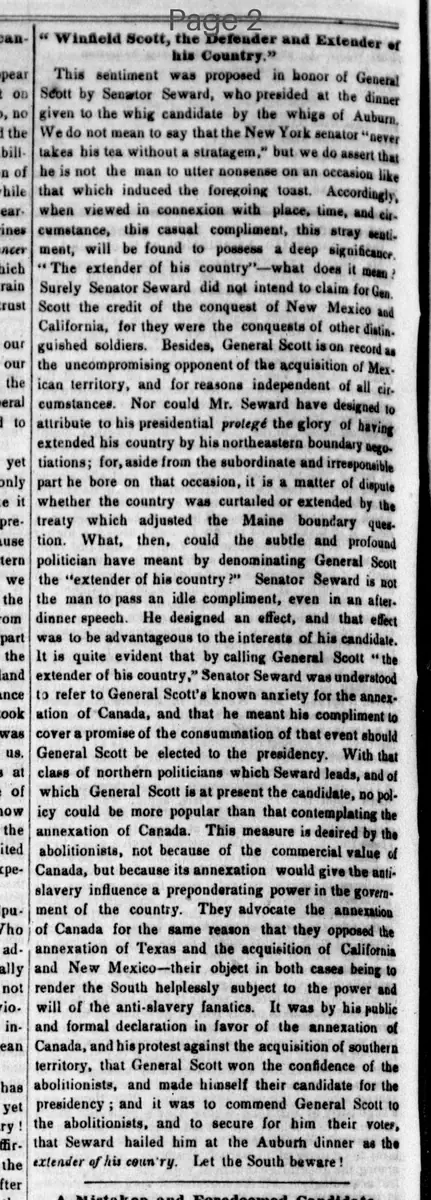
Winfield Scott, the Defender and Extender of his Country.
This sentiment was proposed in honor of General Scott by Senator Seward, who presided at the dinner given to the whig candidate by the whigs of Auburn. We do not mean to say that the New York senator "never takes his tea without a stratagem," but we do assert that he is not the man to utter nonsense on an occasion like that which induced the foregoing toast. Accordingly when viewed in connexion with place, time, and circumstance, this casual compliment, this stray sentiment, will be found to possess a deep significance.
"The extender of his country"'-what does it mean? Surely Senator Seward did not intend to claim for Gen. Scott the credit of the conquest of New Mexico and California, for they were the conquests of other distinguished soldiers. Besides, General Scott is on record as the uncompromising opponent of the acquisition of Mexican territory, and for reasons independent of all circumstances. Nor could Mr. Seward have designed to attribute to his presidential protege the glory of having extended his country by his northeastern boundary negotiations; for, aside from the subordinate and irresponsible part he bore on that occasion, it is a matter of dispute whether the country was curtailed or extended by the treaty which adjusted the Maine boundary question. What, then, could the subtle and profound politician have meant by denominating General Scott the "extender of his country?" Senator Seward is not the man to pass an idle compliment, even in an after-dinner speech. He designed an effect, and that effect was to be advantageous to the interests of his candidate. It is quite evident that by calling General Scott "the extender of his country," Senator Seward was understood to refer to General Scott's known anxiety for the annexation of Canada, and that he meant his compliment to cover a promise of the consummation of that event should General Scott be elected to the presidency. With that class of northern politicians which Seward leads, and of which General Scott is at present the candidate, no policy could be more popular than that contemplating the annexation of Canada. This measure is desired by the abolitionists, not because of the commercial value of Canada, but because its annexation would give the anti-slavery influence a preponderating power in the government of the country. They advocate the annexation of Canada for the same reason that they opposed the annexation of Texas and the acquisition of California and New Mexico-their object in both cases being to render the South helplessly subject to the power and will of the anti-slavery fanatics. It was by his public and formal declaration in favor of the annexation of Canada, and his protest against the acquisition of southern territory, that General Scott won the confidence of the abolitionists, and made himself their candidate for the presidency; and it was to commend General Scott to the abolitionists, and to secure for him their vote, that Seward hailed him at the Auburn dinner as the extender of his country. Let the South beware!
This sentiment was proposed in honor of General Scott by Senator Seward, who presided at the dinner given to the whig candidate by the whigs of Auburn. We do not mean to say that the New York senator "never takes his tea without a stratagem," but we do assert that he is not the man to utter nonsense on an occasion like that which induced the foregoing toast. Accordingly when viewed in connexion with place, time, and circumstance, this casual compliment, this stray sentiment, will be found to possess a deep significance.
"The extender of his country"'-what does it mean? Surely Senator Seward did not intend to claim for Gen. Scott the credit of the conquest of New Mexico and California, for they were the conquests of other distinguished soldiers. Besides, General Scott is on record as the uncompromising opponent of the acquisition of Mexican territory, and for reasons independent of all circumstances. Nor could Mr. Seward have designed to attribute to his presidential protege the glory of having extended his country by his northeastern boundary negotiations; for, aside from the subordinate and irresponsible part he bore on that occasion, it is a matter of dispute whether the country was curtailed or extended by the treaty which adjusted the Maine boundary question. What, then, could the subtle and profound politician have meant by denominating General Scott the "extender of his country?" Senator Seward is not the man to pass an idle compliment, even in an after-dinner speech. He designed an effect, and that effect was to be advantageous to the interests of his candidate. It is quite evident that by calling General Scott "the extender of his country," Senator Seward was understood to refer to General Scott's known anxiety for the annexation of Canada, and that he meant his compliment to cover a promise of the consummation of that event should General Scott be elected to the presidency. With that class of northern politicians which Seward leads, and of which General Scott is at present the candidate, no policy could be more popular than that contemplating the annexation of Canada. This measure is desired by the abolitionists, not because of the commercial value of Canada, but because its annexation would give the anti-slavery influence a preponderating power in the government of the country. They advocate the annexation of Canada for the same reason that they opposed the annexation of Texas and the acquisition of California and New Mexico-their object in both cases being to render the South helplessly subject to the power and will of the anti-slavery fanatics. It was by his public and formal declaration in favor of the annexation of Canada, and his protest against the acquisition of southern territory, that General Scott won the confidence of the abolitionists, and made himself their candidate for the presidency; and it was to commend General Scott to the abolitionists, and to secure for him their vote, that Seward hailed him at the Auburn dinner as the extender of his country. Let the South beware!
What sub-type of article is it?
Partisan Politics
Slavery Abolition
Imperialism
What keywords are associated?
Winfield Scott
William Seward
Annexation Of Canada
Abolitionists
Presidential Election
Southern Interests
What entities or persons were involved?
Winfield Scott
Senator Seward
Abolitionists
Whigs Of Auburn
Editorial Details
Primary Topic
Interpretation Of Seward's Toast To Scott As Promise Of Canadian Annexation For Abolitionist Advantage
Stance / Tone
Anti Abolitionist Warning To The South Against Scott's Candidacy
Key Figures
Winfield Scott
Senator Seward
Abolitionists
Whigs Of Auburn
Key Arguments
Seward's Toast Implies Scott's Support For Annexing Canada
Annexation Of Canada Would Empower Anti Slavery Forces
Scott Opposed Mexican Territory Acquisition But Favors Canadian Annexation
This Policy Appeals To Northern Abolitionists Opposing Southern Expansion
Scott Gained Abolitionist Support Through These Positions
Southerners Should Beware Of Scott's Election