Thank you for visiting SNEWPapers!
Sign up free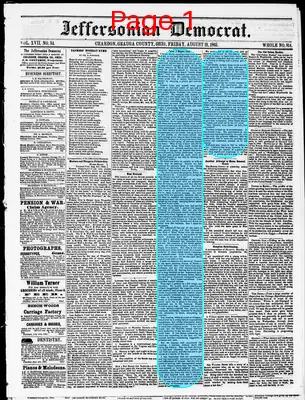
Literary
August 18, 1865
The Jeffersonian Democrat
Chardon, Geauga County, Ohio
What is this article about?
A young boy, jealous over carrying schoolmate Helen Graham across a brook, falls in the water, gets humiliated by rival Donald Lean, and runs away from home. He finds success with an uncle in Edinburgh, travels abroad, and years later reunites with and marries Helen at a ball in Glasgow, discovering Donald as a farmer.
Merged-components note: Single narrative story 'How I Began Life' split into two components, adjacent in reading order and spatially on the same page.
Clipping
OCR Quality
98%
Excellent
Full Text
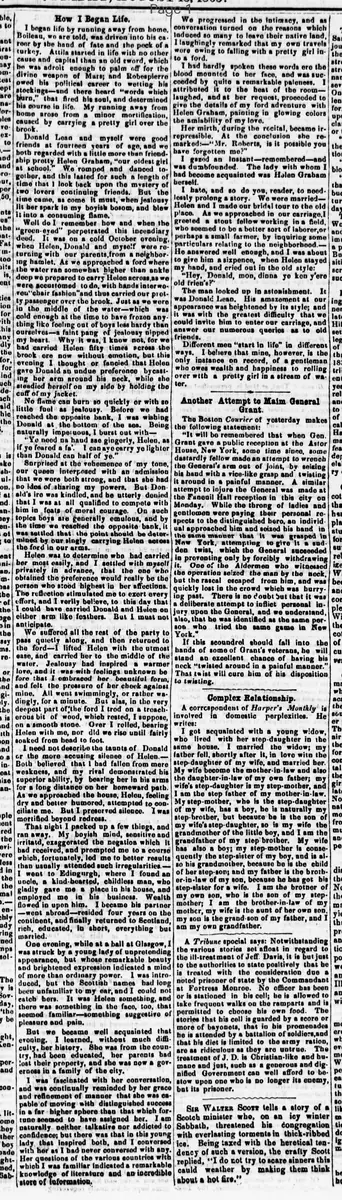
How I Began Life
I began life by running away from home. Boileau, we are told, was driven into his career by the hand of fate and the peck of a turkey. Attila started in life with no other cause and capital than an old sword, which he was adroit enough to palm off for the divine weapon of Mars; and Robespierre owed his political career to wetting his stockings--and there heard "words which burn," that fired his soul, and determined his course in life. My running away from home arose from a minor mortification, caused by carrying a pretty girl over the brook.
Donald Lean and myself were good friends at fourteen years of age, and we both regarded with little more than friendship pretty Helen Graham, "our oldest girl at school." We romped and danced together, and this lasted for such a length of time that I look back upon the mystery of two lovers continuing friends. But the time came, as come it must, when jealousy lit her spark in my boyish bosom, and blew it into a consuming flame.
Well do I remember how and when the "green-eyed" perpetrated this incendiary deed. It was on a cold October evening, when Helen, Donald and myself were returning with our parents, from a neighboring hamlet. As we approached a ford where the water ran somewhat higher than ankle deep we prepared to carry Helen across, as we were accustomed to do, with hands interwoven "chair fashion" and thus carried our pretty passenger over the brook. Just as we were in the middle of the water--which was cold enough at the time to have frozen any thing like fooling out of boys less hardy than ourselves--a faint pang of jealousy nipped my heart. Why it was, I know not, for we had carried Helen fifty times across the brook ere now without emotion, but this evening I thought or fancied that Helen gave Donald an undue preference by casting her arm around his neck, while she steadied herself on my side by holding the cuff of my jacket.
No flame can burn so quickly or with so little fuel as jealousy. Before we had reached the opposite bank, I was wishing Donald at the bottom of the sea. Being naturally impetuous, I burst out with--
"Ye need na haud sae gingerly, Helen, as if ye feared a fa'. I can aye carry ye lighter than Donald can half of ye."
Surprised at the vehemence of my tone, our queen interposed with an admission that we were both strong, and that she had no idea of sharing my powers. But Donald's ire was kindled, and he utterly denied that I was at all qualified to compete with him in feats of mortal courage. On such topics boys are generally emulous, and by the time we reached the opposite bank, it was settled that the point should be determined by our singly carrying Helen across the ford in our arms.
Helen was to determine who had carried her most easily, and I settled with myself privately in advance, that the one who obtained the preference would really be the person who stood highest in her affections. The reflection stimulated me to exert every effort, and I verily believe, to this day that I could have carried Donald and Helen on either arm like feathers. But I must not anticipate.
We suffered all the rest of the party to pass quietly along, and then returned to the ford--I lifted Helen with the utmost ease, and carried her to the middle of the water. Jealousy had inspired a warmer love, and it was with feelings unknown before that I embraced her beautiful form, and felt the pressure of her cheek against mine. All went swimmingly, or rather wadingly, for a minute. But alas, in the very deepest part of the ford I trod on a treacherous bit of wood, which rested, I suppose, on a smooth stone. Over I rolled, bearing Helen with me, nor did we rise until fairly soaked from head to foot.
I need not describe the taunts of Donald or the more accusing silence of Helen. Both believed that I had fallen from mere weakness, and my rival demonstrated his superior ability, by bearing her in his arms for a long distance on her homeward path.
As we approached the house, Helen, feeling dry and better humored, attempted to conciliate me. But I preserved silence. I was mortified beyond redress.
That night I packed up a few things, and ran away. My boyish mind, sensitive and irritated, exaggerated the negation which it had received, and prompted me to a course which, fortunately, led me to better results than usually attended such irregularities.
I went to Edinburgh, where I found an uncle, a kind-hearted, childless man, who gladly gave me a place in his house, and employed me in his business. Wealth flowed in upon him. I became his partner--went abroad--resided four years on the continent, and finally returned to Scotland, rich, educated, in short, everything but married.
One evening, while at a ball at Glasgow, I was struck by a young lady of unpretending appearance, but whose remarkable beauty and brightened expression indicated a mind of more than ordinary power. I was introduced, but the Scottish names had long been unfamiliar to my ear, and I could not catch hers. It was Helen something, and there was something in the face, too, that seemed familiar--something suggestive of pleasure and pain.
But we became well acquainted that evening. I learned, without much difficulty, her history. She was from the country, had been educated, her parents had lost their property, and she was now a governess in a family of the city.
I was fascinated with her conversation, and was continually reminded by her grace and refinement of manner that she was capable of moving with distinguished success in a far higher sphere than that which fortune seemed to have assigned her. I am naturally, neither talkative nor addicted to confidence; but there was that in this young lady, that inspired both, and I conversed with her as I had never conversed with any. Her questions of the various countries with which I was familiar indicated a remarkable knowledge of literature and an incredible store of information.
We progressed in the intimacy, and as conversation turned on the reasons which induced so many to leave their native land, I laughingly remarked that my own travels were owing to falling with a pretty girl into a ford.
I had hardly spoken these words ere the blood mounted to her face, and was succeeded by quite a remarkable paleness. I attributed it to the heat of the room--laughed, and at her request, proceeded to give the details of my ford adventure with Helen Graham, painting in glowing colors the amiability of my love.
Her mirth, during the recital, became irrepressible. At the conclusion she remarked: "Mr. Roberts, is it possible you have forgotten me?"
I gazed an instant--remembered--and was dumbfounded. The lady with whom I had become acquainted was Helen Graham herself.
I hate, and so do you, reader, to needlessly prolong a story. We were married--Helen and I made our bridal tour to the old place. As we approached in our carriage, I greeted a stout fellow working in a field, who seemed to be a better sort of laborer, or perhaps a small farmer, by inquiring some particulars relating to the neighborhood.
He answered well enough, and I was about to give him a sixpence, when Helen stayed my hand, and cried out in the old style:
"Hey, Donald, mon, dinna ye ken yere old frien'e?"
The man looked up in astonishment. It was Donald Lean. His amazement at our appearance was heightened by its style; and it was with the greatest difficulty that we could invite him to enter our carriage, and answer our numerous queries as to old friends.
Different men "start in life" in different ways. I believe that mine, however, is the only instance on record, of a gentleman who owes wealth and happiness to rolling over with a pretty girl in a stream of water.
I began life by running away from home. Boileau, we are told, was driven into his career by the hand of fate and the peck of a turkey. Attila started in life with no other cause and capital than an old sword, which he was adroit enough to palm off for the divine weapon of Mars; and Robespierre owed his political career to wetting his stockings--and there heard "words which burn," that fired his soul, and determined his course in life. My running away from home arose from a minor mortification, caused by carrying a pretty girl over the brook.
Donald Lean and myself were good friends at fourteen years of age, and we both regarded with little more than friendship pretty Helen Graham, "our oldest girl at school." We romped and danced together, and this lasted for such a length of time that I look back upon the mystery of two lovers continuing friends. But the time came, as come it must, when jealousy lit her spark in my boyish bosom, and blew it into a consuming flame.
Well do I remember how and when the "green-eyed" perpetrated this incendiary deed. It was on a cold October evening, when Helen, Donald and myself were returning with our parents, from a neighboring hamlet. As we approached a ford where the water ran somewhat higher than ankle deep we prepared to carry Helen across, as we were accustomed to do, with hands interwoven "chair fashion" and thus carried our pretty passenger over the brook. Just as we were in the middle of the water--which was cold enough at the time to have frozen any thing like fooling out of boys less hardy than ourselves--a faint pang of jealousy nipped my heart. Why it was, I know not, for we had carried Helen fifty times across the brook ere now without emotion, but this evening I thought or fancied that Helen gave Donald an undue preference by casting her arm around his neck, while she steadied herself on my side by holding the cuff of my jacket.
No flame can burn so quickly or with so little fuel as jealousy. Before we had reached the opposite bank, I was wishing Donald at the bottom of the sea. Being naturally impetuous, I burst out with--
"Ye need na haud sae gingerly, Helen, as if ye feared a fa'. I can aye carry ye lighter than Donald can half of ye."
Surprised at the vehemence of my tone, our queen interposed with an admission that we were both strong, and that she had no idea of sharing my powers. But Donald's ire was kindled, and he utterly denied that I was at all qualified to compete with him in feats of mortal courage. On such topics boys are generally emulous, and by the time we reached the opposite bank, it was settled that the point should be determined by our singly carrying Helen across the ford in our arms.
Helen was to determine who had carried her most easily, and I settled with myself privately in advance, that the one who obtained the preference would really be the person who stood highest in her affections. The reflection stimulated me to exert every effort, and I verily believe, to this day that I could have carried Donald and Helen on either arm like feathers. But I must not anticipate.
We suffered all the rest of the party to pass quietly along, and then returned to the ford--I lifted Helen with the utmost ease, and carried her to the middle of the water. Jealousy had inspired a warmer love, and it was with feelings unknown before that I embraced her beautiful form, and felt the pressure of her cheek against mine. All went swimmingly, or rather wadingly, for a minute. But alas, in the very deepest part of the ford I trod on a treacherous bit of wood, which rested, I suppose, on a smooth stone. Over I rolled, bearing Helen with me, nor did we rise until fairly soaked from head to foot.
I need not describe the taunts of Donald or the more accusing silence of Helen. Both believed that I had fallen from mere weakness, and my rival demonstrated his superior ability, by bearing her in his arms for a long distance on her homeward path.
As we approached the house, Helen, feeling dry and better humored, attempted to conciliate me. But I preserved silence. I was mortified beyond redress.
That night I packed up a few things, and ran away. My boyish mind, sensitive and irritated, exaggerated the negation which it had received, and prompted me to a course which, fortunately, led me to better results than usually attended such irregularities.
I went to Edinburgh, where I found an uncle, a kind-hearted, childless man, who gladly gave me a place in his house, and employed me in his business. Wealth flowed in upon him. I became his partner--went abroad--resided four years on the continent, and finally returned to Scotland, rich, educated, in short, everything but married.
One evening, while at a ball at Glasgow, I was struck by a young lady of unpretending appearance, but whose remarkable beauty and brightened expression indicated a mind of more than ordinary power. I was introduced, but the Scottish names had long been unfamiliar to my ear, and I could not catch hers. It was Helen something, and there was something in the face, too, that seemed familiar--something suggestive of pleasure and pain.
But we became well acquainted that evening. I learned, without much difficulty, her history. She was from the country, had been educated, her parents had lost their property, and she was now a governess in a family of the city.
I was fascinated with her conversation, and was continually reminded by her grace and refinement of manner that she was capable of moving with distinguished success in a far higher sphere than that which fortune seemed to have assigned her. I am naturally, neither talkative nor addicted to confidence; but there was that in this young lady, that inspired both, and I conversed with her as I had never conversed with any. Her questions of the various countries with which I was familiar indicated a remarkable knowledge of literature and an incredible store of information.
We progressed in the intimacy, and as conversation turned on the reasons which induced so many to leave their native land, I laughingly remarked that my own travels were owing to falling with a pretty girl into a ford.
I had hardly spoken these words ere the blood mounted to her face, and was succeeded by quite a remarkable paleness. I attributed it to the heat of the room--laughed, and at her request, proceeded to give the details of my ford adventure with Helen Graham, painting in glowing colors the amiability of my love.
Her mirth, during the recital, became irrepressible. At the conclusion she remarked: "Mr. Roberts, is it possible you have forgotten me?"
I gazed an instant--remembered--and was dumbfounded. The lady with whom I had become acquainted was Helen Graham herself.
I hate, and so do you, reader, to needlessly prolong a story. We were married--Helen and I made our bridal tour to the old place. As we approached in our carriage, I greeted a stout fellow working in a field, who seemed to be a better sort of laborer, or perhaps a small farmer, by inquiring some particulars relating to the neighborhood.
He answered well enough, and I was about to give him a sixpence, when Helen stayed my hand, and cried out in the old style:
"Hey, Donald, mon, dinna ye ken yere old frien'e?"
The man looked up in astonishment. It was Donald Lean. His amazement at our appearance was heightened by its style; and it was with the greatest difficulty that we could invite him to enter our carriage, and answer our numerous queries as to old friends.
Different men "start in life" in different ways. I believe that mine, however, is the only instance on record, of a gentleman who owes wealth and happiness to rolling over with a pretty girl in a stream of water.
What sub-type of article is it?
Prose Fiction
What themes does it cover?
Love Romance
Friendship
What keywords are associated?
Jealousy
Romance
Running Away
Ford Incident
Reunion
Marriage
Boyhood Friendship
Literary Details
Title
How I Began Life
Key Lines
"Ye Need Na Haud Sae Gingerly, Helen, As If Ye Feared A Fa'. I Can Aye Carry Ye Lighter Than Donald Can Half Of Ye."
"Mr. Roberts, Is It Possible You Have Forgotten Me?"
"Hey, Donald, Mon, Dinna Ye Ken Yere Old Frien'e?"
I Began Life By Running Away From Home.
Different Men "Start In Life" In Different Ways. I Believe That Mine, However, Is The Only Instance On Record, Of A Gentleman Who Owes Wealth And Happiness To Rolling Over With A Pretty Girl In A Stream Of Water.