Thank you for visiting SNEWPapers!
Sign up free
Norfolk Gazette And Publick Ledger
Norfolk, Virginia
What is this article about?
On April 9, 1814, in the US House, Mr. Calhoun reported from the foreign relations committee recommending repeal of the 1813 embargo act and British import prohibitions, citing benefits to commerce and revenue. The bill was read, debated briefly, and referred to a committee of the whole by majority vote.
Merged-components note: Merged continuation of the report on House of Representatives proceedings regarding the embargo repeal bill.
Clipping
OCR Quality
Full Text
Monday, April 9.
The unfinished business being postponed with that view---
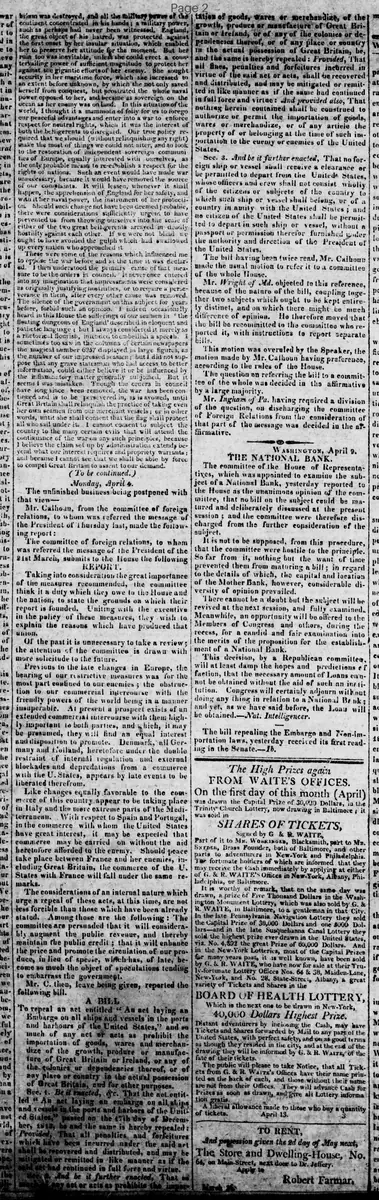
Mr. Calhoun, from the committee of foreign relations, to whom was referred the message of the President of Thursday last, made the following report:
The committee of foreign relations, to whom was referred the message of the President of the 31st March, submits to the House the following REPORT.
Taking into consideration the great importance of the measures recommended, the committee think it a duty which they owe to the House and the nation, to state the grounds on which their report is founded. Uniting with the executive in the policy of these measures, they wish to explain the reasons which have produced that union.
Of the past it is unnecessary to take a review; the attention of the committee is drawn with more solicitude to the future.
Previous to the late changes in Europe, the bearing of our restrictive measures was for the most part confined to our enemies ; the obstruction to our commercial intercourse with the friendly powers of the world being in a manner insuperable. At present a prospect exists of an extended commercial intercourse with them highly important to both parties, and which, it may be presumed, they will find an equal interest and disposition to promote. Denmark, all Germany and Holland, heretofore under the double restraint of internal regulation and external blockades and depredations from a commerce with the U. States, appears by late events to be liberated therefrom.
Like changes equally favorable to the commerce of this country appear to be taking place in Italy and the more extreme parts of the Mediterranean. With respect to Spain and Portugal, in the commerce with whom the United States have great interest, it may be expected that commerce may be carried on without the aid heretofore afforded to the enemy. Should peace take place between France and her enemies, including Great Britain, the commerce of the U. States with France will all under the same remarks.
The considerations of an internal nature which urge a repeal of these acts, at this time, are not less forcible than those which have been already stated. Among those are the following : The committee are persuaded that it will considerably augment the public revenue, and thereby maintain the public credit ; that it will enhance the price and promote the circulation of our produce, in lieu of specie, which has, of late, become so much the object of speculations tending to embarrass the government.
Mr. C. then, leave being given, reported the following bill.
A BILL
To repeal an act entitled An act laying an Embargo on all ships and vessels in the ports and harbors of the United States, and so much of any act or acts as prohibit the importation of goods, wares and merchandise of the growth, produce or manufacture of Great Britain or Ireland, or any of the colonies or dependencies thereof, or of any place or country in the actual possession of Great Britain, and for other purposes.
Sec. 1. Be it enacted, &c. That the act entitled An act laying an embargo on all ships and vessels in the ports and harbors of the United States, passed on the 25th day of December, 1813, be and the same is hereby repealed: Provided, That all penalties and forfeitures which have been incurred under the said act shall be recovered and distributed, and may be mitigated or remitted in like manner as if the act had continued in full force and virtue.
And be it further enacted That so much of any act or acts as prohibit the importation of goods, wares or merchandise, of the growth, produce or manufacture of Great Britain or Ireland, or of any of the colonies or dependencies thereof, or of any place or country in the actual possession of Great Britain, be, and the same is hereby repealed : Provided, That all fines, penalties and forfeitures incurred in virtue of the said act or acts, shall be recovered and distributed, and may be mitigated or remitted in like manner as if the same had continued in full force and virtue: And provided also, That nothing herein contained shall be construed to authorize or permit the importation of goods, wares or merchandise, or of any article the property of or belonging at the time of such importation to the enemy or enemies of the United States.
Sec. 3. And be it further enacted, That no foreign ship or vessel shall receive a clearance or be permitted to depart from the United States, whose officers and crew shall not consist wholly of the citizens or subjects of the country to which such ship or vessel shall belong, or of a country in amity with the United States; and no citizen of the United States shall be permitted to depart in such ship or vessel, without a passport or permission therefor furnished under the authority and direction of the President of the United States.
The bill having been twice read, Mr. Calhoun made the usual motion to refer it to a committee of the whole House.
Mr. Wright of Md. objected to this reference, because of the nature of the bill, coupling together two subjects which ought to be kept entirely distinct, and on which there might be much difference of opinion. He therefore moved that the bill be recommitted to the committee who reported it, with instructions to report separate bills.
This motion was overruled by the Speaker, the motion made by Mr. Calhoun having preference, according to the rules of the House.
The question on referring the bill to a committee of the whole was decided in the affirmative by a large majority.
Mr. Ingham of Pa. having required a division of the question, on discharging the committee of Foreign Relations from the consideration of that part of the message was decided in the affirmative.
What sub-type of article is it?
What keywords are associated?
What entities or persons were involved?
Domestic News Details
Event Date
Monday, April 9
Key Persons
Outcome
bill referred to committee of the whole house by large majority; motion to recommit overruled.
Event Details
Mr. Calhoun reported from the committee of foreign relations on the President's message of March 31, recommending repeal of the December 25, 1813 embargo act and prohibitions on British imports due to European changes favoring US commerce and internal benefits to revenue and produce circulation. The bill was read twice and referred to a committee of the whole despite objection by Mr. Wright for separate bills; Mr. Ingham's division on discharging the committee passed.