Thank you for visiting SNEWPapers!
Sign up free
The Enquirer
Richmond, Henrico County, Virginia
What is this article about?
Letter from Tripoli dated Nov. 24, 1803, detailing the brief retaliatory imprisonment of American officers in the castle due to alleged mistreatment of Tripolitan prisoners by Capt. Rogers, followed by their release back to lodgings after Capt. Bainbridge's refusal to exchange prisoners.
Clipping
OCR Quality
Full Text
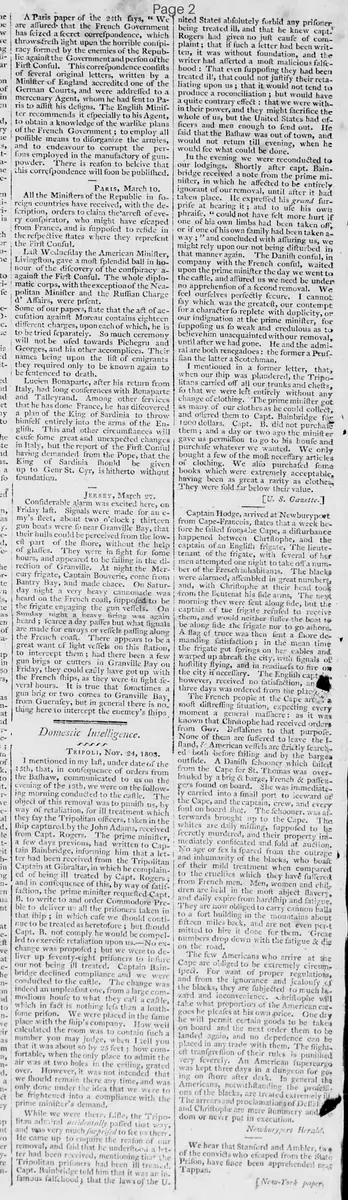
Tripoli, Nov. 24, 1803.
I mentioned in my last, under date of the 15th, that, in consequence of orders from the Bashaw, communicated to us on the evening of the 15th, we were on the following morning conducted to the castle. The object of this removal was to punish us, by way of retaliation, for ill treatment which they say the Tripolitan officers, taken in the ship captured by the John Adams, received from Capt. Rogers. The prime minister, a few days previous, had written to Captain Bainbridge, informing him that a letter had been received from the Tripolitan Captain at Gibraltar, in which he complained of being ill treated by Capt. Rogers; and in consequence of this, by way of satisfaction, the prime minister requested Capt. B. to write to and order Commodore Preble to deliver up all the prisoners taken in that ship; in which case we should continue to be treated as heretofore; but should Capt. B. not comply he would be compelled to exercise retaliation upon us.--No exchange was proposed; but we were to deliver up seventy-eight prisoners to insure our not being ill treated. Captain Bainbridge declined compliance and we were conducted to the castle. The change was indeed an unpleasant one, from a large commodious house to what they call a castle, which in fact is nothing less than a loathsome prison. We were placed in the same place with the ship's company. How well calculated the room was to contain such a number you may judge, when I tell you that it was about 50 by 25 feet; how comfortable, when the only place to admit the air was at two holes in the ceiling, grated over. However, it was not intended that we should remain there any time, and was only done under the idea that we were to be frightened into a compliance with the prime minister's demand.
While we were there, Lisle, the Tripolitan admiral accidentally passed that way, and was very much surprised to see us there. He came up to enquire the reason of our removal, and said that he understood a letter had been received, mentioning that the Tripolitan prisoners had been ill treated. Capt. Bainbridge told him that it was an infamous falsehood; that the laws of the United States absolutely forbid any prisoner being treated ill, and that he knew capt. Rogers had given no just cause of complaint; that if such a letter had been written, it was without foundation, and the writer had asserted a most malicious falsehood: That even supposing they had been treated ill, that could not justify their retaliating upon us; that it would not tend to produce a reconciliation; but would have a quite contrary effect: that we were within their power, and they might sacrifice the whole of us, but the United States had officers and men enough to send out. He said that the Bashaw was out of town, and would not return till evening, when he would see what could be done.
In the evening we were reconducted to our lodgings. Shortly after capt. Bainbridge received a note from the prime minister, in which he affected to be entirely ignorant of our removal, until after it had taken place. He expressed his grand surprise at hearing it; and to use his own phrase, "could not have felt more hurt if one of his own limbs had been taken off; or if one of his own family had been taken away;" and concluded with assuring us, we might rely upon our not being disturbed in that manner again. The Danish consul, in company with the French consul, waited upon the prime minister the day we went to the castle, and assured us we need be under no apprehension of a second removal. We feel ourselves perfectly secure. I cannot say which was the greatest, our contempt for a character so replete with duplicity, or our indignation at the prime minister, for supposing us so weak and credulous as to believe him unacquainted with our removal, until after we had gone. He and the admiral are both renegadoes: the former a Prussian the latter a Scotchman.
I mentioned in a former letter, that, when our ship was plundered, the Tripolitans carried off all our trunks and chests, so that we were left entirely without any change of clothing. The prime minister got as many of our clothes as he could collect, and offered them to Capt. Bainbridge for 1000 dollars. Capt. B. did not purchase them; and a day or two ago the minister gave us permission to go to his house and purchase whatever we wanted. We only bought a few of the most necessary articles of clothing. We also purchased some books which were extremely acceptable, having been as great a rarity as clothes. They were sold far below their value.
[U. S. Gazette.]
What sub-type of article is it?
What keywords are associated?
What entities or persons were involved?
Where did it happen?
Domestic News Details
Primary Location
Tripoli
Event Date
Nov. 15 24, 1803
Key Persons
Outcome
american officers briefly imprisoned in castle then returned to lodgings; no casualties; assurances of no further disturbance; purchased clothing and books.
Event Details
American officers removed to castle prison on morning after Nov. 15 as retaliation for alleged ill treatment of 78 Tripolitan prisoners captured by John Adams under Capt. Rogers; Capt. Bainbridge declines prime minister's demand to release prisoners; interaction with admiral Lisle; returned to lodgings evening of Nov. 16; prime minister denies prior knowledge; consuls provide assurances.