Thank you for visiting SNEWPapers!
Sign up free
Editorial
December 3, 1948
Browning Chief
Browning, Glacier County, Montana
What is this article about?
The editorial views the Tokyo tribunal's sentencing of Hideki Tojo and others as symbolic justice for Pearl Harbor, critiques emperor exclusion and ex post facto issues, praises it as a step toward world law, and warns against preventive war ideas.
Clipping
OCR Quality
100%
Excellent
Full Text
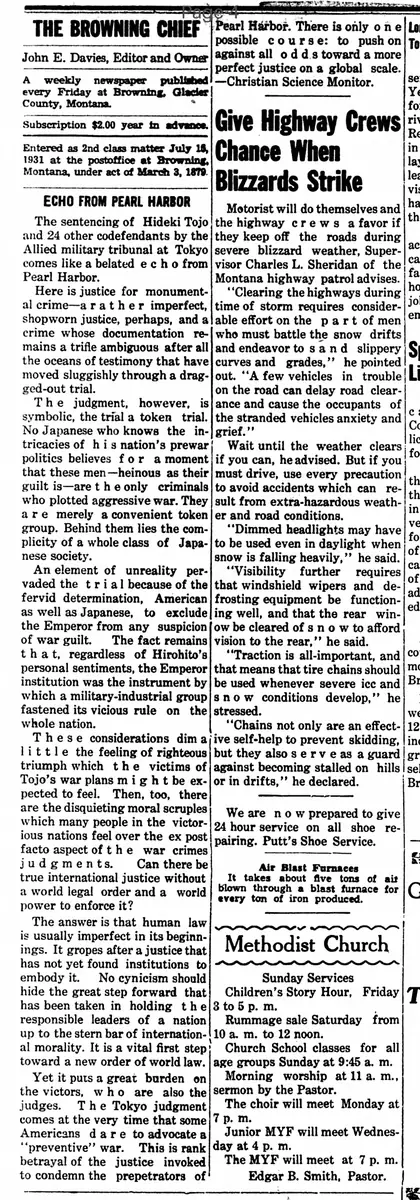
ECHO FROM PEARL HARBOR
The sentencing of Hideki Tojo and 24 other codefendants by the Allied military tribunal at Tokyo comes like a belated echo from Pearl Harbor.
Here is justice for monumental crime-a rather imperfect, shopworn justice, perhaps, and a crime whose documentation remains a trifle ambiguous after all the oceans of testimony that have moved sluggishly through a dragged-out trial.
The judgment, however, is symbolic, the trial a token trial.
No Japanese who knows the intricacies of his nation's prewar politics believes for a moment that these men-heinous as their guilt is-are the only criminals who plotted aggressive war. They are merely a convenient token group. Behind them lies the complicity of a whole class of Japanese society.
An element of unreality pervaded the trial because of the fervid determination, American as well as Japanese, to exclude the Emperor from any suspicion of war guilt.
The fact remains that, regardless of Hirohito's personal sentiments, the Emperor institution was the instrument by which a military-industrial group fastened its vicious rule on the whole nation.
These considerations dim a little the feeling of righteous triumph which the victims of Tojo's war plans might be expected to feel. Then, too, there are the disquieting moral scruples which many people in the victorious nations feel over the ex post facto aspect of the war crimes judgments. Can there be true international justice without a world legal order and a world power to enforce it?
The answer is that human law is usually imperfect in its beginnings. It gropes after a justice that has not yet found institutions to embody it. No cynicism should hide the great step forward that has been taken in holding the responsible leaders of a nation up to the stern bar of international morality. It is a vital first step toward a new order of world law.
Yet it puts a great burden on the victors, who are also the judges. The Tokyo judgment comes at the very time that some Americans dare to advocate a "preventive" war. This is rank betrayal of the justice invoked to condemn the perpetrators of Pearl Harbor. There is only one possible course: to push on against all odds toward a more perfect justice on a global scale.
--Christian Science Monitor.
The sentencing of Hideki Tojo and 24 other codefendants by the Allied military tribunal at Tokyo comes like a belated echo from Pearl Harbor.
Here is justice for monumental crime-a rather imperfect, shopworn justice, perhaps, and a crime whose documentation remains a trifle ambiguous after all the oceans of testimony that have moved sluggishly through a dragged-out trial.
The judgment, however, is symbolic, the trial a token trial.
No Japanese who knows the intricacies of his nation's prewar politics believes for a moment that these men-heinous as their guilt is-are the only criminals who plotted aggressive war. They are merely a convenient token group. Behind them lies the complicity of a whole class of Japanese society.
An element of unreality pervaded the trial because of the fervid determination, American as well as Japanese, to exclude the Emperor from any suspicion of war guilt.
The fact remains that, regardless of Hirohito's personal sentiments, the Emperor institution was the instrument by which a military-industrial group fastened its vicious rule on the whole nation.
These considerations dim a little the feeling of righteous triumph which the victims of Tojo's war plans might be expected to feel. Then, too, there are the disquieting moral scruples which many people in the victorious nations feel over the ex post facto aspect of the war crimes judgments. Can there be true international justice without a world legal order and a world power to enforce it?
The answer is that human law is usually imperfect in its beginnings. It gropes after a justice that has not yet found institutions to embody it. No cynicism should hide the great step forward that has been taken in holding the responsible leaders of a nation up to the stern bar of international morality. It is a vital first step toward a new order of world law.
Yet it puts a great burden on the victors, who are also the judges. The Tokyo judgment comes at the very time that some Americans dare to advocate a "preventive" war. This is rank betrayal of the justice invoked to condemn the perpetrators of Pearl Harbor. There is only one possible course: to push on against all odds toward a more perfect justice on a global scale.
--Christian Science Monitor.
What sub-type of article is it?
War Or Peace
Foreign Affairs
Legal Reform
What keywords are associated?
Tokyo Tribunal
Tojo Sentencing
Pearl Harbor
War Guilt
International Justice
Preventive War
Emperor Hirohito
What entities or persons were involved?
Hideki Tojo
Emperor Hirohito
Allied Military Tribunal
Japanese Military Industrial Group
Editorial Details
Primary Topic
Tokyo War Crimes Tribunal And International Justice
Stance / Tone
Supportive Of Trial As Step Toward World Law, Critical Of Emperor Exclusion And Preventive War
Key Figures
Hideki Tojo
Emperor Hirohito
Allied Military Tribunal
Japanese Military Industrial Group
Key Arguments
Sentencing Echoes Pearl Harbor Justice For Aggressive War
Trial Symbolic, Not Comprehensive, As Only Token Group Prosecuted
Emperor Institution Enabled Military Rule Despite Personal Sentiments
Ex Post Facto Concerns In War Crimes Judgments
Trial Advances International Morality Toward World Law
Victors Must Avoid Preventive War To Uphold Justice