Thank you for visiting SNEWPapers!
Sign up free
Literary
October 12, 1843
The Madisonian
Washington, District Of Columbia
What is this article about?
Newspaper extract praises Crawford's Designs, engravings of sculptures by American artist Thomas Crawford. Describes the first bas-relief depicting the legend of Dibutades of Sycion, where a potter's daughter traces her lover's shadow, originating bas-relief art, emphasizing love and artistic dedication.
Clipping
OCR Quality
98%
Excellent
Full Text
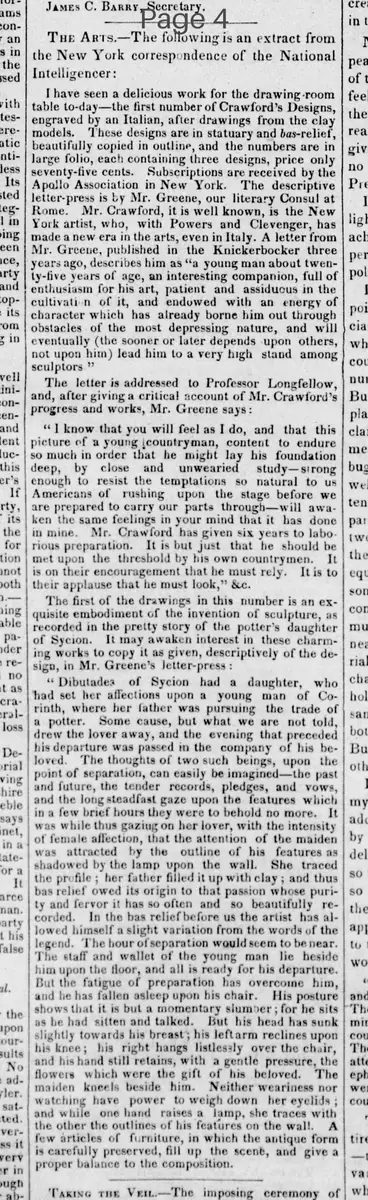
The Arts.—The following is an extract from the New York correspondence of the National Intelligencer:
I have seen a delicious work for the drawing-room table to-day—the first number of Crawford's Designs, engraved by an Italian, after drawings from the clay models. These designs are in statuary and bas-relief, beautifully copied in outline, and the numbers are in large folio, each containing three designs, price only seventy-five cents. Subscriptions are received by the Apollo Association in New York. The descriptive letter-press is by Mr. Greene, our literary Consul at Rome. Mr. Crawford, it is well known, is the New York artist, who, with Powers and Clevenger, has made a new era in the arts, even in Italy. A letter from Mr. Greene, published in the Knickerbocker three years ago, describes him as "a young man about twenty-five years of age, an interesting companion, full of enthusiasm for his art, patient and assiduous in the cultivation of it, and endowed with an energy of character which has already borne him out through obstacles of the most depressing nature, and will eventually (the sooner or later depends upon others, not upon him) lead him to a very high stand among sculptors."
The letter is addressed to Professor Longfellow, and, after giving a critical account of Mr. Crawford's progress and works, Mr. Greene says:
"I know that you will feel as I do, and that this picture of a young countryman, content to endure so much in order that he might lay his foundation deep, by close and unwearied study—strong enough to resist the temptations so natural to us Americans of rushing upon the stage before we are prepared to carry our parts through—will awaken the same feelings in your mind that it has done in mine. Mr. Crawford has given six years to laborious preparation. It is but just that he should be met upon the threshold by his own countrymen. It is on their encouragement that he must rely. It is to their applause that he must look," &c.
The first of the drawings in this number is an exquisite embodiment of the invention of sculpture, as recorded in the pretty story of the potter's daughter of Sycion. It may awaken interest in these charming works to copy it as given, descriptively of the design, in Mr. Greene's letter-press:
"Dibutades of Sycion had a daughter, who had set her affections upon a young man of Corinth, where her father was pursuing the trade of a potter. Some cause, but what we are not told, drew the lover away, and the evening that preceded his departure was passed in the company of his beloved. The thoughts of two such beings, upon the point of separation, can easily be imagined—the past and future, the tender records, pledges, and vows, and the long steadfast gaze upon the features which in a few brief hours they were to behold no more. It was while thus gazing on her lover, with the intensity of female affection, that the attention of the maiden was attracted by the outline of his features as shadowed by the lamp upon the wall. She traced the profile; her father filled it up with clay; and thus bas relief owed its origin to that passion whose purity and fervor it has so often and so beautifully recorded. In the bas relief before us the artist has allowed himself a slight variation from the words of the legend. The hour of separation would seem to be near. The staff and wallet of the young man lie beside him upon the floor, and all is ready for his departure. But the fatigue of preparation has overcome him, and he has fallen asleep upon his chair. His posture shows that it is but a momentary slumber; for he sits as he had sitten and talked. But his head has sunk slightly towards his breast; his left arm reclines upon his knee; his right hangs listlessly over the chair, and his hand still retains, with a gentle pressure, the flowers which were the gift of his beloved. The maiden kneels beside him. Neither weariness nor watching have power to weigh down her eyelids; and while one hand raises a lamp, she traces with the other the outlines of his features on the wall. A few articles of furniture, in which the antique form is carefully preserved, fill up the scene, and give a proper balance to the composition."
I have seen a delicious work for the drawing-room table to-day—the first number of Crawford's Designs, engraved by an Italian, after drawings from the clay models. These designs are in statuary and bas-relief, beautifully copied in outline, and the numbers are in large folio, each containing three designs, price only seventy-five cents. Subscriptions are received by the Apollo Association in New York. The descriptive letter-press is by Mr. Greene, our literary Consul at Rome. Mr. Crawford, it is well known, is the New York artist, who, with Powers and Clevenger, has made a new era in the arts, even in Italy. A letter from Mr. Greene, published in the Knickerbocker three years ago, describes him as "a young man about twenty-five years of age, an interesting companion, full of enthusiasm for his art, patient and assiduous in the cultivation of it, and endowed with an energy of character which has already borne him out through obstacles of the most depressing nature, and will eventually (the sooner or later depends upon others, not upon him) lead him to a very high stand among sculptors."
The letter is addressed to Professor Longfellow, and, after giving a critical account of Mr. Crawford's progress and works, Mr. Greene says:
"I know that you will feel as I do, and that this picture of a young countryman, content to endure so much in order that he might lay his foundation deep, by close and unwearied study—strong enough to resist the temptations so natural to us Americans of rushing upon the stage before we are prepared to carry our parts through—will awaken the same feelings in your mind that it has done in mine. Mr. Crawford has given six years to laborious preparation. It is but just that he should be met upon the threshold by his own countrymen. It is on their encouragement that he must rely. It is to their applause that he must look," &c.
The first of the drawings in this number is an exquisite embodiment of the invention of sculpture, as recorded in the pretty story of the potter's daughter of Sycion. It may awaken interest in these charming works to copy it as given, descriptively of the design, in Mr. Greene's letter-press:
"Dibutades of Sycion had a daughter, who had set her affections upon a young man of Corinth, where her father was pursuing the trade of a potter. Some cause, but what we are not told, drew the lover away, and the evening that preceded his departure was passed in the company of his beloved. The thoughts of two such beings, upon the point of separation, can easily be imagined—the past and future, the tender records, pledges, and vows, and the long steadfast gaze upon the features which in a few brief hours they were to behold no more. It was while thus gazing on her lover, with the intensity of female affection, that the attention of the maiden was attracted by the outline of his features as shadowed by the lamp upon the wall. She traced the profile; her father filled it up with clay; and thus bas relief owed its origin to that passion whose purity and fervor it has so often and so beautifully recorded. In the bas relief before us the artist has allowed himself a slight variation from the words of the legend. The hour of separation would seem to be near. The staff and wallet of the young man lie beside him upon the floor, and all is ready for his departure. But the fatigue of preparation has overcome him, and he has fallen asleep upon his chair. His posture shows that it is but a momentary slumber; for he sits as he had sitten and talked. But his head has sunk slightly towards his breast; his left arm reclines upon his knee; his right hangs listlessly over the chair, and his hand still retains, with a gentle pressure, the flowers which were the gift of his beloved. The maiden kneels beside him. Neither weariness nor watching have power to weigh down her eyelids; and while one hand raises a lamp, she traces with the other the outlines of his features on the wall. A few articles of furniture, in which the antique form is carefully preserved, fill up the scene, and give a proper balance to the composition."
What sub-type of article is it?
Essay
Prose Fiction
What themes does it cover?
Love Romance
Moral Virtue
What keywords are associated?
Crawford Designs
Bas Relief
Dibutades Sycion
Sculpture Origin
American Artist
Thomas Crawford
Love Separation
What entities or persons were involved?
Mr. Greene (Letter Press); New York Correspondence Of The National Intelligencer
Literary Details
Author
Mr. Greene (Letter Press); New York Correspondence Of The National Intelligencer
Subject
Description Of Crawford's Designs, First Bas Relief On The Invention Of Sculpture
Form / Style
Descriptive Prose Narrative Of A Legendary Origin Story
Key Lines
Dibutades Of Sycion Had A Daughter, Who Had Set Her Affections Upon A Young Man Of Corinth, Where Her Father Was Pursuing The Trade Of A Potter.
She Traced The Profile; Her Father Filled It Up With Clay; And Thus Bas Relief Owed Its Origin To That Passion Whose Purity And Fervor It Has So Often And So Beautifully Recorded.
The Maiden Kneels Beside Him. Neither Weariness Nor Watching Have Power To Weigh Down Her Eyelids; And While One Hand Raises A Lamp, She Traces With The Other The Outlines Of His Features On The Wall.