Thank you for visiting SNEWPapers!
Sign up free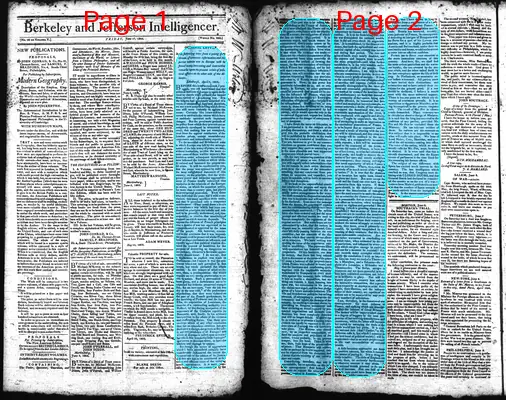
Berkeley And Jefferson Intelligencer
Martinsburg, Berkeley County, Virginia
What is this article about?
A letter from Edinburgh dated April 5, 1803, analyzes the escalating tensions between Britain and France, attributing them to French violations of the Treaty of Amiens, refusal to evacuate Malta, and Bonaparte's aggressions. It predicts inevitable war, discusses Britain's preparedness, and notes domestic calls for Pitt's return to ministry.
Merged-components note: Continuation of the original letter from Edinburgh discussing European political crisis and potential war; text flows directly from the end of the first part.
Clippings

1 of 2
OCR Quality
Full Text
In the following letter from a young gentleman of extensive information and superior talents now in Europe will be found many interesting and instructive remarks upon the present crisis of political affairs on the other side of the Atlantic.
Edinburgh, April 5, 1803.
BEFORE this letter is received, I presume, you will have heard that the political horizon of Europe is again darkened by clouds which portend the immediate revival of a desolating war. Ere the billows had completely subsided of a storm of unexampled fury and duration, we see a new tempest arising which threatens, still more violently to agitate the ocean. Curiosity like yours will be directed to ascertain the causes, which have so suddenly operated such important changes. But the proximate grounds of the policy from which they proceed are so completely enveloped in ministerial secrecy, that nothing has yet transpired, even from the sapient conductors of the London prints, except unsatisfactory conjectures and contradictory reports.
To the unsettled and ill-balanced state in which Europe was left by the arrangements of the late treaty of peace, we may, without hesitation, ascribe the more remote cause of these warlike aspects: But doubtless some subsequent occurrences have inflamed the irritation which already existed and hastened the present awful crisis. It will be recollected by you, that the peace was opposed by many of the most enlightened statesmen of this country, on the principle, that the overgrown power and immense aggrandizement of France totally subverted that equipoise in the relations of the European states, on which the soundest policy for more than a century past, has placed their reciprocal protection. Even those who defended the peace did it with a conviction, that many sacrifices were made, and that it promised only a temporary continuance. They acted from a desire to terminate a war which had been conducted on principles too subtle and refined to be generally understood, and, consequently, to receive that unanimity of support on which success depends. To oppose the diffusion of French principles was a motive of war too equivocal to be comprehended or approved by the mass of the people. All, however, concurred in the sentiment that it was impossible peace could be preserved whilst France held so disproportionate an influence, and equally agreed that political wisdom dictated the renewal of hostilities for the purpose of destroying so dangerous an ascendency, whenever a favorable opportunity should occur. I do not say, that a declaration as explicit was made in Parliament but I assert it was the sentiment which not only prevailed in that house, but which pervaded the whole nation. In this temper of mind we detect, then, a predisposition that would require no very strong provocation to excite to action. Such a provocation has been given, and a forbearance not to be expected has hitherto preserved tranquillity, for we have seen, ere the ink was dry or the wax cold, of the preliminary stipulations, that they were violated on the part of the French government, by the annexing of Piedmont and the Isle of Elba, the acquisition of Louisiana, the exercise of a controlling authority over Holland, by the daring usurpation of the supremacy of the Cisalpine republic by Bonaparte, and, finally, by his arbitrary interposition in the affairs of the virtuous and unoffending Swiss. Can these proceedings admit of any other conclusion than that an atrocious ambition has premeditated a design dangerous to the safety and independence of all Europe? and which all Europe is called upon to resist? but which this wonderful little sea-girt spot seems at this time alone, to have the wisdom and courage to oppose.
But though the series of aggressions which I have mentioned certainly have considerably influenced the recent determinations of the cabinet of St. James, still they are not to be considered as the direct and efficient cause of the existing hostile appearances. It is more generally believed they are occasioned by the
Peremptory refusal of Britain to evacuate Malta. This post was to be relinquished, according to the Treaty of Amiens, but it is now alleged that France can very ill exact a compliance with the stipulations of a treaty—the obligations of which she has so nearly disregarded. It is moreover urged, and which cannot be controverted, that a treaty ceases to be obligatory when the relative situation of the contracting parties differs from what it was when the contract was made. Have not the relative circumstances of the two countries been most materially altered since the period of forming the treaty, by the vast accession of territory which France has acquired, and by her still more extensive indirect influences? Besides, you will recollect that the stipulation respecting Malta was provisional; that is, if Russia would consent to guarantee it. Now as that power has positively refused to do so, and as evidently, in Europe, no other guarantee could be procured that would not be under the influence of France, what can Britain do else but retain it? Every consideration of right and policy forbids it to be relinquished. For were she to evacuate it, there is a certainty of its being virtually or absolutely possessed by her enemy, which would open the way to the invasion of Egypt and expose her Indian possessions to the danger of annoyance if not of conquest.
I have dwelt the more on this point, as I am persuaded it is the subject of the pending discussions—and from a wish to give you the probable vindication that will be published by Britain to the world in the event of a renewal of hostilities. You are, however, to give to my communications no greater confidence than you may suppose they merit as conveying only the most plausible and best supported conjectures which prevail here.
On the very interesting question of the probability of peace or war, I am sure you will eagerly solicit information; but we yet remain in such entire darkness, even as to the causes of the misunderstanding, that any conclusion from premises so uncertain and imperfect, you must be sensible, will be liable to extreme fallacy and deception.
If we look to the unparalleled exertions employed to prepare and equip the navy for service, and likewise to the equally active arrangements in the army, we shall certainly be disposed to conclude that war is inevitable and will very shortly be declared. Ever since the message from the throne the pressing of seamen and the commissioning of ships have been unremittingly continued. The militia have also been ordered out and the most prompt and effectual means are used to recruit completely the regiments of the regular service. But some hopes are yet entertained by a few that the matters in dispute may be amicably adjusted. Couriers are daily passing between the two countries; but the contents of the dispatches which they convey are not allowed to transpire. We have nothing respecting the issue of the negotiation entitled to credibility. The papers are filled with speculations but founded alone on conjecture. Of this however, you may be certain, that there has long existed here a discontent at the terms of the peace (I mean a jealousy of the preponderance which France was suffered to retain) and that the insolence and overbearing spirit, together with the implacable animosity manifested by Bonaparte on every occasion against this country have irritated it into so hostile a disposition, that nothing can restrain it from bursting into open war, but submission on his part to the claims now urged, and the best pledge given of a future amicable intention. The vile and treacherous policy he has so long pursued, of attempting to embarrass the commerce and injure the finances of the country by exciting a constant alarm, by provoking to frequent armaments and then obviating an actual rupture by protracted negotiations and ultimate concessions, has been completely detected and will no longer delude. If affairs can be so settled as to promise a lasting peace (which can hardly be expected in the present state of Europe) war will inevitably take place. The minister who should now, by an imperfect compromise, offend the passions and prejudices of the nation, would probably, in its present temper, lose his head. There is with me, then, little hope of the preservation of peace. That Bonaparte will retract, as far as perhaps he is now required, cannot be expected from his character, and I know that the ministry of this country dare not recede.
Considering, therefore, that war is unavoidable, let us speculate on the probable consequences: And first I will endeavor to expose the error of a very prevalent notion in America, that Great Britain was nearly reduced to bankruptcy by the expenses of the late war, and demonstrate to your entire satisfaction (if you will accredit my statements) her competency to resume and maintain the contest. It is so far from being true, that the war diminished the national wealth, that it did not even check its augmentation. It is established, by the clearest evidence, that both the agricultural and commercial capital of the country was increased during that period. The rent and price of lands were nearly doubled, and the exports and imports were in nearly the same proportion; and what further establishes it, is the very sensible melioration in the credit of the people. This increase of affluence, I am told by those who are competent to decide, is very obvious in every grade of society. If then, at the conclusion of a war of unprecedented sacrifice and expense (which though generally distinguished by the most glorious and successful achievements, was yet marked by some of the heaviest losses and misfortunes) we find that instead of the prosperity of the nation being unfavorably affected, its resources had flourished and multiplied beyond example, we cannot entertain a doubt of her adequacy to support the threatened war, nor any reasonable apprehension of the event, if it be conducted with sagacity and discretion. Taught by experience, the futility of attempting to make an impression on the continental possessions of France, it is to be hoped that so expensive and ineffectual a mode of warring with the enemy will be abandoned, and that alone every energy will be confined to the navy, and thus, at a comparatively inconsiderable expense, a fleet will be maintained equal to the command of the ocean, to harass the coasts of France, to burn many of her towns, to seize her colonies and naval posts, and finally to destroy the remains of her navy and utterly annihilate her commerce; thus raising still higher that naval superiority of which France is now so envious. Where, then, exist the grounds of so much terror of the "mighty nation?" It is true that the phantom of an invasion has again been raised to frighten and deter. But none except the weak and the timid can ever have an apprehension from this source. If Bonaparte should, in the delirium of resentment or the intoxication of vain-glory, have the mad temerity to make the attempt, let us consider the chances of success. Is it presumable that an army of any force can effect an invasion, when watched by a navy so vigilant and powerful? But admitting (which is granting almost an impossibility) that an army of force should land—we are to recollect the numberless disadvantages with which they would have to contend, cut off from their country and without the means of supply or reinforcement, they must, even if primarily successful, be speedily vanquished by the wasting of their numbers. But this is the most unfavorable conclusion. Are we not rather warranted in concluding that British valor, when animated by the call of patriotism, and inflamed by every passion which can give energy to exertion, will not for a moment be resisted? History records many examples which will justify the conclusion I wish to impress. In Grecian story we read of a Thermopylae, a Marathon, and a Salamis—the exploits of a Leonidas, a Miltiades and a Themistocles. The Swiss, meagre in resources and not more powerful in numbers have exhibited exertions not inferior in brilliancy or glory. Nor will the history of our own country less enforce the instructive admonition, that a people when roused by an attempt to seize their rights, their liberties, and the independence of their country, are capable of exertions not to be measured by any ordinary standard of calculation.
I see, therefore, in the threatened war consequences the most ruinous to France, and nothing which can materially affect the interest of Great Britain. The former will be impoverished almost to a degree of beggary by the total suspension of her reviving manufactures and commerce, whilst the latter will increase her capital by sweeping the trade of the whole world into her ports. It is true, the national debt (that "Canker," as Mr. Jefferson calls it, but which I consider as the best band of political society) will be augmented but in no ways proportioned to the vast accumulation of national wealth. A debt becomes oppressive not from its positive amount, but when it exceeds the means of paying it. It is a thing entirely relative. The debt of England can never, then, be seriously burthensome to whatever amount it may attain. If the national wealth proceed in the same ratio of increase. Not one half of the present sum could have been supported by the nation fifty years ago.
You see that I have drawn nothing to my support from a supposition of a coalition on the continent against France. I think, however such a calculation may be made. Russia has betrayed, recently, some jealousy of France, in consequence of detecting an intrigue of Bonaparte with the Porte for a part of his Levant possessions, and it is highly probable that Austria and Switzerland, under their recent insults and losses, would not be averse to enter into an efficient coalition.
Permit me to direct your attention to the more immediate concerns of this country. And here, Sir, we shall find the most ardent patriotism and the warmest loyalty, the one aroused by the present crisis, and the other called forth by the late conspiracy against the life of their king. In Parliament, an unanimity never before witnessed. All parties seem to have buried their distinctions and animosities and to have united their exertions for the general good. If a war should be declared, I believe it would meet with the most universal support. There is but one point on which any diversity of sentiment prevails. It is an opposition to the present Ministry, as being incompetent to the present conjuncture. The recall of Mr. Pitt is clamorously demanded. Many rumours are in circulation about a change of Ministry. It is said that the king has assented to the coalition of any parties, provided Mr. Pitt and Mr. Fox be excluded from the Ministry. He can tolerate neither of them. So various are the rumours on this subject that it is impossible to say what will really take place. We hear of Lord Moira, Grey, Sheridan, and several of the old ministry coming into office. The voice of the nation, which so vehemently calls for Mr. Pitt, must, however be obeyed. It is even said that this is already determined, and that the Easter recess of parliament is the time fixed for his resuming his former offices.
The subject of our difference with Spain has excited much interest in this country. The last intelligence which reached us was, that Congress were debating with CLOSED DOORS, and that General Smith had declared he considered the country as on the eve of a war. Letters from Madrid published here mention that the conduct of Spain towards us proceeds entirely from the instigation of France. Is the matter considered in this light in America?
What sub-type of article is it?
What keywords are associated?
What entities or persons were involved?
Where did it happen?
Foreign News Details
Primary Location
Europe
Event Date
April 5, 1803
Key Persons
Outcome
war between britain and france predicted as inevitable; britain expected to maintain naval superiority and economic growth, while france faces ruinous consequences from loss of commerce and colonies.
Event Details
Letter discusses French violations of Treaty of Amiens including annexations in Piedmont, Elba, Louisiana, control over Holland and Cisalpine Republic, and interference in Swiss affairs. Britain's refusal to evacuate Malta cited as immediate cause of tensions. Ongoing negotiations amid military preparations; domestic British unity and calls for Pitt's return to ministry noted. Speculates on war outcomes favoring Britain.