Thank you for visiting SNEWPapers!
Sign up free
Southern Pioneer, And Carroll, Choctaw And Tallahatchie Counties Advertiser
Carrollton, Carroll County, Mississippi
What is this article about?
The U.S. Supreme Court ruled that state laws interfering with owners' rights to seize fugitive slaves are unconstitutional, affirming Congress's exclusive legislative authority under the Fugitive Slave Clause and federal supremacy over state interference.
Clipping
OCR Quality
Full Text
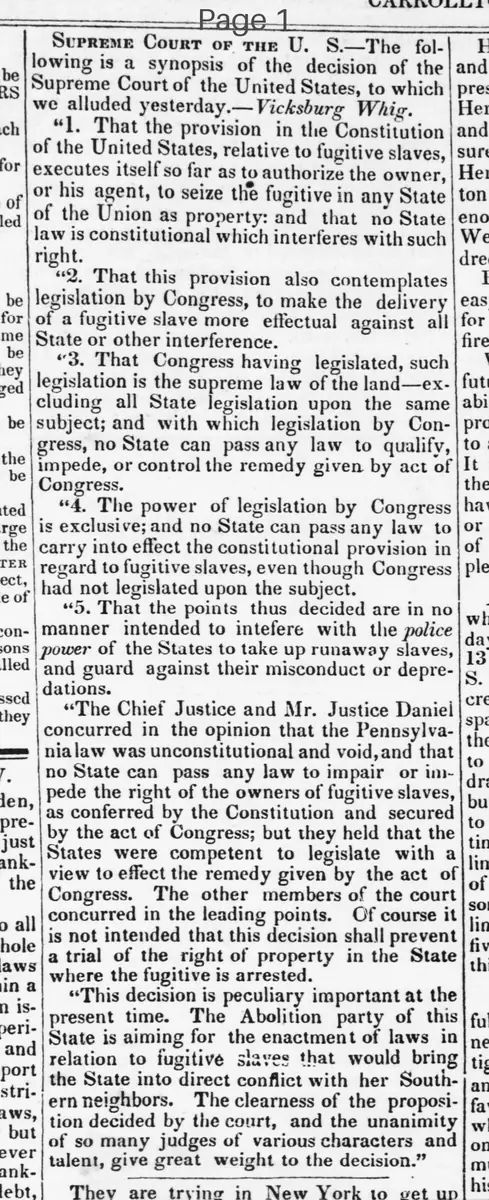
"1. That the provision in the Constitution of the United States, relative to fugitive slaves, executes itself so far as to authorize the owner, or his agent, to seize the fugitive in any State of the Union as property: and that no State law is constitutional which interferes with such right.
"2. That this provision also contemplates legislation by Congress, to make the delivery of a fugitive slave more effectual against all State or other interference.
"3. That Congress having legislated, such legislation is the supreme law of the land-excluding all State legislation upon the same subject; and with which legislation by Congress, no State can pass any law to qualify, impede, or control the remedy given by act of Congress.
"4. The power of legislation by Congress is exclusive; and no State can pass any law to carry into effect the constitutional provision in regard to fugitive slaves, even though Congress had not legislated upon the subject.
"5. That the points thus decided are in no manner intended to interfere with the police power of the States to take up runaway slaves, and guard against their misconduct or depredations.
"The Chief Justice and Mr. Justice Daniel concurred in the opinion that the Pennsylvania law was unconstitutional and void, and that no State can pass any law to impair or impede the right of the owners of fugitive slaves, as conferred by the Constitution and secured by the act of Congress; but they held that the States were competent to legislate with a view to effect the remedy given by the act of Congress.
The other members of the court concurred in the leading points. Of course it is not intended that this decision shall prevent a trial of the right of property in the State where the fugitive is arrested.
"This decision is peculiarly important at the present time. The Abolition party of this State is aiming for the enactment of laws in relation to fugitive slaves that would bring the State into direct conflict with her Southern neighbors. The clearness of the proposition decided by the court, and the unanimity of so many judges of various characters and talent, give great weight to the decision."
What sub-type of article is it?
What keywords are associated?
What entities or persons were involved?
Domestic News Details
Key Persons
Outcome
pennsylvania law declared unconstitutional and void; affirms exclusive federal authority over fugitive slave provisions, preventing state interference.
Event Details
Synopsis of U.S. Supreme Court decision holding that the Constitution allows owners to seize fugitive slaves without state interference; Congress's legislation is supreme law, excluding state laws; states may not legislate on the subject even if Congress has not; does not affect state police powers over runaways. Chief Justice and Justice Daniel concurred with nuances on state competence to aid federal remedy.