Thank you for visiting SNEWPapers!
Sign up free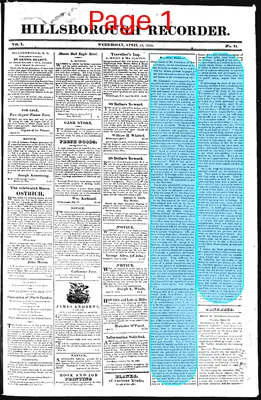
Story
April 19, 1820
The Hillsborough Recorder
Hillsboro, Orange County, North Carolina
What is this article about?
Mr. Cushman of Massachusetts delivers a passionate speech opposing the repeal or modification of pensions for Revolutionary War veterans, emphasizing their sacrifices, quoting Washington, and urging gratitude and justice from the government.
Clipping
OCR Quality
95%
Excellent
Full Text
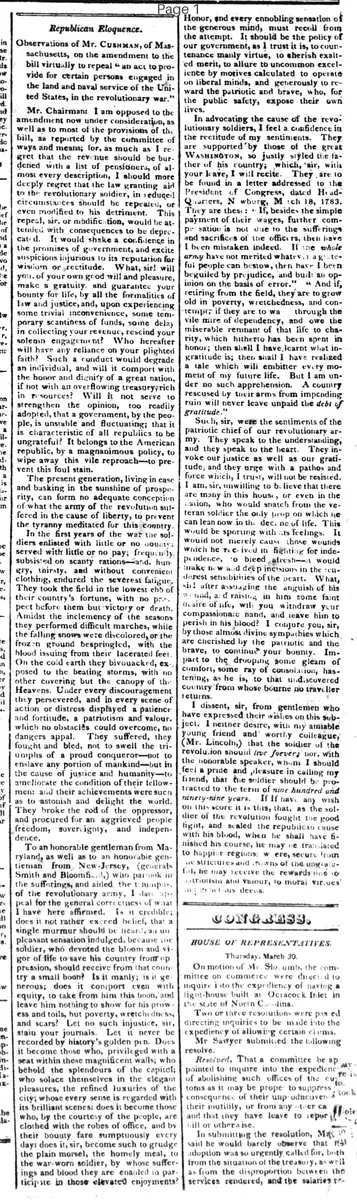
Republican Eloquence.
Observations of Mr. Cushman, of Massachusetts, on the amendment to the bill virtually to repeal " an act to provide for certain persons engaged in the land and naval service of the United States, in the revolutionary war."
Mr. Chairman: I am opposed to the amendment now under consideration, as well as to most of the provisions of the bill, as reported by the committee of ways and means; for, as much as I regret that the revenue should be burdened with a list of pensioners, of almost every description, I should more deeply regret that the law granting aid to the revolutionary soldier, in reduced circumstances should be repealed, or even modified to his detriment. This repeal, sir, or modification, would be attended with consequences to be deprecated. It would shake a confidence in the promises of government, and excite suspicions injurious to its reputation for wisdom or rectitude. What, sir! will you, of your own good will and pleasure, make a gratuity. and guarantee your bounty for life, by all the formalities of law and justice, and, upon experiencing some trivial inconvenience, some temporary scantiness of funds, some delay in collecting your revenue, rescind your solemn engagement? Who hereafter will have any reliance on your plighted faith? Such a conduct would degrade an individual, and will it comport with the honor and dignity of a great nation, if not with an overflowing treasury; rich in resources? Will it not serve to strengthen the opinion, too readily adopted, that a government, by the people, is unstable and fluctuating; that it is characteristic of all republics to be ungrateful? It belongs to the American republic, by a magnanimous policy, to wipe away this vile reproach-to prevent this foul stain.
The present generation, living in ease and basking in the sunshine of prosperity, can form no adequate conception of what the army of the revolution suffered in the cause of liberty, to prevent the tyranny meditated for this country.
In the first years of the war the soldiers enlisted with little or no bounty: served with little or no pay; frequently subsisted on scanty rations-and, hungry, thirsty, and without convenient clothing, endured the severest fatigue.
They took the field in the lowest ebb of their country's fortune, with no prospect before them but victory or death.
Amidst the inclemency of the seasons they performed difficult marches, while the falling snows were discolored, or the frozen ground besprinkled, with the blood issuing from their lacerated feet.
On the cold earth they bivouacked, exposed to the beating storms, with no other covering but the canopy of the Heavens. Under every discouragement they persevered, and in every scene of action or distress displayed a patience and fortitude, a patriotism and valour, which no obstacles could overcome, no dangers appal.
They suffered, they fought and bled, not to swell the triumphs of a proud conqueror-not to enslave any portion of mankind-but in the cause of justice and humanity-to ameliorate the condition of their fellow men: and their achievements were such as to astonish and delight the world.
They broke the rod of the oppressor, and procured for an aggrieved people freedom, sovereignty, and independence.
To an honorable gentleman from Maryland, as well as to an honorable gentleman from New-Jersey, (generals Smith and Bloomfield,) who partook in the sufferings, and aided the triumphs. of the revolutionary army, I dare appeal for the general correctness; of what I have here affirmed. Is it credible: does it not rather exceed belief, that a single murmur should be heard, an unpleasant sensation indulged, because the soldier, who devoted the bloom and vigor of life to save his country from oppression, should receive from that country a small boon? Is it manly; is it generous; does it comport even with equity, to take from him this boon, and leave him nothing to show for his prowess and toils, but poverty, wretchedness, and scars? Let no such injustice, sir, stain your journals. Let it never be recorded by history's golden pen. Does it become those who, privileged with a seat within these magnificent walls; who behold the splendours of the capitol: who solace themselves in the elegant pleasures, the refined luxuries of the city; whose every sense is gratified with its brilliant scenes: does it become those who, by the courtesy of the people, are clothed with the robes of office, and by their bounty fare sumptuously every day: does it, sir, become such to grudge the plain morsel, the homely meal, to the war-worn soldier, by whose sufferings and blood they are enabled to participate in those elevated enjoyments?
Honor, and every ennobling sensation of the generous mind, must recoil from the attempt. It should be the policy of our government, as I trust it is, to countenance manly virtue, to cherish exalted merit, to allure to uncommon excellence by motives calculated to operate on liberal minds, and generously to reward the patriotic and brave, who, for the public safety, expose their own lives.
In advocating the cause of the revolutionary soldiers, I feel a confidence in the rectitude of my sentiments. They are supported by those of the great WASHINGTON, so justly styled the father of his country; which, sir, with your leave, I will recite. They are to be found in a letter addressed to the President of Congress, dated Head-Quarters, Newburg, March 18, 1783.
They are these: - If, besides the simple payment of their wages, further compensation is not due to the sufferings and sacrifices of the officers, then have I been mistaken indeed. If the whole army have not merited whatever a grateful people can bestow, then have I been beguiled by prejudice, and built an opinion on the basis of error." " And if, retiring from the field, they are to grow old in poverty, wretchedness, and contempt;" if they are to wade through the vile mire of dependency, and owe the miserable remnant of that life to charity, which hitherto has been spent in honor: then shall I have learnt what ingratitude is; then shall I have realized a tale which will embitter every moment of my future life. But I am under no such apprehension. A country rescued by their arms from impending ruin will never leave unpaid the debt of gratitude."
Such, sir, were the sentiments of the patriotic chief of our revolutionary army. They speak to the understanding, and they speak to the heart. They invoke our justice as well as our gratitude, and they urge with a pathos and force which, I trust, will not be resisted.
I am, sir, unwilling to believe that there are many in this house, or even in the nation, who would snatch from the veteran soldier the only prop on which he can lean now in the decline of life. This would be sporting with his feelings. It would not merely cause those wounds which he received in fighting for independence, to bleed afresh--it would make new and deep incisions in the tenderest sensibilities of the heart. What, sir! after assuaging the anguish of his wound, and raising in him some faint desire of life, will you withdraw your compassionate hand, and leave him to perish in his blood? I conjure you, sir, by those almost divine sympathies which are cherished by the patriotic and the brave, to continue your bounty. Impart to the drooping some gleam of comfort, some ray of consolation, hastening, as he is, to that undiscovered country 'from whose bourne no traveller returns.'
I dissent, sir, from gentlemen who have expressed their wishes on this subject. I neither desire, with my amiable young friend and worthy colleague, (Mr. Lincoln,) that the soldier of the revolution should live forever; nor, with the honorable speaker, whom I should feel a pride and pleasure in calling my friend, that the soldier should be protracted to the term of nine hundred and ninety-nine years. If I have any wish on this score it is this, that, as the soldier of the revolution fought the good fight, and sealed the republican cause with his blood, when he shall have finished his course, he may be translated to happier regions; where, secure from the strictures and frowns of the ungrateful, he may receive the rewards due to patriotism and valour, to moral virtues
inige aet sus deas.
Observations of Mr. Cushman, of Massachusetts, on the amendment to the bill virtually to repeal " an act to provide for certain persons engaged in the land and naval service of the United States, in the revolutionary war."
Mr. Chairman: I am opposed to the amendment now under consideration, as well as to most of the provisions of the bill, as reported by the committee of ways and means; for, as much as I regret that the revenue should be burdened with a list of pensioners, of almost every description, I should more deeply regret that the law granting aid to the revolutionary soldier, in reduced circumstances should be repealed, or even modified to his detriment. This repeal, sir, or modification, would be attended with consequences to be deprecated. It would shake a confidence in the promises of government, and excite suspicions injurious to its reputation for wisdom or rectitude. What, sir! will you, of your own good will and pleasure, make a gratuity. and guarantee your bounty for life, by all the formalities of law and justice, and, upon experiencing some trivial inconvenience, some temporary scantiness of funds, some delay in collecting your revenue, rescind your solemn engagement? Who hereafter will have any reliance on your plighted faith? Such a conduct would degrade an individual, and will it comport with the honor and dignity of a great nation, if not with an overflowing treasury; rich in resources? Will it not serve to strengthen the opinion, too readily adopted, that a government, by the people, is unstable and fluctuating; that it is characteristic of all republics to be ungrateful? It belongs to the American republic, by a magnanimous policy, to wipe away this vile reproach-to prevent this foul stain.
The present generation, living in ease and basking in the sunshine of prosperity, can form no adequate conception of what the army of the revolution suffered in the cause of liberty, to prevent the tyranny meditated for this country.
In the first years of the war the soldiers enlisted with little or no bounty: served with little or no pay; frequently subsisted on scanty rations-and, hungry, thirsty, and without convenient clothing, endured the severest fatigue.
They took the field in the lowest ebb of their country's fortune, with no prospect before them but victory or death.
Amidst the inclemency of the seasons they performed difficult marches, while the falling snows were discolored, or the frozen ground besprinkled, with the blood issuing from their lacerated feet.
On the cold earth they bivouacked, exposed to the beating storms, with no other covering but the canopy of the Heavens. Under every discouragement they persevered, and in every scene of action or distress displayed a patience and fortitude, a patriotism and valour, which no obstacles could overcome, no dangers appal.
They suffered, they fought and bled, not to swell the triumphs of a proud conqueror-not to enslave any portion of mankind-but in the cause of justice and humanity-to ameliorate the condition of their fellow men: and their achievements were such as to astonish and delight the world.
They broke the rod of the oppressor, and procured for an aggrieved people freedom, sovereignty, and independence.
To an honorable gentleman from Maryland, as well as to an honorable gentleman from New-Jersey, (generals Smith and Bloomfield,) who partook in the sufferings, and aided the triumphs. of the revolutionary army, I dare appeal for the general correctness; of what I have here affirmed. Is it credible: does it not rather exceed belief, that a single murmur should be heard, an unpleasant sensation indulged, because the soldier, who devoted the bloom and vigor of life to save his country from oppression, should receive from that country a small boon? Is it manly; is it generous; does it comport even with equity, to take from him this boon, and leave him nothing to show for his prowess and toils, but poverty, wretchedness, and scars? Let no such injustice, sir, stain your journals. Let it never be recorded by history's golden pen. Does it become those who, privileged with a seat within these magnificent walls; who behold the splendours of the capitol: who solace themselves in the elegant pleasures, the refined luxuries of the city; whose every sense is gratified with its brilliant scenes: does it become those who, by the courtesy of the people, are clothed with the robes of office, and by their bounty fare sumptuously every day: does it, sir, become such to grudge the plain morsel, the homely meal, to the war-worn soldier, by whose sufferings and blood they are enabled to participate in those elevated enjoyments?
Honor, and every ennobling sensation of the generous mind, must recoil from the attempt. It should be the policy of our government, as I trust it is, to countenance manly virtue, to cherish exalted merit, to allure to uncommon excellence by motives calculated to operate on liberal minds, and generously to reward the patriotic and brave, who, for the public safety, expose their own lives.
In advocating the cause of the revolutionary soldiers, I feel a confidence in the rectitude of my sentiments. They are supported by those of the great WASHINGTON, so justly styled the father of his country; which, sir, with your leave, I will recite. They are to be found in a letter addressed to the President of Congress, dated Head-Quarters, Newburg, March 18, 1783.
They are these: - If, besides the simple payment of their wages, further compensation is not due to the sufferings and sacrifices of the officers, then have I been mistaken indeed. If the whole army have not merited whatever a grateful people can bestow, then have I been beguiled by prejudice, and built an opinion on the basis of error." " And if, retiring from the field, they are to grow old in poverty, wretchedness, and contempt;" if they are to wade through the vile mire of dependency, and owe the miserable remnant of that life to charity, which hitherto has been spent in honor: then shall I have learnt what ingratitude is; then shall I have realized a tale which will embitter every moment of my future life. But I am under no such apprehension. A country rescued by their arms from impending ruin will never leave unpaid the debt of gratitude."
Such, sir, were the sentiments of the patriotic chief of our revolutionary army. They speak to the understanding, and they speak to the heart. They invoke our justice as well as our gratitude, and they urge with a pathos and force which, I trust, will not be resisted.
I am, sir, unwilling to believe that there are many in this house, or even in the nation, who would snatch from the veteran soldier the only prop on which he can lean now in the decline of life. This would be sporting with his feelings. It would not merely cause those wounds which he received in fighting for independence, to bleed afresh--it would make new and deep incisions in the tenderest sensibilities of the heart. What, sir! after assuaging the anguish of his wound, and raising in him some faint desire of life, will you withdraw your compassionate hand, and leave him to perish in his blood? I conjure you, sir, by those almost divine sympathies which are cherished by the patriotic and the brave, to continue your bounty. Impart to the drooping some gleam of comfort, some ray of consolation, hastening, as he is, to that undiscovered country 'from whose bourne no traveller returns.'
I dissent, sir, from gentlemen who have expressed their wishes on this subject. I neither desire, with my amiable young friend and worthy colleague, (Mr. Lincoln,) that the soldier of the revolution should live forever; nor, with the honorable speaker, whom I should feel a pride and pleasure in calling my friend, that the soldier should be protracted to the term of nine hundred and ninety-nine years. If I have any wish on this score it is this, that, as the soldier of the revolution fought the good fight, and sealed the republican cause with his blood, when he shall have finished his course, he may be translated to happier regions; where, secure from the strictures and frowns of the ungrateful, he may receive the rewards due to patriotism and valour, to moral virtues
inige aet sus deas.
What sub-type of article is it?
Historical Event
Heroic Act
What themes does it cover?
Bravery Heroism
Justice
Moral Virtue
What keywords are associated?
Revolutionary War
Veterans Pensions
Congressional Speech
Soldier Sacrifices
Government Gratitude
What entities or persons were involved?
Mr. Cushman
Washington
Generals Smith
Bloomfield
Mr. Lincoln
Where did it happen?
U.S. Congress
Story Details
Key Persons
Mr. Cushman
Washington
Generals Smith
Bloomfield
Mr. Lincoln
Location
U.S. Congress
Story Details
Mr. Cushman opposes repealing pensions for Revolutionary War veterans, recounting their hardships and sacrifices, quoting Washington's letter on gratitude, and appealing for continued support to honor their service.