Thank you for visiting SNEWPapers!
Sign up free
Alexandria Daily Advertiser
Alexandria, Virginia
What is this article about?
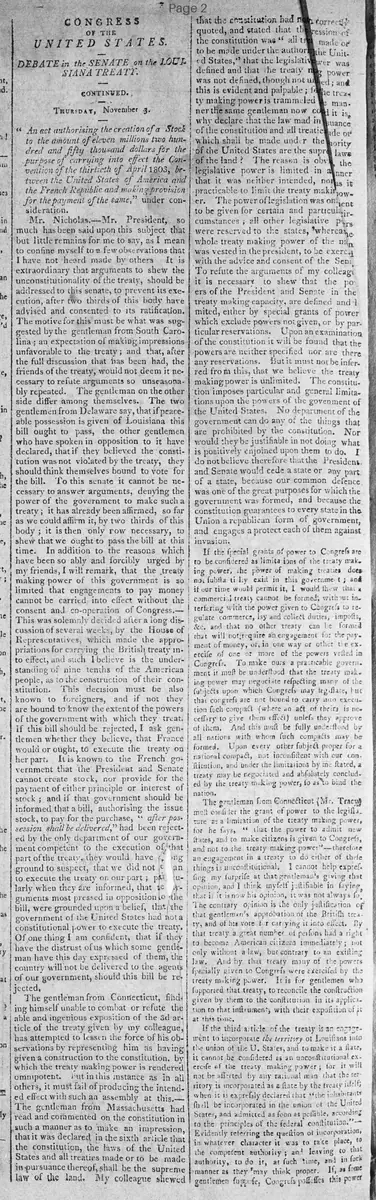
On November 3, 1803, in the US Senate, Mr. Nicholas defends a bill authorizing $11.25 million in stock to fund the Louisiana Treaty with France. He argues the treaty's constitutionality, previously ratified by two-thirds of the Senate, and stresses Congress's role in execution, warning rejection could undermine US commitments.
Merged-components note: These components form a continuous narrative of the Senate debate on the Louisiana Treaty, spanning columns on page 2 and continuing to page 3.
Clippings
1 of 2
OCR Quality
Full Text
OF THE
UNITED STATES.
DEBATE in the SENATE on the LOUISIANA TREATY.
CONTINUED.
Thursday, November 3.
"An act authorising the creation of a Stock to the amount of eleven millions two hundred and fifty thousand dollars for the purpose of carrying into effect the Convention of the thirtieth of April 1803, between the United States of America and the French Republic and making provision for the payment of the same," under consideration.
Mr. Nicholas.--Mr. President, so much has been said upon this subject that but little remains for me to say, as I mean to confine myself to a few observations that I have not heard made by others. It is extraordinary that arguments to shew the unconstitutionality of the treaty, should be addressed to this senate, to prevent its execution, after two thirds of this body have advised and consented to its ratification. The motive for this must be what was suggested by the gentleman from South Carolina; an expectation of making impressions unfavorable to the treaty; and that, after the full discussion that has been had, the friends of the treaty, would not deem it necessary to refute arguments so unseasonably repeated. The gentleman on the other side differ among themselves. The two gentlemen from Delaware say, that if peaceable possession is given of Louisiana this bill ought to pass, the other gentlemen who have spoken in opposition to it have declared, that if they believed the constitution was not violated by the treaty, they should think themselves bound to vote for the bill. To this senate it cannot be necessary to answer arguments, denying the power of the government to make such a treaty; it has already been affirmed, so far as we could affirm it, by two thirds of this body; it is then only now necessary, to shew that we ought to pass the bill at this time. In addition to the reasons which have been so ably and forcibly urged by my friends, I will remark, that the treaty making power of this government is so limited that engagements to pay money cannot be carried into effect without the consent and co-operation of Congress.-- This was solemnly decided after a long discussion of several weeks, by the House of Representatives, which made the appropriations for carrying the British treaty into effect, and such I believe is the understanding of nine tenths of the American people, as to the construction of their constitution. This decision must be also known to foreigners, and if not they are bound to know the extent of the powers of the government with which they treat. If this bill should be rejected, I ask gentlemen whether they believe, that France would or ought, to execute the treaty on her part. It is known to the French government that the President and Senate cannot create stock, nor provide for the payment of either principle or interest of stock; and if that government should be informed that a bill, authorising the issue stock, to pay for the purchase, "after possession shall be delivered," had been rejected by the only department of our government competent to the execution of that part of the treaty, they would have good ground to suspect, that we did not expect to execute the treaty on our part; particularly when they are informed, that the arguments most pressed in opposition to the bill, were grounded upon a belief, that the government of the United States had not a constitutional power to execute the treaty. Of one thing I am confident, that if they have the distrust of us which some gentlemen have this day expressed of them, the country will not be delivered to the agents of our government, should this bill be rejected. The gentleman from Connecticut, finding himself unable to combat or refute the able and ingenious exposition of the 3d article of the treaty given by my colleague has attempted to lessen the force of his observations by representing him as having given a construction to the constitution, by which the treaty making power is rendered omnipotent. But in this instance as in all others, it must fail of producing the intended effect with such an assembly as this.-- The gentleman from Massachusetts had read and commented on the constitution in such a manner as to make an impression, that it was declared in the sixth article that the constitution, the laws of the United States and all treaties made or to be made in pursuance thereof, shall be the supreme law of the land. My colleague shewed that the constitution had not been correctly quoted, and stated that the expression of the constitution was "all treaties made or to be made under the authority of the United States," that the legislative power was defined and that the treaty making power was not defined, though not unlimited; and this is evident and palpable; for the treaty making power is trammeled in a manner the same gentleman now condemns it is. Why declare that the laws made in pursuance of the constitution and all treaties made or which shall be made under the authority of the United States are the supreme laws of the land? The reason is obvious the legislative power is limited in a manner that it was neither intended, nor was it practicable to limit the treaty making power. The power of legislation was not to be given for certain and particular circumstances; all other legislative powers were reserved to the states, whereas the whole treaty making power of the nation was vested in the president, to be exercised with the advice and consent of the Senate. To refute the arguments of my colleague it is necessary to shew that the powers of the President and Senate in the treaty making capacity, are defined and limited, either by special grants of power which exclude powers not given, or by particular reservations. Upon an examination of the constitution it will be found that the powers are neither specified nor are there any reservations. But it must not be inferred from this, that we believe the treaty making power is unlimited. The constitution imposes particular and general limitations upon the powers of the government of the United States. No department of the government can do any of the things that are prohibited by the constitution. Nor would they be justifiable in not doing what is positively enjoined upon them to do. I do not believe therefore that the President and Senate would cede a state or any part of a state, because our common defence was one of the great purposes for which the government was formed, and because the constitution guarantees to every state in the Union a republican form of government, and engages to protect each of them against invasion. If the special grants of power to Congress are to be considered as limitations of the treaty making power, the power of making treaties does not substantially exist in this government; and if our time would permit it, I would shew that a commercial treaty cannot be formed without interfering with the power given to Congress to regulate commerce, lay and collect duties, imposts, &c. and that no other treaty can be formed that will not require an engagement for the payment of money, or, in one way or other tie the exercise of one or more of the powers vested in Congress. To make ours a practicable government it must be understood that the treaty making power may negotiate respecting many of the subjects upon which Congress may legislate, but that congress are not bound to carry into execution such compact (where an act of theirs is necessary to give them effect) unless they approve of them. And this must be fully understood by all nations with whom such compacts may be formed. Upon every other subject proper for a national compact, not inconsistent with our constitution, and under the limitations by me stated, a treaty may be negotiated and absolutely concluded by the treaty making power, so as to bind the nation. The gentleman from Connecticut (Mr. Tracy) must consider the grant of power to the legislature as a limitation of the treaty making power, for he says, "that the power to admit new states, and to make citizens is given to Congress, and not to the treaty making power"--therefore an engagement in a treaty to do either of these things is unconstitutional. I cannot help expressing my surprise at that gentleman's giving that opinion, and I think myself justifiable in saying that if it is now his opinion, it was not always so. The contrary Opinion is the only justification of that gentlemen's approbation of the British treaty, and of his vote for carrying it into effect. By that treaty a great number of persons had a right to become American citizens immediately; not only without a law, but contrary to an existing law. And by that treaty many of the powers especially given to Congress were exercised by the treaty making power. It is for gentlemen who supported that treaty, to reconcile the construction given by them to the constitution in its application to that instrument, with their exposition of it at this time. If the third article of the treaty is an engagement to incorporate the territory of Louisiana into the union of the U. States, and to make it a state, it cannot be considered as an unconstitutional exercise of the treaty making power; for it will not be asserted by any rational man that the territory is incorporated as a state by the treaty itself; when it is expressly declared that "the inhabitants shall be incorporated in the union of the United States, and admitted as soon as possible, according to the principles of the federal constitution."
Evidently referring the question of incorporation, in whatever character it was to take place, to the competent authority: and leaving to that authority, to do it, at such time, and in such manner as they may think proper. If, as some gentlemen suppose, Congress possesses this power
By act of Congress it in the manner that they may think most conducive to the public good. It can only be done by an amendment to the constitution, it is a matter of discretion with the states whether they will do it or not; for it cannot be done according to the principles of the federal constitution, if the Congress or the states are deprived of that discretion, which is given to the first, and reserved to the last by the constitution. In the 3d section of the 4th article of the constitution. It is said, new states may be admitted by the Congress into this union. If Congress have the power, it is derived from this source: for there are no other words in the constitution that can by any construction that can be given to them, be considered as conveying this power. If Congress have not this power, the constitutional mode would be by an amendment to the constitution, it is granted be conceded then that the admission of such territory into the union, as a state, was in the contemplation of the contracting parties, it must be understood with a reservation of the right of this Congress, or of the states to do it, or not; the words admitted as soon as possible, must refer to the voluntary admission in one of the two modes that I have mentioned; for in no other way can a state be admitted into this union.
(Debate to be Continued.)
What sub-type of article is it?
What themes does it cover?
What keywords are associated?
What entities or persons were involved?
Where did it happen?
Story Details
Key Persons
Location
United States Senate
Event Date
Thursday, November 3, 1803
Story Details
Mr. Nicholas argues in favor of the bill to fund the Louisiana Purchase treaty, defending its constitutionality, the limits of treaty-making power, and the necessity of congressional approval to ensure France's compliance.