Thank you for visiting SNEWPapers!
Sign up free
The National Intelligencer And Washington Advertiser
Washington, District Of Columbia
What is this article about?
Series of 1806 diplomatic letters between British Foreign Secretary C.J. Fox and French Foreign Minister Talleyrand discussing peace negotiations between England and France, addressing a reported assassination plot against Napoleon, peace terms based on the Treaty of Amiens, and proposals for direct talks at Lille, emphasizing honorable and durable peace without third-party interference.
Merged-components note: Continuation of diplomatic correspondence between France and England across pages.
Clippings
1 of 2
OCR Quality
Full Text
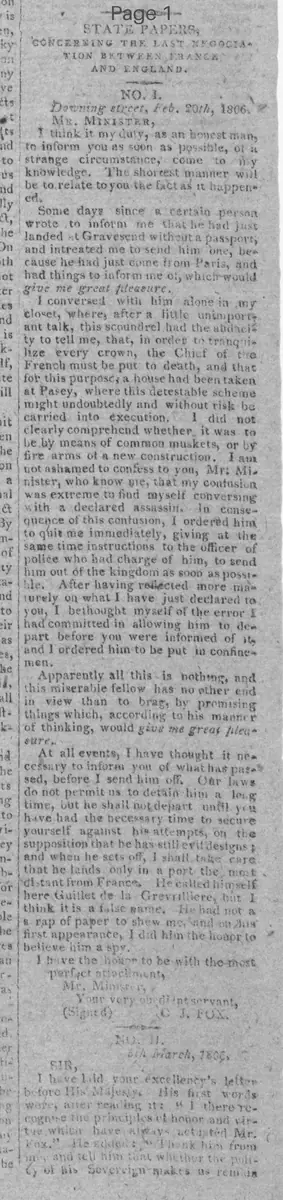
CONCERNING THE LAST NEGOTIATION BETWEEN FRANCE
AND ENGLAND.
NO. I.
Downing street, Feb. 20th, 1806.
MR. MINISTER,
I think it my duty, as an honest man to inform you as soon as possible, of a strange circumstance, come to my knowledge. The shortest manner will be to relate to you the fact as it happened.
Some days since a certain person wrote to inform me that he had just landed at Gravesend without a passport, and intreated me to send him one, because he had just come from Paris, and had things to inform me of, which would give me great pleasure.
I conversed with him alone in my closet, where, after a little unimportant talk, this scoundrel had the audacity to tell me, that, in order to tranquilize every crown, the Chief of the French must be put to death, and that for this purpose; a house had been taken at Pasey, where this detestable scheme might undoubtedly and without risk be carried into execution, I did not clearly comprehend whether it was to be by means of common muskets, or by fire arms of a new construction. I am not ashamed to confess to you, Mr: Minister, who know me, that my confusion was extreme to find myself conversing with a declared assassin. In consequence of this confusion, I ordered him to quit me immediately, giving at the same time instructions to the officer of police who had charge of him, to send him out of the kingdom as soon as possible. After having reflected more maturely on what I have just declared to you, I bethought myself of the error I had committed in allowing him to depart before you were informed of it; and I ordered him to be put in confinement,
Apparently all this is nothing, and this miserable fellow has no other end in view than to brag, by promising things which, according to his manner of thinking, would give me great pleasure..
At all events, I have thought it necessary to inform you of what has passed, before I send him off. Our laws do not permit us to detain him a long time, but he shall not depart until you have had the necessary time to secure yourself against his attempts, on the supposition that he has still evil designs; and when he sets off, I shall take care that he lands only in a port the most distant from France He called himself here Guillet de la Grevrilliere, but I think it is a false name. He had not a scrap of paper to shew me. and on this first appearance, I did him the honor to believe him a spy.
I have the honor to be with the most perfect attachment,
Mr. Ministry,
Your very ob't servant,
(Signed) C J. FOX.
NO. II.
2d March, 1806.
SIR,
I have laid your excellency's letter before His Majesty. His last words after reading it: "I there recognize the principles of honor and virtue which have always actuated Mr. Fox." He added "Thank him from me, and tell him that whether the policy of his Sovereign makes us remain"
Whether a war, or whether a dispute so needless for humanity is to be concluded whenever the two nations desire it, I rejoice at the new character which, by this step, the war has already taken, and which is the presage what may be expected from a cabinet whose principles I take a pleasure in appreciating after those of Mr. Fox, one of those men the best calculated to feel in every respect what is noble and truly great.
I shall not take the liberty, sir, to add anything to the expression of His Imperial and Royal Majesty. I only entreat you to accept the assurance of my highest consideration.
(Signed) C.-M. TALLEYRAND.
Prince of Benevento.
No. III.
Downing Street, 26th March, 1806.
Sir,
The information your excellency has transmitted me of the pacific dispositions of your government, has induced me to fix in a more particular manner the attention of the king to that part of your excellency's letter. His majesty has more than once declared to his Parliament, his sincere desire to embrace the opportunity of re-establishing peace on such solid basis, as may be compatible with the interests and permanent safety of his people. His dispositions are always pacific, but it is a sure and durable peace that his majesty desires, and not an uncertain and hence a restless truce, both for the contending parties and for the rest of Europe. With regard to the stipulations of the treaty of Amiens which might be proposed as the basis of the negotiations, it has been remarked that the phrase may be interpreted in three or four different manners, and that consequently further explanations would be necessary, which would not fail to cause a great delay, even were there no other obstacle. The true basis of such a negotiation between two great powers who equally disdain all ideas of chicane, ought to be reciprocal acknowledgement on both sides of the following principle, viz. that it ought to be the object of the two parties that the peace should be honorable for themselves and their respective allies, and at the same time be of a nature to secure, as much as lies in their power, the future repose of Europe.
England cannot neglect the interests of any of her allies, and she finds herself united to Russia by such close ties that she cannot treat, much less conclude, otherwise than in concert with the emperor Alexander; but previous to the intervention of a Russian plenipotentiary, some of the principal points may still be discussed and even provisionally agreed on. It would appear that Russia, on account of her distant position, has less immediate interests than the other powers to discuss with France; but this court, in every point of view so respectable, takes, like England, a very warm interest in what concerns the lot more or less independent, of the different princes and states of Europe.
You see, Sir, how much we are disposed here to remove all the difficulties which might delay the discussion in question. Surely it is not with the resources we possess, that we have to dread, for what concerns us, the continuation of the war. The English nation is of all Europe the one which suffers the least from its duration; but we do not the less feel for the sufferings of others. It is for us to do then what we can to put an end to them, and let us endeavor, if possible, to reconcile the respective interests and glory of the two countries, with the tranquillity of Europe and the happiness of the human race.
Signed C.J. Fox.
No. IV.
First April, 1806.
Sir,
The very moment I received your letter of the 20th March, I waited on his majesty and I find myself happy to inform you that he authorises me to make you without delay the following answer.
The emperor has nothing to wish for of what England possesses. Peace with France is possible and may be perpetual, when other states will not intermeddle in her internal affairs, and when they will neither wish to constrain her in the legislation of her custom houses, and in the rights of her commerce, nor to make her flag bear any insult.
It is not you, Sir, who have shewn in many public debates an exact knowledge of the general affairs of Europe and of those of France whom it is necessary to continue to convince that France has nothing to wish for but rest, and a situation which may allow her to betake herself without any obstacle to the labors of her industry.
The emperor does not think that this or that article of the treaty of Amiens was the cause of the war. He is convinced that the true cause was the refusal to make a treaty of commerce necessarily hurtful to the manufactures and industry of his subjects.
Your predecessors accused us of wishing to invade every thing. In France, England is also accused. Well! we ask only for equality. We shall never ask of you an account of what you do at home, provided that in your turn you never ask of us an account of what we do in our country. This is a principle of just, reasonable and respectively advantageous reciprocity.
You express a wish that the negotiation may not end in a peace without duration. France is more interested than any other power that the peace be stable. It is not a truce that she has an interest to make; for a truce would only prepare for her new losses. You know very well that nations, similar in this respect to every man considered individually, accustom themselves to a situation of war, in like manner as to a situation of peace. All the losses which France could meet with, she has met with, and will always meet with in the first six months of the war. At this time our commerce and industry have fallen back upon themselves, and have adapted themselves to our situation of war. Hence a truce of two or three years would at the same time be everything most contrary to our commercial interests and to the policy of the emperor.
As to the intervention of a foreign power, the emperor might accept the mediation of a power which should have great maritime forces, for then her participation in the peace would be regulated by the same interests as we have to discuss with you: but the mediation you speak of is not of this nature. You do not wish to deceive us, and you are very sensible that there is no equality between you and us in the guarantee of a power who has three hundred thousand men on foot, and who has no fleet.
However, Sir, your communication has a character of frankness and precision which we have not yet seen in the relations of your court with us. I shall make it my duty to use the same frankness and the same clearness in my answers. We are ready to make peace with all the world. We do not wish to overawe any one; but we will not be overawed, and no one has either the power or the means to do so. It is not in the power of any one to make us change anything in treaties which are executed. The integrity, the entire, absolute independence of the Ottoman empire, is not only the truest wish of the emperor, but the most constant aim of his policy.
Two nations enlightened and approximate to each other would be wanting to the opinion which they ought to have of their own power and wisdom, if they called foreign and distant interventions into the discussion of the grand interests which divide them. Thus, Sir, peace may be immediately treated and concluded, if your court has really a desire of attaining it.
Our interests are reconcileable by the very fact of their being distinct. You are the sovereigns of the seas, your maritime forces are equal to those of all the sovereigns of the world united. We are a great continental power; but there are several powers who have as much strength as we upon land, and your preponderance upon the seas will always put our trade at the disposal of your squadrons from the first declaration of war which you may chuse to make. Do you think it reasonable to expect that the emperor should ever consent to put himself also for the affairs of the continent, at your discretion? If, masters of the sea by your own power, you also wish to be so of the land, by a combined power, peace is not possible; for then you do not wish to arrive at any results but such as you can never attain.
The emperor, used as he may be to run all the chances which present prospects of greatness and glory, wishes for peace with England. He is a man. After so many fatigues, he is, also desirous of rest. The father of his subjects, he wishes as much as it may be compatible with their honor and with the guarantees of the future, to procure them the sweets of peace, and the advantages of a happy and quiet commerce.
It is then, sir, if his majesty the king of England really wishes for peace with France, he will appoint a plenipotentiary to repair to Lisle. I have the honor to address to you passports for this purpose. As soon as his majesty the emperor will have been informed of the arrival of the minister from your court, he will appoint and send one without delay. The emperor is ready to make all the concessions which from the extent of your naval strength and preponderance, you may be desirous of obtaining. I do not think you can refuse to adopt also the principle of making him propositions conformable to the honor of his crown and to the rights of the commerce of his states.
If you are just, if you wish only for what it is possible for you to do, peace will soon be concluded.
I conclude by declaring to you that his majesty entirely accepts the principle laid down in your dispatch and presented as the basis of the negotiation, that the peace proposed ought to be honorable for both courts and for their respective allies.
I have the honor to be with the highest consideration,
Sir,
Your Excellency's
Most humble, and most
Obedient servant,
[SIGNED]
CH: MAU. TALLEYRAND,
Prince of Benevento.
What sub-type of article is it?
What keywords are associated?
What entities or persons were involved?
Where did it happen?
Foreign News Details
Primary Location
France And England
Event Date
February To April 1806
Key Persons
Outcome
proposal for direct peace negotiations at lille; acceptance of principle for honorable peace for both sides and allies; rejection of third-party mediation like russia; reported assassination plot against napoleon dismissed.
Event Details
Exchange of letters: Fox reports a plot to assassinate Napoleon by a man named Guillet de la Grevrilliere; Talleyrand praises Fox's honor; Fox outlines basis for durable peace, referencing Treaty of Amiens and need for concert with Russia; Talleyrand responds affirming France's desire for stable peace, rejecting interference, and proposing bilateral talks at Lille with passports provided.