Thank you for visiting SNEWPapers!
Sign up free
Story
August 31, 1887
The Columbus Journal
Columbus, Platte County, Nebraska
What is this article about?
At the College of Physicians and Surgeons in New York, Professor J. G. Curtis performed a vivisection on a calf during a physiology lecture to demonstrate that the heart shortens during systole, measuring it in the living animal and after removal, amid concerns from animal rights advocates.
Clipping
OCR Quality
95%
Excellent
Full Text
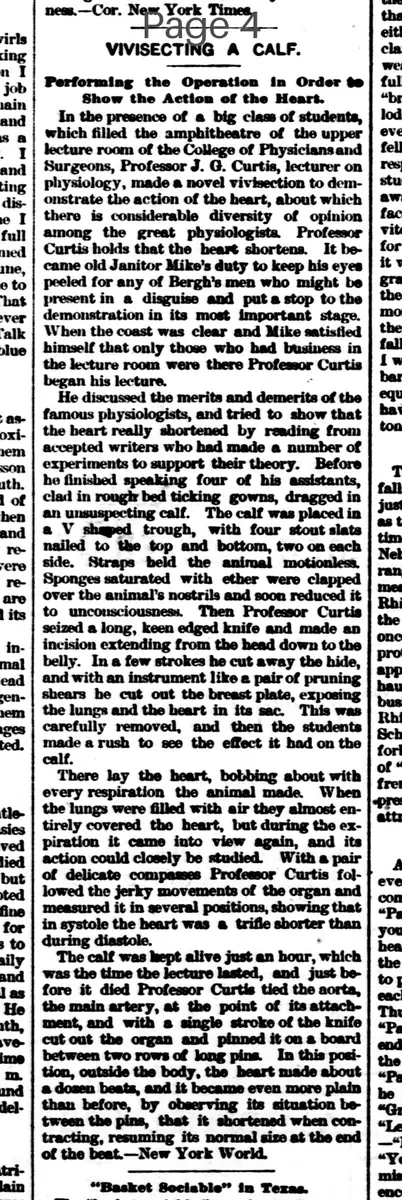
Vivisecting Calf.
Performing the operation in order to show the action of the heart.
In the presence of a big class of students, which filled the amphitheatre of the upper lecture room of the College of Physicians and Surgeons, Professor J. G. Curtis, lecturer on physiology, made a novel vivisection to demonstrate the action of the heart, about which there is considerable diversity of opinion among the great physiologists.
Professor Curtis holds that the heart shortens. It became old Janitor Mike's duty to keep his eyes peeled for any of Bergh's men who might be present in a disguise and put a stop to the demonstration in its most important stage.
When the coast was clear and Mike satisfied himself that only those who had business in the lecture room were there Professor Curtis began his lecture.
He discussed the merits and demerits of the famous physiologists, and tried to show that the heart really shortened by reading from accepted writers who had made a number of experiments to support their theory.
Before he finished speaking four of his assistants, clad in rough bed-ticking gowns, dragged in an unsuspecting calf.
The calf was placed in a V-shaped wooden trough, with four stout slats nailed to the top and bottom, two on each side. Straps held the animal motionless.
Sponges saturated with ether were clapped over the animal's nostrils and soon reduced it to unconsciousness.
Then Professor Curtis seized a long, keen-edged knife and made an incision extending from the head down to the belly.
In a few strokes he cut away the hide and with an instrument like a pair of pruning shears he cut out the breast plate, exposing the lungs and the heart in its sac.
This was carefully removed, and then the students made a rush to see the effect it had on the calf.
There lay the heart, bobbing about with every respiration the animal made.
When the lungs were filled with air they almost entirely covered the heart, but during the expiration it came into view again, and its action could closely be studied.
With a pair of delicate compasses Professor Curtis followed the jerky movements of the organ and measured it in several positions, showing that in systole the heart was a trifle shorter than during diastole.
The calf was kept alive just an hour, which was the time the lecture lasted, and just before it died Professor Curtis tied the aorta, the main artery, at the point of its attachment, and with a single stroke of the knife cut out the organ and pinned it on a board between two rows of long pins.
In this position, outside the body, the heart made about a dozen beats, and it became even more plain than before, by observing its situation between the pins, that it shortened when contracting, resuming its normal size at the end of the beat.—New York World.
Performing the operation in order to show the action of the heart.
In the presence of a big class of students, which filled the amphitheatre of the upper lecture room of the College of Physicians and Surgeons, Professor J. G. Curtis, lecturer on physiology, made a novel vivisection to demonstrate the action of the heart, about which there is considerable diversity of opinion among the great physiologists.
Professor Curtis holds that the heart shortens. It became old Janitor Mike's duty to keep his eyes peeled for any of Bergh's men who might be present in a disguise and put a stop to the demonstration in its most important stage.
When the coast was clear and Mike satisfied himself that only those who had business in the lecture room were there Professor Curtis began his lecture.
He discussed the merits and demerits of the famous physiologists, and tried to show that the heart really shortened by reading from accepted writers who had made a number of experiments to support their theory.
Before he finished speaking four of his assistants, clad in rough bed-ticking gowns, dragged in an unsuspecting calf.
The calf was placed in a V-shaped wooden trough, with four stout slats nailed to the top and bottom, two on each side. Straps held the animal motionless.
Sponges saturated with ether were clapped over the animal's nostrils and soon reduced it to unconsciousness.
Then Professor Curtis seized a long, keen-edged knife and made an incision extending from the head down to the belly.
In a few strokes he cut away the hide and with an instrument like a pair of pruning shears he cut out the breast plate, exposing the lungs and the heart in its sac.
This was carefully removed, and then the students made a rush to see the effect it had on the calf.
There lay the heart, bobbing about with every respiration the animal made.
When the lungs were filled with air they almost entirely covered the heart, but during the expiration it came into view again, and its action could closely be studied.
With a pair of delicate compasses Professor Curtis followed the jerky movements of the organ and measured it in several positions, showing that in systole the heart was a trifle shorter than during diastole.
The calf was kept alive just an hour, which was the time the lecture lasted, and just before it died Professor Curtis tied the aorta, the main artery, at the point of its attachment, and with a single stroke of the knife cut out the organ and pinned it on a board between two rows of long pins.
In this position, outside the body, the heart made about a dozen beats, and it became even more plain than before, by observing its situation between the pins, that it shortened when contracting, resuming its normal size at the end of the beat.—New York World.
What sub-type of article is it?
Medical Curiosity
Extraordinary Event
Curiosity
What keywords are associated?
Vivisection
Calf
Heart Action
Physiology Demonstration
Professor Curtis
Animal Rights
What entities or persons were involved?
Professor J. G. Curtis
Janitor Mike
Bergh
Where did it happen?
Amphitheatre Of The Upper Lecture Room Of The College Of Physicians And Surgeons, New York
Story Details
Key Persons
Professor J. G. Curtis
Janitor Mike
Bergh
Location
Amphitheatre Of The Upper Lecture Room Of The College Of Physicians And Surgeons, New York
Story Details
Professor Curtis vivisected a calf to demonstrate heart shortening during systole, anesthetizing it with ether, exposing and measuring the heart in situ, then removing and pinning it to observe continued beats.