Thank you for visiting SNEWPapers!
Sign up free
The Massachusetts Spy, Or, Thomas's Boston Journal
Boston, Suffolk County, Massachusetts
What is this article about?
Boston's Committee of Correspondence receives resolves from Ipswich, Massachusetts, dated December 1772, affirming colonial rights, criticizing British revenue measures, judicial independence issues, and the Gaspee inquiry act. Ipswich appoints a committee to correspond with Boston and others on grievances.
Merged-components note: Merged continuation of Ipswich town proceedings and resolves across pages.
Clippings
1 of 2
OCR Quality
Full Text
BOSTON.
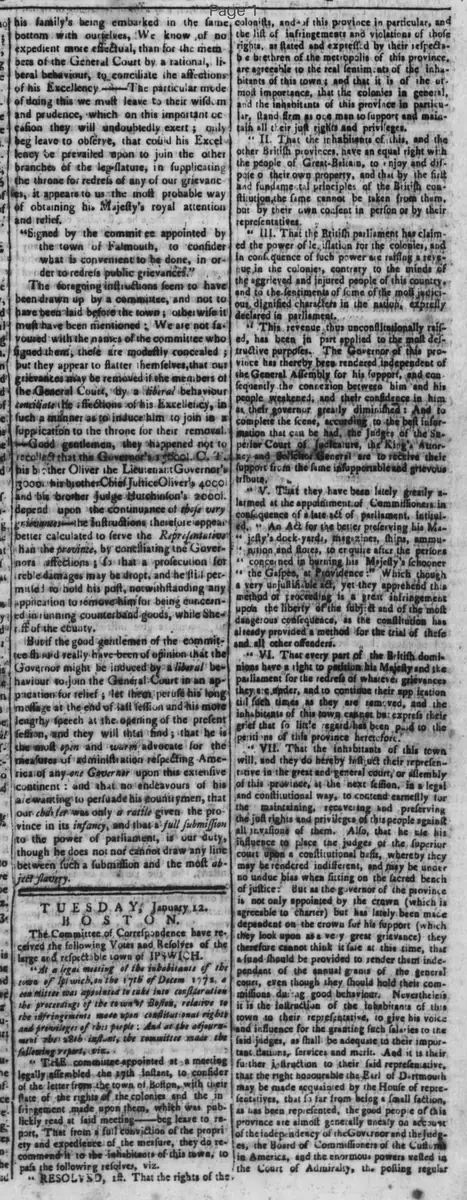
The Committee of Correspondence have received the following Votes and Resolves of the large and respectable town of IPSWICH.
"At a legal meeting of the inhabitants of the town of Ipswich, on the 17th of December 1772, a committee was appointed to take into consideration the proceedings of the town of Boston, relative to the infringements made upon constitutional rights and privileges of the people : And at the adjournment the 28th instant, the committee made the following report, viz.
THE committee appointed at a meeting legally assembled -the 28th instant, to consider of the letter from the town of, Boston, with their state of the rights of the colonies and the infringements , made upon them, which was publicly read at said meeting--beg leave to report, That from full conviction of the propriety and expedience of the measure, they do recommend it to the inhabitants of this town, to pass the following resolves, viz.
"RESOLVED, 1st. That the rights of the colonists, and of this province in particular, and the list of infringements and violations of those rights, as stated and expressed by their respectable brethren of the metropolis of this province, are agreeable to the real sentiments of the inhabitants of this town ; and that it is of the utmost importance, that the colonies in general, and the inhabitants of this province in particular, stand firm as one man to support and maintain all their just rights and privileges.
" II. That the inhabitants of. this, and the other British provinces, have an equal right with the people of Great-Britain, to enjoy and dispose of their own property, and that by the first and fundamental principles of the British constitution,the same cannot be taken from them, but by their own consent in person or by their representatives.
" III. That the British parliament has claimed the power of legislation for the colonies, and in consequence of such power are raising a revenue in the colonies, contrary to the minds of the aggrieved and injured people of this country. and to the sentiments of some of the most judicious. dignified characters in the nation. expressly declared in parliament.
This, revenue. thus unconstitutionally raised, has been in part applied to the most destructive purposes. The Governor of this province has thereby been rendered independent of the General. Assembly for his support, and consequently.the connexion between him and his people weakened, and their confidence in him as their governor greatly diminished: And to complete the scene, according to the best information that can be had, the Judges of the Superior Court of Judicature, the King Attorney and Solicitor General are to receive their support from the same insupportable and grievous tribute.
V.That they have been lately greatly alarmed at the appointment.of Commissioners.in consequence of a late act of parliament. intituled. t An Act for the better preserving his Majesty's dock-yards, magazines, ships, ammunition and stores, to enquire after the persons concerned in burning his Majesty's schooner the Gaspee, at Providence:" Which though a very unjustifiable act, yet they apprehend this method of proceeding is a great infringement upon the liberty of the subject and of the most dangerous consequence, as the constitution has already provided a method for the trial of these and. all other offenders.
.. VI. That every part of the British dominions have a right to petition his Majesty and the parliament for the redress of whatever grievances they lie. under, and to continue their application tiil such times as they are removed, and the inhabitants of this town cannot. but express their grief that so little regard has been paid to the petitions of this province heretofore.
.. VII. That the inhabitants of this town will, and they do hereby instruct their representative in the great and general court, or assembly of this province, at the next session, in legal and constitutional way,to contend: earnestly for the maintaining, recovering and preserving the just rights and privileges of this people against all invasions of them. Also, that he use his influence to place the judges of the, superior court upon a constitutional basis, whereby they may be rendered independent, and may be under no undue bias when sitting on the sacred bench of justice: But as the governor of the province is not only appointed by the crown (which is agreeable to charter) but has lately been made dependent on the crown fur his support (which they look upon as a very great grievance) they therefore cannot think it advisable at this time, that a fund should be provided to render them independent of the annual grants of the general court, even though they should hold their commissions during good behaviour, Nevertheless it is the instruction of the inhabitants of this town to their representative, to give his voice and influence for the granting such salaries to the said judges, as shall: be adequate to their important stations, ervices and merit. And it is their further instruction to their said representative. that the right honourable the Earl of Dartmouth may be made acquainted by the House of representatives, that o far from being a small faction, as has been represented, the good people of this province are almost generally uneasy on account of the independency of the Governor and the judges, the Board of Commissioners of the Customs in America, and the enormous powers vested in the Court of Admiralty, the posting regular
Jan 1773.
Troops in the province, the raising a revenue in America, and appropriating the same without the consent of the people in person or by their representatives: And further that his Lordship be assured that the good people of this province are, and always have been, firmly attached to his present Majesty and his royal family, and are desirous, to the utmost of their ability, to support government, and promote quietness and good order.
Also, it is their further instruction to their said representative, that he use his influence in the next session of the General Assembly, that an agent of the house, separate from that of the Governor and Council, be chosen to represent the grievous state of the province, to the King or his ministers, and in case the Governor should still persist in refusing to give his consent to the grants, of the house for the service of such agent, or those who have been heretofore appointed by the house, to promote and join in a recommendation from the house, to the several towns in the province, to make them compensation by their own grants, in proportion to their province taxes.
Resolved, VIII. That the inhabitants of this town not only acknowledge the proceedings of the town of Boston, as set forth in their printed pamphlet, to be proper and constitutional, but that they are greatly obliged to them for pointing out those alarming encroachments making upon the just rights and privileges of this people, and for moving so seasonably and wisely to obtain the sense of the country concerning the same.
Resolved, IX. That this town will choose a committee to correspond with the Boston committee and the committee of other towns, to receive and communicate to this town, all salutary measures that shall be proposed or offered by any other town, for removing the common grievances of this province, and that the Town Clerk communicate these our proceedings to the Boston committee of correspondence.
The foregoing report being read, and after mature deliberation the same was put to vote, paragraph by paragraph and passed in the affirmative nem. con.
Voted, That Capt Michael Farley, Mr. Daniel Noyes, and Major John Baker, be a committee to correspond with the Boston committee of correspondence, and the committee, of other towns, to receive and communicate all salutary measures that shall be proposed or offered by any other towns.
Attest.
John Baker, Town Clerk, pro tempore.
Copy on File, Examined.
Attest. Daniel Rogers, Town Clerk.
What sub-type of article is it?
What keywords are associated?
What entities or persons were involved?
Where did it happen?
Domestic News Details
Primary Location
Ipswich
Event Date
17th Of December 1772, Adjourned To The 28th Instant
Key Persons
Outcome
resolves passed unanimously (nem. con.); committee appointed to correspond with boston and other towns on grievances.
Event Details
At a town meeting in Ipswich, a committee reported on Boston's letter regarding colonial rights infringements. The town adopted nine resolves supporting Boston's views, criticizing British parliamentary power, revenue raising, governor and judges' independence, the Gaspee commissioners act, and petition rights. Instructions given to representative on judicial salaries, informing Earl of Dartmouth of provincial unease, appointing a separate agent, and acknowledging Boston's proceedings. A correspondence committee was voted.