Thank you for visiting SNEWPapers!
Sign up free
The Charlotte Democrat
Charlotte, Mecklenburg County, North Carolina
What is this article about?
Article from New York Commercial Advertiser describes pickpockets' unassuming appearances, deceptive operations in crowds like political meetings, theaters, and street cars, with anecdotes of a thief posing as a detective and using distractions for thefts, plus tips to avoid being robbed.
Merged-components note: These three sequential components form a single cohesive story on pickpockets, including introduction, anecdote, and methods.
Clipping
OCR Quality
Full Text
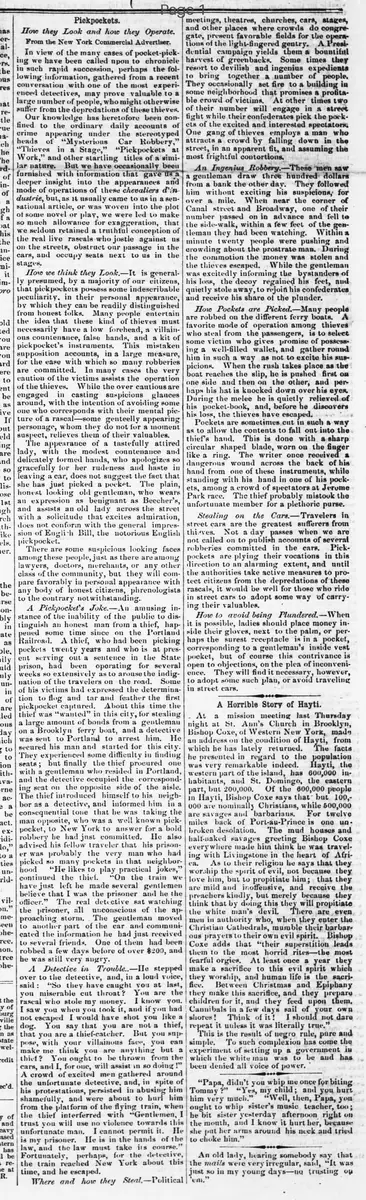
How they Look and How they Operate.
From the New York Commercial Advertiser.
In view of the many cases of pickpocketing we have been called upon to chronicle in such rapid succession, perhaps the following information, gathered from a recent conversation with one of the most experienced detectives, may prove valuable to a large number of people, who might otherwise suffer from the depredations of these thieves.
Our knowledge has heretofore been confined to the ordinary daily accounts of crime appearing under the stereotyped heads of "Mysterious Car Robbery," "Thieves in a Stage," "Pickpockets at Work," and other startling titles of a similar nature. But we have occasionally been furnished with information that gave us a deeper insight into the appearances and mode of operations of these chevaliers d'industrie, but, as it usually came to us in a sensational article, or was woven into the plot of some novel or play, we were led to make so much allowance for exaggeration, that we seldom retained a truthful conception of the real live rascals who jostle against us on the streets, obstruct our passage in the cars, and occupy seats next to us in the stages.
How we think they Look.—It is generally presumed, by a majority of our citizens, that pickpockets possess some indescribable peculiarity in their personal appearance, by which they can be readily distinguished from honest folks. Many people entertain the idea that these kind of thieves must necessarily have a low forehead, a villainous countenance, false hands, and a kit of pickpocket's instruments. This mistaken supposition accounts, in a large measure, for the ease with which so many robberies are committed. In many cases the very caution of the victims assists the operation of the thieves. While the over cautious are engaged in casting suspicious glances around, with the intention of avoiding some one who corresponds with their mental picture of a rascal—some genteelly appearing personage, whom they do not for a moment suspect, relieves them of their valuables.
The appearance of a tastefully attired lady, with the modest countenance and delicately formed hands, who apologizes so gracefully for her rudeness and haste in leaving a car, does not suggest the fact that she has just picked a pocket. The plain, honest looking old gentleman, who wears an expression as benignant as Beecher's, and assists an old lady across the street with a solicitude that excites admiration, does not conform with the general impression of English Bill, the notorious English pickpocket.
There are some suspicious looking faces among these people, just as there are among lawyers, doctors, merchants, or any other class of the community, but they will compare favorably in personal appearance with any body of honest citizens, phrenologists to the contrary notwithstanding.
A Pickpocket's Joke.—An amusing instance of the inability of the public to distinguish an honest man from a thief, happened some time since on the Portland Railroad. A thief, who had been picking pockets twenty years and who is at present serving out a sentence in the State prison, had been operating for several weeks so extensively as to arouse the indignation of the travelers on the road. Some of his victims had expressed the determination to flog and tar and feather the first pickpocket captured. About this time the thief was "wanted" in this city, for stealing a large amount of bonds from a gentleman on a Brooklyn ferry boat, and a detective was sent to Portland to arrest him. He secured his man and started for this city.
They experienced some difficulty in finding seats; but finally the thief procured one with a gentleman who resided in Portland, and the detective occupied the corresponding seat on the opposite side of the aisle. The thief introduced himself to his neighbor as a detective, and informed him in a consequential tone that he was taking the man opposite, who was a well known pickpocket, to New York to answer for a bold robbery he had just committed. He also advised his fellow traveler that his prisoner was probably the very man who had picked so many pockets in that neighborhood "He likes to play practical jokes," continued the thief. "On the train we have just left he made several gentlemen believe that I was the prisoner and he the officer." The real detective sat watching the prisoner, unconscious of the approaching storm. The gentleman moved to another part of the car and communicated the information he had just received to several friends. One of them had been robbed a few days before of over $200, and he was still very angry.
A Detective in Trouble.—He stepped over to the detective, and, in a loud voice, said: "So they have caught you at last, you miserable cut throat? You are the rascal who stole my money. I know you. I saw you when you took it, and if you had not escaped I would have shot you like a dog. You say that you are not a thief, that you are a thief-catcher. But you suppose, with your villainous face, you can make me think you are anything but a thief? You ought to be thrown from the cars, and I, for one, will assist in so doing!"
A crowd of excited men gathered around the unfortunate detective, and, in spite of his protestations, persisted in abusing him shamefully, and were about to hurl him from the platform of the flying train, when the thief interfered with "Gentlemen, I trust you will use no violence towards this unfortunate man. I cannot permit it. He is my prisoner. He is in the hands of the law, and the law must take its course."
Fortunately, perhaps, for the detective, the train reached New York about this time, and he escaped.
Where and how they Steal.—Political meetings, theatres, churches, cars, stages, and other places where crowds do congregate, present favorable fields for the operations of the light-fingered gentry. A Presidential campaign yields them a bountiful harvest of greenbacks. Sometimes they resort to devilish and ingenious expedients to bring together a number of people. They occasionally set fire to a building in some neighborhood that promises a profitable crowd of victims. At other times two of their number will engage in a street fight while their confederates pick the pockets of the excited and interested spectators. One gang of thieves employs a man who attracts a crowd by falling down in the street, in an apparent fit, and assuming the most frightful contortions.
An Ingenious Robbery.—These men saw a gentleman draw three hundred dollars from a bank the other day. They followed him without exciting his suspicions; for over a mile. When near the corner of Canal street and Broadway, one of their number passed on in advance and fell to the side-walk, within a few feet of the gentleman they had been watching. Within a minute twenty people were pushing and crowding about the prostrate man. During the commotion the money was stolen and the thieves escaped. While the gentleman was excitedly informing the bystanders of his loss, the decoy regained his feet, and quietly stole away, to rejoin his confederates and receive his share of the plunder.
How Pockets are Picked.—Many people are robbed on the different ferry boats. A favorite mode of operation among thieves who steal from the passengers, is to select some victim who gives promise of possessing a well-filled wallet, and gather round him in such a way as not to excite his suspicions. When the rush takes place as the boat reaches the slip, he is pushed first on one side and then on the other, and perhaps his hat is knocked down over his eyes. During the melee he is quietly relieved of his pocket-book, and, before he discovers his loss, the thieves have escaped.
Pockets are sometimes cut in such a way as to allow the contents to fall out into the thief's hand. This is done with a sharp circular shaped blade, worn on the finger like a ring. The writer once received a dangerous wound across the back of his hand from one of these instruments, while standing with his hand in one of his pockets, among a crowd of spectators at Jerome Park race. The thief probably mistook the unfortunate member for a plethoric purse.
Stealing on the Cars.—Travelers in street cars are the greatest sufferers from thieves. Not a day passes when we are not called on to publish accounts of several robberies committed in the cars. Pickpockets are plying their vocations in this direction to an alarming extent, and until the authorities take active measures to protect citizens from the depredations of these rascals, it would be well for those who ride in street cars to adopt some way of carrying their valuables.
How to avoid being Plundered.—When it is possible, ladies should place money inside their gloves, next to the palm, or perhaps the surest receptacle is in a pocket corresponding to a gentleman's inside vest pocket, but of course this contrivance is open to objections, on the plea of inconvenience. They will find it necessary, however, to adopt some such plan, or avoid traveling in street cars.
What sub-type of article is it?
What themes does it cover?
What keywords are associated?
What entities or persons were involved?
Where did it happen?
Story Details
Key Persons
Location
New York
Story Details
Article explains pickpockets' ordinary appearances that deceive victims, their methods in crowds and transport using distractions like fights or feigned fits, anecdotes of a thief tricking passengers into attacking a detective and thieves staging a fall to rob a man of $300, techniques like cutting pockets or rushing on ferries, and advice for securing valuables.