Thank you for visiting SNEWPapers!
Sign up free
Story
August 18, 1825
The Wilmingtonian, And Delaware Register
Wilmington, New Castle County, Delaware
What is this article about?
Tom Lumpkin, a lazy village simpleton, doggedly courts Dolly Pringle despite rejections and violence from her family. Tricked into thinking he's won a lottery prize, he marries neglected sweetheart Peggy Fritz and rushes to Philadelphia, where the ticket proves blank, prompting him to flee forever.
Clipping
OCR Quality
92%
Excellent
Full Text
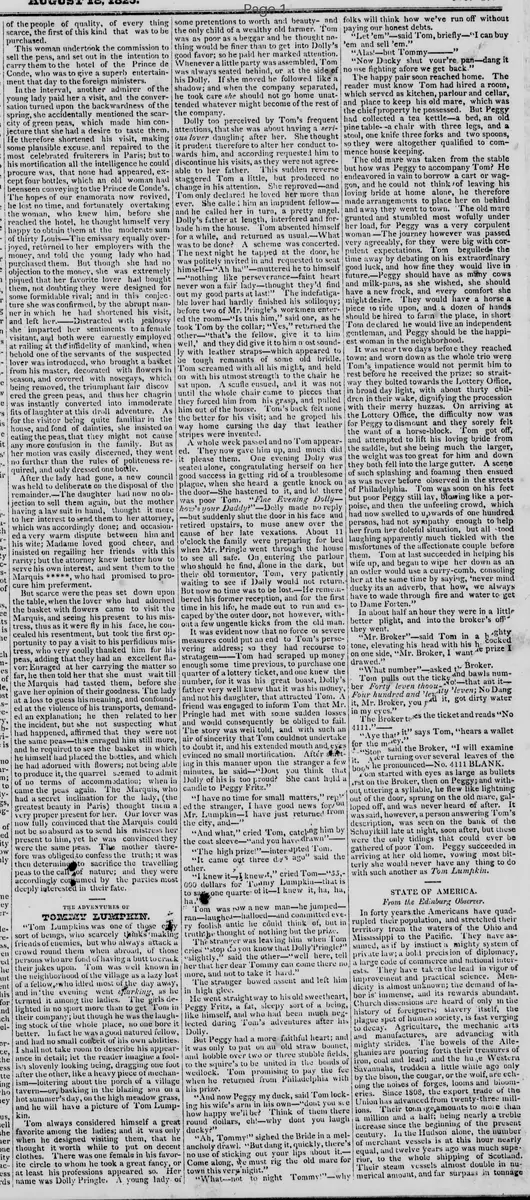
THE ADVENTURES OF TOMEY LUMPKIN.
Tom Lumpkin was one of those sort of beings, who scarcely thinks of making friends or enemies, but who always attract a crowd round them when abroad, of those persons who are fond of having a butt to crack their jokes upon. Tom was well known in the neighborhood of the village as a lazy lout of a fellow, who idled most of the day away, and in the evening went sparking, as he termed it among the ladies. The girls delighted in no sport more than to get Tom in their company; but though he was the laughing stock of the whole place, no one bore it better. In fact he was a good natured fellow, and had no small conceit of his own abilities. I shall not take room to describe his appearance in detail; let the reader imagine a foolish slovenly looking being, dragging one foot after the other, like a heavy piece of mechanism—loitering about the porch of a village tavern—or, basking in the blazing sun on a hot summer's day, on the high meadow grass, and he will have a picture of Tom Lumpkin.
Tom always considered himself a great favorite among the ladies; and it was only when he designed visiting them, that he thought it worth while to put on decent clothes. There was one female in his favorite circle to whom he took a great fancy, or at least his professions appeared so. Her name was Dolly Pringle. A young lady of some pretensions to worth and beauty—and the only child of a wealthy old farmer. Tom was as poor as a beggar and he thought nothing would be finer than to get into Dolly's good favor; so he paid her marked attention. Whenever a little party was assembled, Tom was always seated behind, or at the side of his Dolly. If she moved he followed like a shadow; and when the company separated, he took care she should not go home unattended whatever might become of the rest of the company.
Dolly too perceived by Tom's frequent attentions, that she was about having a serious lover dangling after her. She thought it prudent therefore to alter her conduct towards him, and accordingly requested him to discontinue his visits, as they were not agreeable to her father. This sudden reverse staggered Tom a little, but produced no change in his attention. She reproved—and Tom only declared he loved her more than ever. She called him an impudent fellow—and he called her in turn, a pretty angel. Dolly's father at length, interfered and forbade him the house. Tom absented himself for a while, and returned as usual.—What was to be done? A scheme was concerted. The next night he tapped at the door, he was politely invited in and requested to seat himself—“Ah ha'”—muttered he to himself—“nothing like perseverance—faint heart never won a fair lady—thought they'd find out my good parts at last!” The indefatigable lover had hardly finished his soliloquy; before two of Mr. Pringle's workmen entered the room—“Is this him,” said one, as he took Tom by the collar; “Yes,” returned the other “that's the fellow, give it to him well,' and they did give it to him most soundly with leather straps—which appeared to be tough remnants of some old bridle. Tom screamed with all his might, and held on with his utmost strength to the chair he sat upon. A scuffle ensued, and it was not until the whole chair came to pieces that they forced him from his grasp, and pulled him out of the house. Tom's back felt none the better for his visit; and he groped his way home cursing the day that leather straps were invented.
A whole week passed and no Tom appeared. They now gave him up, and much did it please them. One evening Dolly was seated alone, congratulating herself on her good success in getting rid of a troublesome plague, when she heard a gentle knock on the door—She hastened to it, and lo! there was poor Tom. “Fine Evening Dolly—how's your Daddy?”—Dolly made no reply—but suddenly shut the door in his face and retired upstairs, to muse anew over the cause of her late vexations. About 11 o'clock the family were preparing for bed when Mr. Pringle went through the house to see all safe. On entering the parlour who should he find, alone in the dark, but their old tormentor, Tom, very patiently waiting to see if Dolly would not return. But now no time was to be lost.—He remembered his former reception, and for the first time in his life. he made out to run and escaped by the outer door, not however, without a few ungentle kicks from the old man. It was evident now that no force or severe measures could put an end to Tom's persevering address; so they had recourse to stratagem—Tom had scraped up money enough some time previous, to purchase one quarter of a lottery ticket, and everyone knew the number, for it was his great boast, Dolly's father very well knew that it was his money, and not his daughter, that attracted Tom. A friend was engaged to inform Tom that Mr. Pringle had met with some sudden losses and would consequently be obliged to fail. The story was well told, and with such an air of sincerity that Tom could not undertake to doubt it. and his extended mouth and eyes evinced no small mortification. After sitting in this manner upon the stranger a few minutes, he said—“Dont you think that Dolly of his is too proud? She cant hold a candle to Peggy Fritz."
"I have no time for small matters," replied the stranger, I have good news for you Mr. Lumpkin—I have just returned from the city, and—"And what," cried Tom, catching him by the coat sleeve—"and you have drawn"
"It came out three days ago" said the other. "The high prize:—$55,000"
"I knew it I knew it," cried Tom—"55,000 dollars for Tommy Lumpkin—that is to say one quarter of it—I knew it, ha, ha, ha."
Tom was now a new man—he jumped—ran—laughed—hallooed—and committed every foolish antic he could think of, but in truth: he thought of nothing but the prize. The stranger was leaving him when Tom cried "stop do you know that Dolly Pringle?"
"slightly," said the other—"well here, tell her that her dear Tommy can come there no more, and not to take it hard."
The stranger bowed assent and left him in high glee. He went straight way to his old sweetheart, Peggy Fritz, a fat, sleepy sort of a being. like himself, and who had been much neglected during Tom's adventures after his Dolly. But Peggy had a more faithful heart; and it was only to put on an old straw bonnet, and hobble over two or three stubble fields, to the squire's to be united in the bonds of wedlock. Tom promising to pay the fee when he returned from Philadelphia with his prize.
"And now Peggy my duck, said Tom locking his wife's arm in his own—"dont you see how happy we'll be? Think of them there round dollars, eh!—why dont you laugh ducky?"
"Ah, Tommy!" sighed the Bride in a melancholy drawl. "But dang it, quickly, there's no use of sticking out your lips about it.—Come along, we must rig the old mare for town this very night."
"What—not to night Tommy!" why folks will think how we've run off without paying our honest debts.
"Let'em"—said Tom, briefly—"I can buy 'em and sell 'em."
"Alas!—but Tommy"
"Now Ducky shut your pan—dang it no use fighting afore we get back."
The happy pair soon reached home. The reader must know Tom had hired a room, which served as kitchen, parlour and cellar. and place to keep his old mare, which was the chief property he possessed. But Peggy had collected a tea kettle—a bed, an old pine table—a chair with three legs, and a stool, one knife three forks and two spoons, so they were altogether qualified to commence house keeping
The old mare was taken from the stable but how was Peggy to accompany Tom? He endeavored in vain to borrow a cart or waggon, and he could not think of leaving his loving bride at home alone, he therefore made arrangements to place her on behind and away they went to town. The old mare grunted and stumbled most wofully under her load, for Peggy was a very corpulent woman.—The journey however was passed very agreeably, for they were big with corpulent expectations. Tom beguiled the time away by debating on his extraordinary good luck, and how fine they would live in future.—Peggy should have as many cows and milk-pans, as she wished, she should have a new frock, and every comfort she might desire. They would have a horse a piece to ride upon, and a dozen of hands should be hired to farm the place, in short Tom declared he would live an independent gentleman, and Peggy should be the happiest woman in the neighborhood.
It was near two days before they reached town: and worn down as the whole trio were Tom's impatience would not permit him to rest before he received the prize: so straitway they bolted towards the Lottery Office, in broad day light, with about thirty children in their wake, dignifying the procession with their merry huzzas. On arriving at the Lottery Office, the difficulty now was for Peggy to dismount and they sorely felt the want of a horse-block. Tom got off, and attempted to lift his loving bride from the saddle, but she being much the larger, the weight was too great for him and down they both fell into the large gutter. A scene of such splashing and foaming then ensued as was never before observed in the streets of Philadelphia. Tom was soon on his feet but poor Peggy still lay, blowing like a porpoise, and then the unfeeling crowd, which had now swelled to upwards of one hundred persons, had not sympathy enough to help her from her doleful situation, but all stood laughing apparently much tickled with the misfortunes of the affectionate couple before them. Tom at last succeeded in helping his wife up, and began to wipe her down as an ostler would use a curry-comb, consoling her at the same time by saying, 'never mind ducky its an ill wind that blows nobody good, how we always have to wade through fire and water to get to Dame Fortune.'
In about half an hour they were in a little better plight, and into the broker's office they went.
"Mr. Broker"—said Tom in a haughty tone elevating his head with his cocked hat on one side, "Mr. Broker, I want my prize I drawed."
"What number"—asked the Broker.
"Forty leven thou—No!—that ant it— it, Mr. Broker, you rad it, got dirty water Four hundred and forty leven; No Dang in my eyes."
The Broker takes the ticket and reads "No. 4111."
"Aye thats it" says Tom, "here's a wallet for the money."
"Stop Said the Broker, "I will examine it."
After turning over several leaves of the book, he pronounced—No. 4111 BLANK.
Tom started with eyes as large as bullets first on the Broker, then on Peggy; and without uttering a syllable, he flew like lightning out of the door, sprung on the old mare, galloped off, and was never heard of after. It was said, however, a person answering Tom's description, was seen on the bank of the Schuylkill late at night, soon after, but these were the only tidings that could ever be gathered of poor Tom. Peggy succeeded in arriving at her old home, vowing most bitterly she would never have any thing to do with such another as Tom Lumpkin.
Tom Lumpkin was one of those sort of beings, who scarcely thinks of making friends or enemies, but who always attract a crowd round them when abroad, of those persons who are fond of having a butt to crack their jokes upon. Tom was well known in the neighborhood of the village as a lazy lout of a fellow, who idled most of the day away, and in the evening went sparking, as he termed it among the ladies. The girls delighted in no sport more than to get Tom in their company; but though he was the laughing stock of the whole place, no one bore it better. In fact he was a good natured fellow, and had no small conceit of his own abilities. I shall not take room to describe his appearance in detail; let the reader imagine a foolish slovenly looking being, dragging one foot after the other, like a heavy piece of mechanism—loitering about the porch of a village tavern—or, basking in the blazing sun on a hot summer's day, on the high meadow grass, and he will have a picture of Tom Lumpkin.
Tom always considered himself a great favorite among the ladies; and it was only when he designed visiting them, that he thought it worth while to put on decent clothes. There was one female in his favorite circle to whom he took a great fancy, or at least his professions appeared so. Her name was Dolly Pringle. A young lady of some pretensions to worth and beauty—and the only child of a wealthy old farmer. Tom was as poor as a beggar and he thought nothing would be finer than to get into Dolly's good favor; so he paid her marked attention. Whenever a little party was assembled, Tom was always seated behind, or at the side of his Dolly. If she moved he followed like a shadow; and when the company separated, he took care she should not go home unattended whatever might become of the rest of the company.
Dolly too perceived by Tom's frequent attentions, that she was about having a serious lover dangling after her. She thought it prudent therefore to alter her conduct towards him, and accordingly requested him to discontinue his visits, as they were not agreeable to her father. This sudden reverse staggered Tom a little, but produced no change in his attention. She reproved—and Tom only declared he loved her more than ever. She called him an impudent fellow—and he called her in turn, a pretty angel. Dolly's father at length, interfered and forbade him the house. Tom absented himself for a while, and returned as usual.—What was to be done? A scheme was concerted. The next night he tapped at the door, he was politely invited in and requested to seat himself—“Ah ha'”—muttered he to himself—“nothing like perseverance—faint heart never won a fair lady—thought they'd find out my good parts at last!” The indefatigable lover had hardly finished his soliloquy; before two of Mr. Pringle's workmen entered the room—“Is this him,” said one, as he took Tom by the collar; “Yes,” returned the other “that's the fellow, give it to him well,' and they did give it to him most soundly with leather straps—which appeared to be tough remnants of some old bridle. Tom screamed with all his might, and held on with his utmost strength to the chair he sat upon. A scuffle ensued, and it was not until the whole chair came to pieces that they forced him from his grasp, and pulled him out of the house. Tom's back felt none the better for his visit; and he groped his way home cursing the day that leather straps were invented.
A whole week passed and no Tom appeared. They now gave him up, and much did it please them. One evening Dolly was seated alone, congratulating herself on her good success in getting rid of a troublesome plague, when she heard a gentle knock on the door—She hastened to it, and lo! there was poor Tom. “Fine Evening Dolly—how's your Daddy?”—Dolly made no reply—but suddenly shut the door in his face and retired upstairs, to muse anew over the cause of her late vexations. About 11 o'clock the family were preparing for bed when Mr. Pringle went through the house to see all safe. On entering the parlour who should he find, alone in the dark, but their old tormentor, Tom, very patiently waiting to see if Dolly would not return. But now no time was to be lost.—He remembered his former reception, and for the first time in his life. he made out to run and escaped by the outer door, not however, without a few ungentle kicks from the old man. It was evident now that no force or severe measures could put an end to Tom's persevering address; so they had recourse to stratagem—Tom had scraped up money enough some time previous, to purchase one quarter of a lottery ticket, and everyone knew the number, for it was his great boast, Dolly's father very well knew that it was his money, and not his daughter, that attracted Tom. A friend was engaged to inform Tom that Mr. Pringle had met with some sudden losses and would consequently be obliged to fail. The story was well told, and with such an air of sincerity that Tom could not undertake to doubt it. and his extended mouth and eyes evinced no small mortification. After sitting in this manner upon the stranger a few minutes, he said—“Dont you think that Dolly of his is too proud? She cant hold a candle to Peggy Fritz."
"I have no time for small matters," replied the stranger, I have good news for you Mr. Lumpkin—I have just returned from the city, and—"And what," cried Tom, catching him by the coat sleeve—"and you have drawn"
"It came out three days ago" said the other. "The high prize:—$55,000"
"I knew it I knew it," cried Tom—"55,000 dollars for Tommy Lumpkin—that is to say one quarter of it—I knew it, ha, ha, ha."
Tom was now a new man—he jumped—ran—laughed—hallooed—and committed every foolish antic he could think of, but in truth: he thought of nothing but the prize. The stranger was leaving him when Tom cried "stop do you know that Dolly Pringle?"
"slightly," said the other—"well here, tell her that her dear Tommy can come there no more, and not to take it hard."
The stranger bowed assent and left him in high glee. He went straight way to his old sweetheart, Peggy Fritz, a fat, sleepy sort of a being. like himself, and who had been much neglected during Tom's adventures after his Dolly. But Peggy had a more faithful heart; and it was only to put on an old straw bonnet, and hobble over two or three stubble fields, to the squire's to be united in the bonds of wedlock. Tom promising to pay the fee when he returned from Philadelphia with his prize.
"And now Peggy my duck, said Tom locking his wife's arm in his own—"dont you see how happy we'll be? Think of them there round dollars, eh!—why dont you laugh ducky?"
"Ah, Tommy!" sighed the Bride in a melancholy drawl. "But dang it, quickly, there's no use of sticking out your lips about it.—Come along, we must rig the old mare for town this very night."
"What—not to night Tommy!" why folks will think how we've run off without paying our honest debts.
"Let'em"—said Tom, briefly—"I can buy 'em and sell 'em."
"Alas!—but Tommy"
"Now Ducky shut your pan—dang it no use fighting afore we get back."
The happy pair soon reached home. The reader must know Tom had hired a room, which served as kitchen, parlour and cellar. and place to keep his old mare, which was the chief property he possessed. But Peggy had collected a tea kettle—a bed, an old pine table—a chair with three legs, and a stool, one knife three forks and two spoons, so they were altogether qualified to commence house keeping
The old mare was taken from the stable but how was Peggy to accompany Tom? He endeavored in vain to borrow a cart or waggon, and he could not think of leaving his loving bride at home alone, he therefore made arrangements to place her on behind and away they went to town. The old mare grunted and stumbled most wofully under her load, for Peggy was a very corpulent woman.—The journey however was passed very agreeably, for they were big with corpulent expectations. Tom beguiled the time away by debating on his extraordinary good luck, and how fine they would live in future.—Peggy should have as many cows and milk-pans, as she wished, she should have a new frock, and every comfort she might desire. They would have a horse a piece to ride upon, and a dozen of hands should be hired to farm the place, in short Tom declared he would live an independent gentleman, and Peggy should be the happiest woman in the neighborhood.
It was near two days before they reached town: and worn down as the whole trio were Tom's impatience would not permit him to rest before he received the prize: so straitway they bolted towards the Lottery Office, in broad day light, with about thirty children in their wake, dignifying the procession with their merry huzzas. On arriving at the Lottery Office, the difficulty now was for Peggy to dismount and they sorely felt the want of a horse-block. Tom got off, and attempted to lift his loving bride from the saddle, but she being much the larger, the weight was too great for him and down they both fell into the large gutter. A scene of such splashing and foaming then ensued as was never before observed in the streets of Philadelphia. Tom was soon on his feet but poor Peggy still lay, blowing like a porpoise, and then the unfeeling crowd, which had now swelled to upwards of one hundred persons, had not sympathy enough to help her from her doleful situation, but all stood laughing apparently much tickled with the misfortunes of the affectionate couple before them. Tom at last succeeded in helping his wife up, and began to wipe her down as an ostler would use a curry-comb, consoling her at the same time by saying, 'never mind ducky its an ill wind that blows nobody good, how we always have to wade through fire and water to get to Dame Fortune.'
In about half an hour they were in a little better plight, and into the broker's office they went.
"Mr. Broker"—said Tom in a haughty tone elevating his head with his cocked hat on one side, "Mr. Broker, I want my prize I drawed."
"What number"—asked the Broker.
"Forty leven thou—No!—that ant it— it, Mr. Broker, you rad it, got dirty water Four hundred and forty leven; No Dang in my eyes."
The Broker takes the ticket and reads "No. 4111."
"Aye thats it" says Tom, "here's a wallet for the money."
"Stop Said the Broker, "I will examine it."
After turning over several leaves of the book, he pronounced—No. 4111 BLANK.
Tom started with eyes as large as bullets first on the Broker, then on Peggy; and without uttering a syllable, he flew like lightning out of the door, sprung on the old mare, galloped off, and was never heard of after. It was said, however, a person answering Tom's description, was seen on the bank of the Schuylkill late at night, soon after, but these were the only tidings that could ever be gathered of poor Tom. Peggy succeeded in arriving at her old home, vowing most bitterly she would never have any thing to do with such another as Tom Lumpkin.
What sub-type of article is it?
Romance
Deception Fraud
Journey
What themes does it cover?
Love
Deception
Fortune Reversal
What keywords are associated?
Tom Lumpkin
Dolly Pringle
Peggy Fritz
Lottery Ticket
Failed Courtship
Deception
Marriage
Philadelphia
Fortune Reversal
Village Lout
What entities or persons were involved?
Tom Lumpkin
Dolly Pringle
Peggy Fritz
Mr. Pringle
Where did it happen?
Village Near Philadelphia
Story Details
Key Persons
Tom Lumpkin
Dolly Pringle
Peggy Fritz
Mr. Pringle
Location
Village Near Philadelphia
Story Details
Tom persistently courts Dolly despite rebuffs, beatings, and bans. Her father tricks him with false news of family ruin and a fake lottery win, leading Tom to reject Dolly, marry Peggy, and rush to Philadelphia, where the ticket is blank; he flees forever.