Thank you for visiting SNEWPapers!
Sign up free
Story
September 5, 1837
The New Hampshire Gazette
Portsmouth, Rockingham County, New Hampshire
What is this article about?
Report from Washington Globe on the prosperous conditions of Native American tribes relocated west of the Mississippi, including Choctaws, Cherokees, Creeks, Seminoles, Senecas, and Osages, noting their advancement in agriculture and civilization, with variations among tribes.
Clipping
OCR Quality
98%
Excellent
Full Text
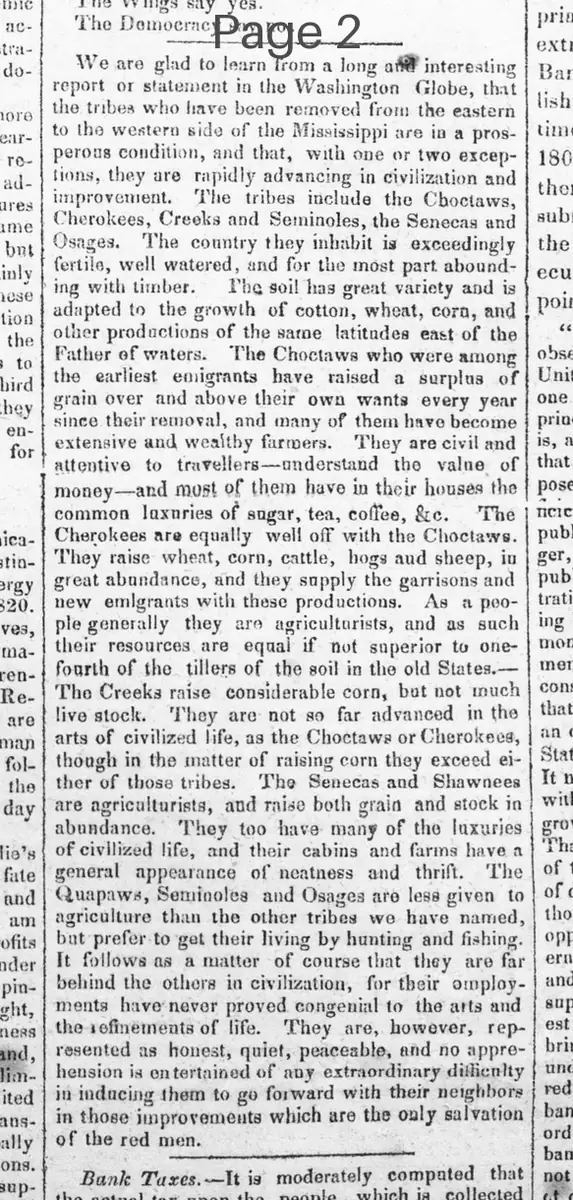
We are glad to learn from a long and interesting report or statement in the Washington Globe, that the tribes who have been removed from the eastern to the western side of the Mississippi are in a prosperous condition, and that, with one or two exceptions, they are rapidly advancing in civilization and improvement. The tribes include the Choctaws, Cherokees, Creeks and Seminoles, the Senecas and Osages. The country they inhabit is exceedingly fertile, well watered, and for the most part abounding with timber. The soil has great variety and is adapted to the growth of cotton, wheat, corn, and other productions of the same latitudes east of the Father of waters.
The Choctaws who were among the earliest emigrants have raised a surplus of grain over and above their own wants every year since their removal, and many of them have become extensive and wealthy farmers. They are civil and attentive to travellers—understand the value of money—and most of them have in their houses the common luxuries of sugar, tea, coffee, &c.
The Cherokees are equally well off with the Choctaws. They raise wheat, corn, cattle, hogs and sheep, in great abundance, and they supply the garrisons and new emigrants with these productions. As a people generally they are agriculturists, and as such their resources are equal if not superior to one-fourth of the tillers of the soil in the old States.—
The Creeks raise considerable corn, but not much live stock. They are not so far advanced in the arts of civilized life, as the Choctaws or Cherokees, though in the matter of raising corn they exceed either of those tribes.
The Senecas and Shawnees are agriculturists, and raise both grain and stock in abundance. They too have many of the luxuries of civilized life, and their cabins and farms have a general appearance of neatness and thrift.
The Quapaws, Seminoles and Osages are less given to agriculture than the other tribes we have named, but prefer to get their living by hunting and fishing. It follows as a matter of course that they are far behind the others in civilization, for their employments have never proved congenial to the arts and the refinements of life. They are, however, represented as honest, quiet, peaceable, and no apprehension is entertained of any extraordinary difficulty in inducing them to go forward with their neighbors in those improvements which are the only salvation of the red men.
The Choctaws who were among the earliest emigrants have raised a surplus of grain over and above their own wants every year since their removal, and many of them have become extensive and wealthy farmers. They are civil and attentive to travellers—understand the value of money—and most of them have in their houses the common luxuries of sugar, tea, coffee, &c.
The Cherokees are equally well off with the Choctaws. They raise wheat, corn, cattle, hogs and sheep, in great abundance, and they supply the garrisons and new emigrants with these productions. As a people generally they are agriculturists, and as such their resources are equal if not superior to one-fourth of the tillers of the soil in the old States.—
The Creeks raise considerable corn, but not much live stock. They are not so far advanced in the arts of civilized life, as the Choctaws or Cherokees, though in the matter of raising corn they exceed either of those tribes.
The Senecas and Shawnees are agriculturists, and raise both grain and stock in abundance. They too have many of the luxuries of civilized life, and their cabins and farms have a general appearance of neatness and thrift.
The Quapaws, Seminoles and Osages are less given to agriculture than the other tribes we have named, but prefer to get their living by hunting and fishing. It follows as a matter of course that they are far behind the others in civilization, for their employments have never proved congenial to the arts and the refinements of life. They are, however, represented as honest, quiet, peaceable, and no apprehension is entertained of any extraordinary difficulty in inducing them to go forward with their neighbors in those improvements which are the only salvation of the red men.
What sub-type of article is it?
Historical Event
Curiosity
What themes does it cover?
Triumph
Survival
Moral Virtue
What keywords are associated?
Native American Tribes
Indian Removal
Civilization Progress
Agricultural Advancement
Tribal Prosperity
Where did it happen?
Western Side Of The Mississippi
Story Details
Location
Western Side Of The Mississippi
Story Details
Tribes removed from east to west of Mississippi are prosperous and advancing in civilization; Choctaws and Cherokees excel in agriculture and wealth; Creeks focus on corn; Senecas and Shawnees thrive in farming; Quapaws, Seminoles, and Osages lag due to hunting preferences but are peaceful.