Thank you for visiting SNEWPapers!
Sign up free
Alexandria Daily Gazette, Commercial & Political
Alexandria, Virginia
What is this article about?
On May 16, 1811, the US frigate President under Commodore John Rodgers engaged the British sloop Little Belt commanded by Captain Bingham off Cape Henry. After hailing and receiving fire first, Rodgers returned fire, damaging the Little Belt with 20-30 casualties; President had minor damage and one wounded. Rodgers regrets the incident and requests inquiry.
Clipping
OCR Quality
Full Text
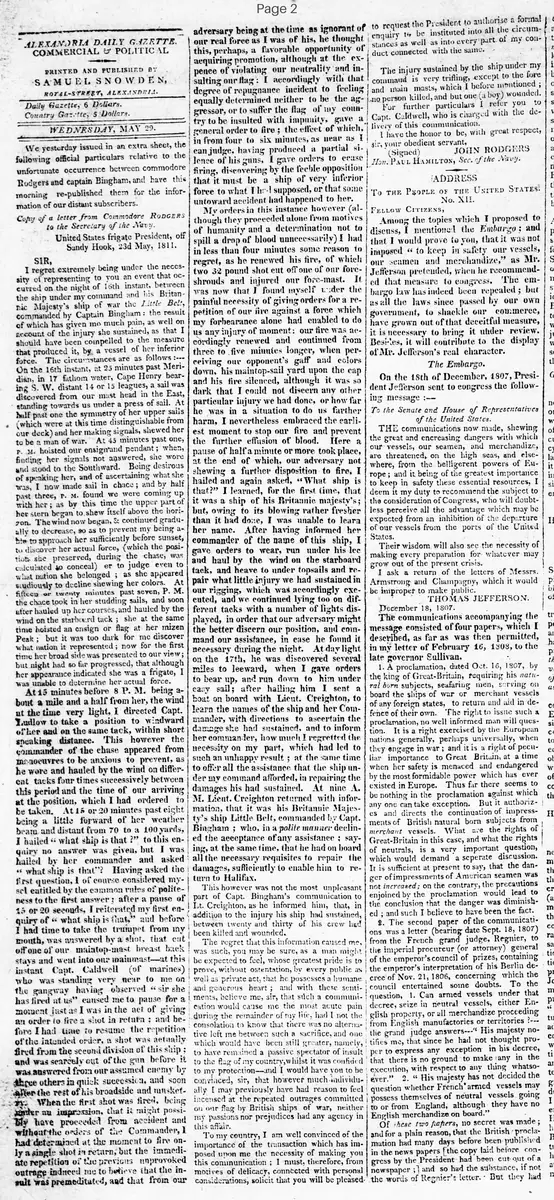
Copy of a letter from Commodore Rodgers to the Secretary of the Navy.
United States frigate President, off Sandy Hook, 23d May, 1811.
SIR,
I regret extremely being under the necessity of representing to you an event that occurred on the night of 16th instant, between the ship under my command and his Britannic Majesty's ship of war the Little Belt, commanded by Captain Bingham: the result of which has given me much pain, as well on account of the injury she sustained, as that I should have been compelled to the measure that produced it, by a vessel of her inferior force. The circumstances are as follows:
On the 16th instant, at 25 minutes past Meridian, in 17 fathoms water, Cape Henry bearing S. W. distant 14 or 15 leagues, a sail was discovered from our mast head in the East, standing towards us under a press of sail. At half past one the symmetry of her upper sails (which were at this time distinguishable from our deck) and her making signals, shewed her to be a man of war. At 45 minutes past one, P. M. hoisted our ensign and pendant; when finding her signals not answered, she wore and stood to the Southward. Being desirous of speaking her, and of ascertaining what she was, I now made sail in chase; and by half past three, P. M. found we were coming up with her; as by this time the upper part of her stern began to shew itself above the horizon. The wind now began, & continued gradually to decrease, so as to prevent my being able to approach her sufficiently before sunset, to discover her actual force, (which the position she preserved, during the chase, was calculated to conceal) or to judge even to what nation she belonged; as she appeared studiously to decline shewing her colors. At fifteen or twenty minutes past seven, P. M. the chase took in her studding sails, and soon after hauled up her courses, and hauled by the wind on the starboard tack; she at the same time hoisted an ensign or flag at her mizen Peak: but it was too dark for me discover what nation it represented; now for the first time her broad side was presented to our view; but night had so far progressed, that although her appearance indicated she was a frigate, I was unable to determine her actual force.
At 15 minutes before 8 P. M. being about a mile and a half from her, the wind at the time very light, I directed Capt. Ludlow to take a position to windward of her and on the same tack, within short speaking distance. This however the commander of the chase appeared from manoeuvres to be anxious to prevent, as he wore and hauled by the wind on different tacks four times successively between this period and the time of our arriving at the position, which I had ordered to be taken. At 15 or 20 minutes past eight being a little forward of her weather beam, and distant from 70 to a 100 yards, I hailed "what ship is that?" to this enquiry no answer was given, but I was hailed by her commander and asked "what ship is that"? Having asked the first question, I of course considered myself entitled by the common rules of politeness to the first answer; after a pause of 15 or 20 seconds, I reiterated my first enquiry of "what ship is that." and before I had time to take the trumpet from my mouth, was answered by a shot, that cut off one of our main-top-mast breast back stays and went into our mainmast--at this instant Capt. Caldwell (of marines) who was standing very near to me on the gangway having observed "sir she has fired at us" caused me to pause for a moment just as I was in the act of giving an order to fire a shot in return; and before I had time to resume the repetition of the intended order, a shot was actually fired from the second division of this ship: and was scarcely out of the gun before it was answered from our assumed enemy by three others in quick succession, and soon after the rest of his broadside and musket.
When the first shot was fired, being under an impression, that it might possibly have proceeded from accident and without the orders of the Commander, I had determined at the moment to fire only a single shot in return; but the immediate repetition of the previous unprovoked outrage induced me to believe that the insult was premeditated, and that from our adversary being at the time as ignorant of our real force as I was of his, he thought this, perhaps, a favorable opportunity of acquiring promotion, although at the expense of violating our neutrality and insulting our flag: I accordingly with that degree of repugnance incident to feeling equally determined neither to be the aggressor, or to suffer the flag of my country to be insulted with impunity, gave a general order to fire; the effect of which, in from four to six minutes, as near as I can judge, having produced a partial silence of his guns, I gave orders to cease firing, discovering by the feeble opposition that it must be a ship of very inferior force to what I had supposed, or that some untoward accident had happened to her.
My orders in this instance however (although they proceeded alone from motives of humanity and a determination not to spill a drop of blood unnecessarily) I had in less than four minutes some reason to regret, as he renewed his fire, of which two 32 pound shot cut off one of our fore-shrouds and injured our fore-mast. It was now that I found myself under the painful necessity of giving orders for a repetition of our fire against a force which my forbearance alone had enabled to do us any injury of moment: our fire was accordingly renewed and continued from three to five minutes longer, when perceiving our opponent's gaff and colors down, his main-top-sail yard upon the cap and his fire silenced, although it was so dark that I could not discern any other particular injury we had done, or how far he was in a situation to do us farther harm, I nevertheless embraced the earliest moment to stop our fire and prevent the further effusion of blood. Here a pause of half a minute or more took place, at the end of which, our adversary not shewing a further disposition to fire, I hailed and again asked, "What ship is that?" I learned, for the first time, that it was a ship of his Britannic majesty's; but, owing to its blowing rather fresher than it had done, I was unable to learn her name. After having informed her commander of the name of this ship, I gave orders to wear, run under his lee and haul by the wind on the starboard tack, and heave to under topsails and repair what little injury we had sustained in our rigging, which was accordingly executed, and we continued lying too on different tacks with a number of lights displayed, in order that our adversary might the better discern our position, and command our assistance, in case he found it necessary during the night. At day light on the 17th, he was discovered several miles to leeward, when I gave orders to bear up, and run down to him under easy sail; after hailing him I sent a boat on board with Lieut. Creighton, to learn the names of the ship and her Commander, with directions to ascertain the damage she had sustained, and to inform her commander, how much I regretted the necessity on my part, which had led to such an unhappy result; at the same time to offer all the assistance that the ship under my command afforded, in repairing the damages his had sustained. At nine A. M. Lieut. Creighton returned with information, that it was his Britannic Majesty's ship Little Belt, commanded by Capt. Bingham; who, in a polite manner declined the acceptance of any assistance; saying, at the same time, that he had on board all the necessary requisites to repair the damages, sufficiently to enable him to return to Halifax.
This however was not the most unpleasant part of Capt. Bingham's communication to Lt. Creighton, as he informed him, that, in addition to the injury his ship had sustained, between twenty and thirty of his crew had been killed and wounded. The regret that this information caused me, was such, you may be sure, as a man might be expected to feel, whose greatest pride is to prove, without ostentation, by every public as well as private act, that he possesses a humane and generous heart; and with these sentiments, believe me, sir, that such a communication would cause me the most acute pain during the remainder of my life, had I not the consolation to know that there was no alternative left me between such a sacrifice, and one which would have been still greater, namely, to have remained a passive spectator of insult to the flag of my country, whilst it was confided to my protection--and I would have you to be convinced, sir, that however much individually I may previously have had reason to feel incensed at the repeated outrages committed on our flag by British ships of war, neither my passions nor prejudices had any agency in this affair.
To my country, I am well convinced of the importance of the transaction which has imposed upon me the necessity of making you this communication; I must, therefore, from motives of delicacy, connected with personal considerations, solicit that you will be pleased to request the President to authorise a formal enquiry to be instituted into all the circumstances as well as into every part of my conduct connected with the same.
The injury sustained by the ship under my command is very trifling, except to the fore and main masts, which I before mentioned: no person killed, and but one (a boy) wounded.
For further particulars I refer you to Capt. Caldwell, who is charged with the delivery of this communication.
I have the honor to be, with great respect,
sir, your obedient servant,
(Signed)
JOHN RODGERS
Hon. PAUL HAMILTON, Sec. of the Navy.
What sub-type of article is it?
What keywords are associated?
What entities or persons were involved?
Where did it happen?
Foreign News Details
Primary Location
Off Cape Henry
Event Date
16th May 1811
Key Persons
Outcome
little belt: ship damaged, 20-30 crew killed and wounded; president: minor damage to rigging and masts, one boy wounded, no killed. bingham declined assistance and planned to return to halifax.
Event Details
US frigate President chased an unidentified ship believed to be a British frigate. After hailing without response and receiving first fire from the Little Belt, Rodgers ordered return fire. Brief engagement ensued; Little Belt's fire silenced after two exchanges. Rodgers offered aid, which was refused.