Thank you for visiting SNEWPapers!
Sign up free
The Richmond Palladium And Sun Telegram
Richmond, Wayne County, Indiana
What is this article about?
An Indiana farm hand's letter to President Roosevelt highlights grueling farm work (3:30 AM to 9 PM), lack of order, and poor conditions driving youth to cities. He urges systematic, educated farming with regular hours. Shared with Country Life Commission for insights on rural labor.
Clipping
OCR Quality
Full Text
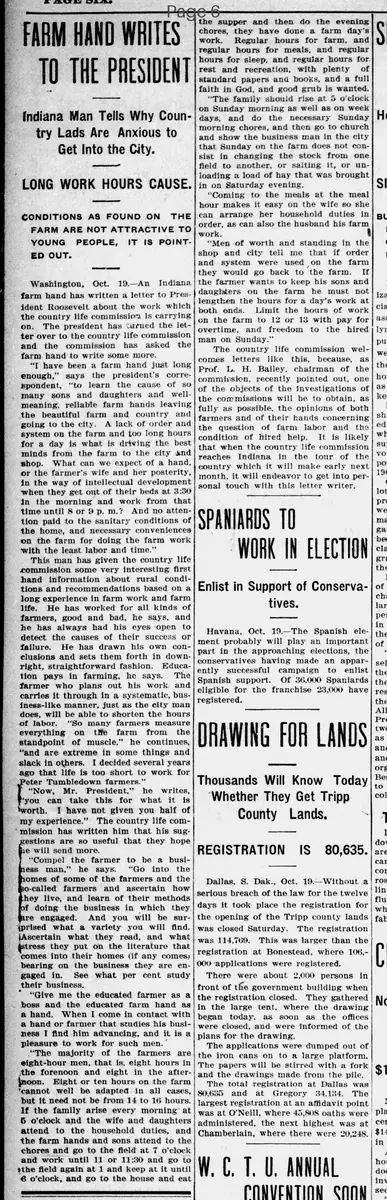
TO THE PRESIDENT
Indiana Man Tells Why Country Lads Are Anxious to Get Into the City.
LONG WORK HOURS CAUSE.
CONDITIONS AS FOUND ON THE FARM ARE NOT ATTRACTIVE TO YOUNG PEOPLE, IT IS POINTED OUT.
Washington, Oct. 19.—An Indiana farm hand has written a letter to President Roosevelt about the work which the country life commission is carrying on. The president has turned the letter over to the country life commission and the commission has asked the farm hand to write some more.
"I have been a farm hand just long enough," says the president's correspondent, "to learn the cause of so many sons and daughters and well-meaning, reliable farm hands leaving the beautiful farm and country and going to the city. A lack of order and system on the farm and too long hours for a day is what is driving the best minds from the farm to the city and shop. What can we expect of a hand, or the farmer's wife and her posterity, in the way of intellectual development when they get out of their beds at 3:30 in the morning and work from that time until 8 or 9 p. m.? And no attention paid to the sanitary conditions of the home, and necessary conveniences on the farm for doing the farm work with the least labor and time."
This man has given the country life commission some very interesting first hand information about rural conditions and recommendations based on a long experience in farm work and farm life. He has worked for all kinds of farmers, good and bad, he says, and he has always had his eyes open to detect the causes of their success or failure. He has drawn his own conclusions and sets them forth in downright, straightforward fashion. Education pays in farming, he says. The farmer who plans out his work and carries it through in a systematic, business-like manner, just as the city man does, will be able to shorten the hours of labor. "So many farmers measure everything on the farm from the standpoint of muscle," he continues, "and are extreme in some things and slack in others. I decided several years ago that life is too short to work for Peter Tumbledown farmers."
"Now, Mr. President," he writes, "you can take this for what it is worth. I have not given you half of my experience." The country life commission has written him that his suggestions are so useful that they hope he will send more.
"Compel the farmer to be a business man," he says. "Go into the homes of some of the farmers and the so-called farmers and ascertain how they live, and learn of their methods of doing the business in which they are engaged. And you will be surprised what a variety you will find. Ascertain what they read, and what stress they put on the literature that comes into their homes (if any comes) bearing on the business they are engaged in. See what per cent study their business.
"Give me the educated farmer as a boss and the educated farm hand as a hand. When I come in contact with a hand or farmer that studies his business I find him advancing, and it is a pleasure to work for such men.
"The majority of the farmers are eight-hour men, that is, eight hours in the forenoon and eight in the afternoon. Eight or ten hours on the farm cannot well be adapted in all cases, but it need not be from 14 to 16 hours. If the family arise every morning at 5 o'clock and the wife and daughters attend to the household duties, and the farm hands and sons attend to the chores and go to the field at 7 o'clock and work until 11 or 11:30 and go to the field again at 1 and keep at it until 6 o'clock, and go to the house and eat the supper and then do the evening chores, they have done a farm day's work. Regular hours for farm, and regular hours for meals, and regular hours for sleep, and regular hours for rest and recreation, with plenty of standard papers and books, and a full faith in God, and good grub is wanted.
"The family should rise at 5 o'clock on Sunday morning as well as on week days, and do the necessary Sunday morning chores, and then go to church and show the business man in the city that Sunday on the farm does not consist in changing the stock from one field to another, or salting it, or unloading a load of hay that was brought in on Saturday evening.
"Coming to the meals at the meal hour makes it easy on the wife so she can arrange her household duties in order, as can also the husband his farm work.
"Men of worth and standing in the shop and city tell me that if order and system were used on the farm they would go back to the farm. If the farmer wants to keep his sons and daughters on the farm he must not lengthen the hours for a day's work at both ends. Limit the hours of work on the farm to 12 or 13 with pay for overtime, and freedom to the hired man on Sunday."
The country life commission welcomes letters like this, because, as Prof. L. H. Bailey, chairman of the commission, recently pointed out, one of the objects of the investigations of the commission will be to obtain, as fully as possible, the opinions of both farmers and of their hands concerning the question of farm labor and the condition of hired help. It is likely that when the country life commission reaches Indiana in the tour of the country which it will make early next month, it will endeavor to get into personal touch with this letter writer.
What sub-type of article is it?
What themes does it cover?
What keywords are associated?
What entities or persons were involved?
Where did it happen?
Story Details
Key Persons
Location
Indiana Farms, Washington
Event Date
Oct. 19
Story Details
An Indiana farm hand writes to President Roosevelt explaining why rural youth leave farms for cities due to long hours, lack of system, poor sanitation, and inefficiency. He advocates for educated, systematic farming, regular hours, and business-like approaches to retain workers. The letter is shared with the Country Life Commission, which requests more details.