Thank you for visiting SNEWPapers!
Sign up free
Gazette Of The United States, & Philadelphia Daily Advertiser
Philadelphia, Philadelphia County, Pennsylvania
What is this article about?
Transcript of U.S. House of Representatives debate on May 24, featuring speeches by Mr. Swanwick and Mr. Livingston on French complaints over U.S. neutrality, British treaty provisions, and the need for amicable negotiation to avoid war, rather than rigid assertions of infallibility.
Merged-components note: Merged sequential components reporting on congressional proceedings from May 24, including speeches by Swanwick and Livingston, and the vote table, into a single coherent story on the debate over the President's address and amendment.
Clippings
1 of 2
OCR Quality
Full Text
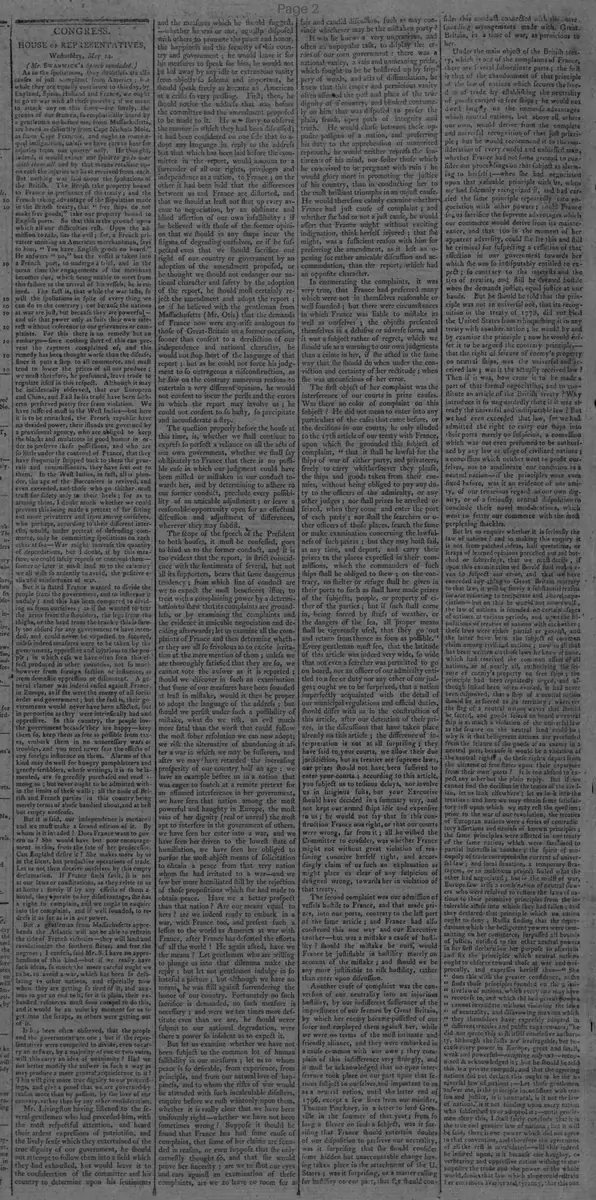
HOUSE OF REPRESENTATIVES.
Wednesday, May 24.
(Mr. Swanwick's Speech concluded.)
As to the depredations, they doubtless are also causes of just complaint from America; but while they are equally continued to this day, by England, Spain, Holland and France, we ought to go to war with all these powers; if we mean to attack any on this score—for surely, the groans of our seamen, so emphatically heard by a gentleman just before me, from Massachusetts, are heard as distinctly from Cape Nicholas Mole, as from Cape Francois, and ought to rouse equal indignation, unless we have ears to hear for injuries from one quarter only. He thought, indeed, it would evince our spirit to go to war with them all and by that means retaliate upon each the injuries we have received from each. But nothing was said about the depredations of the British. The British take property bound to France in pursuance of the treaty; and the French taking advantage of the stipulation made in the British treaty, that "free ships do not make free goods," take our property bound to English ports. So that this is the ground upon which all our difficulties rest. Upon the admission to take, lies the evil; or, a French privateer meeting an American merchantman, says to him, "You have English goods on board." He answers "no," but the vessel is taken into a French port, to undergo a trial, and in the mean time the engagements of the merchant becomes due, which being unable to meet from this failure in the arrival of his vessels, he is ruined. The fact is, that while the war lasts, so will the depredations in spite of every thing we can do to the contrary; not because the nations at war are just, but because they are powerful—and use that power only as suits their own interest without reference to our grievances or complaints. For this there is no remedy but an embargo—since nothing short of this can prevent the captures complained of, and this remedy has been thought worse than the disease, since it puts a stop to all commerce, and must tend to lower the prices of all our produce; we must therefore, he presumed, leave trade to regulate itself in this respect. Although it may be incidentally observed, that our European and China, and East India trade have been hitherto preserved pretty free from violation. We have suffered most in the West Indies—but here it is to be remarked, the French republic have no decided power, their islands are governed by a provisional agency, who are obliged to keep the blacks and mulattoes in good humor in order to preserve those possessions, and who are so little under the controul of France, that they have frequently shipped back to them the generals and commissioners, they have sent out to them. In the West Indies, in fact, all is plunder, the age of the Buccaniers is revived, and even exceeded, and those who go thither must trust for safety only to their heels; for as to arming them, I doubt much whether we could prevent this being made a pretext of for fitting out more privateers and from among ourselves, who perhaps, according to their different interests, would, under pretext of defending commerce, only be committing depredations on each other at sea—War might increase the quantity of depredations, but I doubt, if by this measure, we could safely repress or controul them—sooner or later it must lead us to the calamity we all wish so ardently to avoid, the positive evils and misfortunes of war.
But it is stated France wanted to divide the people from the government, and to influence it unduly; and this has been compared to dividing us from ourselves; as if she wanted to tear the arms from the shoulders, the legs from the thighs, or the head from the trunk; this is surely too absurd for any government to have intended, and could never be expected to succeed. unless indeed measures were to be taken by the government, oppressive and injurious to the people; in which case we have often seen this effect produced in other countries, not so much however from foreign faction or influence, as from domestic oppression or discontent. A general clamor was indeed raised against France. in Europe, as if she were the enemy of all social order and government; but the fact is, their governments would never have been affected, but in proportion as they were intrinsically bad and oppressive. In this country, the people love the government because they are happy—keep them so, keep them as free as possible from taxes, embark them in no unnecessary wars or troubles, and you need never fear the effects of any foreign influence on them. Alarms of this kind may do well for hungry pamphleteers and greedy scribblers, whose writings, it is to be lamented, are so greedily purchased and read among us; but never ought to be admitted within the limits of these walls; all the noise of British and French parties in this country being merely terms of abuse bandied about, and at best but empty nonsense.
But it is said, our independence is menaced and we must make a second edition of it. By whom is it invaded? Does France want to govern us? She would have but poor encouragement in this, from the fate of her predecessor. Can England desire it? She makes more by us in the silent, but productive operations of trade. Let us not then deceive ourselves by this empty declamation. If France finds fault, it is not at our laws or constitutions, as they relate to us at home; surely if by any effects of them abroad, they operate to her disadvantage, she has a right to complain, and we ought to enquire into the complaint, and if well founded, to redress it as far as is in our power.
But a gentleman from Massachusetts apprehends the Atlantic will not be able to restrain the tide of French victories—they will land and revolutionize the southern states, and free the negroes; I confess, said Mr. S. I have no apprehensions of this kind—but if we really have such ideas, so much the more careful ought we to be, to avoid a war, which has been so desolating to other nations, and especially now when they are getting tired of it, and anxious to put an end to it, for it is plain, their exhausted resources must soon compel to do this, and it would be an unlucky moment for us to get into the scrape, as others were getting out of it.
It has been often observed, that the people and the government are one; but if the representatives were compelled to divide, even to carry an answer, by a majority of one or two votes, will this carry an idea of unanimity? Had we not better modify the answer in such a way as may produce a more general acquiescence in it? This will give more true dignity to our proceedings, and give a proof that we are governed by reason more than by passion, by the love of our country, rather than by any other consideration.
Mr. Livingston having listened to the several gentlemen who had preceded him, with the most respectful attention, and heard their ardent expressions of patriotism, and the lively sense which they entertained of the true dignity of our government, he should not attempt to follow them into a field which they had exhausted, but would leave it to the consideration of the committee and his country to determine upon his sentiments and the measures which he should suggest,—whether he was or not, equally disposed with others to promote the peace and honor, the happiness and the security of his country and government; he would leave it for his measures to speak for him, he would not be led away by any idle or extraneous vanity from objects so solemn and important, he should speak freely as became an American at a crisis so very pressing. First, then, he should notice the address that was before the committee and the amendment proposed to be made to it. He was sorry to observe the manner in which they had been discussed; it had been considered on one side that to adopt any language in reply to the address but that which has been laid before the committee in the report, would amount to a surrender of all our rights, privileges and independence as a nation, to France; on the other it had been held that the differences between us and France are distorted, and that we should at least not shut up every avenue to negociation, by an obstinate and blind assertion of our own infallibility: if he believed with those of the former opinion that we should in any shape incur the stigma of degrading ourselves, or if he suspected even that we should sacrifice one right of our country or government by an adoption of the amendment proposed, or he thought we should not endanger our national character and safety by the adoption of the report, he should most certainly reject the amendment and adopt the report; or if he believed with the gentleman from Massachusetts (Mr. Otis) that the demands of France now were any-wise analogous to those of Great-Britain on a former occasion, sooner than consent to a dereliction of our independence and national character, he would not stop short of the language of that report;—but as he could not force his judgment to so outrageous a misconstruCtion, as he saw on the contrary numerous reasons to entertain a very different opinion, he would not consent to incur the perils and the errors in which the report may involve us; he could not consent to so hasty, so precipitate and inconsiderate a step.
The question properly before the house at this time, is, whether we shall continue to express so perfect a reliance on all the acts of our own government, whether we shall say obstinately to France that there is no possible case in which our judgment could have been misled or mistaken in our conduct towards her, and by determining to adhere to our former conduct, preclude every possibility of an amicable adjustment; or leave a reasonable opportunity open for an effectual discussion and adjustment of differences, wherever they may subsist.
The scope of the speech of the President to both houses, it must be confessed, goes to bind us to the former conduct, and it is too evident that the report, in strict coincidence with the sentiments of several, but not all its supporters, bears the same dangerous tendency; from which line of conduct are we to expect the most beneficent issue, to treat with a complaining power by a determination to shew that its complaints are groundless, or by examining the complaints and the evidence in amicable negociation and deciding afterwards; let us examine all the complaints of France and then determine whether they are all so frivolous as to excite irritation at the mere mention of them; unless we are thoroughly satisfied that they are so, we cannot vote the answer as it is reported; should we discover in such an examination that some of our measures have been founded at least in mistake, would it then be proper to adopt the language of the address; but should we persist under such a possibility of mistake, what do we risk, an evil much more fatal than the worst that could follow the most sober resolution we can now adopt; we risk the alternative of abandoning it after a war in which we may be sufferers, and after we may have retarded the increasing prosperity of our country half an age: we have an example before us in a nation that was eager to snatch at a remote pretext for an assumed interference in her government, we have seen that nation among the most powerful and haughty in Europe, the most vain of her dignity (real or unreal) the most apt to interfere in the government of others, we have seen her enter into a war, and we have seen her driven to the lowest state of humiliation, we have seen her obliged to pursue the most abject means of solicitation to obtain a peace from that very nation whom she had irritated to a war---and we saw her more humiliated still by the rejeCtion of those propositions which she had made to obtain peace. Have we a better propect than that nation? Are our means equal to hers? are we indeed ready to embark in a war, with France too, and present such a lesson to the world as America at war with France, after France has defeated the efforts of all the world! He again asked, have we the means? Let gentlemen who are willing to plunge us into that dilemma make the reply: but let not gentlemen indulge in so hateful a picture; but although we have no means, he was still against surrendering the honor of our country. Fortunately no such sacrifice is demanded, no such measure is necessary; and were we ten times more destitute even than we are, he should never submit to our national degradation, were there a power so insolent as to expect it.
But let us examine whether we have not been Subiect to the common lot of human fallibility in our measures; let us to whom peace is so desirable, from experience, from principle, and from our natural love of happiness, and to whom the risks of war would be atttended with such incalculable disasters, enquire before we rush wantonly upon them, whether it is really clear that we have been uniformly right---whether we have not been sometimes wrong? Suppose it should be found that France has had some cause of complaint, that some of her claims are founded in reason, or even suppose that she only earnestly thought so, and that she would prove her sincerity; are we to shut our eyes and ears against an examination of these complaints, are we to leave no room for a vindication whichever may be the mistaken party? It was he knew. a very ungracious, and often an unpopular task, to display the errors of our own government: there was a national vanity, a vain and unmeaning pride, which ought to be bolstered up by frippery of words, and acts of dissimulation, he knew that this empty and pernicious vanity often assumed the post and place of the true dignity of a country, and blinked contumely on him that was disposed to prefer the plain, frank, open path of integrity and truth. He would chuse between these opposite passions of a nation, and preferring his duty to the apprehension of unmerited reproach, he would neither repress the sentiments of his mind, nor foster those which he conceived to be pregnant with ruin: he would glory more in promoting the justice of his country, than in conducting her to the most brilliant triumphs in an unjust cause. He would therefore calmly examine whether France had just cause of complaint; and whether he had or not a just cause, he would assert that France might without exciting indignation, think herself injured; that the might, was a sufficient reason with him for preferring the amendment, as it left an opening or rather amicable discussion and accommodation, than the report, which had an opposite character.
In enumerating the complaints, it was very true, that France had preferred many which were not in themselves reasonable or well founded; but there were circumstances in which France was liable to mistake as well as ourselves; the objects presented themselves in a delusive or adverse form, and it was a subject rather of regret, which we should use as a warning to our own judgments than a crime in her, if she acted in the same way that she should do when under the conviction and certainty of her rectitude; when she was unconscious of her error.
The first object of her complaint was the interference of our courts in prize causes. Was there no color of complaint on this subject? He did not mean to enter into any particulars of the cases that came before, or the decisions in our courts, he only alluded to the 17th article of our treaty with France, upon which she grounded this subject of complaint, "that it shall be lawful for the ships of war of either party, and privateers, freely to carry whithersoever they please, the ships and goods taken from their enemies, without being obliged to pay any duty to the officers of the admiralty, or any other judges; nor shall prizes be arreted or seized, when they come and enter the port of each party; nor shall the searchers or other officers of those places, search the same or make examination concerning the lawfulness of such prizes; but they may hoist sail, at any time, and depart, and carry their prizes to the places expressed in their commissions, which the commanders of such ships shall be obliged to shew; on the contrary, no shelter or refuge shall be given in their ports to such as shall have made prizes of the subjects, people, or property of either of the parties; but if such shall come in, being forced by stress of weather, or the dangers of the sea, all proper means shall be vigorously used, that they go out and return from thence as soon as possible." Every gentleman must see, that the latitude of this article was indeed very wide, so wide that not even a searcher was permitted to go on board, nor an officer of our admiralty entitled to a fee or duty nor any other of our judges; ought we to be surprised, that a nation imperfectly acquainted with the detail of our municipal regulations and official duties, should differ with us in the construCtion of this article, after our detention of their prizes, in the discussions that have taken place already on this article; the difference of interpretation is not at all surprising; they have said to your courts, we allow their due juridiction, but as treaties are supreme laws, our prizes should not have been suffered to enter your courts; according to this article, you subject us to tedious delays, nor involve us in litigious suits, but your Executive should have decided in a summary way, and not kept our armed ships idle and expensive to us; he would not say that in this construction France was right, or that our courts were wrong, far from it; all he wished the Committee to consider, was whether France might not without great violation of reasoning conceive herself right, and accordingly claim of us such an explanation as might place us clear of any suspicion of designed wrong, towards her in violation of that treaty.
The second complaint was our admission of vessels hostile to France, and that made prizes, into our ports, contrary to the last part of the same article: and France had also construed this one way and our Executive another—but was a mistake a cause of hostility? should the mistake be ours, would France be justifiable in hostility merely on account of the mistake; and should we be any more justifiable to risk hostility, rather than enter upon discussion.
Another cause of complaint was the conversion of our neutrality into an injurious hostility, by our indifferent sufferance of the impressment of our seamen by Great Britain, by which her enemy became possessed of our force and employed them against her, while we were on terms of the most intimate and friendly alliance, and they were embarked in a cause common with our own; they complain of this indifference very strongly, and it must be acknowledged that no open interference took place on our part upon that serious subject to ourselves, and important to us as a neutral nation, until the latter end of 1796, except a few lines from our minister, Thomas Pinckney, in a letter to lord Grenville in the summer of that year; from so long a silence on such a subject, was it surprising that France should entertain doubts of our disposition to preserve our neutrality, was it surprising that she should consider some hidden but unaccountable change having taken place in the attachment of the U. States; was it surprising, or a matter calling for hostility on our part, that she should consider this conduct connected with the corresponding arrangements made with Great. Britain, in a time of war, as pernicious to her.
Under the main object of the British treaty, which is one of the complaints of France, there are several subordinate parts; the first is that of the abandonment of that principle of the law of nations which secures the freedom of trade by establishing the neutrality of goods carried in free ships; he would not dwell largely on the immense advantages which neutral nations, but above all others our own, would derive from the complete and universal recognition of that just principle; but he would recommend it to the consideration of every candid and unbiased man, whether France had not some ground to consider our proceedings on that subject as alarming to herself;—when she had negotiated upon that valuable principle with us, when we had solemnly recognized it, and had carried the same principle repeatedly into negotiation with other powers; could France see us sacrifice the supreme advantages which our commerce would derive from its maintenance, and that too in the moment of her apparent adversity, could she see this and still be criminal for suspecting a cessation of that affection in our government towards her which she was so indisputably entitled to expect; so contrary to the interests and the ties of treaties, and ill be deemed hostile when she demands justice, equal justice at our hands. But he should be told that the principle was not an universal one, that its recognition in the treaty of 1778, did not bind the United States from relinquishing it in any treaty with another nation; he would by and by examine the principle; now he would suffer it to be argued the contrary principle—that the right of seizure of enemy's property on neutral ships, was the universal and received law; was it the actually received law? Then if it was, how came it to be made a part of that formal negotiation, and to constitute an article of the British treaty? Why intrdouce it so unguardedly there if it was already the universal and indisputable law? But we had even exceeded that law, or we had admitted the right to carry our ships into their ports merely on suspicion, a concession which was not even presumed to be authorized by any law or usage of civilized nations; a concession which neither went to profit ourselves, nor to ameliorate our condition as a neutral nation—if the principles were even fixed before, was it an evidence of our amity, of our tenacious regard or our own dignity, or of a seriously neutral disposition to conclude these novel modifications, which went to fetter our commerce with the most perplexing shackles.
But let us enquire whether it is seriously the law of nations? and in making this enquiry it is not from patched ideas, half quotations, or scraps of learned opinions parceled out and botched or subterfuge, that we must decide, if upon this examination we should find reason even to suspect our error, and that we have conceded any thing to Great Britain contrary to that law, it will be surely a substantial reason for our resorting to temperate and liberal negociation—but on this he would not now dwell, the law of nations is founded on certain usages of nations at various periods, and upon the stipulations of treaties of nations with each other; these laws were either partial or general, and the latter have been the subject of common claim among civilized nations; now in all that has been written on those laws he knew of none, which had received the common assent of all nations, or of nearly all, authorizing the seizure of enemy's property on free ships; the principle had been repeatedly urged, and although it had been often evaded, it had never been disproved, that a ship of a neutral nation should be as sacred as its territory; wherever the flag of a neutral nation waves that should be sacred, and goods seized on board a neutral ship is as much a violation of the universal law as the seizure on the neutral land could be; why is it that belligerent nations are precluded from the seizure of the goods of an enemy in a neutral port, because it would be a violation of the neutral rights; do these rights depart from the citizens of free states upon their departure from their own ports? It is too absurd to expect any other but the plain reply. But if we cannot find the decision in the tomes of the civ.Ilian, let us look elsewhere: let us look into the treaties: and here we may obtain some satisfactory test upon which we may rest the question; prior to the war of our revolution, the treaties of European nations were a series of contradictory assertions and denials of known principles; the same principles were asserted in one treaty of the same nation, which were ascribed to partial interests in another; the spirit of monopoly of trade corrupted the current of universal law; and local situation, a temporary stratagem, or an ambitious project sealed what the other had negotiated; but in the midst of war, Europe saw arise a combination of neutral powers who were resolved to restore the laws of nations to their primitive principles from the intolerable abuse into which they had fallen; and they declared that principle which no nation ought to deny; Russia finding that the depredations which the belligerent powers were committing on her commerce, surpassed all bounds of justice, notified to the other neutral powers in her first declaration her purpose to ascertain and fix the principles which neutral nations ought to observe toward those at war and reciprocally, and expresses herself thus—“She does this with the greater confidence, as she finds those principles founded on the primitive laws of nations, which every one may have recourse to, and which the belligerent powers cannot invalidate without violating the laws of neutrality, and disavowing maxims which they themselves have expressly adopted in different treaties and public engagements;” he did not quote this as if it itself conclusive authority, although the facts are irrefutable, but because every power in Europe, great and small, weak and powerful excepting only one—recognized & acknowledged it; but he should be told this is a private compact, and that the agreeing nations did not declare this ought to be the universal law of nations;—Let those gentlemen answer me, is the principle inconsistent with reason and justice, is it unnatural, is it not the law of nations, is it not binding upon every nation who subscribed to or adopted it;—until gentlemen deny this, I shall fairly conclude that it is the true and genuine law of nations; but it will be said, there is one power which did not agree to that convention, and therefore the agreement of all the rest is invalidated—will this indeed be insisted upon, is it because one haughty, overbearing and oppressive nation wishing to monopolize the trade and the power of the whole world, denies that law which alone could restrain her enormous avarice and tyranny, that this one placed in the scale against all the other powers of the world, peaceful and belligerent, and with justice and law too on their side, shall determine that the very law itself must become invalid!
But it is said, this declaration of the armed neutrality is only a temporary, and not a permanent compact, and we shall be told that this assertion is supported by an article of the treaty of neutrality itself:—In arguing this objection, he felt a degree of uneasiness that he could not suppress, it had given much disquiet, because it very largely implicated the honour and character of our country:—In a document published by the express authority of Government, a procedure addressed to a public minister then about to proceed on his mission, our Secretary of State, published in the face of the United States and the whole world a letter which was to be the instruction of that minister when in France, a mutilated half of an article of this treaty, in order to justify the measure of our concession to Great Britain; he had seen such bungling things attempted in courts of law in order to deceive an ignorant jury, or a more ignorant judge, but as an act of a national agent, of one of the principal officers of a government, he believed the like was not to be found in the annals of the most vicious policy in any nation: in that letter the 9th article of the armed neutral convention is thus quoted—“The Convention being concluded and agreed on for the time the present war shall last, shall serve as a basis to future engagements which circumstances may render necessary, or on account of new naval wars which Europe may have the misfortune to be troubled with”—and here the quotation is broken off short in the middle of the article; was it to be supposed that our minister of State could obtain only a mutilated copy of this important historical record!—the article concludes with this weighty and important declaration, which our Secretary has entirely omitted—“These stipulations shall further be considered as PERMANENT, and shall decide in ALL MATTERS of Commerce and Navigation; and in short in EVERY Case where the rights of neutral nations are to be determined.”
But a gentleman has told us this principle of the armed neutrality cannot be a true one? and why? truly because the same Empress of Russia who was at the head of the confederation, has, during the present war, entered into a treaty with that power which formerly denied the principle, and had herself agreed to contravene it; and further, that Spain had acceded to that contravention;—that this conduct of that Empress and of Spain is a melancholy proof of the caprice and instability of arbitrary councils and of nations, he was ready to confess; but he did not see upon what ground this partial dereliction of right principles should go to the universal establishment of wrong:
France in the convulsions of her revolution had alarmed all Europe, and Britain always jealous of her power, and much more of that power under the influence of liberty, had entered into an engagement with Russia to starve France, and Spain accedes to this purpose; but under what circumstances; under the proclaimed avowal of the measure being adopted, because the revolution of France was a new case; a flame had been lighted up, as they called it, which threatened to destroy all Europe; and to quench this flame they agree to overturn the law of nations which if obeyed or regarded, would counteract the designs of England and the wishes of Russia and Spain.
But we are told that our government has receded from this principle on a former occasion, and had declared it in our correspondence with Genet; but he would ask any gentleman, does a date alter a principle? Do principles of right and wrong alter with the course of the years? If we abandoned it then or at this day, what is that to France; he tells us we have done it, and we acknowledge it is done; thus the question is then reduced to this point—Have we done right?
This question unfortunately does not rest with our partialities to decide; it not only rests upon the powers of Europe whom it may implicate or concern, but upon our own formal recognition & accession to the principles of the armed neutrality, nay with the compliments expressed by our government to the Empress of Russia for promoting it; upon our accepting of this principle too at a period in which we manifested that our love of justice was in perfect consonance with that love of liberty which then engaged us in our revolution; upon our acceptance of it when it was calculated to operate most seriously to our disadvantage by depriving us of the supplies which could be thereby kept from us; it matters not then what date, or in what manner we relinquished it, if having formally received it we abandoned it to the disadvantage and injury of our allies and of other previously subsisting treaties; we have unquestionably done this evil, perhaps from no malign disposition—but it was our duty, having committed the error, to rectify it; it had been urged that we had been compelled to abandon the principle or go to war with Britain; and we had chosen it as the alternative—what compelled! he would not discuss this unhappy argument—we have inflicted a wound on our commercial neutrality, but what is much worse on our national character, which he feared we should never recover.
Another stipulation is contained in the British treaty relative to provisions, which admits the British, contrary to the law of nations, to seize upon our vessels going to France; it is said that this article does not admit any new principle, and that instead of being disadvantageous to France, he is put on a better footing than before! He would read the article; the first paragraph of the 18th article after defining the new extension of what shall thereafter be deemed contraband, proceeds in the second thus—“and whereas the difficulty of judging of the precise cases in which alone provisions and other articles not generally contraband may BE REGARDED as such, renders it expedient to provide against the inconveniences and misunderstandings which might thence arise: It is further agreed that whenever any such articles so becoming contraband according to the existing law of nations, shall for that reason be seized, the same shall not be confiscated, but the owners thereof shall be speedily and completely indemnified; and the captors, or in their default the Government under whose authority they act shall pay to the master, or owners, of such vessel, the full value of all articles, with a reasonable mercantile profit thereon, together with the freight, and also the demurrage incident to the detention.”
Our treaty in the subsequent paragraphs recapitulates the ordinary provision for the circumstances attending ships proceeding through error or inattention, to blockaded ports, but in the above stipulations a new principle is foisted into the law of nations, for which we are to receive the full price of our articles and a reasonable mercantile profit; and after doing this we are told, that we place our ally in a better condition than she was before—that the power of her enemy to seize our ships, which are protected by the law of nations from seizure having nothing contraband on board, when going to the ports of a belligerent power not blockaded—is an advantage to that power so deprived; we might admit what is not a fact, in the first instance that provisions are contraband, and we accept compensation for our sacrifice of the universal law; we admit the inhuman and horrid principle, that one nation has a right to starve another at its discretion, and while thus conniving at, and profiting by the collusion, affect to be indignant when remonstrance or resentment flows from the injured nation; this is the sad and afflicting picture of error into which we have been blindly seduced! Of all the authors that have written on the law of nations, there is not one—no, not one, that supports the idea of provisions being liable to the description of contraband, in any case but in approaching a blockaded port; the only author indeed that mentions such a thing even in the way of suggestion, is Vattel, who says, that possibly there may be a case where there is a reasonable hope of reducing a nation by want of provisions, they may be deemed contraband; but this is delivered as a mere suggestion, and contrary to his usual diffuseness he leaves it naked and unsupported by any one historical example or reference; But gentlemen say, we do not allow provisions to be contraband, although Vattel has used this suggestion, we think the doctrine unfounded; but he would not dispute about opinions while he had facts, and he would say, while you have denied the doctrine you have allowed the practice; you not only do wrong there to France, but we have done it in the most offensive form—and irritated as she must be by the intrigues that have already torn her for so many years, the foreign machinations and the efforts to subjugate her by all the arts which perfidy could suggest, we should not be surprised if she should be reluctantly led to believe, that we had thus bartered our supplies to Britain, reckless of her ruin and regardless of our treaties; I say she may be reluctantly led to believe this,—since the error of our blindness or our weakness is visible as noon day.
But we are told that this stipulation is advantageous to France, as it holds out a temptation to mercantile adventurers from the certainty of payment in either event of a voyage; for his part he could not discover in the conduct of the negociation, nor in the treaty itself, any such intention on our part;—but he could see in the sacrifice an effort, and he would ask any gentleman how far successful it had proved, to guard against British depredations; but he could see in the argument a weak effort to support a worse measure!—
But let us see what is the construction of our own government upon this principle it must be tested by other facts than its adoption or rejection in a treaty; since the execution of the treaty our Executive has put a strong construction on this principle; but our Executive had also, in a letter of instruction to Mr. Thomas Pinckney, expressed his sentiments equally pertinent but conspicuous—speaking of the orders of the British government for seizing provisions in neutral ships, the first article of which was in these words:
"That it shall be lawful to stop and retain all vessels loaded wholly or in part with corn, flour, or meal, bound to any port in France, or any port occupied by the armies of France, and to send them to such port as shall be most convenient, in order that such corn, meal, or flour, may be purchased on behalf of his majesty's government, and the ships be released after such purchase, and after due allowance for freight, &c."
The Executive thus notices the order,
"this act too tends directly to draw us from that state of peace in which we are wishing to remain: It is an essential character of neutrality, to furnish no aids (not stipulated by treaty) to one party, which we are not equally bound to furnish to another. If we permit corn to be sent to Great-Britain and her friends, we are equally bound to permit it to France. To restrain it would be a partiality which would lead to a war with France; and between restraining it ourselves and permitting her enemies to restrain it unrighteously is no difference—She would consider this as a mere pretext, of which she would not be the dupe, and on what honorable ground could we otherwise explain it? Thus we should see ourselves plunged by this unauthorized act of Great-Britain, into a war with which we meddle not, and which we wish to avoid, if justice to all parties will enable us to avoid it." Now, sir, if government thought France would not be the dupe of an artifice then, what reason have we to believe that she will now? Let gentlemen who are eager for the report, reply and show wherein the distinction lies. In 1793 our Executive considered it as a cause of war only to permit the infraction of that law of nations, or the partial supply of one or other party with provisions; and are we to expect France, to whom we were at least under some ties of regard, not to say obligation, should tamely condescend not to notice our sacrifices thus made; gentlemen would not be serious and expect it.
[To be continued.]
| were | present, | 106 |
| Absent | - | 7 |
| Present | - | 99 |
| Ayes | - | 46 |
| Noes | - | 52 |
| Chairman | - | 1 |
| 99 |
What sub-type of article is it?
What themes does it cover?
What keywords are associated?
What entities or persons were involved?
Where did it happen?
Story Details
Key Persons
Location
House Of Representatives
Event Date
Wednesday, May 24
Story Details
Speeches in Congress debating U.S. response to French grievances over neutrality, treaty interpretations, and depredations; advocates examination of complaints and negotiation to preserve peace and honor, critiquing the British treaty's concessions on free ships and provisions.