Thank you for visiting SNEWPapers!
Sign up free
Editorial
September 6, 1859
Staunton Spectator
Staunton, Virginia
What is this article about?
The Staunton Spectator defends publishing a correspondent's critique of Methodist camp-meetings against criticism from the Vindicator, arguing it upholds press freedom on public interest matters and lacks malice toward the church. It also dismisses threats from another anonymous writer.
Clipping
OCR Quality
95%
Excellent
Full Text
S T A U N T O N
SPECTATOR AND GENERAL ADVERTISER
Staunton Spectator.
STAUNTON, VA.
TUESDAY, SEPTEMBER 6, 1859
The STAUNTON SPECTATOR has as large a circulation as any paper published in Western Virginia, has no superior in this section of country as an advertising medium.
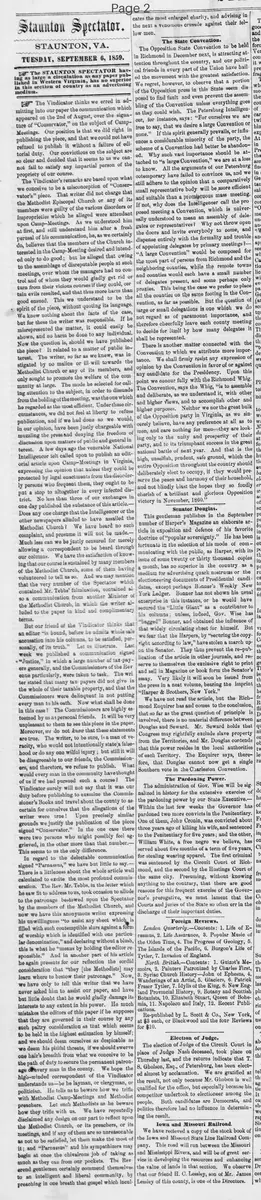
The Vindicator thinks we erred in admitting into our paper the communication which appeared on the 2nd of August, over the signature of "Conservator," on the subject of Camp-Meetings. Our position is that we did right in publishing the piece, and that we could not have refused to publish it without a failure of editorial duty. Our convictions on the subject are so clear and decided that it seems to us we cannot fail to satisfy any impartial person of the propriety of our course.
The Vindicator's remarks are based upon what we conceive to be a misconception of "Conservator's" piece. That writer did not charge that the Methodist Episcopal Church or any of its members were guilty of the various disorders or improprieties which he alleged were attendant upon Camp-Meetings. As we understood him at first, and still understand him after a fresh perusal of his communication, he, as we certainly do, believes that the members of the Church interested in the Camp-Meeting desired and intended only to do good; but he alleged that owing to the assemblage of disreputable people at such meetings, over whom the managers had no control and of whom they would gladly get rid if they could, certain evils resulted, and that thus more harm than good ensued. This we understand to be the spirit of the piece, without quoting its language.
We knew nothing about the facts of the case, but for these the writer was responsible. If he misrepresented the matter, it could easily be shown, and no harm be done to any individual.
Now the question is, should we have published the piece? It related to a matter of public interest. The writer, so far as we knew, was instigated by no malice or ill-will towards the Methodist Church or any of its members, and only sought to promote the welfare of the community at large. The mode he selected for calling attention to the subject, in order to dissuade from the holding of the meeting, was the one which he regarded as the most efficient. Under these circumstances, we did not feel at liberty to refuse publication, and if we had done so we would, in our opinion, have been justly chargeable with muzzling the press and denying the freedom of discussion upon matters of public and general interest. A few days ago the venerable National Intelligencer felt called upon to publish an editorial article upon Camp-Meetings in Virginia, expressing the opinion that unless they could be protected by legal enactments from the disorderly persons who frequent them, they ought to be put a stop to altogether in every infected district. No less than three of our exchanges in one day published the substance of this article. Does any one charge that the Intelligencer or the other newspapers alluded to have assailed the Methodist Church? We have heard no such complaint, and presume it will not be made. Much less can we be justly censured for merely allowing a correspondent to be heard through our columns. We have the satisfaction of knowing that our course is sustained by many members of the Methodist Church, some of them having volunteered to tell us so. And we may mention that the very number of the Spectator which contained Mr. Tebbs' fulmination, contained also a communication from another Minister of the Methodist Church, in which the writer alluded to the paper in kind and complimentary terms.
But our friend of the Vindicator thinks that an editor "is bound, before he admits wholesale accusation into his columns, to be satisfied, personally, of its truth." Let us illustrate. Last week we published a communication signed "Justice," in which a large number of tax-payers generally, and the Commissioners of the Revenue particularly, were taken to task. The writer stated that many tax-payers did not give in the whole of their taxable property, and that the Commissioners were delinquent in not putting every man to his oath. Now what shall be done in this case? The Commissioners are highly esteemed by us as personal friends. It will be very unpleasant to them to see this piece in the paper. Moreover, we do not know that these statements are true. The writer, to be sure, is a man of veracity, who would not intentionally state a falsehood or do any one wilful injury; but still it will be disagreeable to our friends, the Commissioners, and therefore, we refuse to publish. What would every man in the community have thought of us if we had pursued such a course? The Vindicator surely will not say that it was our duty before publishing to examine the Commissioner's Books and travel about the county to ascertain for ourselves that the allegations of the writer were true! Upon precisely similar grounds we justify the publication of the piece signed "Conservator." In the one case there were two persons who might possibly feel aggrieved, in the other more than that number. This seems to us the only difference.
In regard to the delectable communication signed "Parnassus," we have but little to say. There is a littleness about the whole article well calculated to excite the most profound commiseration. The Rev. Mr. Tebbs, in the letter which he saw fit to address to us, took occasion to allude to the patronage bestowed upon the Spectator by the members of the Methodist Church, and now we have this anonymous writer expressing his unwillingness "to assist any sheet which is filled with such contemptible slurs against a form of worship which is identified with one particular denomination," and declaring without a blush, this is what he "means by holding the editor responsible." And in another part of his article he again presents for our reflection the sordid consideration that "they [the Methodists] may learn where to bestow their patronage." Now, we have only to tell this writer that we have never asked him to assist our paper, and have but little doubt that he would gladly damage its interests to any extent in his power. He much mistakes the editors of this paper if he supposes that they are governed in their course by any such paltry consideration as that which seems to be held in the highest estimation by himself; and we should deem ourselves as despicable as we deem his pitiful threats, if we should swerve one hair's breadth from what we conceive to be the path of duty to secure the permanent patronage of every man in the county. We hope the high-winded correspondent of the Vindicator understands us—be he layman, or clergyman, or politician. He tells us to beware how we trifle with Methodist Camp-Meetings and Methodist preachers. Let such Methodists as he beware how they trifle with us. We have repeatedly disclaimed any design on our part to reflect upon the Methodist Church, or its preachers, or its meetings, and if any of them are so unreasonable as not to be satisfied, let them make the most of it; and "Parnassus" and his sympathizers may begin at once the chivalrous job of taking as much as they can from our pockets. The Reverend gentlemen certainly commend themselves to an intelligent and liberal community, by preaching in one breath that gospel which inculcates the most enlarged charity, and advising in the next a venomous crusade against their fellow-men.
SPECTATOR AND GENERAL ADVERTISER
Staunton Spectator.
STAUNTON, VA.
TUESDAY, SEPTEMBER 6, 1859
The STAUNTON SPECTATOR has as large a circulation as any paper published in Western Virginia, has no superior in this section of country as an advertising medium.
The Vindicator thinks we erred in admitting into our paper the communication which appeared on the 2nd of August, over the signature of "Conservator," on the subject of Camp-Meetings. Our position is that we did right in publishing the piece, and that we could not have refused to publish it without a failure of editorial duty. Our convictions on the subject are so clear and decided that it seems to us we cannot fail to satisfy any impartial person of the propriety of our course.
The Vindicator's remarks are based upon what we conceive to be a misconception of "Conservator's" piece. That writer did not charge that the Methodist Episcopal Church or any of its members were guilty of the various disorders or improprieties which he alleged were attendant upon Camp-Meetings. As we understood him at first, and still understand him after a fresh perusal of his communication, he, as we certainly do, believes that the members of the Church interested in the Camp-Meeting desired and intended only to do good; but he alleged that owing to the assemblage of disreputable people at such meetings, over whom the managers had no control and of whom they would gladly get rid if they could, certain evils resulted, and that thus more harm than good ensued. This we understand to be the spirit of the piece, without quoting its language.
We knew nothing about the facts of the case, but for these the writer was responsible. If he misrepresented the matter, it could easily be shown, and no harm be done to any individual.
Now the question is, should we have published the piece? It related to a matter of public interest. The writer, so far as we knew, was instigated by no malice or ill-will towards the Methodist Church or any of its members, and only sought to promote the welfare of the community at large. The mode he selected for calling attention to the subject, in order to dissuade from the holding of the meeting, was the one which he regarded as the most efficient. Under these circumstances, we did not feel at liberty to refuse publication, and if we had done so we would, in our opinion, have been justly chargeable with muzzling the press and denying the freedom of discussion upon matters of public and general interest. A few days ago the venerable National Intelligencer felt called upon to publish an editorial article upon Camp-Meetings in Virginia, expressing the opinion that unless they could be protected by legal enactments from the disorderly persons who frequent them, they ought to be put a stop to altogether in every infected district. No less than three of our exchanges in one day published the substance of this article. Does any one charge that the Intelligencer or the other newspapers alluded to have assailed the Methodist Church? We have heard no such complaint, and presume it will not be made. Much less can we be justly censured for merely allowing a correspondent to be heard through our columns. We have the satisfaction of knowing that our course is sustained by many members of the Methodist Church, some of them having volunteered to tell us so. And we may mention that the very number of the Spectator which contained Mr. Tebbs' fulmination, contained also a communication from another Minister of the Methodist Church, in which the writer alluded to the paper in kind and complimentary terms.
But our friend of the Vindicator thinks that an editor "is bound, before he admits wholesale accusation into his columns, to be satisfied, personally, of its truth." Let us illustrate. Last week we published a communication signed "Justice," in which a large number of tax-payers generally, and the Commissioners of the Revenue particularly, were taken to task. The writer stated that many tax-payers did not give in the whole of their taxable property, and that the Commissioners were delinquent in not putting every man to his oath. Now what shall be done in this case? The Commissioners are highly esteemed by us as personal friends. It will be very unpleasant to them to see this piece in the paper. Moreover, we do not know that these statements are true. The writer, to be sure, is a man of veracity, who would not intentionally state a falsehood or do any one wilful injury; but still it will be disagreeable to our friends, the Commissioners, and therefore, we refuse to publish. What would every man in the community have thought of us if we had pursued such a course? The Vindicator surely will not say that it was our duty before publishing to examine the Commissioner's Books and travel about the county to ascertain for ourselves that the allegations of the writer were true! Upon precisely similar grounds we justify the publication of the piece signed "Conservator." In the one case there were two persons who might possibly feel aggrieved, in the other more than that number. This seems to us the only difference.
In regard to the delectable communication signed "Parnassus," we have but little to say. There is a littleness about the whole article well calculated to excite the most profound commiseration. The Rev. Mr. Tebbs, in the letter which he saw fit to address to us, took occasion to allude to the patronage bestowed upon the Spectator by the members of the Methodist Church, and now we have this anonymous writer expressing his unwillingness "to assist any sheet which is filled with such contemptible slurs against a form of worship which is identified with one particular denomination," and declaring without a blush, this is what he "means by holding the editor responsible." And in another part of his article he again presents for our reflection the sordid consideration that "they [the Methodists] may learn where to bestow their patronage." Now, we have only to tell this writer that we have never asked him to assist our paper, and have but little doubt that he would gladly damage its interests to any extent in his power. He much mistakes the editors of this paper if he supposes that they are governed in their course by any such paltry consideration as that which seems to be held in the highest estimation by himself; and we should deem ourselves as despicable as we deem his pitiful threats, if we should swerve one hair's breadth from what we conceive to be the path of duty to secure the permanent patronage of every man in the county. We hope the high-winded correspondent of the Vindicator understands us—be he layman, or clergyman, or politician. He tells us to beware how we trifle with Methodist Camp-Meetings and Methodist preachers. Let such Methodists as he beware how they trifle with us. We have repeatedly disclaimed any design on our part to reflect upon the Methodist Church, or its preachers, or its meetings, and if any of them are so unreasonable as not to be satisfied, let them make the most of it; and "Parnassus" and his sympathizers may begin at once the chivalrous job of taking as much as they can from our pockets. The Reverend gentlemen certainly commend themselves to an intelligent and liberal community, by preaching in one breath that gospel which inculcates the most enlarged charity, and advising in the next a venomous crusade against their fellow-men.
What sub-type of article is it?
Press Freedom
Moral Or Religious
What keywords are associated?
Press Freedom
Camp Meetings
Methodist Church
Vindicator Criticism
Editorial Duty
Public Discussion
Patronage Threats
What entities or persons were involved?
Vindicator
Conservator
Parnassus
Methodist Church
National Intelligencer
Rev. Mr. Tebbs
Commissioners Of The Revenue
Editorial Details
Primary Topic
Defense Of Publishing Criticism Of Camp Meetings
Stance / Tone
Strongly Defensive Of Press Freedom And Critical Of Detractors
Key Figures
Vindicator
Conservator
Parnassus
Methodist Church
National Intelligencer
Rev. Mr. Tebbs
Commissioners Of The Revenue
Key Arguments
Publication Upholds Editorial Duty And Freedom Of Discussion On Public Interest Matters
Conservator's Piece Critiques Disorders From Outsiders, Not The Church Itself
No Malice Toward Methodist Church; Aimed At Community Welfare
Similar To National Intelligencer's Editorial On Camp Meetings
Editors Not Required To Verify Facts Personally Before Publishing
Rejects Threats Of Patronage Withdrawal As Paltry And Hypocritical