Thank you for visiting SNEWPapers!
Sign up free
Daily National Intelligencer
Washington, District Of Columbia
What is this article about?
Report on northwestern frontier security: 9,700 Indian warriors (3,600 hostile) threaten U.S. borders amid British influence. Urges 3,000-man mounted expedition by April 20 to punish hostiles, supply allies, prevent massacres, and protect Mississippi navigation. Critiques block-house defenses.
Merged-components note: Continuation of the article on the Northwestern Frontier within the same page, sequential reading order.
Clipping
OCR Quality
Full Text
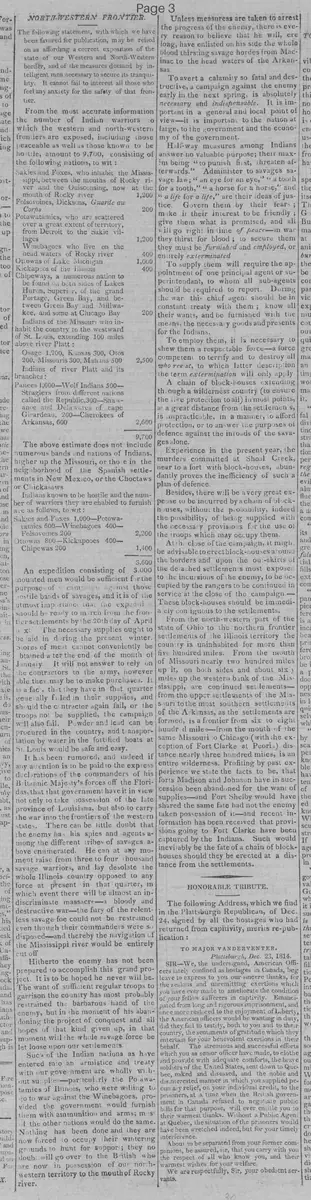
The following statement, with which we have been favored for publication, may be relied on as affording a correct exposition of the state of our Western and North-Western border, and of the measures deemed by intelligent men necessary to secure its tranquillity. It cannot fail to interest all those who feel any anxiety for the safety of that frontier.
From the most accurate information the number of Indian warriors on which the western and north-western frontiers are exposed, including those peaceable as well as those known to be hostile, amount to 9,700, consisting of the following nations, to wit:
Sakies and Foxes, who inhabit the Mississippi, between the mouths of Rocky river and the Ouisconsing, now at the mouth of Rocky river, 1,200.
Folsovoines, Dicksons, Guard du Corps, 200.
Potawatamies, who are scattered over a great extent of territory, from Detroit to the Sakie villages, 1,200.
Winnebagoes who live on the head waters of Rocky river, 400.
Ottowas of Lake Michigan, 1,000.
Kickapoos of the Illinois, 400.
Chipeways, a numerous nation to be found on both sides of Lakes Huron, Superior, of the grand Portage, Green Bay, and between Green Bay and Milwaukee, and some at Chicago Bay, 200.
Indians of the Missouri who inhabit the country to the westward of St. Louis, extending 100 miles above river Platte:
Osage 1,200, Kanza 300, Otos 200. Missouris 300. Mahas 500, 2,500.
Indians of river Platte and its branches:
Pawnees 1,000, Wolf Indians 500.
Stragglers from different nations called the Republic, 300—Shawanoe and Delawares of Cape Girardeau, 200—Cherokees of Arkansas, 600, 2,600.
9,700.
The above estimate does not include numerous bands and nations of Indians higher up the Missouri, or those in the neighborhood of the Spanish settlements in New Mexico, or the Choctaws or Chickasaws.
Indians known to be hostile and the number of warriors they are enabled to furnish are as follows, to wit:
Saks and Foxes 1,000—Potawatamies 600—Winnebagoes 400—Folsovoines 200, 2,200.
Ottowas 800—Kickapoos 400—Chipewas 200, 1,400.
3,600.
An expedition consisting of 3,000 mounted men would be sufficient for the purpose, of campaign against those hostile bands of savages, and it is of the utmost importance that the expedition should be ready to march from the frontier settlements by the 20th day of April next. The necessary supplies ought to be laid in during the present winter. Stores of meat cannot conveniently be obtained after the end of the month of January. It will not answer to rely on the contractors to the army, however able they may be to make purchases. It is a fact, that they have in that quarter generally failed in their supplies, and should the contractor again fail, or the troops not be supplied, the campaign will also fail. Powder and lead can be procured in the country, and transportation by water in the fortified boats at St. Louis would be safe and easy.
It has been rumored, and indeed if any attention is to be paid to the express declarations of the commanders of his Britannic Majesty's forces off the Floridas, that that government have it in view not only to take possession of the late province of Louisiana, but also to carry the war into the frontiers of the western state. There can be little doubt that the enemy has his spies and agents among the different tribes of savages above enumerated. He can at any moment raise from three to four thousand savage warriors, and lay desolate the whole Illinois country opposed to any force at present in that quarter, in which event there will be almost an indiscriminate massacre—a bloody and destructive war—the fury of the relentless savage foe could not be restrained even though their commanders were so disposed—and thereby the navigation of the Mississippi river would be entirely cut off.
Hitherto the enemy has not been prepared to accomplish this grand project. It is to be hoped he never will be. The want of sufficient regular troops to garrison the country has most probably restrained the barbarous hand of the enemy, but in the moment of his abandoning the project of conquest and all hopes of that kind given up, in that moment will the whole savage force be let loose upon our settlements.
Such of the Indian nations as have entered into an armistice and treaty with our government are wholly without supplies—particularly the Potawatamies of Illinois, who were willing to go to war against the Winnebagoes, provided the government would furnish them with ammunition and arms; most of the other nations would do the same. Nothing has been done and they are now forced to occupy their wintering grounds to hunt for support; they no doubt will go over to the British who are now in possession of our north-western territory to the mouth of Rocky river.
Unless measures are taken to arrest the progress of the enemy, there is every reason to believe that he will, ere long, have enlisted on his side the whole blood thirsting savage hordes from Mackinac to the head waters of the Arkansas.
To avert a calamity so fatal and destructive, a campaign against the enemy early in the next spring, is absolutely necessary and indispensable. It is important in a general and local point of view—it is important to the nation at large, to the government and the economy of the government.
Half-way measures among Indians answer no valuable purpose; their maxim being "to punish first, threaten afterwards." Administer to savages savage law; "an eye for an eye," "a tooth for a tooth," "a horse for a horse," and "a life for a life," are their ideas of justice. Govern them by their fear; make it their interest to be friendly; give them what is promised, and all will go right in time of peace—in war they thirst for blood; to secure them they must be furnished and employed, or entirely exterminated.
To supply them will require the appointment of one principal agent or superintendent, to whom all sub-agents should be required to report. During the war, this chief agent should be in constant treaty with them; know all their wants, and be furnished with the means, the necessary goods and presents for the Indians.
To employ them, it is necessary to shew them a respectable force—a force competent to terrify and to destroy all who resist, to which latter description the term extermination will only apply.
A chain of block-houses extending through a wilderness country (to ensure the like protection to all) in most points, at a great distance from the settlements, is impracticable, in a manner, to afford protection, or to answer the purposes of defence against the inroads of the savages alone.
Experience in the present year, the murders committed at Shoal Creek, near to a fort with block-houses, abundantly proves the inefficiency of such a plan of defence.
Besides, there will be a very great expense to be incurred by a chain of block-houses, without the probability, indeed the possibility, of being supplied with the necessary provisions for the use of the troops which may occupy them.
At the close of the campaign, it might be advisable to erect block-houses around the borders and upon the out-skirts of the detached settlements most exposed to the incursions of the enemy, to be occupied by the rangers to be continued in service at the close of the campaign—These block-houses should be immediately contiguous to the settlements.
From the north-western part of the state of Ohio to the northern frontier settlements of the Illinois territory the country is uninhabited for more than five hundred miles. From the mouth of Missouri nearly two hundred miles up it, on both sides and about six miles up the western bank of the Mississippi, are continued settlements—from the upper settlements of the Missouri to the most southern settlements of the Arkansas. As the settlements are formed, is a frontier from six to eight hundred miles—from the mouth of the same Missouri to Chicago (with the exception of Fort Clark at Peoria) distance nearly three hundred miles, is an entire wilderness. Profiting by past experience we state the facts to be, that forts Madison and Johnson have in succession been abandoned for the want of supplies—and Fort Shelby would have shared the same fate had not the enemy taken possession of it—and recent information has been received that provisions going to Fort Clark have been captured by the Indians. Such would inevitably be the fate of a chain of block-houses should they be erected at a distance from the settlements.
What sub-type of article is it?
What themes does it cover?
What keywords are associated?
Where did it happen?
Story Details
Location
Northwestern Frontier, Western And North Western Border, Mississippi River, Illinois Territory, Missouri, Arkansas
Event Date
By The 20th Day Of April Next
Story Details
A detailed report estimates 9,700 Indian warriors on the frontiers, with 3,600 hostile, from various nations. Recommends a 3,000 mounted men expedition starting April to combat threats, secure supplies in winter, counter British influence inciting savages, and prevent massacre and river navigation cutoff. Advocates punishing hostile tribes, supplying friendly ones, and avoiding ineffective block-houses far from settlements.