Thank you for visiting SNEWPapers!
Sign up free
Literary
April 3, 1841
Salt River Journal
Bowling Green, Pike County, Missouri
What is this article about?
Extract from Gouge's 'Inquiry into the Principles of the American Banking System,' Chapter X, refuting popular arguments for banks, such as making money plenty, lowering interest rates, and providing security, arguing they drive out specie, increase usury, and cause economic instability.
Clipping
OCR Quality
95%
Excellent
Full Text
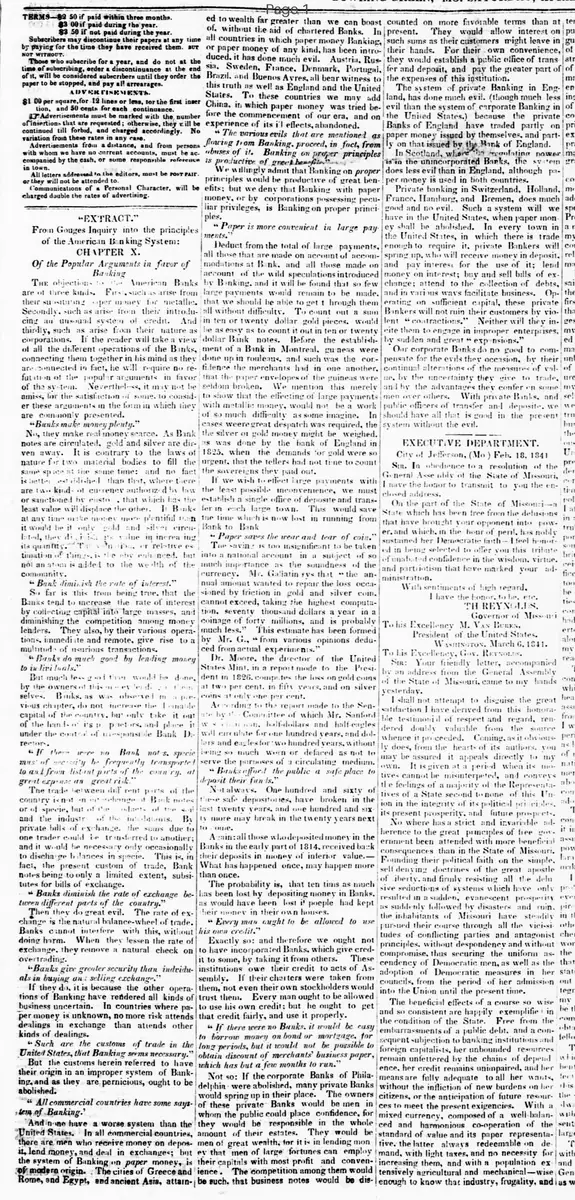
EXTRACT.
From Gouge's Inquiry into the principles of the American Banking System:
CHAPTER X.
Of the Popular Arguments in favor of Banking.
The objections to American Banks are of three kinds. First, such as arise from their substituting paper money for metallic. Secondly, such as arise from their introducing an unsound system of credit. And thirdly, such as arise from their nature as corporations. If the reader will take a view of all the different operations of the Banks, connecting them together in his mind as they are connected in fact, he will require no refutation of the popular arguments in favor of the system. Nevertheless, it may not be amiss, for the satisfaction of some, to consider these arguments in the form in which they are commonly presented.
"Banks make money plenty."
No, they make real money scarce. As Bank notes are circulated, gold and silver are driven away. It is contrary to the laws of nature for two material bodies to fill the same space at the same time: and no fact is better established than that, where there are two kinds of currency authorized by law or sanctioned by custom, that which has the least value will displace the other. Banks at any time make money more plentiful. But, it would be if only gold and silver circulated. But, they do this by increasing its quantity. They increase the estimation of things in the physical world, but not an atom is added to the wealth of the community.
"Banks diminish the rate of interest."
So far is this from being true, that the Banks tend to increase the rate of interest by collecting capital into large masses, and diminishing the competition among money lenders. They also, by their various operations immediate and remote, give rise to a multitude of usurious transactions.
"Banks do much good by lending money to individuals."
But much less good than would be done by the owners of this metal themselves. Banks, as was observed in a previous chapter, do not increase the national capital of the country, but only take it out of the hands of the people's own projectors, and place it under the control of miserable Bank Directors.
"If there were no Banks, specie must of necessity be frequently transported to and from distant parts of the country, at great expense and great risk."
The trade between distant parts of the country is not in change of Bank notes or of specie, but of produce, of stock, and the industry of the soil. By private bills of exchange, the sums due to one trader could be transferred to another: and it would be necessary only occasionally to discharge balances in specie. This is, in fact, the present custom of trade, Bank notes being to only a limited extent, substitutes for bills of exchange.
"Banks diminish the rate of exchange between different parts of the country."
Then they do great evil. The rate of exchange is the natural balance-wheel of trade. Banks cannot interfere with this, without doing harm. When they lessen the rate of exchange, they remove a natural check on overtrading.
"Banks give greater security than individuals in buying and selling exchange."
If they do, it is because the other operations of Banking have rendered all kinds of business uncertain. In countries where paper money is unknown, no more risk attends dealings in exchange than attends other kinds of dealings.
"Such are the customs of trade in the United States, that Banking seems necessary."
But the customs herein referred to have their origin in an improper system of Banking and as they are pernicious, ought to be abolished.
All commercial countries have some system of Banking.
And none have a worse system than the United States. In all commercial countries, there are men who receive money on deposit, lend money, and deal in exchanges; but the system of Banking on paper money, is of modern origin. The cities of Greece and Rome, and Egypt, and ancient Asia, attained to wealth far greater than we can boast of, without the aid of chartered Banks. In all countries in which paper money Banking or paper money of any kind, has been introduced, it has done much evil. Austria, Russia, Sweden, France, Denmark, Portugal, Brazil, and Buenos Ayres, all bear witness to this truth as well as England and the United States. To these countries we may add China, in which paper money was tried before the commencement of our era, and on experience of its ill effects, abandoned.
"The various evils that are mentioned as flowing from Banking, proceed, in fact, from abuses of it. Banking on proper principles is productive of great benefit."
We willingly admit that Banking on proper principles would be productive of great benefits: but we deny that Banking with paper money, or by corporations possessing peculiar privileges, is Banking on proper principles.
"Paper is more convenient in large payments."
Deduct from the total of large payments, all those that are made on account of accommodations at Bank, and all those made on account of the wild speculations introduced by Banking, and it will be found that so few large payments would remain to be made, that we should be able to get through them all without difficulty. To count out a sum in ten or twenty dollar gold pieces, would be as easy as to count it out in ten or twenty dollar Bank notes. Before the establishment of a Bank in Montreal, guineas were done up in rouleaus, and such was the confidence the merchants had in one another, that the paper envelopes of the guineas were seldom broken. We mention this merely to show that the effecting of large payments with metallic money, would not be a work of so much difficulty as some imagine. In cases where great despatch was required, the silver or gold money might be weighed, as was done by the Bank of England in 1825, when the demands for gold were so urgent, that the tellers had not time to count the sovereigns they paid out.
If we wish to effect large payments with the least possible inconvenience, we must establish a single office of deposit and transfer in each large town. This would save the time which is now lost in running from Bank to Bank.
"Paper saves the wear and tear of coin."
The saving is too insignificant to be taken into a national account in a subject of so much importance as the soundness of the currency. Mr. Gallatin says that "the annual amount wanted to repair the loss occasioned by friction in gold and silver coin, cannot exceed, taking the highest computation, seventy thousand dollars a year in a coinage of forty millions, and is probably much less."
This estimate has been formed by Mr. G., "from various opinions deduced from actual experiments."
Dr. Moore, the director of the United States Mint, in a report made to the President in 1826, computes the loss on gold coins at two per cent. in fifty years, and on silver coins at only one per cent. According to the report made to the Senate by a Committee of which Mr. Sanford was chairman, half-dollars and half-eagles will circulate for one hundred years, and dollars and eagles for two hundred years, without being so much worn or defaced as not to serve the purposes of a circulating medium.
"Banks afford the public a safe place to deposit their funds."
Not always. One hundred and sixty safe deposit offices, have broken in the last twenty years, and one hundred and six more may break in the twenty years next to come.
Again: all those who deposited money in the Banks in the early part of 1814, received back their deposits in money of inferior value. What has happened once, may happen more than once.
The probability is, that ten times as much has been lost by depositing money in Banks, as would have been lost if people had kept their money in their own houses.
"Every man ought to be allowed to use his own credit."
Exactly so: and therefore we ought not to have incorporated Banks, which give credit to some, by taking it from others. These institutions owe their credit to acts of Assembly. If their charters were taken from them, not even their own stockholders would trust them. Every man ought to be allowed to use his own credit: but he ought to get that credit fairly, and use it properly.
If there were no Banks, it would be easy to borrow money on bond or mortgage, for long periods, but it would not be possible to obtain discount of merchants' business paper, which has but a few months to run.
Not so: If the corporate Banks of Philadelphia were abolished, many private Banks would spring up in their place. The owners of these private Banks would be men in whom the public could place confidence, for they would be responsible in the whole amount of their estates. They would be men of great wealth, for it is in lending money that men of large fortunes can employ their capitals with most profit and convenience. The competition among them would be such, that business notes would be discounted on more favorable terms than at present. They would allow interest on such sums as their customers might leave in their hands. For their own convenience, they would establish a public office of transfer and deposit, and pay the greater part of the expenses of this institution.
The system of private Banking in England, has done much evil, (though much less evil than the system of corporate Banking in the United States.) because the private Banks of England have traded partly on paper money issued by themselves, and partly on that issued by the Bank of England.
In Scotland, where the circulating power is in the unincorporated Banks, the system does less evil than in England, although paper money is used in both countries.
Private banking in Switzerland, Holland, France, Hamburg, and Bremen, does much good and no evil. Such a system will we have in the United States, when paper money shall be abolished. In every town in the United States, in which there is trade enough to require it, private Bankers will spring up, who will receive money in deposit, and pay interest for the use of it: lend money on interest; buy and sell bills of exchange: attend to the collection of debts, and in various ways facilitate business. Operating on sufficient capital, these private Bankers will not ruin their customers by violent contractions. Neither will they invite them to engage in improper enterprises, by sudden and great expansions.
Our corporate Banks do no good to compensate for the evils they occasion, by their continual alterations of the measures of value, by the uncertainty they give to trade, and by the advantages they confer on some men over others. With private Banks, and public officers of transfer and deposit, we should have all that is good in the present system without the evil.
From Gouge's Inquiry into the principles of the American Banking System:
CHAPTER X.
Of the Popular Arguments in favor of Banking.
The objections to American Banks are of three kinds. First, such as arise from their substituting paper money for metallic. Secondly, such as arise from their introducing an unsound system of credit. And thirdly, such as arise from their nature as corporations. If the reader will take a view of all the different operations of the Banks, connecting them together in his mind as they are connected in fact, he will require no refutation of the popular arguments in favor of the system. Nevertheless, it may not be amiss, for the satisfaction of some, to consider these arguments in the form in which they are commonly presented.
"Banks make money plenty."
No, they make real money scarce. As Bank notes are circulated, gold and silver are driven away. It is contrary to the laws of nature for two material bodies to fill the same space at the same time: and no fact is better established than that, where there are two kinds of currency authorized by law or sanctioned by custom, that which has the least value will displace the other. Banks at any time make money more plentiful. But, it would be if only gold and silver circulated. But, they do this by increasing its quantity. They increase the estimation of things in the physical world, but not an atom is added to the wealth of the community.
"Banks diminish the rate of interest."
So far is this from being true, that the Banks tend to increase the rate of interest by collecting capital into large masses, and diminishing the competition among money lenders. They also, by their various operations immediate and remote, give rise to a multitude of usurious transactions.
"Banks do much good by lending money to individuals."
But much less good than would be done by the owners of this metal themselves. Banks, as was observed in a previous chapter, do not increase the national capital of the country, but only take it out of the hands of the people's own projectors, and place it under the control of miserable Bank Directors.
"If there were no Banks, specie must of necessity be frequently transported to and from distant parts of the country, at great expense and great risk."
The trade between distant parts of the country is not in change of Bank notes or of specie, but of produce, of stock, and the industry of the soil. By private bills of exchange, the sums due to one trader could be transferred to another: and it would be necessary only occasionally to discharge balances in specie. This is, in fact, the present custom of trade, Bank notes being to only a limited extent, substitutes for bills of exchange.
"Banks diminish the rate of exchange between different parts of the country."
Then they do great evil. The rate of exchange is the natural balance-wheel of trade. Banks cannot interfere with this, without doing harm. When they lessen the rate of exchange, they remove a natural check on overtrading.
"Banks give greater security than individuals in buying and selling exchange."
If they do, it is because the other operations of Banking have rendered all kinds of business uncertain. In countries where paper money is unknown, no more risk attends dealings in exchange than attends other kinds of dealings.
"Such are the customs of trade in the United States, that Banking seems necessary."
But the customs herein referred to have their origin in an improper system of Banking and as they are pernicious, ought to be abolished.
All commercial countries have some system of Banking.
And none have a worse system than the United States. In all commercial countries, there are men who receive money on deposit, lend money, and deal in exchanges; but the system of Banking on paper money, is of modern origin. The cities of Greece and Rome, and Egypt, and ancient Asia, attained to wealth far greater than we can boast of, without the aid of chartered Banks. In all countries in which paper money Banking or paper money of any kind, has been introduced, it has done much evil. Austria, Russia, Sweden, France, Denmark, Portugal, Brazil, and Buenos Ayres, all bear witness to this truth as well as England and the United States. To these countries we may add China, in which paper money was tried before the commencement of our era, and on experience of its ill effects, abandoned.
"The various evils that are mentioned as flowing from Banking, proceed, in fact, from abuses of it. Banking on proper principles is productive of great benefit."
We willingly admit that Banking on proper principles would be productive of great benefits: but we deny that Banking with paper money, or by corporations possessing peculiar privileges, is Banking on proper principles.
"Paper is more convenient in large payments."
Deduct from the total of large payments, all those that are made on account of accommodations at Bank, and all those made on account of the wild speculations introduced by Banking, and it will be found that so few large payments would remain to be made, that we should be able to get through them all without difficulty. To count out a sum in ten or twenty dollar gold pieces, would be as easy as to count it out in ten or twenty dollar Bank notes. Before the establishment of a Bank in Montreal, guineas were done up in rouleaus, and such was the confidence the merchants had in one another, that the paper envelopes of the guineas were seldom broken. We mention this merely to show that the effecting of large payments with metallic money, would not be a work of so much difficulty as some imagine. In cases where great despatch was required, the silver or gold money might be weighed, as was done by the Bank of England in 1825, when the demands for gold were so urgent, that the tellers had not time to count the sovereigns they paid out.
If we wish to effect large payments with the least possible inconvenience, we must establish a single office of deposit and transfer in each large town. This would save the time which is now lost in running from Bank to Bank.
"Paper saves the wear and tear of coin."
The saving is too insignificant to be taken into a national account in a subject of so much importance as the soundness of the currency. Mr. Gallatin says that "the annual amount wanted to repair the loss occasioned by friction in gold and silver coin, cannot exceed, taking the highest computation, seventy thousand dollars a year in a coinage of forty millions, and is probably much less."
This estimate has been formed by Mr. G., "from various opinions deduced from actual experiments."
Dr. Moore, the director of the United States Mint, in a report made to the President in 1826, computes the loss on gold coins at two per cent. in fifty years, and on silver coins at only one per cent. According to the report made to the Senate by a Committee of which Mr. Sanford was chairman, half-dollars and half-eagles will circulate for one hundred years, and dollars and eagles for two hundred years, without being so much worn or defaced as not to serve the purposes of a circulating medium.
"Banks afford the public a safe place to deposit their funds."
Not always. One hundred and sixty safe deposit offices, have broken in the last twenty years, and one hundred and six more may break in the twenty years next to come.
Again: all those who deposited money in the Banks in the early part of 1814, received back their deposits in money of inferior value. What has happened once, may happen more than once.
The probability is, that ten times as much has been lost by depositing money in Banks, as would have been lost if people had kept their money in their own houses.
"Every man ought to be allowed to use his own credit."
Exactly so: and therefore we ought not to have incorporated Banks, which give credit to some, by taking it from others. These institutions owe their credit to acts of Assembly. If their charters were taken from them, not even their own stockholders would trust them. Every man ought to be allowed to use his own credit: but he ought to get that credit fairly, and use it properly.
If there were no Banks, it would be easy to borrow money on bond or mortgage, for long periods, but it would not be possible to obtain discount of merchants' business paper, which has but a few months to run.
Not so: If the corporate Banks of Philadelphia were abolished, many private Banks would spring up in their place. The owners of these private Banks would be men in whom the public could place confidence, for they would be responsible in the whole amount of their estates. They would be men of great wealth, for it is in lending money that men of large fortunes can employ their capitals with most profit and convenience. The competition among them would be such, that business notes would be discounted on more favorable terms than at present. They would allow interest on such sums as their customers might leave in their hands. For their own convenience, they would establish a public office of transfer and deposit, and pay the greater part of the expenses of this institution.
The system of private Banking in England, has done much evil, (though much less evil than the system of corporate Banking in the United States.) because the private Banks of England have traded partly on paper money issued by themselves, and partly on that issued by the Bank of England.
In Scotland, where the circulating power is in the unincorporated Banks, the system does less evil than in England, although paper money is used in both countries.
Private banking in Switzerland, Holland, France, Hamburg, and Bremen, does much good and no evil. Such a system will we have in the United States, when paper money shall be abolished. In every town in the United States, in which there is trade enough to require it, private Bankers will spring up, who will receive money in deposit, and pay interest for the use of it: lend money on interest; buy and sell bills of exchange: attend to the collection of debts, and in various ways facilitate business. Operating on sufficient capital, these private Bankers will not ruin their customers by violent contractions. Neither will they invite them to engage in improper enterprises, by sudden and great expansions.
Our corporate Banks do no good to compensate for the evils they occasion, by their continual alterations of the measures of value, by the uncertainty they give to trade, and by the advantages they confer on some men over others. With private Banks, and public officers of transfer and deposit, we should have all that is good in the present system without the evil.
What sub-type of article is it?
Essay
What themes does it cover?
Commerce Trade
Political
What keywords are associated?
American Banking
Paper Money
Specie
Credit System
Corporate Banks
Private Banking
Economic Evils
What entities or persons were involved?
From Gouge's Inquiry Into The Principles Of The American Banking System
Literary Details
Title
Chapter X. Of The Popular Arguments In Favor Of Banking.
Author
From Gouge's Inquiry Into The Principles Of The American Banking System
Subject
Refutation Of Popular Arguments Supporting American Banks
Key Lines
"Banks Make Money Plenty." No, They Make Real Money Scarce. As Bank Notes Are Circulated, Gold And Silver Are Driven Away.
Banks, As Was Observed In A Previous Chapter, Do Not Increase The National Capital Of The Country, But Only Take It Out Of The Hands Of The People's Own Projectors, And Place It Under The Control Of Miserable Bank Directors.
In All Countries In Which Paper Money Banking Or Paper Money Of Any Kind, Has Been Introduced, It Has Done Much Evil.