Thank you for visiting SNEWPapers!
Sign up free
Editorial
April 16, 1875
The Cheyenne Daily Leader
Cheyenne, Laramie County, Wyoming
What is this article about?
Editorial criticizes the third party movement and independent journals for trying to split the Republican vote amid debates on federal supremacy versus state sovereignty following elections in New Hampshire and Connecticut. It defends President Grant's administration and predicts the major parties will prevail.
Clipping
OCR Quality
95%
Excellent
Full Text
THE THIRD PARTY.
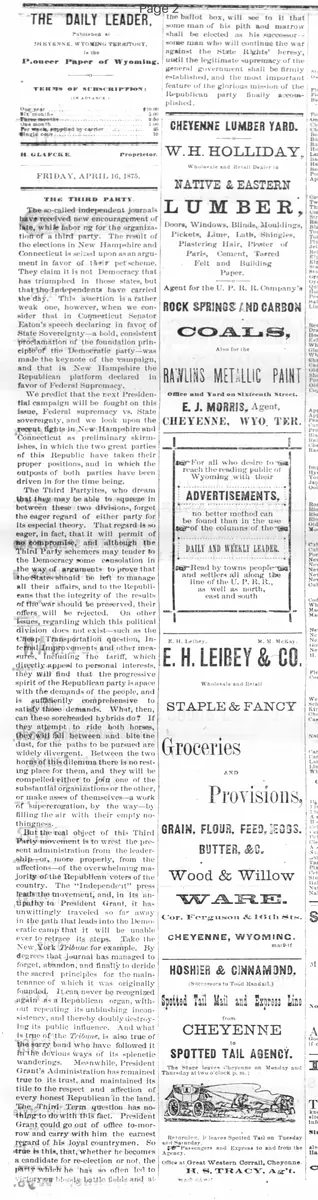
The so-called independent journals have received new encouragement of late, while laboring for the organization of a third party. The result of the elections in New Hampshire and Connecticut is seized upon as an argument in favor of this pet scheme. They claim it is not Democracy that has triumphed in those states, but that the Independents have carried the day. This assertion is a rather weak one, however, when we consider that in Connecticut Senator Eaton's speech declaring in favor of State Sovereignty—a bold, consistent proclamation of the foundation principle of the Democratic party—was made the keynote of the campaign, and that in New Hampshire the Republican platform declared in favor of Federal Supremacy.
We predict that the next Presidential campaign will be fought on this issue. Federal supremacy vs. State sovereignty, and we look upon the recent fights in New Hampshire and Connecticut as preliminary skirmishes, in which the two great parties of this Republic have taken their proper positions, and in which the outposts of both parties have been driven in for the time being.
The Third Partyites, who dream that they may be able to squeeze in between these two divisions, forget the eager regard of either party for its especial theory. That regard is so eager, in fact, that it will permit of no compromise, and although the Third Party schemers may tender to the Democracy some consolation in the way of arguments to prove that the States should be left to manage all their affairs, and to the Republicans that the integrity of the results of the war should be preserved, their offers will be rejected. On other issues, regarding which this political division does not exist—such as the Cheap Transportation question, Internal Improvements and other measures, including the tariff, which directly appeal to personal interests, they will find that the progressive spirit of the Republican party is apace with the demands of the people, and is sufficiently comprehensive to satisfy those demands. What, then, can these soreheaded hybrids do? If they attempt to ride both horses, they will fall between and bite the dust, for the paths to be pursued are widely divergent. Between the two horns of this dilemma there is no resting place for them, and they will be compelled either to join one of the substantial organizations or the other, or make asses of themselves—a work of supererogation, by the way—by filling the air with their empty nothingness.
But the real object of this Third Party movement is to wrest the present administration from the leadership—or, more properly, from the affections—of the overwhelming majority of the Republican voters of the country. The "Independent" press leads the movement, and, in its antipathy to President Grant, it has unwittingly traveled so far away in the path that leads into the Democratic camp that it will be unable ever to retrace its steps. Take the New York Tribune for example. By degrees that journal has managed to forget, abandon, and finally to deride the sacred principles for the maintenance of which it was originally founded. It can never be recognized again as a Republican organ, without repeating its unblushing inconsistency, and thereby doubly destroying its public influence. And what is true of the Tribune, is also true of the sorry band who have followed it in the devious ways of its splenetic wanderings.
Meanwhile, President Grant's Administration has remained true to its trust, and maintained its title to the respect and affection of every honest Republican in the land. The Third Term question has nothing to do with this fact. President Grant could go out of office to-morrow and carry with him the earnest regard of his loyal countrymen. So true is this, that, whether he becomes a candidate for re-election or not, the party which he has so often led to victory on bloody battle fields and at the ballot box, will see to it that some man of his pith and marrow shall be elected as his successor—some man who will continue the war against the State Rights' heresy, until the legitimate supremacy of the general government shall be firmly established, and the most important feature of the glorious mission of the Republican party finally accomplished.
The so-called independent journals have received new encouragement of late, while laboring for the organization of a third party. The result of the elections in New Hampshire and Connecticut is seized upon as an argument in favor of this pet scheme. They claim it is not Democracy that has triumphed in those states, but that the Independents have carried the day. This assertion is a rather weak one, however, when we consider that in Connecticut Senator Eaton's speech declaring in favor of State Sovereignty—a bold, consistent proclamation of the foundation principle of the Democratic party—was made the keynote of the campaign, and that in New Hampshire the Republican platform declared in favor of Federal Supremacy.
We predict that the next Presidential campaign will be fought on this issue. Federal supremacy vs. State sovereignty, and we look upon the recent fights in New Hampshire and Connecticut as preliminary skirmishes, in which the two great parties of this Republic have taken their proper positions, and in which the outposts of both parties have been driven in for the time being.
The Third Partyites, who dream that they may be able to squeeze in between these two divisions, forget the eager regard of either party for its especial theory. That regard is so eager, in fact, that it will permit of no compromise, and although the Third Party schemers may tender to the Democracy some consolation in the way of arguments to prove that the States should be left to manage all their affairs, and to the Republicans that the integrity of the results of the war should be preserved, their offers will be rejected. On other issues, regarding which this political division does not exist—such as the Cheap Transportation question, Internal Improvements and other measures, including the tariff, which directly appeal to personal interests, they will find that the progressive spirit of the Republican party is apace with the demands of the people, and is sufficiently comprehensive to satisfy those demands. What, then, can these soreheaded hybrids do? If they attempt to ride both horses, they will fall between and bite the dust, for the paths to be pursued are widely divergent. Between the two horns of this dilemma there is no resting place for them, and they will be compelled either to join one of the substantial organizations or the other, or make asses of themselves—a work of supererogation, by the way—by filling the air with their empty nothingness.
But the real object of this Third Party movement is to wrest the present administration from the leadership—or, more properly, from the affections—of the overwhelming majority of the Republican voters of the country. The "Independent" press leads the movement, and, in its antipathy to President Grant, it has unwittingly traveled so far away in the path that leads into the Democratic camp that it will be unable ever to retrace its steps. Take the New York Tribune for example. By degrees that journal has managed to forget, abandon, and finally to deride the sacred principles for the maintenance of which it was originally founded. It can never be recognized again as a Republican organ, without repeating its unblushing inconsistency, and thereby doubly destroying its public influence. And what is true of the Tribune, is also true of the sorry band who have followed it in the devious ways of its splenetic wanderings.
Meanwhile, President Grant's Administration has remained true to its trust, and maintained its title to the respect and affection of every honest Republican in the land. The Third Term question has nothing to do with this fact. President Grant could go out of office to-morrow and carry with him the earnest regard of his loyal countrymen. So true is this, that, whether he becomes a candidate for re-election or not, the party which he has so often led to victory on bloody battle fields and at the ballot box, will see to it that some man of his pith and marrow shall be elected as his successor—some man who will continue the war against the State Rights' heresy, until the legitimate supremacy of the general government shall be firmly established, and the most important feature of the glorious mission of the Republican party finally accomplished.
What sub-type of article is it?
Partisan Politics
Constitutional
What keywords are associated?
Third Party
Federal Supremacy
State Sovereignty
President Grant
Republican Party
New Hampshire Election
Connecticut Election
New York Tribune
What entities or persons were involved?
Third Partyites
Independent Journals
Democrats
Republicans
President Grant
New York Tribune
Senator Eaton
Editorial Details
Primary Topic
Opposition To Third Party Movement And Defense Of Republican Federal Supremacy
Stance / Tone
Strongly Pro Republican And Anti Third Party
Key Figures
Third Partyites
Independent Journals
Democrats
Republicans
President Grant
New York Tribune
Senator Eaton
Key Arguments
Elections In Nh And Ct Show Major Parties' Positions On Federal Vs State Sovereignty
Third Party Cannot Compromise Between Irreconcilable Party Theories
Republicans Meet Demands On Issues Like Transportation, Improvements, Tariff
Third Party Aims To Undermine Grant's Administration
Grant's Administration Deserves Republican Loyalty
Successor To Grant Will Continue Fight Against State Rights Heresy