Thank you for visiting SNEWPapers!
Sign up free
Letter to Editor
March 4, 1862
Union County Star And Lewisburg Chronicle
Lewisburg, Union County, Pennsylvania
What is this article about?
Union soldier J.M.L. reports from near Roanoke Island, N.C., on Feb. 19, 1862, detailing his command of 500 Confederate prisoners aboard the Cossack, their dire conditions, battle experiences including swamp assaults and casualties, fort descriptions, and hopes for swift war resolution amid logistical challenges.
Clipping
OCR Quality
95%
Excellent
Full Text
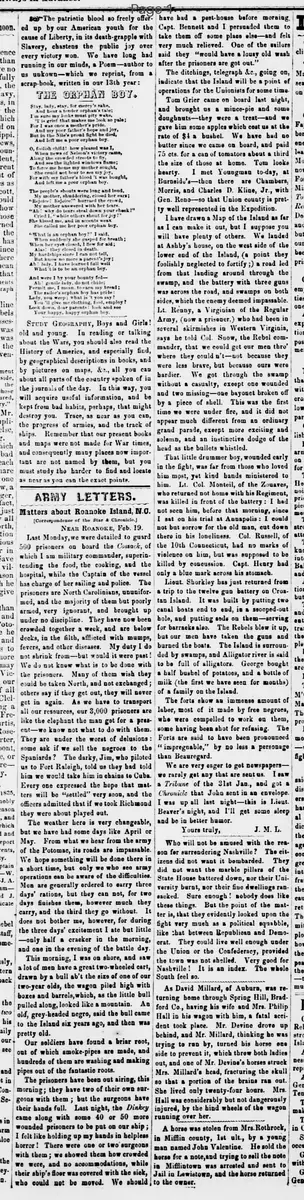
ARMY LETTERS.
Matters about Roanoke Island, N.C.
[Correspondence of the Star & Chronicle.]
Near Roanoke, Feb. 19.
Last Monday, we were detailed to guard 500 prisoners on board the Cossack, of which I am military commander, superintending the food, the cooking, and the hospital, while the Captain of the vessel has charge of her sailing and police. The prisoners are North Carolinians, ununiformed, and the majority of them but poorly armed, very ignorant, and brought up under no discipline. They have now been crowded together a week, and are below decks, in the filth, afflicted with mumps, fevers, and other diseases. My duty I do not shrink from-but would it were past!
We do not know what is to be done with the prisoners. Many of them wish they could be taken North, and not exchanged; others say if they get out, they will never get in again. As we have to transport all our resources, our 3,000 prisoners are like the elephant the man got for a present-we know not what to do with them.
They are under the worst of delusions: some ask if we sell the negroes to the Spaniards? The darky, Jim, who piloted us to Fort Raleigh, told us they had told him we would take him in chains to Cuba.
Every one expressed the hope that matters will be "settled" very soon, and the officers admitted that if we took Richmond they were about played out.
The weather here is very changeable, but we have had some days like April or May. From what we hear from the army of the Potomac, its roads are impassable. We hope something will be done there in a short time, but only we who see army operations can be aware of the difficulties.
Men are generally ordered to carry three days' rations, but they can not, for two days finishes them, however much they carry, and the third they go without. It does not bother me, however, for during the three days' excitement I ate but little-only half a cracker in the morning, and one in the evening of the battle day.
This morning, I was on shore, and saw a lot of men have a great two-wheeled cart, drawn by a bull about the size of one of our two-year olds, the wagon piled high with boxes and barrels, which, as the little bull pulled along, looked like a mountain. An old, grey-headed negro, said the bull came to the Island six years ago, and then was pretty old.
Our soldiers have found a briar root, out of which smoke-pipes are made, and hundreds of them are washing and making pipes out of the fantastic roots.
The prisoners have been out airing, this morning; they have two of their own surgeons with them; but the surgeons have their hands full. Last night, the Dinkey came along with some 40 or 50 more wounded prisoners to be put on our ship; I felt like holding up my hands in helpless horror! There were one or two surgeons with them; we showed them how crowded we were, and no accommodations, while their ship's floor was covered with the sick, who could not be moved. We should have had a pest-house before morning
Capt. Bennett and I persuaded them to take them off some place else-and felt very much relieved. One of the sailors said they "would have a lousy old wash after the prisoners are got out."
The ditchings, telegraph &c., going on, indicate that the Island will be a point of operations for the Unionists for some time.
Tom Grier came on board last night, and brought us a mince-pie and some doughnuts-they were a treat-and we gave him some apples which cost us at the rate of $1 a bushel. We have had no butter since we came on board, and paid 75 cts. for a can of tomatoes about a third the size of those at home. Tom looks hearty.
I met Youngman to-day, at Burnside's-then there are Chambers, Morris, and Charles D. Kline, Jr., with Gen. Reno-so that Union county is pretty well represented in the Expedition.
I have drawn a Map of the Island as far as I can make it out, but I suppose you will have plenty of others. We landed at Ashby's house, on the west side of the lower end of the Island, (a point they foolishly neglected to fortify ;) a road led from that landing around through the swamp, and the battery with three guns was across the road, and swamps on both sides, which the enemy deemed impassable.
Lt. Renny, a Virginian of the Regular Army, (now a prisoner,) who had been in several skirmishes in Western Virginia, says he told Col. Snow, the Rebel commander, that we could get our men thro' where they couldn't-not because they were less brave, but because ours were hardier. We got through the swamp without a casualty, except one wounded and two missing-one bayonet broken off by a piece of shell. This was the first time we were under fire, and it did not appear much different from an ordinary grand parade, except more exciting and solemn, and an instinctive dodge of the head as the bullets whistled.
That little drummer boy, wounded early in the fight, was far from those who loved him most, yet kind hands ministered to him. Lt. Col. Monteil, of the Zouaves, who returned not home with his Regiment, was killed in front of the battery: I had not seen him, before that morning, since I sat on his trial at Annapolis: I could not but sorrow for the old man, cut down there in his loneliness. Col. Russell, of the 10th Connecticut, had no marks of violence on him, but was supposed to be killed by concussion. Capt. Henry had only a blue mark across his stomach.
Lieut. Shockley has just returned from a trip to the twelve gun battery on Croatan Island. It was built by putting two canal boats end to end, in a scooped-out hole, and putting sods on them-serving for barracks also. The Rebels blow it up, but our men have taken the guns and burned the boats. The Island is surrounded by swamps, and Alligator river is said to be full of alligators. George bought a half bushel of potatoes, and a bottle of milk (the first we have seen for months) of a family on the Island
The forts show an immense amount of labor, most of it made by free negroes, who were compelled to work on them, some having been shot for refusing.
The Forts are said to have been pronounced "impregnable," by no less a personage than Beauregard.
We are very eager to get newspapers-we rarely get any that are sent us. I saw a Tribune of the 31st Jan., and got a Chronicle that John sent in an envelope.
I was up all last night-this is Lieut. Beaver's night, and I'll get some sleep and be in better humor.
Yours truly,
J. M. L.
Matters about Roanoke Island, N.C.
[Correspondence of the Star & Chronicle.]
Near Roanoke, Feb. 19.
Last Monday, we were detailed to guard 500 prisoners on board the Cossack, of which I am military commander, superintending the food, the cooking, and the hospital, while the Captain of the vessel has charge of her sailing and police. The prisoners are North Carolinians, ununiformed, and the majority of them but poorly armed, very ignorant, and brought up under no discipline. They have now been crowded together a week, and are below decks, in the filth, afflicted with mumps, fevers, and other diseases. My duty I do not shrink from-but would it were past!
We do not know what is to be done with the prisoners. Many of them wish they could be taken North, and not exchanged; others say if they get out, they will never get in again. As we have to transport all our resources, our 3,000 prisoners are like the elephant the man got for a present-we know not what to do with them.
They are under the worst of delusions: some ask if we sell the negroes to the Spaniards? The darky, Jim, who piloted us to Fort Raleigh, told us they had told him we would take him in chains to Cuba.
Every one expressed the hope that matters will be "settled" very soon, and the officers admitted that if we took Richmond they were about played out.
The weather here is very changeable, but we have had some days like April or May. From what we hear from the army of the Potomac, its roads are impassable. We hope something will be done there in a short time, but only we who see army operations can be aware of the difficulties.
Men are generally ordered to carry three days' rations, but they can not, for two days finishes them, however much they carry, and the third they go without. It does not bother me, however, for during the three days' excitement I ate but little-only half a cracker in the morning, and one in the evening of the battle day.
This morning, I was on shore, and saw a lot of men have a great two-wheeled cart, drawn by a bull about the size of one of our two-year olds, the wagon piled high with boxes and barrels, which, as the little bull pulled along, looked like a mountain. An old, grey-headed negro, said the bull came to the Island six years ago, and then was pretty old.
Our soldiers have found a briar root, out of which smoke-pipes are made, and hundreds of them are washing and making pipes out of the fantastic roots.
The prisoners have been out airing, this morning; they have two of their own surgeons with them; but the surgeons have their hands full. Last night, the Dinkey came along with some 40 or 50 more wounded prisoners to be put on our ship; I felt like holding up my hands in helpless horror! There were one or two surgeons with them; we showed them how crowded we were, and no accommodations, while their ship's floor was covered with the sick, who could not be moved. We should have had a pest-house before morning
Capt. Bennett and I persuaded them to take them off some place else-and felt very much relieved. One of the sailors said they "would have a lousy old wash after the prisoners are got out."
The ditchings, telegraph &c., going on, indicate that the Island will be a point of operations for the Unionists for some time.
Tom Grier came on board last night, and brought us a mince-pie and some doughnuts-they were a treat-and we gave him some apples which cost us at the rate of $1 a bushel. We have had no butter since we came on board, and paid 75 cts. for a can of tomatoes about a third the size of those at home. Tom looks hearty.
I met Youngman to-day, at Burnside's-then there are Chambers, Morris, and Charles D. Kline, Jr., with Gen. Reno-so that Union county is pretty well represented in the Expedition.
I have drawn a Map of the Island as far as I can make it out, but I suppose you will have plenty of others. We landed at Ashby's house, on the west side of the lower end of the Island, (a point they foolishly neglected to fortify ;) a road led from that landing around through the swamp, and the battery with three guns was across the road, and swamps on both sides, which the enemy deemed impassable.
Lt. Renny, a Virginian of the Regular Army, (now a prisoner,) who had been in several skirmishes in Western Virginia, says he told Col. Snow, the Rebel commander, that we could get our men thro' where they couldn't-not because they were less brave, but because ours were hardier. We got through the swamp without a casualty, except one wounded and two missing-one bayonet broken off by a piece of shell. This was the first time we were under fire, and it did not appear much different from an ordinary grand parade, except more exciting and solemn, and an instinctive dodge of the head as the bullets whistled.
That little drummer boy, wounded early in the fight, was far from those who loved him most, yet kind hands ministered to him. Lt. Col. Monteil, of the Zouaves, who returned not home with his Regiment, was killed in front of the battery: I had not seen him, before that morning, since I sat on his trial at Annapolis: I could not but sorrow for the old man, cut down there in his loneliness. Col. Russell, of the 10th Connecticut, had no marks of violence on him, but was supposed to be killed by concussion. Capt. Henry had only a blue mark across his stomach.
Lieut. Shockley has just returned from a trip to the twelve gun battery on Croatan Island. It was built by putting two canal boats end to end, in a scooped-out hole, and putting sods on them-serving for barracks also. The Rebels blow it up, but our men have taken the guns and burned the boats. The Island is surrounded by swamps, and Alligator river is said to be full of alligators. George bought a half bushel of potatoes, and a bottle of milk (the first we have seen for months) of a family on the Island
The forts show an immense amount of labor, most of it made by free negroes, who were compelled to work on them, some having been shot for refusing.
The Forts are said to have been pronounced "impregnable," by no less a personage than Beauregard.
We are very eager to get newspapers-we rarely get any that are sent us. I saw a Tribune of the 31st Jan., and got a Chronicle that John sent in an envelope.
I was up all last night-this is Lieut. Beaver's night, and I'll get some sleep and be in better humor.
Yours truly,
J. M. L.
What sub-type of article is it?
Informative
Reflective
Historical
What themes does it cover?
Military War
Slavery Abolition
Infrastructure
What keywords are associated?
Roanoke Island
Confederate Prisoners
Burnside Expedition
Civil War Battle
Union Soldiers
Negro Labor
Prisoner Conditions
Fortifications
What entities or persons were involved?
J. M. L.
Star & Chronicle
Letter to Editor Details
Author
J. M. L.
Recipient
Star & Chronicle
Main Argument
describes the challenging conditions of guarding ill and crowded confederate prisoners on roanoke island, recounts union successes in battle despite difficulties, and expresses hope for a quick end to the war if richmond falls.
Notable Details
Prisoners Afflicted With Mumps, Fevers; Delusions About Selling Negroes To Spaniards
Forts Built By Compelled Free Negroes, Some Shot For Refusing
Battle Details: Swamp Assault Without Major Casualties
Casualties: Lt. Col. Monteil Killed, Col. Russell By Concussion, Capt. Henry Marked
Forts Deemed Impregnable By Beauregard