Thank you for visiting SNEWPapers!
Sign up free
Wood County Reporter
Wisconsin Rapids, Wood County, Wisconsin
What is this article about?
Promotional article on Grand Rapids and Centralia, Wisconsin, highlighting their transition from lumber industry decline to new manufacturing opportunities powered by abundant, reliable water power on the Wisconsin River, urging capital investment in mills and factories amid 1882 developments.
Clipping
OCR Quality
Full Text
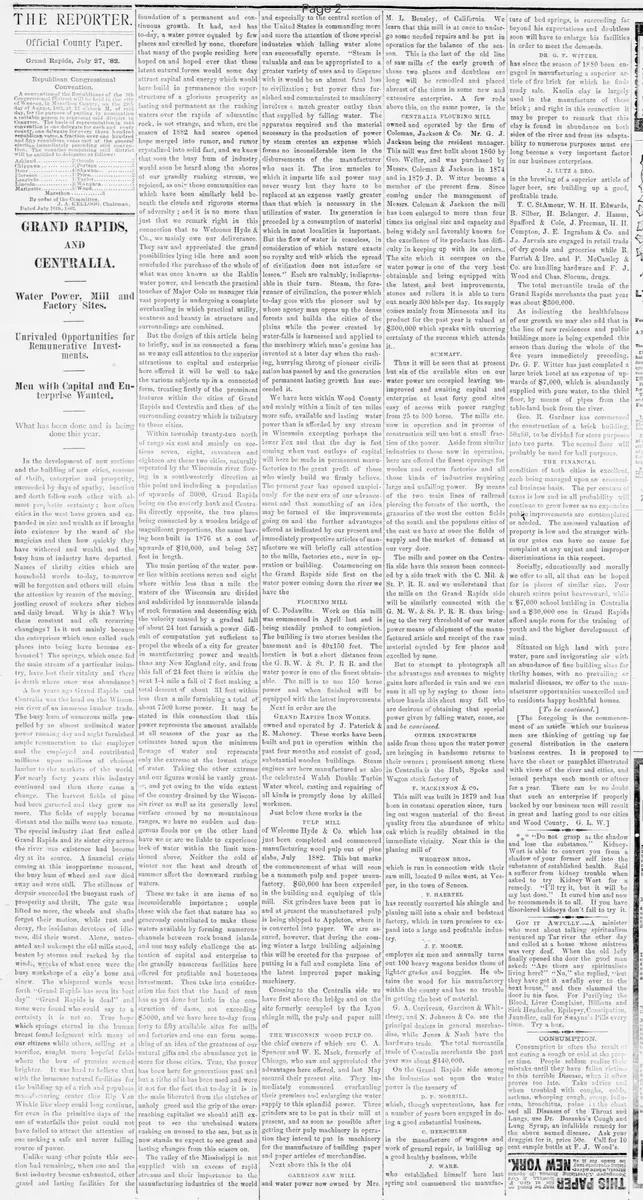
Water Power. Mill and Factory Sites.
Unrivaled Opportunities for Remunerative Investments.
Men with Capital and Enterprise Wanted.
What has been done and is being done this year.
In the development of new sections and the building of new cities, seasons of thrift, enterprise and prosperity, succeeded by days of apathy, inaction and dearth follow each other with almost prophetic certainty; how often cities in the west have grown and expanded in size and wealth as if brought into existence by the wand of the magician and then how quickly they have withered and wealth and the busy hum of industry have departed. Names of thrifty cities which are household words to-day, to-morrow will be forgotten and others will claim the attention by reason of the moving, jostling crowd of seekers after riches and daily bread. Why is this? Why these constant and oft recurring changings? Is it not mainly because the enterprises which once called such places into being have become exhausted? The springs, which once fed the main stream of a particular industry, have lost their vitality and there is dearth where once was abundance?
A few years ago Grand Rapids and Centralia was the head on the Wisconsin river of an immense lumber trade. The busy hum of numerous mills propelled by an almost unlimited water power running day and night furnished ample remuneration to the employer and the employed and contributed millions upon millions of choicest lumber to the markets of the world. For nearly forty years this industry continued and then there came a change. The harvest fields of pine had been garnered and they grew no more. The fields of supply became distant and the mills were too remote. The special industry that first called Grand Rapids and its sister city across the river into existence had become dry at its source. A financial crisis coming at this inopportune moment, the busy hum of wheel and saw died away and were still. The stillness of despair succeeded the buoyant rush of prosperity and thrift. The gate was lifted no more, the wheels and shafts forgot their motion, while rust and decay, the insidious devotees of idleness, did their worst. Alone, untenanted and unkempt the old mills stood, beaten by storms and racked by the winds, wrecks of what once were the busy workshops of a city's bone and sinew. The whispered words went forth "Grand Rapids has seen its best day" "Grand Rapids is dead" and none were found who could say to a certainty it is not so. True hope which springs eternal in the human breast found lodgment with many of our citizens while others, selling at a sacrifice, sought more hopeful fields where the bow of promise seemed brighter. It was hard to believe that with the immense natural facilities for the building up of a rich and populous manufacturing center this Rip Van Winkle like sleep could long continue, for even in the primitive days of the use of waterfalls this point could not have failed to attract the attention of one seeking a safe and never failing source of power.
Unlike many other points this section had remaining, when one and the first industry became exhausted, other grand and lasting facilities for the foundation of a permanent and continuous growth. It had, and has to-day, a water power equaled by few places and excelled by none, therefore that many of the people residing here hoped on and hoped ever that these latent natural forces would some day attract capital and energy which would here build in permanence the superstructure of a glorious prosperity as lasting and permanent as the rushing waters over the rapids of adamantine rock, is not strange, and when, ere the season of 1882 had scarce opened hope merged into rumor, and rumor crystalized into solid fact, and we knew that soon the busy hum of industry would soon be heard along the shores of our grandly rushing stream, we rejoiced, as only those communities can which have been similarly held beneath the clouds and rigorous storms of adversity; and it is no more than just that we remark right in this connection that to Welcome Hyde & Co., we mainly owe our deliverance. They saw and appreciated the grand possibilities lying idle here and soon concluded the purchase of the whole of what was once known as the Rablin water power, and beneath the practical touches of Major Cole as manager this vast property is undergoing a complete overhauling in which practical utility, neatness and beauty in structure and surroundings are combined.
But the design of this article being to briefly, and in as connected a form as we may call attention to the superior attractions to capital and enterprise here offered it will be well to take the various subjects up in a connected form, treating firstly of the prominent features within the cities of Grand Rapids and Centralia and then of the surrounding country which is tributary to these cities.
Within township twenty-two north of range six east and mainly on sections seven, eight, seventeen and eighteen are these two cities, naturally separated by the Wisconsin river flowing in a southwesterly direction at this point and including a population of upwards of 3000, Grand Rapids being on the easterly bank and Centralia directly opposite, the two places being connected by a wooden bridge of magnificent proportions, the same having been built in 1876 at a cost of upwards of $10,000, and being 587 feet in length.
The main portion of the water power lies within sections seven and eight where within less than a mile the waters of the Wisconsin are divided and subdivided by innumerable islands of rock formation and descending with the velocity caused by a gradual fall of about 24 feet furnish a power difficult of computation yet sufficient to propel the wheels of a city for greater in manufacturing power and wealth than any New England city, and from this fall of 24 feet there is within the next 1-4 mile a fall of 7 feet making a total descent of about 31 feet within less than a mile furnishing a total of about 7500 horse power. It may be stated in this connection that this power represents the amount available at all seasons of the year as the estimates based upon the minimum flowage of water and represents only the extreme at the lowest stage of water. Taking the other extreme and our figures would be vastly greater, and yet owing to the wide extent of the country drained by the Wisconsin river as well as its generally level surface crossed by no mountainous ranges, we have no sudden and dangerous floods nor on the other hand have we or are we liable to experience lack of water within the limit mentioned above. Neither the cold of winter nor the heat and drouth of summer affect the downward rushing waters.
These we take it are items of no inconsiderable importance; couple these with the fact that nature has so generously contributed to make these waters available by forming numerous channels between rock bound islands and one may safely challenge the attention of capital and enterprise to the grandly numerous facilities here offered for profitable and bounteous investment. Then take into consideration the fact that the hand of man has as yet done but little in the construction of dams, not exceeding $5000, and we have here to-day from forty to fifty available sites for mills and factories and one can form some thing of an idea of the greatness of our natural gifts and the abundance yet in store for these cities. True, the power has been here for generations past and but a tithe of it has been used and were it not for the fact that to-day it is in the main liberated from the clutches of unholy greed and the grip of the over reaching capitalist we should still expect to see the unchained waters rushing on unused to the sea, but as it now stands we expect to see great and lasting changes from this season on.
The valley of the Mississippi is not supplied with an excess of rapid streams and their importance to the manufacturing industries of the world and especially to the central section of the United States is commanding more and more the attention of those special industries which falling water alone can successfully operate. "Steam is valuable and can be appropriated to a greater variety of uses and to dispense with it would be an almost fatal loss to civilization; but power thus furnished and communicated to machinery involves a much greater outlay than that supplied by falling water. The apparatus required and the material necessary in the production of power by steam creates an expense which forms no inconsiderable item in the disbursements of the manufacturer who uses it. The iron muscles to which it imparts life and power may never weary but they have to be replaced at an expense vastly greater than that which is necessary in the utilization of water. Its generation is preceded by a consumption of material which in most localities is important. But the flow of water is ceaseless, in consideration of which nature exacts no royalty and with which the spread of civilization does not interfere or lessen." Each are valuably, indispensable in their turn. Steam, the forerunner of civilization, the power which to-day goes with the pioneer and by whose agency man opens up the dense forests and builds the cities of the plains while the power created by water-falls is harnessed and applied to the machinery which man's genius has invented at a later day when the rushing, hurrying throng of pioneer civilization has passed by and the generation of permanent lasting growth has succeeded it.
We have here within Wood County and mainly within a limit of ten miles more safe, available and lasting water power than is afforded by any stream in Wisconsin excepting perhaps the lower Fox and that the day is fast coming when vast outlays of capital will here be made in permanent manufacturing factories to the great profit of those who wisely build we firmly believe.
The present year has opened auspiciously for the new era of our advancement and that something of an idea may be formed of the improvements going on and the further advantages offered as indicated by our present and immediately prospective articles of manufacture we will briefly call attention to the mills, factories etc., now in operation or building. Commencing on the Grand Rapids side first on the water power coming down the river we have the
FLOURING MILL of C. Podawiltz. Work on this mill was commenced in April last and is being steadily pushed to completion. The building is two stories besides the basement and is 40x150 feet. The location is but a short distance from the G. B. W. & St. P. R. R. and the water power is one of the finest obtainable. The mill is to use 150 horse power and when finished will be equipped with the latest improvements.
Next in order are the Grand Rapids Iron Works, owned and operated by J. Paterick & E. Mahoney. These works have been built and put in operation within the past four months and consist of good substantial wooden buildings. Steam engines are here manufactured as also the celebrated Walsh Double Turbin Water wheel, casting and repairing of all kinds is promptly done by skilled workmen.
Just below these works is the PULP MILL of Welcome Hyde & Co. which has just been completed and commenced manufacturing wood pulp out of pine slabs, July 1882. This but marks the commencement of what will soon be a mammoth pulp and paper manufactory. $60,000 has been expended in the building and equipping of this mill. Six grinders have been put in and at present the manufactured pulp is being shipped to Appleton, where it is converted into paper. We are assured, however, that during the coming winter a large building adjoining this will be erected for the purpose of putting in a full and complete line of the latest improved paper making machinery.
Crossing to the Centralia side we have first above the bridge and on the site formerly occupied by the Lyon shingle mill, the pulp and paper mill of THE WISCONSIN WOOD PULP CO. the chief owners of which are C. A. Spencer and W. E. Mack, formerly of Chicago, who saw and appreciated the advantages here offered, and last May secured their present site. They immediately commenced overhauling their premises and enlarging the water supply to this splendid power. Three grinders are to be put in their mill at present, and as soon as possible after getting their pulp machinery in operation they intend to put in machinery for the manufacture of building paper and paper articles of merchandise.
Next above this is the old GARRISON SAW MILL and water power now owned by Mrs. M. L. Bensley, of California. We learn that this mill is at once to undergo some needed repairs and be put in operation for the balance of the season. This is the last of the old line of saw mills of the early growth of these two places and doubtless ere long will be remodeled and placed abreast of the times in some new and extensive enterprise. A few rods above this, on the same power, is the CENTRALIA FLOURING MILL owned and operated by the firm of Coleman, Jackson & Co. Mr. G. J. Jackson being the resident manager. This mill was first built about 1860 by Geo. Weller, and was purchased by Messrs. Coleman & Jackson in 1874 and in 1879 J. D. Witter became a member of the present firm. Since coming under the management of Messrs. Coleman & Jackson the mill has been enlarged to more than four times its original size and capacity and being widely and favorably known for the excellence of its products has difficulty in keeping up with its orders. The site which it occupies on the water power is one of the very best obtainable and being equipped with the latest and best improvements stones and rollers it is able to turn out nearly 300 bbls per day. Its supply comes mainly from Minnesota and its product for the past year is valued at $300,000 which speaks with unerring certainty of the success which attends it.
SUMMARY.
Thus it will be seen that at present but six of the available sites on our water power are occupied leaving unimproved and awaiting capital and enterprise at least forty good sites easy of access with power ranging from 25 to 500 horse. The mills etc. now in operation and in process of construction will use but a small fraction of the power. Aside from similar industries to those now in operation, here are offered the finest openings for woolen and cotton factories and all those kinds of industries requiring large and unfailing power. By means of the two main lines of railroad piercing the forests of the north, the granaries of the west the cotton fields of the south and the populous cities of the east we have at once the fields of supply and the market of demand at our very door.
The mills and power on the Centralia side have this season been connected by a side track with the C. Mil. & St. P. R. R. and we understand that the mills on the Grand Rapids side will be similarly connected with the G. M. W. & St. P. R. R. thus bringing to the very threshold of our water power means of shipment of the manufactured article and receipt of the raw material equaled by few places and excelled by none.
But to attempt to photograph all the advantages and avenues to mighty gains here afforded is vain and we can sum it all up by saying to those into whose hands this sheet may fall who are desirous of obtaining that special power given by falling water, come, see and be convinced.
OTHER INDUSTRIES aside from those upon the water power are bringing in handsome returns to their owners: prominent among these in Centralia is the Hub, Spoke and Wagon stock factory of F. MACKINNON & CO. This mill was built in 1879 and has been in constant operation since, turning out wagon material of the finest quality from the abundance of white oak which is readily obtained in the immediate vicinity. Near this is the planing mill of WHORTON BROS. which is run in connection with their saw mill, located 9 miles west, at Vesper, in the town of Seneca.
F. HAERTEL has recently converted his shingle and planing mill into a chair and bedstead factory, which in turn promises to expand into a large and profitable industry.
J. F. MOORE. employs six men and annually turns out 100 heavy wagons besides those of lighter grades and buggies. He obtains the wood for his manufactory within the county and has no trouble in getting the best of material.
G. A. Corriveau, Garrison & Whittlesey, and N. Johnson & Co. are the principal dealers in general merchandise, while Jones & Nash have the hardware trade. The total mercantile trade of Centralia merchants the past year was about $140,000.
On the Grand Rapids side among the industries not upon the water power is the tannery of D. P. MORRILL. which, though unpretentious, has for a number of years been engaged in doing a good substantial business.
C. HERSCHLEB in the manufacture of wagons and work of general repair, is building up a good healthy business, while J. WARE. who established himself here last spring and commenced the manufacture of bed springs, is succeeding far beyond his expectations and doubtless soon will have to enlarge his facilities in order to meet the demands.
DR. G. F. WITTER. has since the season of 1880 been engaged in manufacturing a superior article of fire brick for which he finds ready sale. Kaolin clay is largely used in the manufacture of these brick: and right in this connection it may be proper to remark that this clay is found in abundance on both sides of the river and from its adaptability to numerous purposes must ere long become a very important factor in our business enterprises.
J. LUTZ & BRO. in the brewing of a superior article of lager beer, are building up a good, profitable trade.
T. C. StAmour, W. H. H. Edwards. B. Silber, H. Belanger. J. Hamm, Spafford & Cole. J. Freemap. H. H. Compton, J. E. Ingraham & Co. and Jo. Jarvais are engaged in retail trade of dry goods and groceries while R. Farrish & Bro. and P. McCamley & Co. are handling hardware and F. J. Wood and Chas. Slocum, drugs.
The total mercantile trade of the Grand Rapids merchants the past year was about $300,000.
As indicating the healthfulness of our growth we may also add that in the line of new residences and public buildings more is being expended this season than during the whole of the five years immediately preceding.
Dr. G. F. Witter has just completed a large brick hotel at an expense of upwards of $7,000, which is abundantly supplied with pure water to the third floor, by means of pipes from the table-land back from the river.
Geo. R. Gardner has commenced the construction of a brick building 50x80, to be divided for store purposes into two parts. The second floor will probably be used for hall purposes.
THE FINANCIAL condition of both cities is excellent, each being managed upon an economical business basis. The per centum of taxes is low and in all probability will continue to grow lower as no expensive public improvements are contemplated or needed. The assessed valuation of property is low and the stranger within our gates can have no cause for complaint at any unjust and improper discriminations in this respect.
Socially, educationally and morally we offer to all, all that can be hoped for in places of similar size. Four church spires point heavenward, while a $7,000 school building in Centralia and a $30,000 one in Grand Rapids afford ample room for the training of youth and the higher development of mind.
Situated on high land with pure water, pure and invigorating air with an abundance of fine building sites for thrifty homes, with no prevailing or malarial diseases, we offer to the manufacturer opportunities unexcelled and to residents happy healthful homes.
[To be continued.]
The foregoing is the commencement of an article which our business men are thinking of getting up for general distribution in the eastern business centres. It is proposed to have the sheet or pamphlet illustrated with views of the river and cities, and issued perhaps each month or oftener for a year. There can be no doubt that such an enterprise if properly backed by our business men will result in great and lasting good to our cities and Wood County. G. L. W.
What sub-type of article is it?
What themes does it cover?
What keywords are associated?
What entities or persons were involved?
Where did it happen?
Story Details
Key Persons
Location
Grand Rapids And Centralia, Wisconsin River, Wood County, Wisconsin
Event Date
1882
Story Details
Grand Rapids and Centralia, once booming lumber towns, declined after pine supplies exhausted; now reviving through vast untapped water power attracting new industries like pulp mills and iron works, led by investors like Welcome Hyde & Co., promising permanent manufacturing growth.