Thank you for visiting SNEWPapers!
Sign up free
Oxford Democrat
Paris, South Paris, Oxford County, Maine
What is this article about?
On July 2, 1863, the Maine Supreme Judicial Court ruled that cities and towns lack legal authority to pledge credit or raise taxes to pay commutation fees for citizens drafted into U.S. military service under the 1863 Enrollment Act, as submitted by Governor Coburn on June 27.
Merged-components note: These sequential components form a single continuous article on an important judicial decision regarding commutation for military draft.
Clipping
OCR Quality
Full Text
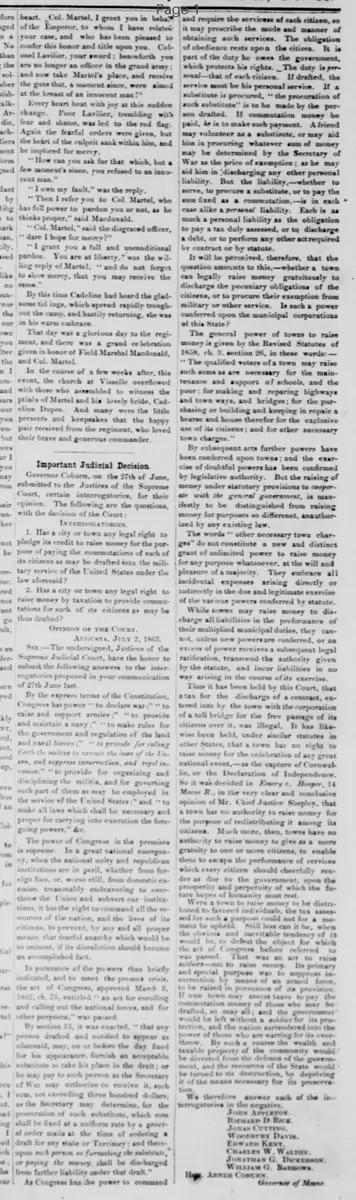
Governor Coburn, on the 27th of June,
submitted to the Justices of the Supreme
Court, certain interrogatories, for their
opinion. The following are the questions,
with the decision of the Court:
INTERROGATORIES,
1. Has a city or town any legal right to
pledge its credit to raise money for the pur-
pose of paying the commutations of such of
its citizens as may be drafted into the mili-
tary service of the United States under the
law aforesaid?
2. Has a city or town any legal right to
raise money by taxation to provide commu-
tations for such of its citizens as may be
thus drafted?
OPINION OF THE COURT.
Augusta, July 2, 1863,
Sir:—The undersigned, Justices of the
Supreme Judicial Court, have the honor to
submit the following answers to the inter-
rogatories proposed in your communication
of 27th June last.
By the express terms of the Constitution,
Congress has power "to declare war;" "to
raise and support armies;" "to provide
and maintain a navy," "to make rules for
the government and regulation of the land
and naval forces;" "to provide for calling
forth the militia to execute the laws of the Un-
ion, and suppress insurrections, and repel in-
vasions;" "to provide for organizing and
disciplining the militia, and for governing
such part of them as may be employed in
the service of the United States;" and "to
make all laws which shall be necessary and
proper for carrying into execution the fore-
going powers," &c.
The power of Congress in the premises
is supreme. In a great national emergen-
cy, when the national unity and republican
institutions are in peril., whether from for-
eign foes, or, worse still, from domestic en-
emies, treasonably endeavoring to over-
throw the Union and subvert our institg-
tions, it has the right to command all the re-
sources of the nation, and the lives of its
citizens, to prevent, by any and all proper
means, that fearful anarchy which would be
so imminent, if its dissolution should become
an accomplished fact.
In pursuance of the powers thus briefly
indicated, and to meet the present crisis,
the act of Congress, approved March 3,
1863, ch. 81, entitled "an act for enrolling
and calling out the national forces, and for
other purposes," was passed.
By section 13, it was enacted, "that any
person drafted and notified to appear as
aforesaid, may, on or before the day fixed
for his appearance, furnish an acceptable
substitute to take his place in the draft; or
he may pay to such person as the Secretary
of War may authorize to receive it, such
sum, not exceeding three hundred dollars,
as the Secretary may determine, for the
procuration of such substitute, which sum
shall be fixed at a uniform rate by a gener-
al order made at the time of ordering a
draft for any state or Territory: and there-
upon such person so furnishing the substitute,
or paying the money, shall be discharged
from further liability under that draft."
and require the services of each citizen, so
it may prescribe the mode and manner of
obtaining such services. The obligation
of obedience rests upon the citizen. It is
part of the duty he owes the government,
which protects his rights. The duty is per-
sonal—that of each citizen. If drafted, the
service must be his personal service. If a
substitute is procured, "the procuration of
such substitute" is to be made by the per-
son drafted. If commutation money be
paid, he is to make such payment. A friend
may volunteer as a substitute, or may aid
him in procuring whatever sum of money
may be determined by the Secretary of
War as the price of exemption; as he may
aid him in discharging any other personal
liability. But the liability,—whether to
serve, to procure a substitute, or to pay the
sum fixed as a commutation,—is in each
case alike a personal liability. Each is as
much a personal liability as the obligation
to pay a tax duly assessed, or to discharge
a debt, or to perform any other act required
by contract or by statute.
It will be perceived, therefore, that the
question amounts to this,—whether a town
can legally raise money gratuitously to
discharge the pecuniary obligations of the
citizens, or to procure their exemption from
military or other service. Is such a power
conferred upon the municipal corporations
of this State?
The general power of towns to raise
money is given by the Revised Statutes of
1857, ch. 3, section 26, in these words:-
"The qualified voters of a town may raise
such sums as are necessary for the main-
tenance and support of schools, and the
poor; for making and repairing highways
and town ways, and bridges; for the pur-
chasing or building and keeping in repair a
hearse and house therefor for the exclusive
use of its citizens; and for other necessary
town charges."
By subsequent acts further powers have
been conferred upon towns; and the exer-
cise of doubtful powers has been confirmed
by legislative authority. But the raising of
money under statutory provisions to cooper-
ate with the general government, is man-
ifestly to be distinguished from raising
money for purposes so different, as author-
ized by any existing law.
The words "other necessary town char-
ges" do not constitute a new and distinct
grant of unlimited power to raise money
for any purpose whatsoever, at the will and
pleasure of a majority. They embrace all
incidental expenses arising directly or
indirectly in the due and legitimate exercise
of the various powers conferred by statute.
While towns may raise money to dis-
charge all liabilities in the performance of
their multiplied municipal duties, they can-
not, unless new powers are conferred, or an
excess of power receives a subsequent legal
ratification, transcend the authority given
by the statute, and incur liabilities in no
way arising in the course of its exercise.
Thus it has been held by this Court, that
a tax for the discharge of a contract, en-
tered into by the town with the corporation
of a toll bridge for the free passage of its
citizens over it, was illegal. It has like-
wise been held, under similar statutes in
other States, that a town has no right to
raise money for the celebration of any great
national event,—as the capture of Cornwal-
lis, or the Declaration of Independence.
So it was decided in Emery v. Hooper, 14
Maine R., in the very clear and conclusive
opinion of Mr. Chief Justice Shepley, that
a town has no authority to raise money for
the purpose of redistributing it among its
citizens. Much more, then, towns have no
authority to raise money to give as a mere
gratuity to one or more citizens, to enable
them to escape the performance of services
which every citizen should cheerfully ren-
der as due to the government, upon the
prosperity and perpetuity of which the fu-
ture hopes of humanity must rest.
Were a town to raise money to be distr-
buted to favored individuals, the tax asses-
sed for such a purpose could not for a mo-
ment be upheld. Still less can it be, when
the obvious and inevitable tendency of it
would be, to defeat the object for which
the act of Congress before referred to
was passed. That was an act to raise
soldiers—not to raise money. Its primary
and special purpose was to suppress in-
surrection by means of an armed force.,
to be raised in pursuance of its provisions.
If one town may assess taxes to pay the
commutation money of those who may be
drafted, so may all; and the government
would be left without a soldier for its pro-
tection, and the nation surrendered into the
power of those who are warring for its over-
throw. By such a course the wealth and
taxable property of the community would
be diverted from the defence of the govern-
ment, and the resources of the State would
be turned to its destruction, by depriving
it of the means necessary for its preserva-
tion
We therefore answer each of the in-
terrogatories in the negative.
John Appleton
Richard D. Rice
Jonas Cutting.
Woodbury Davis.
Edward Kent.
Charles W. Walton.
Jonathan G. Dickerson.
William G. Barrows.
What sub-type of article is it?
What keywords are associated?
What entities or persons were involved?
Where did it happen?
Domestic News Details
Primary Location
Augusta
Event Date
July 2, 1863
Key Persons
Outcome
the court answered both interrogatories in the negative, ruling that cities and towns have no legal right to pledge credit or raise money by taxation for paying commutations of drafted citizens.
Event Details
Governor Coburn submitted interrogatories to the Supreme Judicial Court on June 27, 1863, regarding whether cities or towns could pledge credit or raise taxes to pay commutation fees for citizens drafted under the U.S. Enrollment Act of March 3, 1863. The Court, in an opinion dated July 2, 1863, from Augusta, explained Congress's supreme power over military matters and concluded that such actions by municipalities exceed their statutory authority under Maine's Revised Statutes.