Thank you for visiting SNEWPapers!
Sign up free
Story
August 13, 1870
The Ottawa Free Trader
Ottawa, La Salle County County, Illinois
What is this article about?
Legal dispute in 1870 Illinois between Judge J.D. Caton and Fox River Valley Railroad over property damage from rail line. Court rules on when new constitution's eminent domain provisions took effect, appointing commissioners to assess damages instead of jury.
Clipping
OCR Quality
95%
Excellent
Full Text
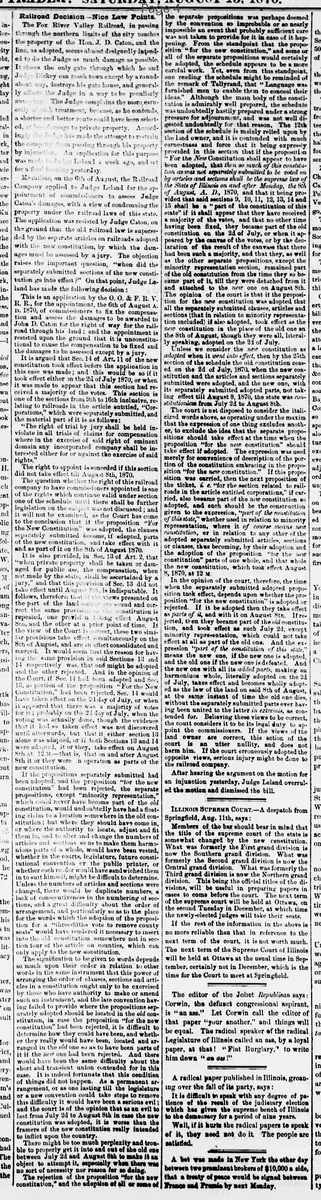
Railroad Decision-Nico Law Points
The Fox River Valley Railroad, in passing through the northern limits of the city touches the property of the Hon. J. D. Caton, and the line, as adopted, seems almost designedly intended to do the Judge as much damage as possible. It closes the only gate through which he and Judge Dickey can reach town except by a round-about way, destroys his gate house, and generally affects the Judge in a way to be peculiarly annoying. The Judge complains the more earnestly of such treatment, because, as he contends, a shorter and better route could have been selected, at less damage to private property. Accordingly the Judge has made the attempt to restrain the company from passing through his property by injunction. An application for this purpose was made to Judge Leland a week ago, and set for a final hearing yesterday.
Meantime, on the 6th of August, the Railroad Company applied to Judge Leland for the appointment of commissioners to assess Judge Caton's damages, with a view of condemning the property under the railroad laws of this state. The application was resisted by Judge Caton, on the ground that the old railroad law is superseded by the separate articles on railroads adopted with the new constitution, by which the damages must be assessed by a jury. The objection raises the important question, "when did the separately submitted sections of the new constitution go into effect?" On that point, Judge Leland has made the following decision:
This is an application by the O. & F. R. V. R. R., for the appointment, the 6th of August A. D. 1870, of commissioners to fix the compensation and assess the damages to be awarded to John D. Caton for the right of way for the railroad through his land; and the appointment is resisted upon the ground that it is unconstitutional to cause the compensation to be fixed and the damages to be assessed except by a jury.
It is argued that Sec. 14 of Art. II of the new constitution took effect before the application in this case was made: and this would be so if it took effect either on the 2d of July 1870, or when it was made to appear that this section had received a majority of the votes. This section is one of the sections from 9th to 16th inclusive, relating to railroads in the article entitled "Corporations," which were separately submitted, and the material part of it is as follows:
"The right of trial by jury shall be held inviolate in all trials of claims for compensation where in the exercise of said right of eminent domain any incorporated company shall be interested either for or against the exercise of said rights."
The right to appoint is conceded if this section did not take effect till August 8th, 1870.
The question whether the right of this railroad company to have commissioners appointed is one of the rights which continue valid under section one of the schedule until there shall be further legislation on the subject was not discussed; and it will not be examined, as the Court has come to the conclusion that if the proposition "For the New Constitution" was adopted, the clauses separately submitted become, if adopted, parts of the new constitution, and take effect with it and as part of it on the 8th of August 1870.
It is also provided, in Sec. 13 of Art. 2, that "when private property shall be taken or damaged for public use, the compensation, when not made by the state, shall be ascertained by a jury," and that this provision of Sec. 13 did not take effect until August 8th, is indisputable. It follows, therefore, that if the views presented on the part of the land owner are sound and correct the same provision in the constitution is repeated, one provision taking effect August 8th, and the other at a prior point of time. If the view of the Court is correct, these two similar provisions take effect simultaneously on the 8th of August, and are in effect consolidated and merged. It would seem that the reason for having the same provision in said Sections 13 and 14 respectively was, that one might be adopted and the other rejected. And in the opinion of the Court, if Sec. 14 had been adopted and Sec. 13, as portion of the proposition "For the New Constitution," had been rejected, Sec. 14 would have taken effect on the 2d day of July, or when it appeared that there was a majority of votes for it; probably on the 2d day of July, when the voting was actually done, though the evidence that it had so taken effect was not discovered until afterwards, but that if either section 13 alone was adopted, or if both Sections 13 and 14 were adopted, it or they, take effect on August 8th at 12 M.--that is, that on and after August 8th it or they were in operation as parts of the new constitution.
If the propositions separately submitted had been adopted, and the proposition "for the new constitution" had been rejected, the separate propositions, except "minority representation," which could never have become part of the old constitution, would undoubtedly have had a floating claim to a location somewhere in the old constitution; but where they should have come in, or where the authority to locate, adjust and fit them in, and to alter and change the numbers of articles and sections so as to make them harmonious parts of a whole, would have been vested, whether in the courts, legislature, future constitutional convention or the public printer, or whether each reader would have sandwiched them in to suit himself, might be difficult to determine. Unless the numbers of articles and sections were changed, there would be duplicate numbers, a lack of consecutiveness in the numbering of sections, and a great difficulty about the order of arrangement, and particularly so as to the place for the words which the adoption of the proposition for a "three-fifths vote to remove county seats" would have rendered it necessary to insert into the old constitution somewhere not in section four of the article on counties, which can only apply to the new constitution.
The signification to be given to words depends so much upon their order in relation to other words in the same instrument that this power of arranging the order of clauses, sections and articles in a constitution ought only to be exercised by those who have authority to make or amend such an instrument, and the late convention having failed to provide where the propositions separately adopted should be located in the old constitution, in case the proposition "for the new constitution" had been rejected, it is difficult to determine how they could have been, and whether they really would have been, located and arranged in the old one so as to have been parts of it if the new one had been rejected. And there would have been the same difficulty about the short and transient union contended for in this case. It is indeed fortunate that this condition of things did not happen. As a permanent arrangement, or as one lasting till the legislature or a new convention could take steps to remove this difficulty it would have been a serious evil: and the court is of the opinion that as an evil to last from July 2d to August 8th in case the new constitution was adopted, it is worse than the framers of the new constitution really intended to inflict upon the country.
There might be too much perplexity and trouble to properly get it into and out of the old one between July 2d and August 8th to make it an object to attempt it, especially when there was no sort of necessity nor reason for so doing. The rejection of the proposition "For the new constitution," and the adoption of all or some of the separate propositions was perhaps deemed by the convention so improbable or so nearly impossible an event that probably sufficient care was not taken to provide for it in case of its happening. From the standpoint that the proposition "for the new constitution," and some or all of the separate propositions would certainly be adopted, the schedule appears to be a more careful work. Yet, even from this standpoint, one reading the schedule might be reminded of the remark of Talleyrand, that "Language was furnished men to enable them to conceal their ideas." Although the main body of the constitution is admirably well prepared, the schedule was undoubtedly hastily prepared under a strong pressure for adjournment, and was not well digested undoubtedly for that reason. The 12th section of the schedule is mainly relied upon by the land owner, and it is contended with much earnestness and force that it being expressly provided in this section that if the proposition "For the New Constitution shall appear to have been adopted, that then so much of this constitution as was not separately submitted to be voted on by articles and sections shall be the supreme law of the State of Illinois on and after Monday, the 8th of August, A. D., 1870, and that it being provided that said sections 9, 10, 11, 12, 13, 14 and 15 shall be "part of the constitution of this state" if it shall appear that they have received a majority of the votes, and that no other time having been fixed, they became part of the old constitution on the 2d of July, or when it appeared by the canvas of the votes, or by the declaration of the result of the canvass that there had been such a majority, and that they, as well as the other separate propositions, except the minority representation section, remained part of the old constitution from the time they so became part of it, till they were detached from it and attached to the new one on August 8th.
The opinion of the court is that if the proposition for the new constitution was adopted that all the separately submitted clauses, articles and sections (that in relation to minority representation included) if also adopted, took effect as the new constitution in the place of the old one on the 8th of August, though they were all, literally speaking, adopted on the 2d of July.
Unless we consider the new constitution as adopted when it went into effect, then by the 25th section of the schedule the old constitution ceased on the 2d of July, 1870, when the new constitution and the articles and sections separately submitted were adopted, and the new one, with its separately submitted adopted parts, not taking effect till August 8, 1870, the state was constitutionless from July 2d to August 8th.
The court is not disposed to consider the italicized words above, as operating under the maxim that the expression of one thing excludes another, to exclude the idea that the separate propositions should take effect at the time when the proposition "for the new constitution" should take effect if adopted. The expression was used merely for convenience of description of the portion of the constitution embracing in the proposition "for the new constitution." If this proposition was carried, then the next proposition of the ticket, i.e. "for the section related to railroads in the article entitled corporations," if carried, also became part of the new constitution so adopted, and such should be the construction given to the expression, "part of the constitution of this state," whether used in relation to minority representation, where it of course means new constitution, or in relation to any other of the adopted separately submitted articles, sections or clauses, thus becoming, by their adoption and the adoption of the proposition "for the new constitution" parts of one whole, and that whole the new constitution, which took effect August 8, 1870, at 12 m.
In the opinion of the court, therefore, the time when the separately submitted adopted proposition took effect, depends upon whether the proposition "for the new constitution" is adopted or rejected. If it be adopted then they take effect as parts of it and with it on August 8th. If rejected, then they became part of the old constitution, and took effect as such July 2d, except minority representation, which could not take effect at all as part of the old one. And the expression "part of the constitution of this state," means the new one, if the new one is adopted, and the old one if the new one is defeated. And the new one with all its added parts, making a harmonious whole, literally adopted on the 2d of July, takes effect and becomes wholly adopted as the law of the land on said 8th of August, at the same instant of time the old one dies, without the separately submitted parts ever having been united to the latter in extremis, as contended for. Believing these views to be correct, the court considers it to be its legal duty to appoint the commissioners. If the views of the land owner are correct, this action of the court is an utter nullity, and does not harm him. If the court erroneously adopted the opposite views, serious injury might be done to the railroad company.
After hearing the argument on the motion for an injunction yesterday, Judge Leland overruled the motion and dismissed the bill.
The Fox River Valley Railroad, in passing through the northern limits of the city touches the property of the Hon. J. D. Caton, and the line, as adopted, seems almost designedly intended to do the Judge as much damage as possible. It closes the only gate through which he and Judge Dickey can reach town except by a round-about way, destroys his gate house, and generally affects the Judge in a way to be peculiarly annoying. The Judge complains the more earnestly of such treatment, because, as he contends, a shorter and better route could have been selected, at less damage to private property. Accordingly the Judge has made the attempt to restrain the company from passing through his property by injunction. An application for this purpose was made to Judge Leland a week ago, and set for a final hearing yesterday.
Meantime, on the 6th of August, the Railroad Company applied to Judge Leland for the appointment of commissioners to assess Judge Caton's damages, with a view of condemning the property under the railroad laws of this state. The application was resisted by Judge Caton, on the ground that the old railroad law is superseded by the separate articles on railroads adopted with the new constitution, by which the damages must be assessed by a jury. The objection raises the important question, "when did the separately submitted sections of the new constitution go into effect?" On that point, Judge Leland has made the following decision:
This is an application by the O. & F. R. V. R. R., for the appointment, the 6th of August A. D. 1870, of commissioners to fix the compensation and assess the damages to be awarded to John D. Caton for the right of way for the railroad through his land; and the appointment is resisted upon the ground that it is unconstitutional to cause the compensation to be fixed and the damages to be assessed except by a jury.
It is argued that Sec. 14 of Art. II of the new constitution took effect before the application in this case was made: and this would be so if it took effect either on the 2d of July 1870, or when it was made to appear that this section had received a majority of the votes. This section is one of the sections from 9th to 16th inclusive, relating to railroads in the article entitled "Corporations," which were separately submitted, and the material part of it is as follows:
"The right of trial by jury shall be held inviolate in all trials of claims for compensation where in the exercise of said right of eminent domain any incorporated company shall be interested either for or against the exercise of said rights."
The right to appoint is conceded if this section did not take effect till August 8th, 1870.
The question whether the right of this railroad company to have commissioners appointed is one of the rights which continue valid under section one of the schedule until there shall be further legislation on the subject was not discussed; and it will not be examined, as the Court has come to the conclusion that if the proposition "For the New Constitution" was adopted, the clauses separately submitted become, if adopted, parts of the new constitution, and take effect with it and as part of it on the 8th of August 1870.
It is also provided, in Sec. 13 of Art. 2, that "when private property shall be taken or damaged for public use, the compensation, when not made by the state, shall be ascertained by a jury," and that this provision of Sec. 13 did not take effect until August 8th, is indisputable. It follows, therefore, that if the views presented on the part of the land owner are sound and correct the same provision in the constitution is repeated, one provision taking effect August 8th, and the other at a prior point of time. If the view of the Court is correct, these two similar provisions take effect simultaneously on the 8th of August, and are in effect consolidated and merged. It would seem that the reason for having the same provision in said Sections 13 and 14 respectively was, that one might be adopted and the other rejected. And in the opinion of the Court, if Sec. 14 had been adopted and Sec. 13, as portion of the proposition "For the New Constitution," had been rejected, Sec. 14 would have taken effect on the 2d day of July, or when it appeared that there was a majority of votes for it; probably on the 2d day of July, when the voting was actually done, though the evidence that it had so taken effect was not discovered until afterwards, but that if either section 13 alone was adopted, or if both Sections 13 and 14 were adopted, it or they, take effect on August 8th at 12 M.--that is, that on and after August 8th it or they were in operation as parts of the new constitution.
If the propositions separately submitted had been adopted, and the proposition "for the new constitution" had been rejected, the separate propositions, except "minority representation," which could never have become part of the old constitution, would undoubtedly have had a floating claim to a location somewhere in the old constitution; but where they should have come in, or where the authority to locate, adjust and fit them in, and to alter and change the numbers of articles and sections so as to make them harmonious parts of a whole, would have been vested, whether in the courts, legislature, future constitutional convention or the public printer, or whether each reader would have sandwiched them in to suit himself, might be difficult to determine. Unless the numbers of articles and sections were changed, there would be duplicate numbers, a lack of consecutiveness in the numbering of sections, and a great difficulty about the order of arrangement, and particularly so as to the place for the words which the adoption of the proposition for a "three-fifths vote to remove county seats" would have rendered it necessary to insert into the old constitution somewhere not in section four of the article on counties, which can only apply to the new constitution.
The signification to be given to words depends so much upon their order in relation to other words in the same instrument that this power of arranging the order of clauses, sections and articles in a constitution ought only to be exercised by those who have authority to make or amend such an instrument, and the late convention having failed to provide where the propositions separately adopted should be located in the old constitution, in case the proposition "for the new constitution" had been rejected, it is difficult to determine how they could have been, and whether they really would have been, located and arranged in the old one so as to have been parts of it if the new one had been rejected. And there would have been the same difficulty about the short and transient union contended for in this case. It is indeed fortunate that this condition of things did not happen. As a permanent arrangement, or as one lasting till the legislature or a new convention could take steps to remove this difficulty it would have been a serious evil: and the court is of the opinion that as an evil to last from July 2d to August 8th in case the new constitution was adopted, it is worse than the framers of the new constitution really intended to inflict upon the country.
There might be too much perplexity and trouble to properly get it into and out of the old one between July 2d and August 8th to make it an object to attempt it, especially when there was no sort of necessity nor reason for so doing. The rejection of the proposition "For the new constitution," and the adoption of all or some of the separate propositions was perhaps deemed by the convention so improbable or so nearly impossible an event that probably sufficient care was not taken to provide for it in case of its happening. From the standpoint that the proposition "for the new constitution," and some or all of the separate propositions would certainly be adopted, the schedule appears to be a more careful work. Yet, even from this standpoint, one reading the schedule might be reminded of the remark of Talleyrand, that "Language was furnished men to enable them to conceal their ideas." Although the main body of the constitution is admirably well prepared, the schedule was undoubtedly hastily prepared under a strong pressure for adjournment, and was not well digested undoubtedly for that reason. The 12th section of the schedule is mainly relied upon by the land owner, and it is contended with much earnestness and force that it being expressly provided in this section that if the proposition "For the New Constitution shall appear to have been adopted, that then so much of this constitution as was not separately submitted to be voted on by articles and sections shall be the supreme law of the State of Illinois on and after Monday, the 8th of August, A. D., 1870, and that it being provided that said sections 9, 10, 11, 12, 13, 14 and 15 shall be "part of the constitution of this state" if it shall appear that they have received a majority of the votes, and that no other time having been fixed, they became part of the old constitution on the 2d of July, or when it appeared by the canvas of the votes, or by the declaration of the result of the canvass that there had been such a majority, and that they, as well as the other separate propositions, except the minority representation section, remained part of the old constitution from the time they so became part of it, till they were detached from it and attached to the new one on August 8th.
The opinion of the court is that if the proposition for the new constitution was adopted that all the separately submitted clauses, articles and sections (that in relation to minority representation included) if also adopted, took effect as the new constitution in the place of the old one on the 8th of August, though they were all, literally speaking, adopted on the 2d of July.
Unless we consider the new constitution as adopted when it went into effect, then by the 25th section of the schedule the old constitution ceased on the 2d of July, 1870, when the new constitution and the articles and sections separately submitted were adopted, and the new one, with its separately submitted adopted parts, not taking effect till August 8, 1870, the state was constitutionless from July 2d to August 8th.
The court is not disposed to consider the italicized words above, as operating under the maxim that the expression of one thing excludes another, to exclude the idea that the separate propositions should take effect at the time when the proposition "for the new constitution" should take effect if adopted. The expression was used merely for convenience of description of the portion of the constitution embracing in the proposition "for the new constitution." If this proposition was carried, then the next proposition of the ticket, i.e. "for the section related to railroads in the article entitled corporations," if carried, also became part of the new constitution so adopted, and such should be the construction given to the expression, "part of the constitution of this state," whether used in relation to minority representation, where it of course means new constitution, or in relation to any other of the adopted separately submitted articles, sections or clauses, thus becoming, by their adoption and the adoption of the proposition "for the new constitution" parts of one whole, and that whole the new constitution, which took effect August 8, 1870, at 12 m.
In the opinion of the court, therefore, the time when the separately submitted adopted proposition took effect, depends upon whether the proposition "for the new constitution" is adopted or rejected. If it be adopted then they take effect as parts of it and with it on August 8th. If rejected, then they became part of the old constitution, and took effect as such July 2d, except minority representation, which could not take effect at all as part of the old one. And the expression "part of the constitution of this state," means the new one, if the new one is adopted, and the old one if the new one is defeated. And the new one with all its added parts, making a harmonious whole, literally adopted on the 2d of July, takes effect and becomes wholly adopted as the law of the land on said 8th of August, at the same instant of time the old one dies, without the separately submitted parts ever having been united to the latter in extremis, as contended for. Believing these views to be correct, the court considers it to be its legal duty to appoint the commissioners. If the views of the land owner are correct, this action of the court is an utter nullity, and does not harm him. If the court erroneously adopted the opposite views, serious injury might be done to the railroad company.
After hearing the argument on the motion for an injunction yesterday, Judge Leland overruled the motion and dismissed the bill.
What sub-type of article is it?
Historical Event
What themes does it cover?
Justice
What keywords are associated?
Railroad Eminent Domain
Constitutional Law
Illinois Constitution 1870
Property Damage
Jury Trial
Commissioners Appointment
What entities or persons were involved?
J. D. Caton
Judge Dickey
Judge Leland
Fox River Valley Railroad
O. & F. R. V. R. R.
Where did it happen?
Northern Limits Of The City, Illinois
Story Details
Key Persons
J. D. Caton
Judge Dickey
Judge Leland
Fox River Valley Railroad
O. & F. R. V. R. R.
Location
Northern Limits Of The City, Illinois
Event Date
August 6th, 1870
Story Details
Judge Caton seeks injunction against railroad's route damaging his property; company applies for commissioners to assess damages. Judge Leland rules that new constitution's jury trial provision for eminent domain took effect August 8, 1870, allowing commissioners; overrules injunction.