Thank you for visiting SNEWPapers!
Sign up free
Editorial
March 18, 1837
Richmond Palladium
Richmond, Wayne County, Indiana
What is this article about?
An editorial eulogizing the printing profession's vital role in disseminating knowledge, advancing enlightenment, fostering liberty, and supporting democratic institutions, contrasting it with music and highlighting printers' intellectual and social contributions.
Clipping
OCR Quality
82%
Good
Full Text
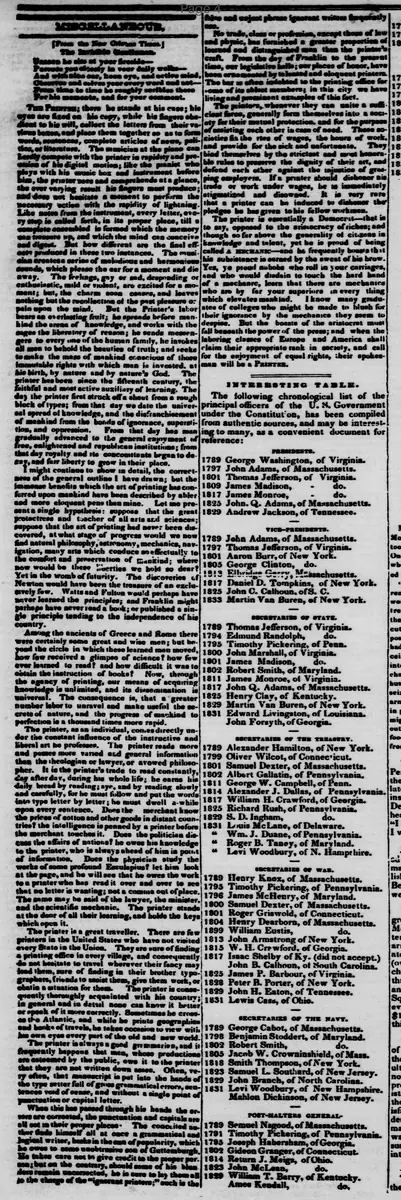
From the New Orleans Times.
Vengeance to seize my freedom—
Proudly guard it daily well.
And this thee ever, keep eye, and active mind,
Wherever and convey your every word and notion
From time to time be roughly sensible these
Not but moments, and for your comment.
The Press: there he stands at his case; his
Eyes are fixed on his copy, while his finger etc.
Sent to him will, collect the
Letter from their pigeon
boxes, and place them together so as to form
Words, sentences, complete articles of news, poli-
Tics, or literature. The musician at the piano can
Steadily compete with the printer in rapidity and pre-
Cision of his digital motion: like the pianist who
Plays with his music box and instrument before
Him, the printer sees and comprehends at a glance,
The ever varying result his fingers must produce;
And does not hesitate a moment to perform the
Necessary action with the rapidity of lightning
Like notes from the instrument, every letter, eve-
Ry stop is called forth, in its proper place, till a
Complete ensemble is formed which the memory
Can treasure up, and which the mind can conceive
And digest. But how different are the final eff-
Ects produced in these two instances. The musi-
Cian creates series of melodious and harmonious
Sounds, which please the ear for a moment and die
Away. The feelings, gay or sad, desponding or
Enthusiastic, mild or violent, are excited for a mo-
Ment; but, the charm soon ceases, and leaves
Nothing but the recollection of the past pleasure or
Pain upon the mind. But the Printer's labor
Bears an everlasting fruit; he spreads before man-
Kind the arena of knowledge, and works with the
Sages the laboratory of reason; he sends messen-
Gers to every name of the human family, he invokes
All men to behold the beauties of truth; and seeks
To make the mass of mankind conscious of those
Immutable rights with which man is invested at
His birth, by nature and by nature's God. The
Printer has been since the fifteenth century, The
Gibbet and most active auxiliary of learning. The
Day the printer first struck off a sheet from a rough
Block of types; from that day we date the univer-
Sal spread of knowledge, and the disfranchisement
Of mankind from the bonds of ignorance, supersti-
Tion, and oppression. From that day has man
Gradually advanced to the general enjoyment of
Free, enlightened and republican institutions; from
That day royalty and its concomitants began to de-
Cay, and fair liberty to grow in their place.
I might continue to show in detail, the correct-
Ness of the general outline I have drawn; but the
Immense benefits which the art of printing has con-
Ferred upon mankind have been described by abler
And more eloquent pens than mine. Let me pre-
Sent a single hypothesis: suppose that the great
Protector and teacher of all arts and sciences;
Suppose that the art of printing had never been dis-
Covered, at what stage of progress would we now
Find natural philosophy, astronomy, mechanics, nav-
Igation, many arts which conduce so effectually to
The comfort and preservation of mankind: where
Now would be those liberties we hold so dear?
Yet in the womb of futurity. The discoveries of
Newton would have been the treasure of an exclu-
Sively few. Watts and Fulton would perhaps have
Never learned the principles; and Franklin might
Perhaps have never read a book; or published a sin-
Gle principle tending to the independence of his
Country.
Among the ancients of Greece and Rome there
Were certainly some great and wise men: but how
Beyond the circle in which these learned men moved,
How few received a glimpse of science? how few
Ever happened to read? and how difficult it was to
Obtain the instruction of books?
Now, through
The agency of printing, our means of acquiring
Knowledge is unlimited, and its dissemination is
Universal. The consequence is, that a greater
Number labor to unravel and make useful the se-
Crets of nature, and the progress of mankind to
Perfection is a thousand times more rapid.
The printer, as an individual, comes directly un-
Der the constant influence of the instructive and
Liberal art he professes. The printer reads more
And possesses more varied and general information
Than the theologian or lawyer, or avowed philoso-
Pher. It is the printer's trade to read constantly,
Day after day, during his whole life: he earns his
Daily bread by reading; aye, and by reading slowly
And carefully, for he must follow and put the words
Into type letter by letter; he must dwell a-while
Upon every sentence. Does the merchant know
The prices of cotton and other goods in distant coun-
Tries? the intelligence is penned by a printer before
The merchant touches it. Does the politician dis-
Cuss the affairs of nations? he owes his knowledge
To the printer, who is always ahead of him in poinT
Of information. Does the physician study the
Works of some profound Esculapius? let him look
At the page, and he will see that he owes the work
To a printer who has read it over and over to see
That no letter is wanting; not a comma out of place.
The same may be said of the lawyer, the minister.
And the scientific mechanic. The printer stands
At the door of all their learning, and holds the keys
Which open it.
The printer is a great traveller. There are few
Printers in the United States who have not visited
Every state in the Union. They are sure of finding
A printing office in every village, and consequently
Do not hesitate to travel wherever their fancy may
Lead them, sure of finding in their brother typo-
Graphers, friends to assist them, give them work, or
Obtain a situation for them. The printer is conse-
Quently thoroughly acquainted with his country;
In general and in detail none can know it better
Or speak of it more correctly. Sometimes he crosses
The Atlantic, and while he prints geographies
And books of travel, he takes occasion to view with
His own eyes every part of the old and new world.
The printer is always a good grammarian, and it
Frequently happens that men, whose productions
Are esteemed by the public, owe it to the printer
That they are not written down asses. Often, ve-
Ry often, that manuscript is put into the hands of
The type setter full of gross grammatical errors, sen-
Tences void of sense, and without a single point of
Punctuation or capital letter.
When this has passed through his hands the er-
Rors are corrected, the punctuation and capitals are
All set in their proper places: The conceited au-
Thor finds himself all at once a grammatical and
Logical writer, books in the sun of popularity, which
He owes to some unobtrusive son of Gutenberg.
He takes care not to give credit to the paper per-
Son; but on the contrary, should some of his blun-
Ders remain uncorrected, he is sure to lay them all
Upon the charge of the "ignorant printers;" such is the
General and unjust phrase ignorant writers so quietly
No trade, class or profession, except those of law
And physic, has furnished a greater proportion of
Learned and distinguished men than the printer's
Craft. From the day of Franklin to the present
Time, our legislative halls; our places of honor, have
Been ornamented by talented and eloquent printers.
The bar is often indebted to the printing office for
Some of its ablest members; in this city we have
Living and prominent examples of this fact.
The printers, whenever they can unite a suffi-
Cient force, generally form themselves into a soci-
Ety for their mutual protection, and for the purpose
Of assisting each other in case of need. Those so-
Cieties fix the rates of wages, the hours of work,
And provide for the sick and unfortunate. They
Bind themselves by the strictest and most honor-
Able rules to preserve
The dignity of their art, and
Defend each other
Against the injustice of grasping
Employers. If a printer should dishonor his
Trade or work under wages, he is immediately
Stigmatized and
Disowned. It is very rare
That a printer can be induced to dishonor the
Pledges he has given to his fellow workmen.
The printer is essentially a Democrat—that is
To say, opposed to the aristocracy of riches; and
Though so far above the generality of citizens in
Knowledge and talent, yet he is proud of being
Called a mechanic—and he frequently boasts that
His subsistence is earned by the sweat of his brow.
Yes, ye proud nabobs who roll in your carriages,
And who would disdain to touch the hard hand
Of a mechanic, learn that there are mechanics
Who are by far your superiors in every
Thing
Which elevates man. I know many gradu-
Ates of colleges who might be made to blush for
Their ignorance by the mechanics they seem to
Despise. But the boasts of the aristocrat must
Fall beneath the power of the press; and when the
Laboring classes of Europe and America shall
Claim their appropriate rank in society, and call
For the enjoyment of equal rights, their spokes-
Man will be a Printer.
Vengeance to seize my freedom—
Proudly guard it daily well.
And this thee ever, keep eye, and active mind,
Wherever and convey your every word and notion
From time to time be roughly sensible these
Not but moments, and for your comment.
The Press: there he stands at his case; his
Eyes are fixed on his copy, while his finger etc.
Sent to him will, collect the
Letter from their pigeon
boxes, and place them together so as to form
Words, sentences, complete articles of news, poli-
Tics, or literature. The musician at the piano can
Steadily compete with the printer in rapidity and pre-
Cision of his digital motion: like the pianist who
Plays with his music box and instrument before
Him, the printer sees and comprehends at a glance,
The ever varying result his fingers must produce;
And does not hesitate a moment to perform the
Necessary action with the rapidity of lightning
Like notes from the instrument, every letter, eve-
Ry stop is called forth, in its proper place, till a
Complete ensemble is formed which the memory
Can treasure up, and which the mind can conceive
And digest. But how different are the final eff-
Ects produced in these two instances. The musi-
Cian creates series of melodious and harmonious
Sounds, which please the ear for a moment and die
Away. The feelings, gay or sad, desponding or
Enthusiastic, mild or violent, are excited for a mo-
Ment; but, the charm soon ceases, and leaves
Nothing but the recollection of the past pleasure or
Pain upon the mind. But the Printer's labor
Bears an everlasting fruit; he spreads before man-
Kind the arena of knowledge, and works with the
Sages the laboratory of reason; he sends messen-
Gers to every name of the human family, he invokes
All men to behold the beauties of truth; and seeks
To make the mass of mankind conscious of those
Immutable rights with which man is invested at
His birth, by nature and by nature's God. The
Printer has been since the fifteenth century, The
Gibbet and most active auxiliary of learning. The
Day the printer first struck off a sheet from a rough
Block of types; from that day we date the univer-
Sal spread of knowledge, and the disfranchisement
Of mankind from the bonds of ignorance, supersti-
Tion, and oppression. From that day has man
Gradually advanced to the general enjoyment of
Free, enlightened and republican institutions; from
That day royalty and its concomitants began to de-
Cay, and fair liberty to grow in their place.
I might continue to show in detail, the correct-
Ness of the general outline I have drawn; but the
Immense benefits which the art of printing has con-
Ferred upon mankind have been described by abler
And more eloquent pens than mine. Let me pre-
Sent a single hypothesis: suppose that the great
Protector and teacher of all arts and sciences;
Suppose that the art of printing had never been dis-
Covered, at what stage of progress would we now
Find natural philosophy, astronomy, mechanics, nav-
Igation, many arts which conduce so effectually to
The comfort and preservation of mankind: where
Now would be those liberties we hold so dear?
Yet in the womb of futurity. The discoveries of
Newton would have been the treasure of an exclu-
Sively few. Watts and Fulton would perhaps have
Never learned the principles; and Franklin might
Perhaps have never read a book; or published a sin-
Gle principle tending to the independence of his
Country.
Among the ancients of Greece and Rome there
Were certainly some great and wise men: but how
Beyond the circle in which these learned men moved,
How few received a glimpse of science? how few
Ever happened to read? and how difficult it was to
Obtain the instruction of books?
Now, through
The agency of printing, our means of acquiring
Knowledge is unlimited, and its dissemination is
Universal. The consequence is, that a greater
Number labor to unravel and make useful the se-
Crets of nature, and the progress of mankind to
Perfection is a thousand times more rapid.
The printer, as an individual, comes directly un-
Der the constant influence of the instructive and
Liberal art he professes. The printer reads more
And possesses more varied and general information
Than the theologian or lawyer, or avowed philoso-
Pher. It is the printer's trade to read constantly,
Day after day, during his whole life: he earns his
Daily bread by reading; aye, and by reading slowly
And carefully, for he must follow and put the words
Into type letter by letter; he must dwell a-while
Upon every sentence. Does the merchant know
The prices of cotton and other goods in distant coun-
Tries? the intelligence is penned by a printer before
The merchant touches it. Does the politician dis-
Cuss the affairs of nations? he owes his knowledge
To the printer, who is always ahead of him in poinT
Of information. Does the physician study the
Works of some profound Esculapius? let him look
At the page, and he will see that he owes the work
To a printer who has read it over and over to see
That no letter is wanting; not a comma out of place.
The same may be said of the lawyer, the minister.
And the scientific mechanic. The printer stands
At the door of all their learning, and holds the keys
Which open it.
The printer is a great traveller. There are few
Printers in the United States who have not visited
Every state in the Union. They are sure of finding
A printing office in every village, and consequently
Do not hesitate to travel wherever their fancy may
Lead them, sure of finding in their brother typo-
Graphers, friends to assist them, give them work, or
Obtain a situation for them. The printer is conse-
Quently thoroughly acquainted with his country;
In general and in detail none can know it better
Or speak of it more correctly. Sometimes he crosses
The Atlantic, and while he prints geographies
And books of travel, he takes occasion to view with
His own eyes every part of the old and new world.
The printer is always a good grammarian, and it
Frequently happens that men, whose productions
Are esteemed by the public, owe it to the printer
That they are not written down asses. Often, ve-
Ry often, that manuscript is put into the hands of
The type setter full of gross grammatical errors, sen-
Tences void of sense, and without a single point of
Punctuation or capital letter.
When this has passed through his hands the er-
Rors are corrected, the punctuation and capitals are
All set in their proper places: The conceited au-
Thor finds himself all at once a grammatical and
Logical writer, books in the sun of popularity, which
He owes to some unobtrusive son of Gutenberg.
He takes care not to give credit to the paper per-
Son; but on the contrary, should some of his blun-
Ders remain uncorrected, he is sure to lay them all
Upon the charge of the "ignorant printers;" such is the
General and unjust phrase ignorant writers so quietly
No trade, class or profession, except those of law
And physic, has furnished a greater proportion of
Learned and distinguished men than the printer's
Craft. From the day of Franklin to the present
Time, our legislative halls; our places of honor, have
Been ornamented by talented and eloquent printers.
The bar is often indebted to the printing office for
Some of its ablest members; in this city we have
Living and prominent examples of this fact.
The printers, whenever they can unite a suffi-
Cient force, generally form themselves into a soci-
Ety for their mutual protection, and for the purpose
Of assisting each other in case of need. Those so-
Cieties fix the rates of wages, the hours of work,
And provide for the sick and unfortunate. They
Bind themselves by the strictest and most honor-
Able rules to preserve
The dignity of their art, and
Defend each other
Against the injustice of grasping
Employers. If a printer should dishonor his
Trade or work under wages, he is immediately
Stigmatized and
Disowned. It is very rare
That a printer can be induced to dishonor the
Pledges he has given to his fellow workmen.
The printer is essentially a Democrat—that is
To say, opposed to the aristocracy of riches; and
Though so far above the generality of citizens in
Knowledge and talent, yet he is proud of being
Called a mechanic—and he frequently boasts that
His subsistence is earned by the sweat of his brow.
Yes, ye proud nabobs who roll in your carriages,
And who would disdain to touch the hard hand
Of a mechanic, learn that there are mechanics
Who are by far your superiors in every
Thing
Which elevates man. I know many gradu-
Ates of colleges who might be made to blush for
Their ignorance by the mechanics they seem to
Despise. But the boasts of the aristocrat must
Fall beneath the power of the press; and when the
Laboring classes of Europe and America shall
Claim their appropriate rank in society, and call
For the enjoyment of equal rights, their spokes-
Man will be a Printer.
What sub-type of article is it?
Press Freedom
Social Reform
What keywords are associated?
Printing Profession
Press Role
Knowledge Dissemination
Liberty Advancement
Printer Characteristics
Democracy
Enlightenment
What entities or persons were involved?
Printers
Franklin
Newton
Watts
Fulton
Gutenberg
Editorial Details
Primary Topic
Eulogy To The Printing Profession's Role In Spreading Knowledge And Liberty
Stance / Tone
Eulogistic And Celebratory
Key Figures
Printers
Franklin
Newton
Watts
Fulton
Gutenberg
Key Arguments
Printers Disseminate Enduring Knowledge Unlike Fleeting Music
Printing Since The 15th Century Has Spread Knowledge And Advanced Liberty
Without Printing, Sciences And Liberties Would Lag
Printers Are Well Read And Informed Across Professions
Printers Travel Widely And Know Their Country Well
Printers Correct Authors' Errors And Contribute To Literature
Printers Form Societies For Mutual Aid And Dignity
Printers Are Democrats Opposing Aristocracy