Thank you for visiting SNEWPapers!
Sign up free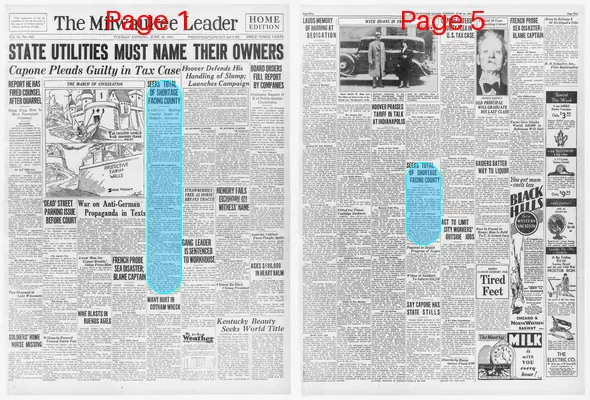
The Milwaukee Leader
Milwaukee, Milwaukee County, Wisconsin
What is this article about?
Milwaukee County's auditor A.A. Nowicki examines large budget deficit amid depression, recommending transfers and over $1M borrowing. Bill 965-A seeks to raise borrowing limit to 50% of tax levy. Socialist supervisor H.G. Tucker blames non-partisan board for carrying prior deficits, especially in relief accounts that ballooned in 1930.
Merged-components note: Continuation of county shortage story from page 1 to page 5 ('Turn to Page Five, Column Four').
Clippings

1 of 2
OCR Quality
Full Text
OF SHORTAGE
FACING COUNTY
Auditor
Making
Careful Study of
Budgets, Accounts.
Just how big the county's deficit really totals has been engaging the attention of A. A. Nowicki, auditor of budgets and accounts for the county, for some time, The Leader learned today.
Reports are being completed which will suggest the transfer of unused balances from some accounts in the budget to others. But the need to borrow more than a million dollars is also stressed by the auditor.
A measure has also been introduced in the legislature, known as 965-A, to permit counties with more than 200,000 population to increase their borrowing powers from 20 per cent of the last tax levy to 50 per cent.
Gumshoed Into Legislature.
The measure is drawn specifically for the benefit of Milwaukee county because it is the only one with more than 200,000 residents. Other counties in the state have authority from the state to borrow 50 per cent of the tax levy, but Milwaukee county, in the past, has been limited to 20 per cent.
Socialist supervisors point out that the shortage of cash has developed and been carried along on the county's book with the aid of the non-partisan majority on the county board.
The bill in the legislature was quietly introduced at Madison without any publicity attending either its introduction or its reading. Non-partisan leaders discuss the bill with great reluctance.
Statement of Tucker.
Supervisor Herman G. Tucker, Socialist, and a close student of the county's finances, points out an additional reason for the present deficit. He says:
"It is not merely the mounting cost of the county's charities due to the depression. Nor are the facts that taxes are harder to collect while building expenditures mount and bond issues fall due, the only other factors.
"The trouble is also due to the non-partisans' action in insisting that deficits from previous years be carried along on the county's books and in the budget.
"Inactive accounts on the county's books have been raided, and money has been switched from these temporarily sleeping accounts to places where it was urgently needed.
"If anyone wants to satisfy himself as to the truth of this statement let him simply scan the poor relief accounts.
What Accounts Show.
"While poor relief is not the biggest item on the county's books, it has grown by leaps and bounds during the era of Hoover prosperity and is therefore conspicuous in the public eye at this time.
"Lump together the budgets in 1929 and 1930 for blind pensions, soldiers' relief, support of dependent children, old age pensions and outdoor relief and compare them with the expenditures for those same items during the same period
"In 1929, a year of prosperity
Turn to Page Five, Column Four.
SEEKS TOTAL
OF SHORTAGE
FACING COUNTY
Continued From Page One
the budget for these accounts was
$610,038; expenditures out of the
budget were $602,812.85. This left
a small surplus.
"But in 1930 the budget was
$738,196 and the expenditures to-
totaled $1,496,302.56. The deficit was
$758,106.56. The 1931 budget al-
lotted only $1,303,316 to cover this
deficit and provide for poor aid
throughout the year.
To "Make Good Showing."
"That entire 1931 budget was not
large enough to even stretch around
the expenditures of the outdoor re-
lief department for the first five
months of the year, to say nothing
of soldiers' pensions, old age assist-
ance and the other branches of
county relief activities.
"Here you have a very apparent
effort by the non-partisan majority
on the county board to keep taxes
down in order to make a good show-
ing to the people of the county.
"This simply amounts to a finan-
cial passing of the buck."
What sub-type of article is it?
What keywords are associated?
What entities or persons were involved?
Where did it happen?
Domestic News Details
Primary Location
Milwaukee County
Key Persons
Outcome
county deficit over a million dollars; need to borrow more than a million dollars; legislative measure 965-a to increase borrowing powers from 20% to 50% of tax levy; deficits carried from previous years including $758,106.56 in 1930 for poor relief accounts.
Event Details
A. A. Nowicki, auditor of budgets and accounts for Milwaukee county, is studying the county's deficit. Reports suggest transferring unused balances and stress borrowing needs. Measure 965-A introduced in legislature to allow counties over 200,000 population to borrow up to 50% of tax levy, specifically for Milwaukee. Socialist supervisors blame non-partisan majority for carrying deficits and raiding inactive accounts. Herman G. Tucker highlights mounting charity costs due to depression, hard tax collection, building expenditures, bond issues, and non-partisans' insistence on carrying deficits, especially in poor relief accounts which grew from $610,038 budget in 1929 to $1,496,302.56 expenditures in 1930, leaving deficits.