Thank you for visiting SNEWPapers!
Sign up free
The Daily Intelligencer
Seattle, King County, Washington
What is this article about?
Editorial critiques the logging industry's unprofitability in the region despite cheap resources and labor advantages, blaming high worker wages that bankrupt owners. Advocates systemic reform, emulating 'down East' model where farmers log seasonally to build local wealth and end complaints about non-viable business.
Clipping
OCR Quality
Full Text
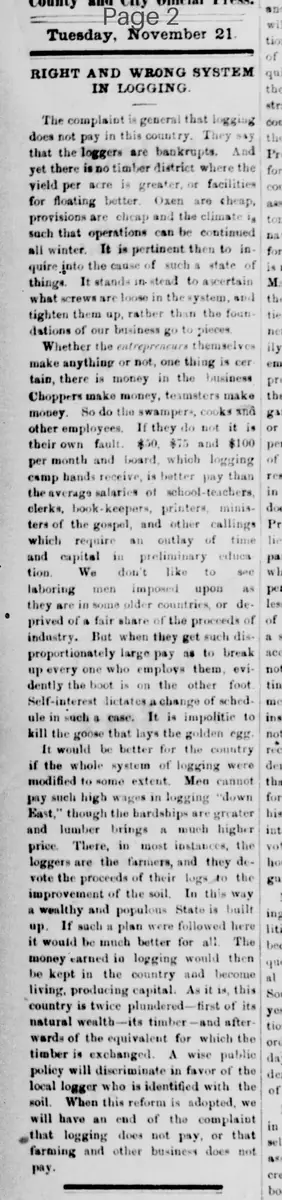
RIGHT AND WRONG SYSTEM
IN LOGGING.
The complaint is general that logging does not pay in this country. They say that the loggers are bankrupts. And yet there is no timber district where the yield per acre is greater, or facilities for floating better. Oxen are cheap. Provisions are cheap and the climate is such that operations can be continued all winter. It is pertinent then to inquire into the cause of such a state of things. It stands in stead to ascertain what screws are loose in the system, and tighten them up, rather than the foundations of our business go to pieces. Whether the entrepreneurs themselves make anything or not, one thing is certain, there is money in the business. Choppers make money, teamsters make money. So do the swampers, cooks and other employees. If they do not it is their own fault. $50, $75 and $100 per month and board, which logging camp hands receive, is better pay than the average salaries of school-teachers, clerks, book-keepers, printers, ministers of the gospel, and other callings which require an outlay of time and capital in preliminary education.
We don't like to see laboring men imposed upon as they are in some older countries, or deprived of a fair share of the proceeds of industry. But when they get such disproportionately large pay as to break up every one who employs them, evidently the boot is on the other foot. Self-interest dictates a change of schedule in such a case. It is impolitic to kill the goose that lays the golden egg.
It would be better for the country if the whole system of logging were modified to some extent. Men cannot pay such high wages in logging 'down East,' though the hardships are greater and lumber brings a much higher price. There, in most instances, the loggers are the farmers, and they devote the proceeds of their logs to the improvement of the soil. In this way a wealthy and populous State is built up. If such a plan were followed here it would be much better for all. The money earned in logging would then be kept in the country and become living, producing capital. As it is, this country is twice plundered—first of its natural wealth—its timber—and afterwards of the equivalent for which the timber is exchanged. A wise public policy will discriminate in favor of the local logger who is identified with the soil. When this reform is adopted, we will have an end of the complaint that logging does not pay, or that farming and other business does not pay.
What sub-type of article is it?
What keywords are associated?
Where did it happen?
Story Details
Location
This Country (Timber District); Down East
Event Date
Tuesday, November 21
Story Details
General complaint that logging is unprofitable despite superior yields, cheap resources, and year-round operations; workers earn high wages ($50-$100/month plus board) while owners bankrupt; suggests modifying system like in 'down East' where farmers log seasonally to invest proceeds locally, retaining wealth and ending economic complaints.