Thank you for visiting SNEWPapers!
Sign up free
Story
August 13, 1930
Windham County Observer
Putnam, Windham County, Connecticut
What is this article about?
Article on extending the pasture season from May to November using supplemental crops like sweet clover, alfalfa, and barley, based on studies at Storrs, Connecticut. Discusses limitations of nitrogen on permanent pastures and recommends lime and superphosphate for improvements.
Clipping
OCR Quality
98%
Excellent
Full Text
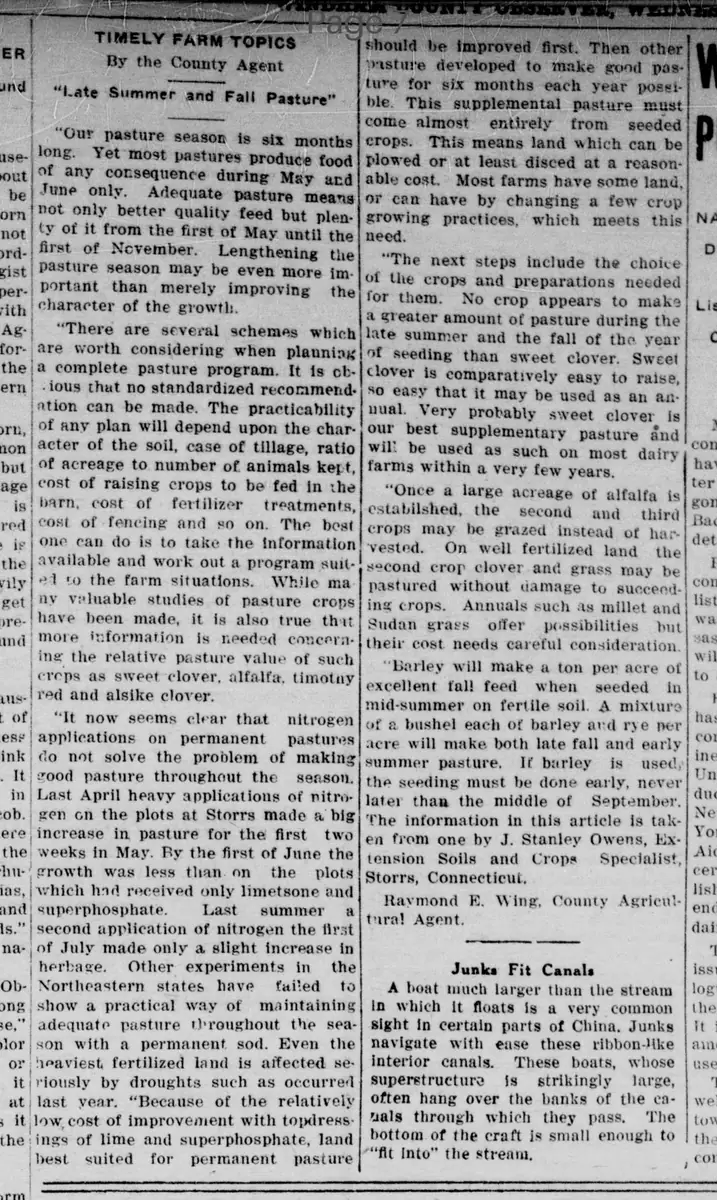
Timely Farm Topics
By the County Agent
Late Summer and Fall Pasture
Our pasture season is six months long. Yet most pastures produce food of any consequence during May and June only. Adequate pasture means not only better quality feed but plenty of it from the first of May until the first of November. Lengthening the pasture season may be even more important than merely improving the character of the growth.
There are several schemes which are worth considering when planning a complete pasture program. It is obvious that no standardized recommendation can be made. The practicability of any plan will depend upon the character of the soil, ease of tillage, ratio of acreage to number of animals kept, cost of raising crops to be fed in the barn, cost of fertilizer treatments, cost of fencing and so on. The best one can do is to take the information available and work out a program suited to the farm situations. While many valuable studies of pasture crops have been made, it is also true that more information is needed concerning the relative pasture value of such crops as sweet clover, alfalfa, timothy, red and alsike clover.
It now seems clear that nitrogen applications on permanent pastures do not solve the problem of making good pasture throughout the season. Last April heavy applications of nitrogen on the plots at Storrs made a big increase in pasture for the first two weeks in May. By the first of June the growth was less than on the plots which had received only limestone and superphosphate. Last summer a second application of nitrogen the first of July made only a slight increase in herbage. Other experiments in the Northeastern states have failed to show a practical way of maintaining adequate pasture throughout the season with a permanent sod. Even the heaviest fertilized land is affected seriously by droughts such as occurred last year.
Because of the relatively low cost of improvement with topdressings of lime and superphosphate, land best suited for permanent pasture should be improved first. Then other pasture developed to make good pasture for six months each year possible. This supplemental pasture must come almost entirely from seeded crops. This means land which can be plowed or at least disced at a reasonable cost. Most farms have some land, or can have by changing a few crop growing practices, which meets this need.
The next steps include the choice of the crops and preparations needed for them. No crop appears to make a greater amount of pasture during the late summer and the fall of the year of seeding than sweet clover. Sweet clover is comparatively easy to raise, so easy that it may be used as an annual. Very probably sweet clover is our best supplementary pasture and will be used as such on most dairy farms within a very few years.
Once a large acreage of alfalfa is established, the second and third crops may be grazed instead of harvested. On well fertilized land the second crop clover and grass may be pastured without damage to succeeding crops. Annuals such as millet and Sudan grass offer possibilities but their cost needs careful consideration.
Barley will make a ton per acre of excellent fall feed when seeded in mid-summer on fertile soil. A mixture of a bushel each of barley and rye per acre will make both late fall and early summer pasture. If barley is used, the seeding must be done early, never later than the middle of September.
The information in this article is taken from one by J. Stanley Owens, Extension Soils and Crops Specialist, Storrs, Connecticut.
Raymond E. Wing, County Agricultural Agent.
By the County Agent
Late Summer and Fall Pasture
Our pasture season is six months long. Yet most pastures produce food of any consequence during May and June only. Adequate pasture means not only better quality feed but plenty of it from the first of May until the first of November. Lengthening the pasture season may be even more important than merely improving the character of the growth.
There are several schemes which are worth considering when planning a complete pasture program. It is obvious that no standardized recommendation can be made. The practicability of any plan will depend upon the character of the soil, ease of tillage, ratio of acreage to number of animals kept, cost of raising crops to be fed in the barn, cost of fertilizer treatments, cost of fencing and so on. The best one can do is to take the information available and work out a program suited to the farm situations. While many valuable studies of pasture crops have been made, it is also true that more information is needed concerning the relative pasture value of such crops as sweet clover, alfalfa, timothy, red and alsike clover.
It now seems clear that nitrogen applications on permanent pastures do not solve the problem of making good pasture throughout the season. Last April heavy applications of nitrogen on the plots at Storrs made a big increase in pasture for the first two weeks in May. By the first of June the growth was less than on the plots which had received only limestone and superphosphate. Last summer a second application of nitrogen the first of July made only a slight increase in herbage. Other experiments in the Northeastern states have failed to show a practical way of maintaining adequate pasture throughout the season with a permanent sod. Even the heaviest fertilized land is affected seriously by droughts such as occurred last year.
Because of the relatively low cost of improvement with topdressings of lime and superphosphate, land best suited for permanent pasture should be improved first. Then other pasture developed to make good pasture for six months each year possible. This supplemental pasture must come almost entirely from seeded crops. This means land which can be plowed or at least disced at a reasonable cost. Most farms have some land, or can have by changing a few crop growing practices, which meets this need.
The next steps include the choice of the crops and preparations needed for them. No crop appears to make a greater amount of pasture during the late summer and the fall of the year of seeding than sweet clover. Sweet clover is comparatively easy to raise, so easy that it may be used as an annual. Very probably sweet clover is our best supplementary pasture and will be used as such on most dairy farms within a very few years.
Once a large acreage of alfalfa is established, the second and third crops may be grazed instead of harvested. On well fertilized land the second crop clover and grass may be pastured without damage to succeeding crops. Annuals such as millet and Sudan grass offer possibilities but their cost needs careful consideration.
Barley will make a ton per acre of excellent fall feed when seeded in mid-summer on fertile soil. A mixture of a bushel each of barley and rye per acre will make both late fall and early summer pasture. If barley is used, the seeding must be done early, never later than the middle of September.
The information in this article is taken from one by J. Stanley Owens, Extension Soils and Crops Specialist, Storrs, Connecticut.
Raymond E. Wing, County Agricultural Agent.
What sub-type of article is it?
Agricultural Advice
Farming Guide
What keywords are associated?
Pasture Season
Sweet Clover
Alfalfa
Nitrogen Application
Supplemental Crops
Barley Seeding
Lime Superphosphate
What entities or persons were involved?
J. Stanley Owens
Raymond E. Wing
Where did it happen?
Storrs, Connecticut
Story Details
Key Persons
J. Stanley Owens
Raymond E. Wing
Location
Storrs, Connecticut
Story Details
Pasture season is six months but productive mainly in May-June; extend with supplemental seeded crops like sweet clover for late summer/fall, alfalfa for second/third crops, barley/rye mixtures; nitrogen ineffective long-term; improve permanent pastures with lime/superphosphate first.