Thank you for visiting SNEWPapers!
Sign up free
Richmond Enquirer
Richmond, Richmond County, Virginia
What is this article about?
A constituent addresses the Virginia General Assembly with doubts about the proposed public education system, arguing it undermines parental rights, deprives the poor of children's labor, fosters idleness, confuses learning with knowledge, and risks increasing slave involvement in mechanics while diminishing societal productivity.
Clipping
OCR Quality
Full Text
No. 7.
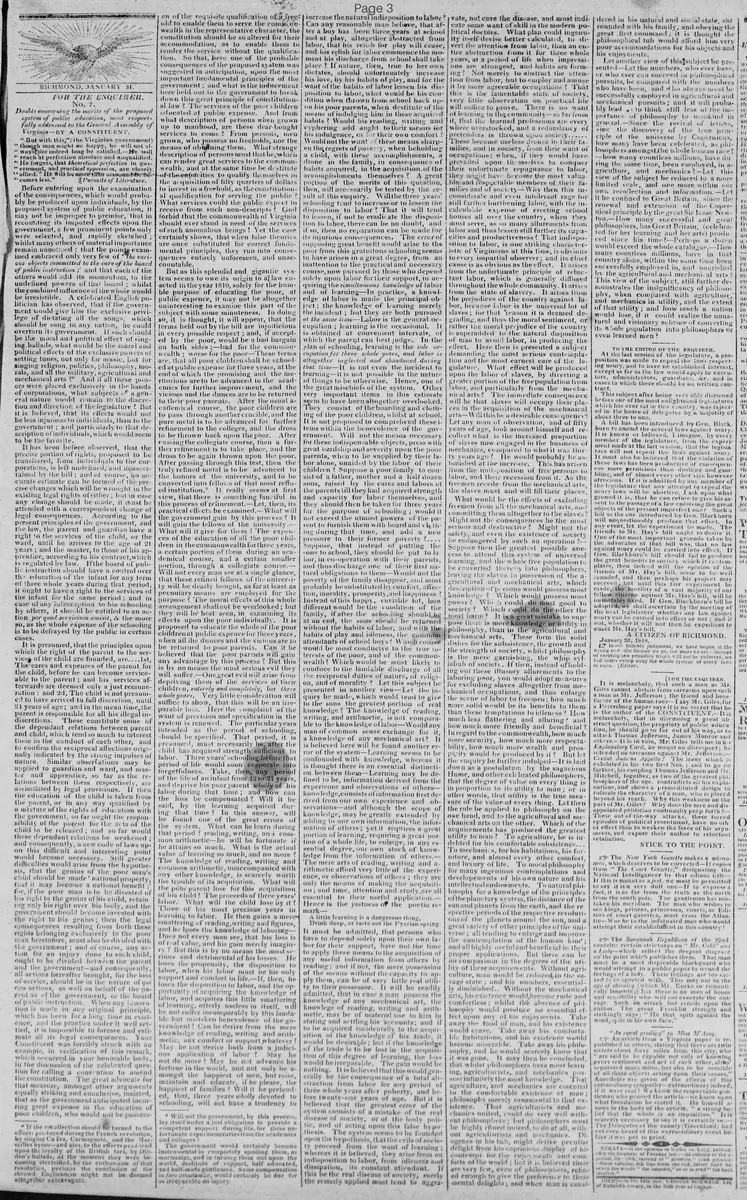
Doubts concerning the merits of the proposed system of public education, most respectfully addressed to the General Assembly of Virginia—BY A CONSTITUENT.
"But with this," (the Virginian government) "though man might be happy, he will not always, nor indeed long be satisfied.—He will reach at perfection absolute and unqualified."
"He forgets, that theoretical perfection in government, and practical oppression, are closely allied. He will be more than man, and he becomes less."
Pursuits of Literature.
Before entering upon the examination of the consequences, which would probably be produced upon individuals, by the proposed system of public education, it may not be improper to premise, that in recounting its imputed effects upon the government, a few prominent points only were selected, and rapidly sketched; whilst many others of material importance remain unnoticed: that the points examined embraced only very few of the various objects committed to the care of the board of public instruction; and that each of the others would add its momentum, to the undefined powers of that board: whilst the combined influence of the whole would be irresistible. A celebrated English politician has observed, that if the government would give him the exclusive privilege of dictating all the songs, which should be sung in any nation, he could overturn its government. If such should be the moral and political effect of singing ballads, what would be the moral and political effects of the exclusive powers of setting tunes, not only for music, but for singing religion, politics, philosophy, morals, and all the military, agricultural and mechanical arts? And if all these powers were placed exclusively in the hands of corporations, what subjects of a general nature would remain to the discretion and direction of the legislature? But it is believed, that its effects would not be less injurious to individuals, than to the government; and particularly to that description of individuals, which would seem to be the favorite.
It has been before observed, that the precise portion of rights, proposed to be transferred, from individuals to the corporations, is left undefined, and unascertained by the bill: and of course, no accurate estimate can be formed of the precise changes which will be wrought in the existing legal rights of either; but in case any change should be made, it must be attended with a correspondent change of legal consequences. According to the present principles of the government, and the law, the parent and guardian have a right to the services of the child, or the ward, until he arrives to the age of 21 years; and the master, to those of his apprentice, according to his contract, which is regulated by law. If the board of public instruction should have a control over the education of the infant for any term of three whole years during that period, it ought to have a right to the services of the infant for the same period; and in case of any interruption to his schooling by others, it should be entitled to an action, per quod servicium amisit, & the more so, as the whole expense of the schooling is to be defrayed by the public in certain cases.
It is presumed, that the principles upon which the right of the parent to the services of the child are founded, are....1st, The cares and expenses of the parent for the child, before he can become serviceable to the parent; and his services afterwards are deemed only a just remuneration: and 2d, The child is not presumed to have arrived to full discretion, until 21 years of age; and in the mean time, the parent is responsible for all his illegal indiscretions. These constitute some of the dependant relations between parent and child, which tend so much to interest them in the conduct of each other, and to confirm the reciprocal affections originally indicated by the strong impulses of nature. Similar observations may be applied to guardian and ward, and master and apprentice, so far as the relations between them respectively, are assimilated by legal provisions. If then the education of the child is taken from the parent, or in any way qualified by a mixture of the rights of education with the government, so far ought the responsibility of the parent for the acts of the child to be released: and so far would these dependant relations be weakened; and consequently, a new code of laws upon this difficult and interesting point would become necessary. Still greater difficulties would arise from the hypothesis, that the genius of the poor man's child should be made national property, that it may become a national benefit; for, if the poor man is to be divested of his right to the genius of his child, retaining only his right over his body, and the government should become invested with the right to his genius; then the legal consequences resulting from both these rights belonging exclusively to the poor man heretofore, must also be divided with the government; and of course, any action for an injury done to such child, ought to be divided between the parent and the government—and consequently, all actions hereafter brought, for the loss of service, should be in the nature of qui tam actions, as well on behalf of the parent as of the government, or the board of public instruction. When any innovation is made in any original principle, which has been for a long time in existence, and the practice under it well settled, it is impossible to foresee and estimate all its legal consequences. Your Constituent was forcibly struck with an example, in verification of this remark, which occurred in your honorable body, in the discussion of the celebrated question for calling a convention to amend the constitution. The great advocate for that measure, amongst other arguments equally striking and conclusive, insisted, that as the government anticipated incurring great expense in the education of poor children, who would not be possess-
6.
If the recollection should be turned to the effects produced during the French revolution, by singing Ca Ira, Carmagnole, and the Marseilles hymn—and also, to the effects produced upon the loyalty of the British tars, by Dibden's ballads, at the moment they were becoming electrified, by the enthusiasm of that revolution, perhaps the conclusion of the shrewd Englishman might not be deemed altogether extravagant.
end of the requisite qualification of a freeholder to enable them to serve the common wealth in the representative character, the constitution should be so altered for their accommodation, as to enable them to render the service without the qualification. So that, here one of the probable consequences of the proposed system was suggested in anticipation, upon the most important fundamental principles of the government; and what is the inducement here held out to the government to break down this great principle of constitutional law? The services of the poor children educated at public expense. And from what description of persons when grown up to manhood, are these dear-bought services to come? From persons, men grown, who possess no freeholds, nor the means of obtaining them. What strange description of persons must that be, which can render great services to the commonwealth, and at the same time be destitute of the capacities to qualify themselves in the acquisition of fifty quarters of dollars to invest in a freehold, as the constitutional qualification for serving the public? What services could the public expect to receive from such non-descripts? God forbid that the commonwealth of Virginia should ever stand in need of the services of such anomalous beings! Yet the case certainly shows, that when false theories are once substituted for correct fundamental principles, they run into consequences entirely unforeseen, and unaccountable.
But as this splendid and gigantic system seems to owe its origin to a law enacted in the year 1810, solely for the humble purpose of educating the poor, at public expense, it may not be altogether uninteresting to examine this part of the subject with some minuteness. In doing so, it is thought, it will appear, that the terms held out by the bill are injudicious in every possible respect; and, if accepted by the poor, would be a bad bargain on both sides:—bad for the commonwealth: worse for the poor—These terms are, that all poor children shall be schooled at public expense for three years, at the end of which the promising and the meritorious are to be advanced to the academies for further improvement, and the vicious and the dunces are to be returned to their poor parents. After the usual academical course, the poor children are to pass through another crucible, and the pure metal is to be advanced for further refinement to the colleges, and the dross to be thrown back upon the poor. After passing the collegiate course, then a further refinement is to take place, and the dross to be again thrown upon the poor. After passing through this test, then the truly refined metal is to be advanced to the honors of the university, and to be converted into fellows of that most refined institution.* It really seems at first view, that there is something fanciful in this process of refinement.—Let, then, its practical effects be examined.—What will the government gain by this process? It will gain the fellows of the university.—What will it give for them? The expenses of the education of all the poor children in the commonwealth for three years, a certain portion of them during an academical course, and a certain smaller portion, through a collegiate course.—Will not every man see at a single glance, that these refined fellows of the university will be dearly bought, as far at least as pecuniary means are employed for the purpose? The moral effects of this whole arrangement shall not be overlooked: but they will be best seen, in examining its effects upon the poor individually. It is proposed to educate the whole of the poor children at public expense for three years, when all the dunces and the vicious are to be returned to poor parents. Can it be believed that the poor parents will gain any advantage by this process? But this is by no means the most serious evil they will suffer.—One great evil will arise from depriving them of the services of their children, entirely and completely, for three whole years. Very little consideration will suffice to show, that this will be an irreparable loss. Here the complaint of the want of precision and specification in the system is renewed. The particular years intended as the period of schooling, should be specified. That period, it is presumed, must necessarily be, after the child has acquired strength sufficient to labor. Three years' schooling before that period of life would soon evaporate into forgetfulness. Take, then, any period of the life of an infant from 12 to 21 years, and deprive his poor parent wholly of his labor during that time; and how can the loss be compensated? Will it be said, by the learning acquired during that time? In this answer, will be found one of the great errors of the system. What can he learn during that period? reading, writing, and common arithmetic—he will be fortunate if he attains so much. What is the actual value of learning so much, and no more? The knowledge of reading, writing and common arithmetic, unaccompanied with any other knowledge, is scarcely worth the trouble of its acquisition. What will the poor parent lose for this acquisition of his child? The proceeds of three years' labor. What will the child lose by it? Three of his most precious years in learning to labor. He then gains a mere smattering of reading, writing and figures, and he loses the knowledge of laboring—Does not every man see, that his loss is of real value, and his gain merely imaginary? But this is by no means the most serious and detrimental of his losses. He loses the propensity, the disposition to labor, when his labor must be his only support and comfort in life. If, then, he loses the disposition to labor, and the opportunity of acquiring the knowledge of labor, and acquires this little smattering of learning, utterly useless in itself, will he not suffer incomparably by this laudable but mistaken benevolence of the government? Can he derive from the mere knowledge of reading, writing and arithmetic, any comfort or support whatever? May he not derive both from a judicious application of labor? May he not do more? May he not advance his fortune in the world, and not only be amongst the happiest of men, but raise, maintain and educate, if he please, the happiest of families? Will it be pretended, that, three years wholly devoted to schooling, will not have a tendency to increase the natural indisposition to labor? Can any reasonable man believe, that after a boy has been three years at school and at play, altogether abstracted from labor, that his relish for play will cease, and his relish for labor commence the moment his discharge from school shall take place? If nature, then, true to her own dictates, should unfortunately increase his love, by his habits of play, and for the want of the habits of labor lessen his disposition to labor, what would be his condition when thrown from school back upon his poor parents, when destitute of the means of indulging him in these acquired habits? Would his reading, writing and cyphering add aught to their means for his indulgence, or for their own comfort? Would not the want of these means sharpen the regrets of poverty, when beholding a child, with these accomplishments, a drone in the family, in consequence of habits acquired, in the acquisition of the accomplishments themselves? A great portion of the merits of this question, then, will necessarily be tested by the result of this enquiry. Will the three years schooling tend to increase or to lessen the disposition to labor? That it will tend to lessen, if not to eradicate the disposition to labor, there can be no doubt. "and if so, then no reparation can be made for its injurious consequences. The error of supposing great benefit would arise to the poor from this gratuitous schooling seems to have arisen in a great degree, from an inattention to the practical and necessary course, now pursued by those who depend solely upon labor for their support, in acquiring the simultaneous knowledge of labor and of learning—In practice, a knowledge of labor is made the principal object: the knowledge of learning merely the incident; but they are both pursued at the same time—Labor is the general occupation: learning is the occasional. It is obtained at convenient intervals, of which the parent can best judge. In the plan of schooling, learning is the sole occupation for three whole years, and labor is altogether neglected and abandoned during that time—It is not even the incident to learning—it is not possible in the nature of things to be otherwise. Hence, one of the great mischiefs of the system. Other very important items in this estimate seem to have been altogether overlooked. They consist of the boarding and clothing of the poor children, whilst at school. It is not proposed to comprehend these items within the benevolence of the government.. Will not the means necessary for these indispensable objects, press with great hardship and severity upon the poor parents, when to be supplied by their labor alone, unaided by the labor of their children? Suppose a poor family to consist of a father, mother and a half dozen sons, raised by the cares and labors of the parents till they had acquired strength and capacity for labor themselves, and they should then be taken for three years for the purpose of schooling: would it not exceed the utmost powers of the parents to furnish them with board and clothing during that time, and add a new pressure to their former poverty?.... Suppose, that instead of putting the sons to school, they should be put to labor, in co-operation with their parents, and thus discharge one of their first natural obligations to them—Would not the poverty of the family disappear, and most probably be substituted by comfort, affection, morality, prosperity, and happiness? Instead of this happy, enviable lot, how different would be the condition of the family, if after the schooling should be at an end, the sons should be returned without the habits of labor, and with the habits of play and idleness, the common attendants of school boys? Which course would be most conducive to the true interests of the poor, and of the commonwealth? Which would be most likely to conduce to the laudable discharge of all the reciprocal duties of nature, of religion, and of morality? Let this subject be presented in another view—Let the enquiry be made, which would tend to give to the sons the greatest portion of real knowledge? The knowledge of reading, writing, and arithmetic, is not comparable to the knowledge of labor—Would any man of common sense exchange for it, a knowledge of any mechanical art? It is believed here will be found another error of the system—Learning seems to be confounded with knowledge, whereas it is thought there is an essential distinction between them—Learning may be defined to be, information derived from the experience and observations of others—knowledge, consists of information first derived from our own experience and observations—and although the scope of knowledge, may be greatly extended by adding to our own information, the information of others; yet it requires a great portion of learning, requiring a great portion of a whole life, to enlarge, in any essential degree, our own stock of knowledge from the information of others.—The mere arts of reading, writing and arithmetic afford very little of the experience, or observations of others; they are only the means of making the acquisition; and time, attention and study, are all essential to their useful application.—Hence is the justice of the poetic remark
A little learning is a dangerous thing,
Drink deep, or taste not the Pierian spring
It must be admitted, that persons who have to depend solely upon their own labor for their support, have not the time to apply these means to the acquisition of any useful information from others by reading: and if not, the mere possession of the means without the capacity to apply them, can be of very little real utility to their possessor. It will be readily admitted, that in case a man possess the knowledge of any mechanical art, the knowledge of reading, writing and arithmetic, may be of material use to him in stating and settling his accounts; and if to be acquired incidentally to the acquisition of the knowledge of his trade, it would be desirable: but if the knowledge of the trade is to be lost in the acquisition of this degree of learning, the loss would be irreparable. The gain would be nothing. It is believed that this would generally be the consequence of a total abstraction from labor for any period of three whole years after puberty, and before twenty-one years of age. But it is believed that the greatest error of the system consists of a mistake of the real disease of society, or of the body politic, and of acting upon this false hypothesis. The system seems to be founded upon the hypothesis, that the evils of society proceed from the want of learning: whereas it is believed, they arise from an indisposition to labor, from idleness and dissipation, its constant attendant. If this be the real disease of society, surely the remedy applied must tend to aggra-
vate, not cure the disease, and must indicate some want of skill in the modern political doctors. What plan could ingenuity itself devise better calculated, to divert the attention from labor, than an entire abstraction from it for three whole years, at a period of life when impressions are strongest, and habits are forming? Not merely to abstract the attention from labor, but to employ and amuse it by more agreeable occupations? That this is the lamentable state of society, very little observation on practical life will suffice to prove. There is no want of learning in the community—so far from it, that the learned professions are every where overstocked, and a redundancy of pretenders is thrown upon society...... These become useless drones in their families, and in society, from their want of occupations: when, if they would have prevailed upon themselves to conquer their unfortunate repugnance to labor, they might have become the most valuable and respectable members of their families and of society—Why then this inconsiderate and even intolerant rage for still further burthening labor, with the incalculable expense of erecting school houses all over the country, when they must serve, as so many allurements from labor and thus lessen still further its capacities and productiveness? That indisposition to labor, is one striking characteristic of Virginians at this time, is obvious to every impartial observer; and its chief cause is as obvious as the effect. It arises from the unfortunate principle of reluctant labor, which is generally diffused throughout the whole community. It arises from the state of slavery. It arises from the prejudices of the country against labor, because labor is the universal lot of slaves; for that reason it is deemed degrading, and thus the moral sentiment, or rather the moral prejudice of the country is superadded to the natural disposition of man to avoid labor, in producing the effect. Here then is presented a subject demanding the most serious contemplation and the most earnest care of the legislature. What effect will be produced upon the labor of slaves, by diverting a greater portion of the free population from labor, and particularly from the mechanical arts? The immediate consequence will be that slaves will occupy their places in the acquisition of the mechanical arts—Will this be a desirable consequence? Let any man of observation, and of fifty years of age, look around himself and recollect what is the increased proportion of slaves now engaged in the business of mechanics, compared to what it was thirty years ago? He would probably be astonished at the increase. This has arisen from the indisposition of free persons to labor, and their recession from it. As the freemen recede from the mechanical arts, the slaves must and will fill their places. What would be the effects of excluding freemen from all the mechanical arts, and committing them altogether to the slaves? Might not the consequences be the most serious and destructive? Might not the safety, and even the existence of society be endangered by such an operation?—Suppose then the greatest possible success to attend this system of universal learning, and the whole free population to be converted thereby into philosophers, leaving the slaves in possession of the agricultural and mechanical arts, which description of persons would possess most knowledge? Which would possess most power? Which could do most good to society? Which could do the other the most harm? It is a great mistake to suppose there is more knowledge or utility in philosophy, than in the agricultural and mechanical arts. These form the solid dishes for the subsistence, the growth and the strength of society, whilst philosophy is the mere garnishing, the whip syllabub of society. If then, instead of holding out these illusory allurements to the laboring poor, you would adopt measures for excluding slaves altogether from mechanical occupations, and thus enlarge the scene of labor to freemen; how much more solid would be its benefits to them than these temptations to idleness? How much less flattering and alluring? and how much more friendly and beneficial? In regard to the commonwealth, how much more security, how much more respectability, how much more wealth and prosperity would be produced by it? But let the enquiry be further indulged—It is laid down as a postulatum by the sagacious Hume, and other celebrated philosophers, that the degree of value on every thing is in proportion to its utility to man; or in other words, that utility is the true measure of the value of every thing. Let then the rule be applied to philosophy on the one hand, and to the agricultural and mechanical arts on the other. Which of the acquirements has produced the greatest utility to man? To agriculture, he is indebted for his comfortable subsistence... To mechanics, for his habitations, his furniture, and almost every other comfort and luxury of life. To moral philosophy for many ingenious contemplations and developments of his own nature and his intellectual endowments. To natural philosophy for a knowledge of the principles of the planetary system, the distance of the sun and planets from the earth, and the respective periods of the respective revolutions of the planets around the sun, and a great variety of other principles of the universe; all tending to enlarge and improve the contemplation of the human kind: and all highly useful and beneficial in their proper applications. But there can be no comparison in the degrees of the utility of these acquirements. Without agriculture, man would be reduced to the savage state: and his numbers essentially diminished.. Without the mechanical arts, his existence would become rude and comfortless: whilst the absence of philosophy would produce no essential effect upon any of his enjoyments. Take away the food of man, and his existence would cease. Take away his comfortable habitations, and his existence would become miserable. Take away his philosophy, and he would scarcely know that it was gone. It may then be concluded, that whilst philosophers have most learning, agriculturists and mechanics possess infinitely the most knowledge. That agriculture, and mechanics are essential to the comfortable existence of man; philosophy merely ornamental to that existence. That agriculturists and mechanics united, could do very well without philosophers: but philosophers must be highly refined indeed, to do at all, without agriculturists and mechanics. Diogenes in his tub, might derive peculiar delight from his capricious display of his contempt for the enjoyments and comforts of the world: but it is believed there are very few, even of philosophers, refined enough to give the preference to these mental delights; and when man is considered in his natural and social state, surrounded with his family, and obeying the great first command: it is thought the philosophical tub would afford him very poor accommodations for his objects and his enjoyments.
Let another view of this subject be presented—Let the numbers, who ever have, or who ever can succeed in philosophical pursuits, be compared with the numbers who have been, and who always must be successfully employed in agricultural and mechanical pursuits: and it will probably lead us to think still less of the importance of philosophy to mankind in general.—Since the revival of letters, since the discovery of the true principle of the universe by Copernicus, how many have been celebrated, as philosophers amongst the whole human race? —how many countless millions, have during the same time, been employed, in agriculture, and mechanics?—Let this view of the subject be reduced to a more limited scale, and one more within our own recollection and information.—Let it be confined to Great Britain, since the renewal and extension of the Copernical principle by the great Sir Isaac Newton.—How many successful and great philosophers, has Great Britain, (celebrated for her learning and her arts) produced since his time? Perhaps a dozen would exceed the whole catalogue.—How many countless millions, have in that country alone, within the same time been successfully employed in, and nourished by the agricultural and mechanical arts? This view of the subject, still further demonstrates the insignificancy of philosophy, when compared with agriculture, and mechanics in utility, and the extent of that utility; and how much a nation would lose, if it could realize the unnatural and visionary scheme of converting its whole population into philosophers or even learned men?
What sub-type of article is it?
What themes does it cover?
What keywords are associated?
What entities or persons were involved?
Letter to Editor Details
Author
A Constituent
Recipient
The General Assembly Of Virginia
Main Argument
the proposed public education system in virginia will erode parental rights, impose irreparable losses on the poor by depriving them of children's labor for three years, promote idleness over essential labor skills, misidentify societal ills as lack of learning rather than aversion to work, and exacerbate slavery's negative effects by diverting free persons from mechanical arts.
Notable Details