Thank you for visiting SNEWPapers!
Sign up free
Story
July 4, 1904
The Topeka State Journal
Topeka, Shawnee County, Kansas
What is this article about?
Kansas City debates theater safety ordinance post-Iroquois fire, mandating low first-floor auditoriums and fire precautions; affects second-floor venues like Gillis; Topeka unconcerned despite similar setup. (187 chars)
Clipping
OCR Quality
98%
Excellent
Full Text
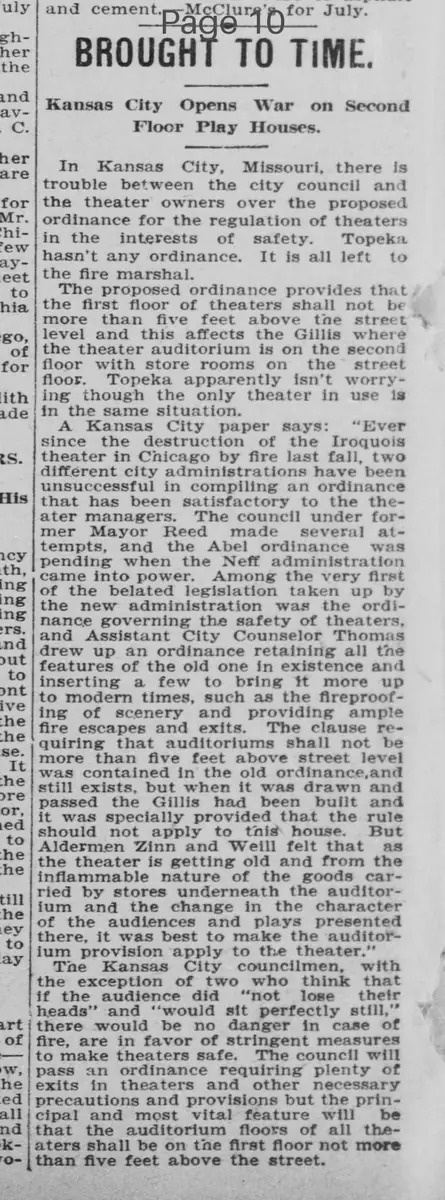
BROUGHT TO TIME.
Kansas City Opens War on Second Floor Play Houses.
In Kansas City, Missouri, there is trouble between the city council and the theater owners over the proposed ordinance for the regulation of theaters in the interests of safety. Topeka hasn't any ordinance. It is all left to the fire marshal.
The proposed ordinance provides that the first floor of theaters shall not be more than five feet above the street level and this affects the Gillis where the theater auditorium is on the second floor with store rooms on the street floor. Topeka apparently isn't worrying though the only theater in use is in the same situation.
A Kansas City paper says:
"Ever since the destruction of the Iroquois theater in Chicago by fire last fall, two different city administrations have been unsuccessful in compiling an ordinance that has been satisfactory to the theater managers. The council under former Mayor Reed made several attempts, and the Abel ordinance was pending when the Neff administration came into power. Among the very first of the belated legislation taken up by the new administration was the ordinance governing the safety of theaters, and Assistant City Counselor Thomas drew up an ordinance retaining all the features of the old one in existence and inserting a few to bring it more up to modern times, such as the fireproofing of scenery and providing ample fire escapes and exits. The clause requiring that auditoriums shall not be more than five feet above street level was contained in the old ordinance, and still exists, but when it was drawn and passed the Gillis had been built and it was specially provided that the rule should not apply to this house. But Aldermen Zinn and Weill felt that as the theater is getting old and from the inflammable nature of the goods carried by stores underneath the auditorium and the change in the character of the audiences and plays presented there, it was best to make the auditorium provision apply to the theater."
The Kansas City councilmen, with the exception of two who think that if the audience did "not lose their heads" and "would sit perfectly still," there would be no danger in case of fire, are in favor of stringent measures to make theaters safe. The council will pass an ordinance requiring plenty of exits in theaters and other necessary precautions and provisions but the principal and most vital feature will be that the auditorium floors of all theaters shall be on the first floor not more than five feet above the street.
Kansas City Opens War on Second Floor Play Houses.
In Kansas City, Missouri, there is trouble between the city council and the theater owners over the proposed ordinance for the regulation of theaters in the interests of safety. Topeka hasn't any ordinance. It is all left to the fire marshal.
The proposed ordinance provides that the first floor of theaters shall not be more than five feet above the street level and this affects the Gillis where the theater auditorium is on the second floor with store rooms on the street floor. Topeka apparently isn't worrying though the only theater in use is in the same situation.
A Kansas City paper says:
"Ever since the destruction of the Iroquois theater in Chicago by fire last fall, two different city administrations have been unsuccessful in compiling an ordinance that has been satisfactory to the theater managers. The council under former Mayor Reed made several attempts, and the Abel ordinance was pending when the Neff administration came into power. Among the very first of the belated legislation taken up by the new administration was the ordinance governing the safety of theaters, and Assistant City Counselor Thomas drew up an ordinance retaining all the features of the old one in existence and inserting a few to bring it more up to modern times, such as the fireproofing of scenery and providing ample fire escapes and exits. The clause requiring that auditoriums shall not be more than five feet above street level was contained in the old ordinance, and still exists, but when it was drawn and passed the Gillis had been built and it was specially provided that the rule should not apply to this house. But Aldermen Zinn and Weill felt that as the theater is getting old and from the inflammable nature of the goods carried by stores underneath the auditorium and the change in the character of the audiences and plays presented there, it was best to make the auditorium provision apply to the theater."
The Kansas City councilmen, with the exception of two who think that if the audience did "not lose their heads" and "would sit perfectly still," there would be no danger in case of fire, are in favor of stringent measures to make theaters safe. The council will pass an ordinance requiring plenty of exits in theaters and other necessary precautions and provisions but the principal and most vital feature will be that the auditorium floors of all theaters shall be on the first floor not more than five feet above the street.
What sub-type of article is it?
Historical Event
What themes does it cover?
Justice
Catastrophe
What keywords are associated?
Theater Safety
Ordinance
Kansas City
Iroquois Fire
Fire Escapes
What entities or persons were involved?
Mayor Reed
Aldermen Zinn
Aldermen Weill
Assistant City Counselor Thomas
Where did it happen?
Kansas City, Missouri
Story Details
Key Persons
Mayor Reed
Aldermen Zinn
Aldermen Weill
Assistant City Counselor Thomas
Location
Kansas City, Missouri
Event Date
Last Fall
Story Details
Kansas City city council proposes theater safety ordinance after Iroquois theater fire, requiring auditoriums not more than five feet above street level, affecting second-floor theaters like the Gillis; Topeka has no such rules; council favors stringent measures including fireproofing and exits.