Thank you for visiting SNEWPapers!
Sign up free
Constitutional Whig
Richmond, Virginia
What is this article about?
On March 3, 1831, the U.S. Senate debated a memorial from Abraham Bradley, former Assistant Postmaster General, claiming official Post Office documents were altered to falsely attribute extra mail allowances to him instead of Postmaster General Barry. After investigation confirming erasures in 36 cases, the Senate unanimously suspended printing the report to avoid injustice.
Merged-components note: Continuous detailed report on Senate debate regarding the Post Office Department and Abraham Bradley's memorial.
Clipping
OCR Quality
Full Text
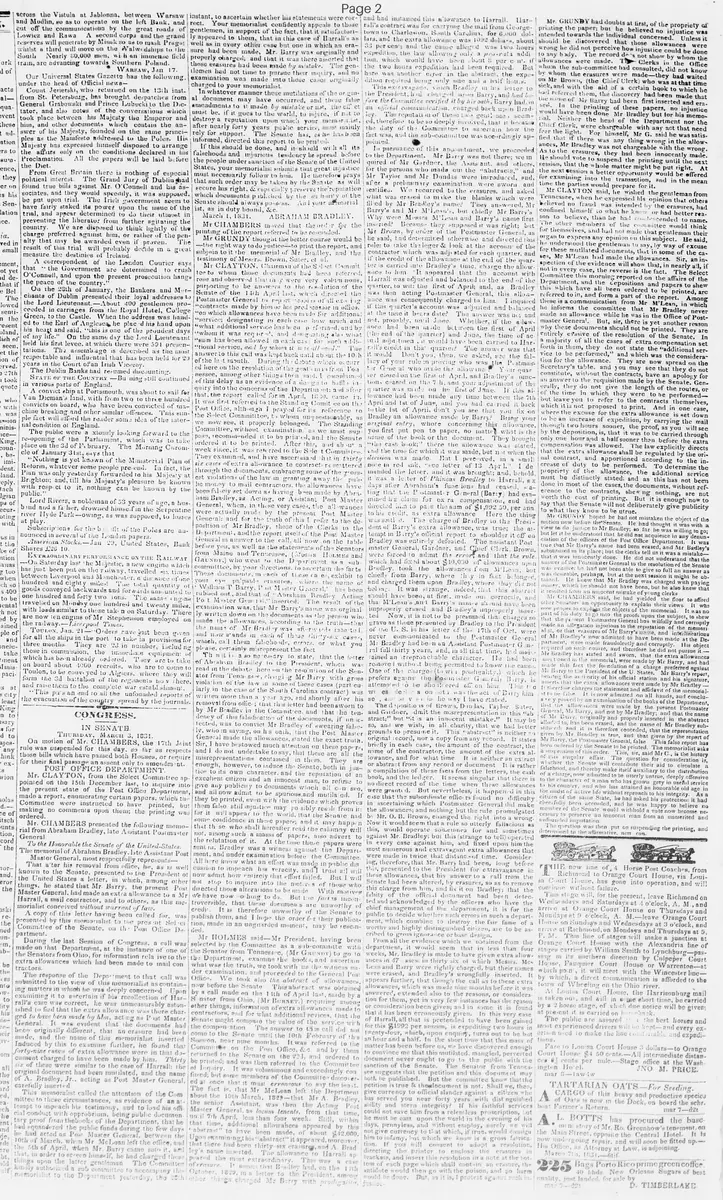
IN SENATE.
THURSDAY, MARCH 3, 1831.
On motion of Mr. CHAMBERS, the 17th Joint rule was suspended for this day, so far as respects those bills which have passed both Houses, or require for their final passage an assent only to amendment.
POST OFFICE DEPARTMENT.
Mr. CLAYTON, from the Select Committee appointed on the 15th December last, to inquire into the present state of the Post Office Department, made a report, enumerating certain papers, which the Committee were instructed to have printed, but making no comments upon them; the printing was ordered.
Mr. CHAMBERS presented the following memorial from Abraham Bradley, late Assistant Postmaster General:
To the Honorable the Senate of the United States.
The memorial of Abraham Bradley, late Assistant Post Master General, most respectfully represents—
That after his removal from office, he, as is well known to the Senate, presented to the President of the United States a letter, in which, among other things, he stated that Mr. Barry, the present Post Master General, had made an extra allowance to a Mr. Harrall, a mail contractor, and to others, as this memorialist conceived without warrant of law.
A copy of this letter having been called for, was presented by this memorialist to the present Select Committee of the Senate, on the Post Office Department.
During the last Session of Congress, a call was made on that Department, at the instance of one or the Senators from Ohio, for information relative to the extra allowances which had been made to mail contractors.
The response of the Department to that call was submitted to the view of this memorialist as containing matters in which he was deeply concerned. Upon examining it to ascertain if his recollection of Harrall's case was correct, he was unmeasurably astonished to find that the extra allowance was there charged to have been made by him, acting as Post Master General. It was evident that the documents had been originally different, that an erasure had been made, and the name of this memorialist inserted.
Induced by this to examine further, he found that forty-nine cases of extra allowance were in that document charged to have been made by him. Thirty six of these were similar to the case of Harrall: the original document had been mutilated, and the name of A. Bradley, Jr., acting as Post Master General, carefully inserted.
This memorialist called the attention of the Committee to these circumstances, as evidence of an attempt to impeach his testimony, and to load his official conduct with opprobrium, being public documentary proof from the books of the Department, that he had squandered the public funds during the few days he had acted as Post Master General, between the 10th of March, when Mr McLean left the office, and the 5th of April, when Mr Barry came into it; and that, in order to screen himself, he had charged these things upon the latter gentleman. The Committee kindly authorized a sub committee to accompany this memorialist to the Department yesterday, the 30th instant, to ascertain whether his statements were correct. Your memorialist confidently appeals to those gentlemen, in support of the fact, that it satisfactorily appeared to them, that in this case of Harrall's as well as in every other case but one in which an erasure had been made, Mr. Barry was originally and properly charged: and that it was there asserted that those erasures had been made by mistake. The gentlemen had not time to pursue their inquiry, and no examination was made into those cases originally charged to your memorialist.
In whatever manner these mutilations of the original document may have occurred, and these false amendments to it made by mistake or intent, the effect must be, if it goes to the world, to injure, if not to destroy reputation after nearly forty years public service, must mainly rely for support. The Senate has, as he has been informed, directed this report to be printed.
If this should be done, and it should with all its falsehoods and injurious tendency be spread before the people under sanction of the Senate of the United States, your memorialist submits that great injustice must necessarily follow to him. He therefore prays that such order may be taken by the Senate as will secure his right, & especially preserve the reputation which documents published by the authority of the Senate should always possess.
And your memorialist, as in duty bound, &c.
March 1, 1831.
ABRAHAM BRADLEY.
Mr CHAMBERS moved that the order for the printing of the report referred to be rescinded.
Mr GRUNDY thought the better course would be—the right way to do justice—to print the report, and subjoin to it the memorial of Mr Bradley, and the testimony of Messrs. Brown, Suter, et al. to whom those documents had been referred.
Mr CLAYTON, Chairman of the Select Committee, rose and observed that they were very voluminous, purporting to be answers to the resolution of the Senate of the 11th April last, which directed the Postmaster General in report copies of all existing 'contracts made by him or his predecessor in office, on which allowances have been made for additional service; designating in each case how much and what additional service has been required, and by whom it was required, and designating also what sum has been allowed in each case for such additional service, and by whom it was allowed.' The answer to this call was kept back until about the 10th of the last month. During the debate which occurred here on the resolution of the gentleman from Tennessee, among other things then said, I complained of this delay as an evidence of a design to him in inquiry into the concerns of the Department: and after that, the report called for in April, 1830, came in.
It was first referred to the Standing Committee on the Post Office, although I prayed for its reference to the Select Committee, to whom unquestionably, as we now see, it properly belonged. The Standing Committee, without examination, as we must suppose, recommended it to be printed, and the Senate ordered it to be printed. After this, and about a week since, it was referred to the Select Committee. They examined, and have ascertained that in thirty six cases of extra allowance to contractors, scattered through the documents, embracing some of the grossest violations of the law in granting away the public money to mail contractors, the allowances have been falsely set down as having been made by Abraham Bradley, as Acting, or Assistant Post Master General, when, in these very cases, the allowances were actually made by the present Post Master General: and for the truth of this I refer to the deposition of Mr Bradley, those of the Clerks in the Department, and the report itself of the Post Master General in answer to the call, all now on the table before you, as well as the statements of the Senators from Maine and Tennessee, (Messrs. HOLMES and GRUNDY,) who went to the Department as a sub committee, by your directions, to ascertain the facts.
These documents, in each of these cases, exhibit to your own eyes palpable erasures, where the name of 'William T. Barry, Post Master General,' has been rubbed out, and that of 'Abraham Bradley Acting Post Master General,' inserted. The result of the examination was, that Mr Barry's name was originally written down on the documents as the person who made the allowances, according to the truth—that the name of Mr Bradley was afterwards inserted, and now stands in each of these thirty-six cases, which, call them falsehoods, errors, or what you please, certainly misrepresent the fact.
Then it is also necessary to state, that the letter of Abraham Bradley to the President, when was read in the debate here on the resolution of the Senator from Tennessee, charging Mr Barry with gross violation of the law in some of these cases (particularly in the case of the South Carolina contract) was written more than a year ago, and shortly after his removal from office; that this letter had been sworn to by Mr Bradley in the Committee, and that the tendency of this falsification of the documents, if undetected, was to convict Mr Bradley of swearing falsely, who in saying, on his oath, that the Post Master General made the allowances, stated the exact truth.
Sir, I have bestowed much attention on these papers, and I do not undertake to say, that these are all the misrepresentations contained in them. They are enough, however, to induce the Senate, both in justice to its own character, and the reputation of an excellent citizen and an innocent man, to refuse to give any publicity to documents which all can see, and all now admit to be spurious, and mutilated. If they be printed, even with the evidence which proves them false, still injustice may possibly result from it: for it will appear to the world, that the Senate had some confidence in these papers; and it may happen that those who shall hereafter read the calumny will not, among such a mass of papers, also advert to the refutation of it. At the time these papers were sent in, Bradley was a witness against the Department, and under examination before the Committee. All here know what an effort was made in public discussion to impeach his veracity, and I trust all will now admit how entirely that effort failed. But I will not stop to inquire into the motives of those who directed those alterations to be made. With motives we have now nothing to do. But the fact is incontrovertible, that these documents are unworthy of credit. It is therefore unworthy of the Senate to publish them, and I hope the order for their publication, made in an unguarded moment, may be rescinded.
Mr HOLMES said—Mr President, having been selected by the Committee as a sub-committee with the Senator from Tennessee, (Mr Grundy) to go to the Department, examine the books, and ascertain what was the truth, we took with us a witness under examination, and proceeded to the General Post Office. We took also the abstract of allowances, now before the Senate. This abstract was obtained by a call made on the 11th of April last, made by a Senator from Ohio, (Mr Burnet,) requiring among other things, information of extra allowances made to contractors, and for what additional services, that the Senate might compare the value of the service with the compensation. The answer to this call did not come to the Senate until the 10th February of this Session, near nine months. It was referred to the Committee on the Post Office, &c and by them returned to the Senate on the 22d, and ordered to be printed; and was then referred to the Committee of Inquiry. It was voluminous and exceedingly confused; but some members of the Committee discovered at once that it must be erroneous to say the least.
The fact is, that Mr McLean left the Department about the 10th March, 1829—that Mr A. Bradley, the senior Assistant, was then the Acting Post Master General, as locum tenens, from that time, until 7th April, less than four weeks. Still, within that time, additional allowances appeared by this 'abstract' to have been made, of about $6,000.
Upon examining this 'abstract' it appeared, moreover, that there had been thirty six erasures, and A Bradley's name inserted. The allowance to Harrall appeared the most extraordinary. This was a case of erasure. Phineas Bradley had, on the 13th October, 1829, in a letter to the President, among other things charged Mr. Barry with prodigality.
and had instanced this allowance to Harrall. Harrall's contract was for carrying the mail from Georgetown to Charleston, South Carolina, for $6,000 dollars, and the extra allowance was $1,092 dollars, about 33 percent; and the cause alleged was two hours expedition, the law allowing only a pro-rata addition, which would have been about 8 per cent. of the two hours expedition had been required. But here was another error in the abstract, the expedition required being only one and a half hours.
This extravagance, which Bradley on his letter to the President, had charged upon Barry, and had before the Committee verified it by his oath, Barry had, in an official communication, charged back upon Bradley. The reputation of these two gentlemen seemed, therefore, to be so deeply involved, that it became the duty of the Committee to ascertain how the fact was, and the sub-committee was accordingly appointed.
In pursuance of this appointment, we proceeded to the Department. Mr Barry was not there; we inquired of Mr Gardner, the Assistant, and others, for the persons who made out the 'abstracts,' and Mr Taylor and Mr Dundas were introduced, and, after a preliminary examination were sworn and testified. We recurred to the erasures, and asked what was erased to make the blanks which were filled by Mr Bradley's name? They answered, Mr Barry's and Mr McLean's, but chiefly Mr Barry's.
Why were Messrs McLean and Barry's name first inserted? Because they supposed it was right; but Mr Brown, by order of the Postmaster General, as he said, had determined otherwise and directed this rule: to take the ledger & look at the account of the contractor which was adjusted for each quarter, and if the credit of the allowance at the end of the quarter is carried into Bradley's time, charge the allowance to him. It appeared that the account with Harrall was adjusted and balanced to the end of the quarter, to wit: the first of April; and, as Bradley was then acting Postmaster General, this allowance was consequently charged to him. I inquired if this quarter's account was adjusted and balanced at the time it bears date? The answer was no; and not, probably, until June. Whether, if the allowance had been made between the first of April (the end of the quarter) and June, the time of accounting and adjustment, it would have been carried to Harrall's credit in that quarter? The answer was that it would. Don't you, then, we asked, see the fallacy of your rule in proving who was the Postmaster General who made this allowance? Your quarter closed on the first of April, and Bradley's tenure ceased on the 7th, and your adjustment of the quarter was made on the first of June. If this allowance had been made any time between the 7th April and 1st of June, and you had carried it back to the 1st of April, don't you see that you fix on Bradley an allowance made by Barry? Bring your original entry, where concerning this allowance, you first put pen to paper, no matter what is the name of the book or the document. They brought 'the cash book;' there the allowance was stated, and the time for which it was made, but not when the decision was made. But I perceived, in a small noted marked, the letter of 13 April. I demanded the letter, and it was brought; and, behold, it was a letter of Phineas Bradley to Harrall, six days after Abraham's functions had ceased, stating that the Postmaster General (Barry) had examined his claim for extra compensation, and had directed him to pass the sum of $1,992 50, per annum, to his credit, as extra allowance. Here the thing was settled. The charge of Bradley to the President of Barry's extra allowance, was true; the attempt in Barry's official report to shoulder it off on Bradley was entirely defeated. The assistant Postmaster General, Gardner, and Chief Clerk, Brown, were forced to admit the error, and that the rule, which had fixed about $6,000 of allowances upon Bradley, took the allowances from McLean, but chiefly from Barry, where they in fact belonged, and charged them upon Bradley, where they did not belong. It was strange, indeed, that this abstract should have been, at first, made out correctly, and that McLean's and Barry's name should have been improperly erased and Bradley's improperly inserted.
Now, it is not to be presumed that charges so grave as those presented by Bradley to the President of the U. S. in his letter of the 17th of Oct. were never communicated to the Postmaster General. Mr Bradley had been an Assistant Postmaster General full thirty years, and, in all that time, had maintained an irreproachable character. He had been removed without being permitted to know the cause. One of the charges (two: prodigality.) which he prefers against the Postmaster General: Barry, is attempted to be shouldered off on him. This too is done in the most deliberate manner—the act of Barry himself, an arrival in the way I have stated.
The depositions of Brown, Dundas, Taylor, Suter, and Gardner, admit the misrepresentation in this 'abstract;' but 'it is an innocent mistake.' It may be so, and we wish, in all charity, that we had better grounds to presume it. This 'abstract' is neither an original record, nor a copy from any record. It states briefly in each case, the amount of the contract, the name of the contractor, the amount of the extra allowance, and for what time. It is neither an extract or abstract from any record or document. It is rather a compilation of these facts from the letters, the cash book, and the ledger. It seems singular that there is no direct record of the time when these allowances were granted. But nevertheless, it happened in this case that the subordinate officers found no difficulty in ascertaining which Postmaster General did make the allowances; and nothing but the rule promulgated by Mr. O. B. Brown, changed the right into a wrong.
Now it would seem that a rule so utterly fallacious as this, would operate sometimes for and sometimes against Mr. Bradley; but this (strange to tell) operated in every case against him, and fixed upon him the most numerous and extravagant extra allowances that were made in twice that distance of time. Considering, therefore, that Mr. Barry had been, long before this, presented to the President for extravagance in these allowances, that his answer to a call from the Senate had been altered, by erasures, so as to remove this charge from him, and fix it on Bradley; that the falsity of the official document had been detected and acknowledged by the officers who have the chief management of the department, it is for the public to decide whether such errors in such a department, which combine to destroy the fair fame of a worthy and highly distinguished citizen, are to be ascribed to gross ignorance or base design.
From all the evidence which we obtained from the department, it would seem that in less than four weeks, Mr. Bradley is made to have given extra allowances in 47 cases: in thirty six of which Messrs. McLean and Barry were rightly charged, but their names were erased, and Bradley's wrongfully inserted. It appears further, that though the call as to these extra allowances, which was made nine months before it was answered, extended also to the reasons, or consideration for them, yet in very few instances has the reason or consideration been given; and in some it is found that it has been erroneously given. In this very case of Harrall, all that is pretended to have been gained for this $1,992 per annum, is expediting two hours in twenty-four, which, upon enquiry, turns out to be but an hour and a half. In the short time that this mass of matter has been before us, we have discovered enough to convince me that this mutilated, mangled, perverted document never ought to go to the public with the sanction of the Senate. The Senator from Tennessee suggests that the petition and this document may both, be published. But the committee know that the petition is true & the document is not. Shall we, therefore, give currency to official slander against a citizen who has served you near forty years with distinguished ability and stern integrity? If his faithful services could not save him from a relentless proscription, at least he must be cast upon the world in this evening of his days, penniless, and without employ, surely we will not give currency to that which, if true, would consign him to infamy, but which we know is a gross fabrication. If you will consent to adopt a resolution, directing the printer to enclose the erasures in brackets, and insert this resolution in a note at the bottom of each page which shall contain an erasure, the antidote would then go with the poison, and no harm would be done. But, as it is, I protest against such injustice.
Mr. GRUNDY had doubts at first, of the propriety of printing the paper: but he believed no injustice was intended towards the individual concerned. Unless it should be discovered that those allowances were wrong he did not perceive how injustice could be done to any body. The record does not show by whom the allowances were made. The Clerks in the Office whom the sub-committee had consulted, did not know by whom the erasures were made—they had waited on Mr Brown, (the Chief Clerk) who was at that time sick, and with the aid of a certain book to which he had referred them, the discovery had been made that the name of Mr Barry had been first inserted and erased. In the printing of these papers, no injustice would have been done Mr Bradley but for his memorial. Neither the head of the Department nor the Chief Clerk, were chargeable with any act that need fear the light. For himself, Mr G. said he was satisfied that if there was any thing wrong in the allowances, Mr Bradley was not chargeable with the wrong. As to the erasures, they had been innocently made. He should vote to suspend the printing until the next session, that the whole matter might be put right. At the next session a better opportunity would be offered for examining into the transaction, and in the mean time the parties would prepare for it.
Mr CLAYTON said, he wished the gentleman from Tennessee, when he expressed his opinion that others believed no fraud was intended by the erasures, had confined himself to what he knew or had better reason to believe, than he had condescended to name. The other members of the committee would think for themselves, and had not made that gentleman their organ to express any opinion on this subject. He said, he understood the gentleman to say, by way of excuse for these mutilated documents, that in some of the cases, Mr McLean had made the allowances. Sir, an inspection of the evidence will show that, in nearly all, if not in every case, the reverse is the fact. The Select Committee this morning reported on the affairs of the Department, and the depositions and papers to show this which have all been ordered to be printed, are referred to in, and form a part of the report. Among these is a communication from Mr McLean, in which he informs the committee that Mr Bradley never made an allowance while he was in the Office of Postmaster General. But, sir, there is yet another reason why these documents should not be printed. They are entirely evasive of the resolution of the Senate. In a majority of all the cases of extra compensation set forth in them, they do not state the "additional service to be performed," and which was the consideration for the allowance.
They are now spread on the Secretary's table, and you may see that they do not constitute, without the contracts, have an apology for an answer to the requisition made by the Senate. Generally, they do not give the length of the routes, or of the time in which they were to be performed—but leave you to refer to the contracts themselves, which it is not proposed to print. And in one case, where the excuse for the extra allowance is set down to be an increase of expedition, by carrying the mail through two hours sooner, the proof, as you will see by the deposition, is, that it was to be carried through only one hour and a half sooner than before the extra compensation was allowed. The law explicitly directs that the extra allowance shall be regulated by the original contract, and apportioned according to the increase of duty to be performed. To determine the propriety of the allowance, the additional service must be distinctly stated; and as this has not been done in most of the cases, the documents, without reference to the contracts, showing nothing, are not worth the cost of printing. But it is enough now to say that the Senate will not deliberately give publicity to what they know to be untrue.
Mr GRUNDY hoped he had not mistaken the object of the motion now before the Senate. He had thought it was with a view to do justice to Mr Bradley; so far he was willing to go: but let it be understood that he did not acquiesce in any denunciation of the officers of the Post Office Department. It was true that Mr Barry's name had been erased, and Mr Bradley's substituted in its place; but the clerks tell us it was a mistake—that it was innocently done. He did not understand that the answer of the Postmaster General to the resolution of the Senate was evasive: he had not been able to give so full an answer as was desirable, perhaps, but at the next session it might be obtained. He knew that Mr Bradley was charged with paying money, which he should not have been, but he also knew that it resulted from an innocent mistake of young clerks.
Mr CHAMBERS said, he had yielded the floor to afford other Senators an opportunity to explain their views. It was now proper to explain the objects of the memorial. It was no part of his duty to go into the proofs upon the subject, to show that the present Postmaster General has wilfully and corruptly made an allegation injurious to the reputation of the memorialist, or that erasures of Mr Barry's name, and interlineations of Mr Bradley's now admitted to have been made at the Department, were made fraudulently and corruptly. His object required no such course, and therefore he did not pursue it.
Mr Bradley has stated and sworn, that the extra allowances mentioned in the memorial, were made by Mr Barry, and had made this fact the foundation of a charge preferred against Mr Barry to the President of the United States. Mr Barry's report, bearing the authority of his official station and his signature, asserts that the extra allowances were made by Mr Bradley—It therefore charges the statement and affidavit of the memorialist to be false. It is now admitted on all hands, and conclusively proved by an examination of the books of the Department, that the allowances were made by the present Postmaster General, Mr Barry, and not by Mr Bradley; and that the name of Mr Barry, originally and properly inserted in the abstract alluded to, has been erased, and the name of Mr Bradley substituted: and it is therefore conceded, that the representation given by Mr Bradley is true, and that given by the report of Mr Barry, the Postmaster General, false. This false report has been ordered by the Senate to be printed. The memorialist asks a suspension of this order. This, sir, said Mr C., is the history of this singular affair. The question for consideration is, whether the Senate will contribute their aid to circulate a falsehood, and thereby make itself auxiliary to the distribution of a charge, now admitted to be utterly untrue, deeply offensive to the character of a man who has grown grey in useful service to his country, and who has attained an honorable old age in the midst of active life without reproach to his integrity. As a citizen of the same State, he had asked his protection: it had cheerfully been accorded, and he was happy to believe no member of the Senate would withhold a vote now become necessary to preserve an innocent man from an unmerited and unfounded imputation.
The question was then put on suspending the printing, and determined in the affirmative, nem con.
What sub-type of article is it?
What keywords are associated?
What entities or persons were involved?
Where did it happen?
Domestic News Details
Primary Location
Washington
Event Date
Thursday, March 3, 1831
Key Persons
Outcome
the senate voted unanimously to suspend the printing of the post office department report due to discovered erasures and false attributions of extra allowances to abraham bradley instead of postmaster general barry.
Event Details
Senate debate on a memorial from former Assistant Postmaster General Abraham Bradley alleging alterations in official documents that falsely attributed extra mail contract allowances to him rather than Postmaster General Barry. The Select Committee investigated, confirming erasures in 36 cases. Senators discussed the integrity of the report, potential injustice to Bradley, and decided to rescind the printing order.